
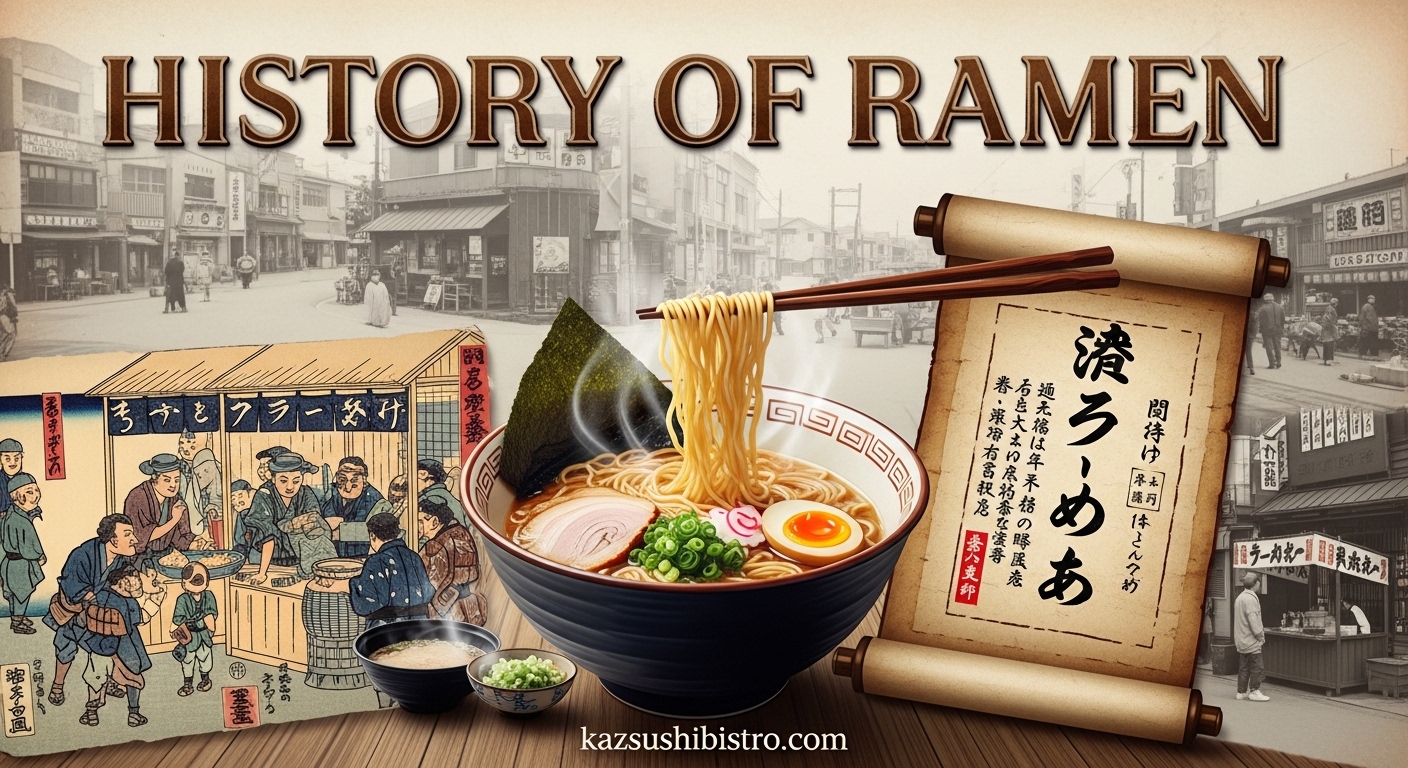
Ramen began as a Chinese noodle dish brought to Japan in 1859 and transformed over 160 years into one of the world’s most beloved comfort foods. The history of ramen traces a fascinating journey from humble port-city stalls to Michelin-starred restaurants, shaped by earthquakes, wars, and one man’s obsession with feeding the hungry.
Our team spent months researching original sources, academic texts, and historical records to bring you this complete timeline. Whether you are a casual noodle lover or a devoted ramen enthusiast, this guide will change how you see every bowl you slurp.
Table of Contents
Key Takeaways: Ramen History at a Glance 2026
Here are the essential facts about where ramen came from and how it evolved:
- Chinese Origins: Ramen descends from Chinese lamian (hand-pulled wheat noodles) introduced to Japan through Yokohama Chinatown in 1859
- Not Japanese Originally: The popular myth about Tokugawa Mitsukuni eating ramen in the 1660s is a marketing story, not historical fact
- Earthquake Catalyst: The 1923 Great Kanto Earthquake displaced thousands of ramen vendors from Tokyo to the rest of Japan, spreading the dish nationwide
- Illegal Food: After WWII, unlicensed ramen vendors operated on black markets because wheat flour rationing made noodle sales illegal
- Instant Revolution: Momofuku Ando invented instant ramen in 1958 to combat post-war hunger, later creating Cup Noodles in 1971
- Regional Diversity: Japan developed distinct styles including Sapporo miso, Hakata tonkotsu, and Kitakata shoyu ramen
The Chinese Roots: Where Ramen Really Began?
Ramen owes its existence to Chinese wheat noodle traditions stretching back centuries. The dish did not emerge from Japanese kitchens but rather arrived as an import that underwent a remarkable transformation.
The Lamian Connection
Chinese lamian, or hand-pulled wheat noodles, form the direct ancestor of what Japanese diners now call ramen. These noodles relied on wheat flour mixed with kansui, an alkaline mineral water that gives ramen noodles their characteristic yellow tint, springy texture, and ability to hold up in hot broth without dissolving.
The kansui component remains essential to this day. Without alkaline water, noodles turn mushy and lose their distinctive chew. This technical element traveled with Chinese immigrants who brought their cooking methods across the East China Sea.
Debunking the Tokugawa Mitsukuni Myth
You may have heard that Tokugawa Mitsukuni, a feudal lord from the 1660s, was the first Japanese person to eat ramen. This story appears in promotional materials and some casual histories. It is not true.
The legend claims Mitsukuni ate ramen prepared by a Chinese refugee named Zhu Zhiyu. While Mitsukuni did exist and did patronize Chinese scholars, no historical records connect him to anything resembling modern ramen. The story originated in the 20th century as a marketing creation for noodle shops seeking prestige through historical association.
We verified this through academic food history research, including the work of historian George Solt. Real ramen arrived nearly 200 years after Mitsukuni died.
The 1859 Yokohama Connection
The true introduction of ramen to Japan occurred in 1859 when Japan opened several ports to foreign trade after centuries of isolation. Yokohama became home to a thriving Chinatown where Chinese immigrants opened restaurants serving their native cuisine.
Japanese visitors to Yokohama Chinatown encountered noodle dishes completely foreign to their culinary tradition. These early versions were called “shina soba” (Chinese soba) or “nankin soba” (Nanjing soba). The wheat noodles differed sharply from Japanese soba made from buckwheat.
Pivotal Moments That Shaped Ramen History
Understanding ramen requires examining the specific historical events that transformed it from an ethnic curiosity into a Japanese national dish. Each milestone reveals how external forces shaped this culinary evolution.
1910: The Birth of Rairaiken and Restaurant Culture
The first dedicated ramen restaurant in Japan opened in 1910 in Tokyo’s Asakusa district. Rairaiken employed Chinese cooks who served noodles to working-class Japanese customers. The shop became popular enough to inspire competitors.
Tokyo developed a vibrant ramen culture through the 1910s and 1920s. Vendors wheeled carts through entertainment districts serving late-night crowds. The dish gained association with urban nightlife and quick, affordable sustenance. At this stage, ramen remained closely tied to Chinese culinary techniques even as Japanese customers made it their own.
1923: How the Great Kanto Earthquake Changed Everything
The September 1, 1923 Great Kanto Earthquake devastated Tokyo and Yokohama, killing over 100,000 people and destroying countless businesses. Among the displaced were hundreds of ramen vendors whose shops and carts were wiped out.
These vendors scattered across Japan seeking new opportunities. They brought their noodle skills to Osaka, Hokkaido, and cities throughout the country. This forced migration distributed ramen knowledge nationwide, transforming a regional specialty into a dish available throughout Japan.
The earthquake’s silver lining was ramen’s geographic expansion. Regions that might never have encountered Chinese-style noodles suddenly had vendors opening shops on their streets.
Post-WWII: The Black Market Era
World War II brought severe food shortages to Japan. The government controlled rice distribution strictly and rationed wheat flour. Operating a noodle shop without proper permits became illegal.
Ramen did not disappear. Instead, it moved underground. Unlicensed vendors set up stalls in black markets, operating at night to avoid authorities. These illegal ramen vendors fed hungry citizens willing to risk arrest for a hot bowl of noodles.
The post-war black market era cemented ramen’s reputation as food for the common people. It sustained working-class neighborhoods when official food distribution failed. This period also bred innovation as vendors experimented with available ingredients to create distinctive flavors.
1955: The End of Illegality and Ramen’s Revival
In 1955, Japan’s Ministry of Agriculture lifted wheat flour controls, finally making ramen sales legal again. The dish emerged from the shadows and exploded in popularity. Ramen shops opened legally throughout the country.
By this point, ramen had become thoroughly Japanese despite its Chinese origins. Vendors had spent a decade improvising with local ingredients. The post-legalization period set the stage for regional styles to develop distinct identities.
From Humble Invention to Global Phenomenon
No account of ramen history is complete without Momofuku Ando, the Taiwanese-Japanese inventor who revolutionized how the world eats noodles. His story embodies post-war determination and creative problem-solving.
The Story Behind Chicken Ramen
Momofuku Ando observed the long lines at illegal ramen stalls in post-war Osaka. He saw people desperate for hot food and realized Japan needed an affordable, convenient solution to hunger. In 1958, after months of experimentation in a shed behind his house, Ando invented the world’s first instant noodles.
His breakthrough came from flash-frying cooked noodles, which removed moisture while creating a porous structure that rehydrated quickly in hot water. He named his product “Chicken Ramen” despite containing no chicken, choosing the name for its appetizing sound.
Nissin Foods, the company Ando founded, sold 13 million packages of Chicken Ramen in its first year. The product cost more than fresh ramen at market stalls, but its convenience attracted busy workers and families.
Cup Noodles: Eating on the Go
Ando was not finished innovating. During a 1971 business trip to America, he noticed supermarket employees breaking Chicken Ramen into pieces and eating it from paper cups with hot water. This observation sparked an idea.
Returning to Japan, Ando developed Cup Noodles, packaging flash-fried noodles in a waterproof foam cup with attached seasoning. Consumers could add hot water and eat immediately without additional dishes. This invention expanded instant ramen from a home-cooked meal to a true on-the-go food.
Cup Noodles launched in 1971 and became an immediate sensation. The product reached international markets within years, introducing global consumers to Japanese-style noodles for the first time.
How Instant Ramen Conquered the World?
Instant ramen spread globally through the 1970s and 1980s. Different countries developed local flavor variations. The low cost made it attractive in developing nations. United Nations officials praised instant noodles for combating hunger in refugee camps and disaster zones.
By the 1990s, worldwide instant noodle consumption exceeded 20 billion packages annually. What began as a solution to Japanese food shortages became a global industry worth billions of dollars. Today, over 100 billion instant noodle servings are consumed worldwide each year.
Space Ramen: The Final Frontier
At age 94, Momofuku Ando continued innovating. In 2005, he developed “Space Ram,” special instant noodles for astronauts aboard the Discovery space shuttle. These noodles were smaller, covered in thick sauce rather than loose broth, and required no refrigeration.
Ando personally ate Space Ram with Japanese astronaut Soichi Noguchi aboard the shuttle, fulfilling his lifelong dream of creating noodles that could be eaten anywhere on Earth or beyond. He passed away in 2007, leaving a legacy that feeds billions.
Regional Ramen Styles and Their Origins
As ramen spread across Japan, different regions adapted it to local tastes and available ingredients. These regional variations represent distinct evolutionary branches, each with devoted fans who argue passionately for their local style’s superiority.
Sapporo: The Birthplace of Miso Ramen
Sapporo, Hokkaido’s capital, gave birth to miso ramen in 1955. Morito Omiya of Aji no Sanpei restaurant created the style accidentally while experimenting with different soup bases. He found that hearty miso paste held up better than lighter broths in Hokkaido’s harsh winters.
Sapporo miso ramen features curly noodles that trap the thick broth, along with stir-fried vegetables like corn, bean sprouts, and garlic. The style emphasizes richness and warmth, perfectly suited to cold climates. Today, Sapporo’s Ramen Yokocho (Ramen Alley) hosts seventeen shops in a single narrow corridor, attracting pilgrims from across Japan.
Hakata: Tonkotsu Perfection
Hakata, in Fukuoka Prefecture on Kyushu island, developed tonkotsu ramen, famous for its opaque, creamy pork bone broth. The style emerged from street stalls that served workers in the region.
Traditional tonkotsu broth requires boiling pork bones for 12 to 18 hours until the marrow and collagen dissolve into a milky white soup. Hakata ramen uses thin, straight noodles that cook quickly, allowing shops to serve customers at counter seating within minutes of ordering.
Iconic Hakata shops like Ichiran and Ippudo expanded globally, introducing tonkotsu ramen to international audiences. The style’s intense flavor and rich texture have made it one of Japan’s most exported ramen varieties.
Kitakata and Onomichi: Lesser-Known Gems
Kitakata, a small city in Fukushima Prefecture, punches above its weight in ramen culture. With over 100 shops for a population of 50,000, it claims the highest per-capita ramen shop density in Japan. Kitakata ramen features flat, curly noodles in a soy sauce-based broth with pork belly chashu.
Onomichi ramen from Hiroshima Prefecture distinguishes itself with a fish-based broth incorporating small sardines called “nyumen” along with pork and chicken stock. The result tastes lighter than tonkotsu but more complex than simple shoyu varieties.
Ramen Yokocho: The Culture of Ramen Streets
As ramen culture matured, specific neighborhoods developed concentrations of shops that became destinations in themselves. Ramen Yokocho (Ramen Street or Ramen Alley) emerged in cities across Japan.
Sapporo’s Ganso Ramen Yokocho, established in 1951, remains the most famous example. Visitors can sample multiple regional styles within a few hundred meters. These alleys became social spaces where salarymen gather after work, students celebrate milestones, and tourists experience authentic Japanese food culture.
The ramen street phenomenon reflects how deeply the dish embedded itself in Japanese urban life. What began as working-class sustenance became a source of civic pride and tourist attraction.
Ramen Goes Global: From Street Food to Michelin Stars 2026
Ramen’s international journey began with instant noodles but expanded dramatically in the 2000s as authentic Japanese ramen shops opened overseas. The dish now occupies a unique position straddling comfort food and haute cuisine.
Tsuta Tokyo became the world’s first Michelin-starred ramen restaurant in 2016, earning a single star for its truffle oil-enhanced shoyu soba. Chef Yuki Onishi demonstrated that ramen could achieve the same recognition as French or Japanese haute cuisine. Other starred ramen shops followed, including Nakiryu and Konjiki Hototogisu.
In America, David Chang’s Momofuku restaurant group (named after the instant ramen inventor) helped elevate ramen from college dorm food to serious dining. Ivan Orkin’s Ivan Ramen brought Japanese-trained expertise to New York City, proving non-Japanese chefs could master the craft.
Today, ramen shops operate in every major global city. London, Paris, Sydney, and New York host acclaimed restaurants serving authentic regional styles. Ramen competitions, festivals, and social media communities connect enthusiasts worldwide. The dish that arrived in Yokohama in 1859 has become a truly global phenomenon.
Frequently Asked Questions
Where did ramen actually originate?
Ramen originated from Chinese lamian (hand-pulled wheat noodles) introduced to Japan through Yokohama Chinatown in 1859. While the dish evolved significantly in Japan, its fundamental techniques and ingredients trace directly to Chinese culinary traditions brought by immigrants during Japan’s opening to foreign trade.
Who invented ramen and why?
Momofuku Ando invented instant ramen in 1958 to address post-war food shortages in Japan. Observing long lines at illegal ramen stalls, he developed flash-fried noodles that could be quickly rehydrated with hot water. His invention was not the fresh ramen served in restaurants, but rather the convenient packaged version that became a global phenomenon.
Why was ramen illegal in Japan?
After World War II, Japan’s government strictly rationed wheat flour to manage food shortages. Selling noodles made from rationed wheat without permits became illegal. Unlicensed vendors operated in black markets, feeding hungry citizens willing to risk arrest for a hot meal. Ramen became legal again in 1955 when wheat flour controls were lifted.
Is it disrespectful to not finish ramen in Japan?
Finishing your ramen is considered good manners and a compliment to the chef. However, circumstances matter. If you are genuinely full, leaving a small amount is acceptable. Some shops offer smaller portions for lighter appetites. The key is showing appreciation for the food through your behavior, not forcing yourself to overeat.
The Enduring Legacy of Ramen
The history of ramen reveals a dish that adapted and survived through centuries of change. From Chinese immigrants serving wheat noodles in 1859 Yokohama to black market vendors feeding post-war Japan, from Momofuku Ando’s shed experiments to Michelin-starred restaurants, ramen has shown remarkable resilience and evolution.
What strikes us most about this journey is how ramen reflects broader historical forces. Earthquakes, wars, economic booms, and cultural opening all left their marks on the dish. Each bowl contains not just noodles and broth, but stories of migration, survival, innovation, and cultural exchange.
When you next lift chopsticks to a steaming bowl, remember you are participating in a tradition stretching back over 160 years. Whether you prefer Sapporo miso, Hakata tonkotsu, or a simple cup of instant noodles, you are connected to millions of people across generations and continents who found comfort, sustenance, and joy in this remarkable dish.
The story of ramen is far from over. New regional styles emerge. Celebrity chefs continue pushing boundaries. Global consumption grows annually. Somewhere, perhaps right now, someone is taking their first bite of ramen and beginning their own chapter in this ongoing history.