
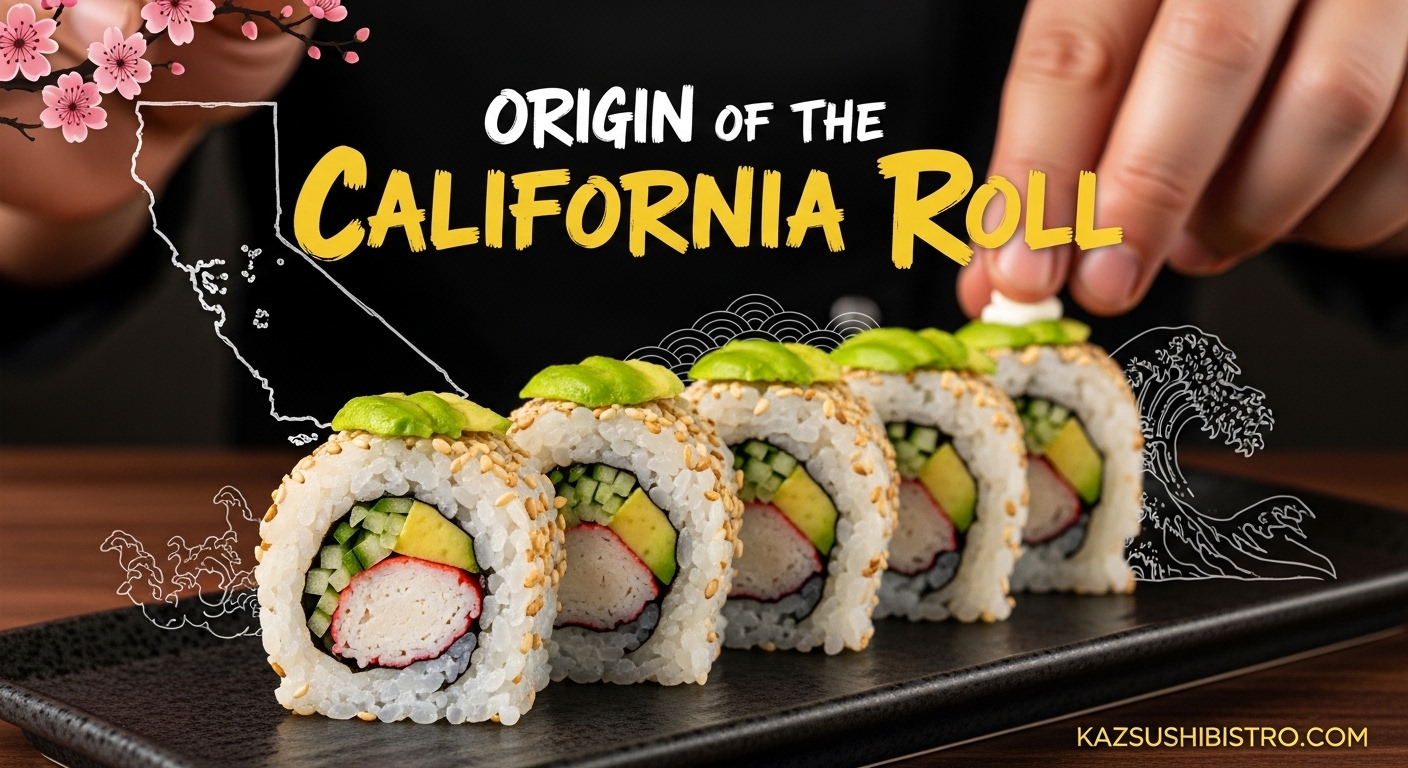
The California roll carries one of the most contested origin stories in modern food history. Depending on who you ask, this iconic inside-out sushi roll was either invented by a Japanese immigrant chef in Vancouver, Canada, or by another Japanese chef in Los Angeles, California. At KAZ Sushi Bistro, we believe understanding where your food comes from deepens your appreciation for every bite. The debate over the origin of the California roll reveals as much about cultural adaptation and immigrant innovation as it does about the roll itself.
I spent weeks researching this topic, digging through newspaper archives, academic food history papers, and firsthand accounts from both cities. What emerged was not a clear-cut answer but a fascinating story of parallel innovation, cultural translation, and the blurred lines of culinary authenticity.
Table of Contents
Who Really Invented the California Roll?
Two competing origin stories dominate the California roll history, each with credible evidence and passionate defenders. The most widely publicized claim credits Japanese-Canadian chef Hidekazu Tojo in Vancouver, while another strong claim points to Japanese-American chef Ichiro Mashita in Los Angeles.
Lesser-known theories also exist, including one involving chef Ken Seusa at Kin Jo restaurant. The timeline for all claims centers on the early 1970s, a period when sushi was just beginning to gain traction outside Japan.
The Vancouver Origin Story: Hidekazu Tojo and the Tojo Maki
Hidekazu Tojo arrived in Vancouver in 1971, part of a wave of Japanese chefs seeking opportunities abroad. He opened his restaurant in the city’s West End and quickly discovered a significant barrier: most Canadians found the smell of traditional Japanese fish markets overwhelming and were hesitant to try raw fish.
Tojo approached this challenge through the omakase philosophy, which means “I leave it to you” in Japanese. Rather than forcing customers to adapt to traditional sushi, he adapted sushi to his customers. He started experimenting with ingredients that would feel familiar to Western palates while maintaining the essence of Japanese culinary technique.
The breakthrough came when Tojo turned the roll inside-out. By placing rice on the outside and hiding the nori seaweed inside, he created something visually different from traditional sushi while keeping the fundamental structure intact. He added cooked crab meat, avocado, and cucumber, ingredients that were accessible and appealing to his Canadian customers.
He originally called his creation the Tojo Maki. The roll gained popularity quickly among Vancouver residents who had previously been sushi-avoidant. Word spread, and soon other restaurants were copying the concept.
The Japanese Ministry of Agriculture, Forestry and Fisheries officially recognized Tojo as the creator of the California roll in 2026. This government recognition carries significant weight in a country that takes culinary heritage seriously. Tojo continues to operate his restaurant in Vancouver today, serving the same roll that started it all over 50 years ago.
Food historian Andrew F. Smith has cited Tojo’s claim as credible, noting the specificity of his account and the documentation supporting his timeline. Many Vancouver residents proudly claim the California roll as a Canadian invention, pointing to Tojo’s continued presence and the Ministry recognition as definitive proof.
The Los Angeles Origin Story: Ichiro Mashita and Tokyo Kaikan 2026
The competing theory places the California roll’s birth in Los Angeles’s Little Tokyo district, specifically at a restaurant called Tokyo Kaikan. According to this version, chef Ichiro Mashita, along with his assistant Teruo Imaizumi, developed the roll during the 1970s in response to a practical problem.
Los Angeles faced a tuna shortage during this period, making the traditional tuna roll expensive and difficult to source consistently. Mashita began experimenting with local ingredients to create alternatives that would satisfy customers without breaking the restaurant’s budget. He discovered that ripe avocado had a similar fatty texture to tuna, making it an excellent substitute.
Like Tojo, Mashita turned the roll inside-out. The rice-on-outside technique served a practical purpose in Los Angeles as well. Many of his customers were unfamiliar with nori and found its texture and appearance off-putting. By hiding the seaweed inside, Mashita made sushi less intimidating for first-time diners.
The original Los Angeles version used local Dungeness crab instead of the imitation crab common in modern versions. This ingredient choice connected the roll to California’s coastal heritage and made it distinctively local. The combination of avocado, crab, and cucumber proved irresistible to customers.
Tokyo Kaikan became a popular destination in Little Tokyo, and the roll’s reputation spread throughout Los Angeles. From there, it traveled to other California cities and eventually across the United States. Los Angeles residents firmly believe their city gave the roll both its birth and its name.
The Little Tokyo origin story emphasizes practical necessity over philosophical adaptation. Mashita wasn’t trying to introduce omakase principles to a new audience. He was solving a supply problem while making sushi accessible to Americans who had never encountered it before.
Comparison of Competing Origin Theories
Both origin stories share remarkable similarities. Both involve Japanese immigrant chefs working in North America during the early 1970s. Both chefs turned the roll inside-out to hide the nori. Both used avocado and crab as signature ingredients. Both were responding to the same fundamental challenge: making sushi accessible to Western customers unfamiliar with raw fish.
| Aspect | Hidekazu Tojo (Vancouver) | Ichiro Mashita (Los Angeles) |
|---|---|---|
| Year | 1971 | Early 1970s |
| Restaurant | Tojo’s Restaurant (West End) | Tokyo Kaikan (Little Tokyo) |
| Primary Motivation | Customer resistance to raw fish/smell | Tuna shortage, supply issues |
| Original Name | Tojo Maki | California Roll |
| Original Crab Type | Cooked crab meat | Dungeness crab |
| Key Assistant | None credited | Teruo Imaizumi |
| Official Recognition | Japanese Ministry of Agriculture | None official |
| Chef Status Today | Still operating restaurant | Retired/deceased |
The timeline presents the biggest challenge for determining the true inventor. If Tojo’s 1971 claim is accurate, he predates Mashita’s early 1970s development. However, food historians note that multiple chefs may have developed similar solutions independently around the same time. The concept was logical enough that parallel invention is entirely plausible.
The Third Claimant: Ken Seusa and Kin Jo
A lesser-known theory credits chef Ken Seusa at Kin Jo restaurant, also in Los Angeles. This claim received coverage in the Los Angeles Times and other publications, suggesting Seusa may have developed a precursor version or contributed to the roll’s evolution.
The Nippo newspaper, a Japanese-language publication in Los Angeles, has been cited in connection with this alternative origin story. However, documentation supporting this claim is sparser than for Tojo or Mashita. Most food historians consider the Seusa claim less substantiated, though not necessarily invalid.
The existence of a third claimant further complicates the origin story. It suggests that the California roll may have emerged from a broader context of experimentation among Japanese chefs in North America during the 1970s, rather than from a single moment of individual inspiration.
Why Is It Called the California Roll?
The name itself reveals clues about the roll’s origin, though interpretations differ. According to the Los Angeles theory, the name simply reflects where it was invented. If Mashita created the roll at Tokyo Kaikan in Little Tokyo, calling it a California roll would be a straightforward geographic identifier.
Tojo offers a different explanation. He claims the name came from the ingredients, particularly the avocado, which is closely associated with California cuisine. The Golden State’s avocado industry was booming in the 1970s, and the fruit had become a symbol of California’s culinary identity.
Another theory suggests the name honors the roll’s popularity among California tourists who encountered it in Vancouver and brought the concept back home. In this version, the roll acquired its name not from its birthplace but from the people who popularized it.
Regardless of which theory is correct, the name stuck. By the mid-1970s, “California roll” was the standard term for this rice-on-outside, crab-and-avocado combination across North America. The name’s simplicity and geographic specificity helped it become one of the most recognizable sushi items worldwide.
How the Inside-Out Roll Changed Sushi Forever
The uramaki technique, the technical term for inside-out rolls, predates the California roll in Japanese cuisine but was rarely used. Traditional makizushi almost always places nori on the outside, with rice and fillings inside. The California roll popularized the uramaki style and made it the default for Western-style sushi.
Creating an uramaki roll requires a specific technique. The chef spreads rice on a sheet of nori, flips it over, adds fillings to the nori side, then rolls with the rice on the outside. The finished roll gets topped with sesame seeds, tobiko (flying fish roe), or other garnishes that stick to the rice surface.
This innovation solved multiple problems simultaneously. The rice-on-outside presentation looked less intimidating to customers unfamiliar with seaweed. The exposed rice surface provided a canvas for decorative toppings. The hidden nori stayed crisp longer since it was protected from air exposure by the rice layer.
The inside-out format also made sushi more approachable for beginners. First-time diners could try something that looked like a rice-based dish rather than a seaweed-wrapped mystery. This accessibility factor explains why the California roll became known as “gateway sushi” for an entire generation of North American diners.
Today, uramaki represents the majority of sushi rolls sold in North America. The technique that Tojo and Mashita independently employed has become the dominant form of rolled sushi in the West, while traditional maki remains more common in Japan.
Evolution of Ingredients: Original Recipe vs Modern Version
The California roll has undergone significant ingredient changes since its creation in the 1970s. Understanding these changes reveals how economic pressures and supply chains have shaped even the most iconic dishes.
The original versions, whether from Vancouver or Los Angeles, used real crab meat. Tojo’s early rolls featured cooked crab, while Mashita specifically used local Dungeness crab from California waters. Both chefs chose real seafood over processed alternatives.
As the roll gained popularity and spread to restaurants across North America, supply became a challenge. Fresh crab was expensive and difficult to source consistently in landlocked states. Enter surimi, the processed seafood product most commonly sold as imitation crab.
Surimi, made from white fish (typically pollock) that’s been processed, flavored, and colored to resemble crab, solved the supply problem. It was cheap, shelf-stable, and provided a consistent product that tasted crab-like enough for most customers. By the 1980s, imitation crab had become the standard filling for California rolls in most American restaurants.
Purists lament this change. Food historians note that a California roll made with real Dungeness crab tastes markedly different from the surimi version most people know today. Some high-end restaurants have returned to using real crab, marketing it as a premium or “authentic” California roll experience.
Other ingredient variations have emerged over time. Some versions add mayonnaise for creaminess. Others include cucumber for crunch. Tobiko or masago (fish roe) toppings have become common additions. The basic formula remains consistent, but individual chefs continue to put their own spin on the classic.
The Authenticity Debate: Is the California Roll Real Sushi?
The California roll sparked an ongoing debate about what constitutes “authentic” sushi that continues to divide food enthusiasts today. Traditionalists argue that the roll represents a departure from Japanese culinary principles, while fusion advocates see it as a legitimate evolution of the cuisine.
Japanese sushi traditionalists point to several deviations. The inside-out format violates conventional presentation norms. The use of avocado, a New World fruit with no historical connection to Japanese cuisine, breaks ingredient traditions. The substitution of cooked crab for raw fish contradicts the emphasis on fresh, uncooked seafood that defines classic sushi.
Hiroko Shimbo, author of “The Sushi Experience” and respected authority on Japanese cuisine, has argued that authenticity in food is more complex than rigid adherence to tradition. She notes that Japanese cuisine has always adapted to available ingredients and cultural contexts. What seems inauthentic today may become tradition tomorrow.
Chef Masaharu Morimoto, known for his work on Iron Chef and his fusion approach to Japanese cooking, has defended the California roll as a legitimate expression of Japanese culinary principles. He emphasizes that the core techniques, rice preparation, and flavor balance remain fundamentally Japanese even when the ingredients differ.
The authenticity debate often reveals more about the debater than the food. First-generation immigrants may view fusion dishes as dilutions of their heritage. Second and third-generation descendants often embrace these adaptations as expressions of their hybrid identity. Food historians increasingly recognize that authenticity itself is a constructed concept that shifts across time and context.
For the average diner, this debate matters less than the experience itself. The California roll introduced millions of people to Japanese flavors and textures they might never have encountered otherwise. Whether that introduction represents authentic cultural sharing or culinary appropriation depends largely on perspective.
Cultural Impact: How the California Roll Made Sushi Mainstream
The California roll’s impact on North American food culture cannot be overstated. Before its introduction, sushi was a niche cuisine found only in major cities with significant Japanese populations. Most Americans viewed raw fish with suspicion or outright disgust. The California roll changed that perception permanently.
Food historians credit the roll with creating the “gateway sushi” phenomenon. Customers who would never have ordered raw tuna or salmon felt comfortable trying a California roll. Once they discovered they enjoyed the flavor combinations and textures, many became willing to explore other options. The roll served as a stepping stone from American comfort food to Japanese cuisine.
This gateway effect transformed the restaurant industry. Sushi restaurants proliferated across North America during the 1980s and 1990s, following the path the California roll had paved. Supermarkets began selling pre-made sushi. Sushi-grade fish suppliers expanded their operations. An entire industry grew from the foundation laid by those early experimental rolls.
The California roll also inspired a wave of fusion innovation. The Philadelphia roll, featuring smoked salmon and cream cheese, followed a similar formula of combining Japanese technique with Western ingredients. The New York roll, the Boston roll, and countless other regional variations emerged, each adapting the uramaki format to local tastes.
Japanese immigrant chefs played an underappreciated role in this cultural exchange. They served as culinary translators, bridging gaps between their heritage and their new homes. The California roll represents their success in making that translation accessible and appealing to mainstream audiences.
Today, sushi has become thoroughly integrated into North American food culture. You’ll find it in shopping malls, airports, and college dining halls. This normalization began with the California roll and the pioneering chefs who dared to adapt tradition to new contexts.
FAQ: Common Questions About the California Roll Origin
Why is the California roll called a California roll?
The name likely comes from either its Los Angeles origin (if you believe the Ichiro Mashita theory) or from its California ingredients like avocado (according to Hidekazu Tojo). Some theories suggest California tourists popularized the roll in Vancouver, leading to the name. Regardless of origin, the name became standard by the mid-1970s.
Who first made California rolls?
Two chefs claim this title: Hidekazu Tojo in Vancouver, Canada (1971) and Ichiro Mashita in Los Angeles (early 1970s). Tojo has official recognition from the Japanese Ministry of Agriculture, while Mashita’s claim is supported by Los Angeles food historians. Both developed similar rolls independently around the same time.
Was the California roll invented in California?
Maybe. If you believe Ichiro Mashita created it at Tokyo Kaikan in Los Angeles, then yes. However, Hidekazu Tojo claims he invented it in Vancouver, Canada, in 1971, and the Japanese government recognizes his claim. The debate continues among food historians.
Is California roll authentic sushi?
This depends on your definition of authenticity. Traditionalists say no because it uses non-traditional ingredients like avocado and cooked crab, and features the inside-out uramaki style. Fusion advocates argue yes because it maintains Japanese technique and represents natural culinary evolution. Many experts now view it as a legitimate fusion creation.
What was in the original California roll?
Original versions used real crab meat, not imitation crab. Tojo’s version used cooked crab, avocado, and cucumber with rice on the outside. Mashita’s Los Angeles version specifically used local Dungeness crab, avocado, and hid the nori inside. Modern versions often substitute surimi (imitation crab) for cost reasons.
Why did chefs hide the nori seaweed inside?
Both Tojo and Mashita discovered that Western customers in the 1970s found nori unfamiliar and sometimes off-putting. By placing rice on the outside and hiding the seaweed within, they made sushi more approachable for first-time diners. This inside-out uramaki technique proved essential to the roll’s mainstream success.
Conclusion: A Delicious Mystery
The origin of the California roll remains one of food history’s most intriguing unsolved mysteries. Whether born in Vancouver or Los Angeles, the roll represents immigrant ingenuity and cultural adaptation at its finest. Both Hidekazu Tojo and Ichiro Mashita responded to the same challenge, making Japanese cuisine accessible to Western audiences, and both succeeded beyond their wildest expectations.
Perhaps the most important truth is that the California roll changed how North America experiences sushi forever. From its contested beginnings in the early 1970s to its status as a global phenomenon today, this humble inside-out roll opened doors between culinary traditions and introduced millions to flavors they might never have discovered otherwise. The next time you order a California roll, you’re not just eating sushi. You’re tasting a piece of cultural history.