
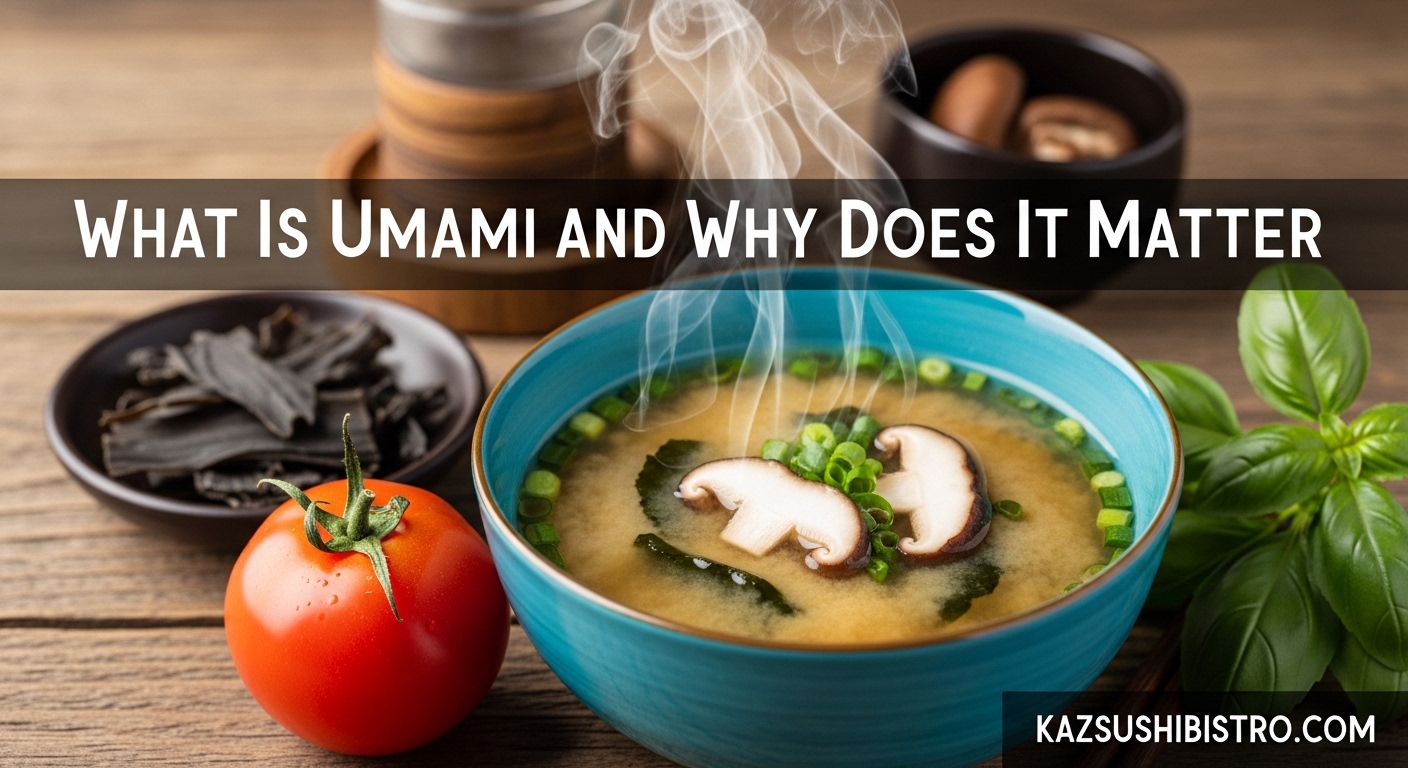
Umami is the fifth basic taste, joining sweet, sour, salty, and bitter as one of the fundamental flavors your tongue can detect. Discovered in 1908 by Japanese scientist Kikunae Ikeda, it is the savory, deeply satisfying essence that makes broths rich, tomatoes mouthwatering, and sushi absolutely irresistible. Understanding umami transforms how you cook, eat, and appreciate food.
Have you ever wondered why a simple bowl of miso soup feels so comforting? Or why you cannot stop reaching for another piece of sushi? That pull, that craving for one more bite, is umami at work. I remember the first time I truly tasted umami in isolation. I was comparing plain dashi broth with kombu-enhanced dashi, and the difference was impossible to ignore. One was flat and one-dimensional. The other had depth, roundness, and a lingering savory finish that made me instantly hungry for more.
At KAZ Sushi Bistro, umami is the invisible thread that runs through every dish we create. From the nori wrapping our maki rolls to the soy sauce brushing our nigiri, umami is what makes Japanese cuisine so deeply satisfying. In this guide, I will explain exactly what umami is, why it matters for your health and your cooking, and how to recognize it in every meal.
Table of Contents
What Is Umami? Understanding the Fifth Taste 2026
Umami is a savory, brothy, mouth-filling taste often described as meaty or deeply satisfying. While sweet signals energy-rich carbohydrates and salty indicates mineral content, umami tells your brain you have found protein. It is the taste of glutamate, an amino acid found in nearly every living thing, and it triggers a unique set of taste receptors on your tongue.
The five basic tastes are sweet, sour, salty, bitter, and umami. For decades, Western science only recognized the first four. Sweetness detects sugars. Sourness senses acidity. Saltiness monitors sodium. Bitterness warns of potential toxins. Umami, however, serves a different purpose entirely. It signals the presence of protein and amino acids, essential building blocks for human health.
What makes umami distinct from salty is subtle but crucial. Salt hits your tongue immediately with a sharp, mineral edge. It enhances other flavors but does not create depth on its own. Umami unfolds slowly. It spreads across your entire palate, creates a mouthwatering sensation, and leaves a long, satisfying finish. Where salt is a spotlight, umami is warm ambient light that fills the room.
The Three Signature Properties of Umami
Umami has three distinct characteristics that set it apart from other tastes. First, it spreads across the entire tongue rather than concentrating in specific areas. Second, it lasts longer than other basic tastes, creating a lingering sensation. Third, it stimulates saliva production and creates a mouthwatering feeling that makes food taste more appealing.
When you eat something umami-rich, you will notice the flavor seems to coat your whole mouth. This full-palate experience is unique to umami. Sweetness is concentrated on the tip of your tongue. Bitterness hits the back. Umami operates everywhere at once, creating what chefs call a rounded or complete flavor profile.
The lasting quality of umami is why you crave another bite. The flavor stays with you, creating what Japanese chefs describe as a long tail. A well-made dashi broth can leave a savory impression on your palate for minutes after you finish drinking it. This persistence is your brain signaling that you have consumed something nutritionally valuable.
The History of Umami: From Tokyo to the World
Umami was discovered in 1908 by Kikunae Ikeda, a chemistry professor at Tokyo Imperial University. Ikeda was puzzled by the distinctive savory flavor of dashi, the traditional Japanese broth made from kombu seaweed and dried bonito flakes. He knew this taste was not sweet, sour, salty, or bitter. It was something else entirely, something that had no name in Western science.
After months of research, Ikeda isolated the source of dashi’s unique flavor. He identified glutamate as the compound responsible and named the taste umami. The word comes from the Japanese umai, meaning delicious, combined with mi, meaning essence or taste. Literally translated, umami means delicious taste or the essence of deliciousness.
Despite his discovery, Ikeda faced skepticism from the Western scientific community. Western taste science had recognized only four basic tastes for centuries, and many scientists were reluctant to accept a fifth. Umami remained largely a Japanese concept for decades, acknowledged in Asian cuisine but dismissed by Western researchers as a subcategory of salty or simply a figment of imagination.
From Controversy to Acceptance
Umami gained scientific legitimacy in 1985 when the term was officially recognized at the first Umami International Symposium in Hawaii. Researchers confirmed that umami has its own unique taste receptors on the human tongue, separate from those for sweet, sour, salty, and bitter. This discovery proved that umami was not a cultural concept but a biological reality hardwired into human taste perception.
In 2000, breakthrough research identified the specific taste receptors responsible for detecting umami. Scientists discovered T1R1 and T1R3, proteins on taste buds that respond specifically to glutamate. This discovery sealed umami’s status as the fifth official basic taste. What Kikunae Ikeda had identified through careful observation nearly a century earlier was finally validated by modern molecular biology.
Today, umami is universally accepted by scientists and chefs worldwide. It is no longer considered exotic or solely Japanese. Every major culinary tradition uses umami-rich ingredients, from Italian Parmesan to American barbecue sauce to French consomme. The understanding of umami has transformed cooking, nutrition science, and food product development across the globe.
The Science Behind Umami: Glutamate and Taste Receptors
Umami works through a fascinating interplay between specific molecules and specialized taste receptors on your tongue. The primary umami compound is glutamate, an amino acid that occurs naturally in protein-containing foods. When glutamate binds to umami taste receptors, it triggers a signal to your brain that you are consuming something protein-rich and nutritionally valuable.
Your tongue contains specialized cells called taste receptor cells clustered in taste buds. Within these cells, specific proteins detect different tastes. For umami, the key receptors are T1R1 and T1R3, which form a complex that specifically recognizes glutamate. When you eat something containing free glutamate, these receptors activate and send signals through your nervous system to your brain.
Nucleotides: Umami’s Secret Amplifiers
While glutamate is the primary umami compound, two nucleotides dramatically enhance its effect. Inosinate, found primarily in meat and fish, and guanylate, abundant in dried mushrooms, do not create much umami on their own. However, when combined with glutamate, they multiply the umami sensation. This is the principle of umami synergy.
The synergy effect is why certain food combinations taste exponentially better than the sum of their parts. A classic example is Japanese dashi, which combines glutamate-rich kombu with inosinate-rich bonito flakes. The combination creates an umami intensity far greater than either ingredient could achieve alone. This is not just culinary tradition. It is hardwired biochemistry.
Umami synergy also explains why Parmesan cheese on tomato sauce tastes so incredible. Tomatoes are high in glutamate. Aged Parmesan contains both glutamate and nucleotides. Together, they create what chefs call an umami bomb, a flavor explosion that hits multiple taste receptors simultaneously. This is the science behind why some food combinations feel inevitable and perfect.
Why Umami Tastes the Way It Does
From an evolutionary perspective, umami serves as a protein detector. Protein is essential for human survival, but not all protein sources are safe or nutritious. Umami taste receptors signal that you have found bioavailable, digestible protein. This explains why umami creates satisfaction and craving. It is your body rewarding you for finding nutrition.
Umami also stimulates saliva production and digestive juice secretion. When you taste something umami-rich, your body prepares for protein digestion. Saliva flow increases, making food easier to swallow and beginning the digestive process. Gastric juices begin flowing in anticipation. This physiological response is part of why umami makes food feel more satisfying and easier to eat.
The mouthwatering sensation associated with umami comes from its interaction with calcium-sensing receptors in addition to the primary umami receptors. This dual activation creates a unique feeling of fullness and richness that no other taste can replicate. When chefs talk about depth of flavor or a rounded palate, they are describing this complex umami response.
Umami in Sushi: Why Japanese Cuisine Tastes Irresistible
Japanese cuisine, and sushi in particular, represents one of the purest expressions of umami in world cooking. Every element on a sushi plate contributes glutamate, nucleotides, or both. The combination creates a layered, complex umami experience that explains why sushi feels so deeply satisfying despite appearing simple. At KAZ Sushi Bistro, we build each piece with this umami symphony in mind.
When you sit down for sushi, you are not just eating fish and rice. You are experiencing centuries of accumulated umami wisdom. The Japanese culinary tradition intuitively understood umami synergy long before science gave it a name. Every ingredient, from the nori to the soy sauce, has been selected and prepared to maximize savory depth.
Nori: The Umami Powerhouse
Nori, the dried seaweed wrapping maki rolls, is one of the most concentrated natural sources of umami on Earth. This seemingly simple paper-thin sheet contains extraordinarily high levels of free glutamate, the compound that triggers umami taste receptors. The drying process concentrates these compounds, making dried nori significantly more umami-rich than fresh seaweed.
The umami in nori develops during the cultivation and drying process. Seaweed is grown in carefully managed waters, harvested at peak maturity, then washed, shredded, and dried into paper-thin sheets. This processing breaks down proteins into free amino acids, increasing glutamate concentration. A single sheet of nori can contain more umami than a bowl of miso soup.
When you bite into a maki roll, the nori delivers an immediate umami hit. This savory burst complements the fish and rice perfectly, creating a complete flavor profile in every bite. The slight oceanic quality of nori also signals freshness and authenticity. Without nori, a maki roll would taste flat and incomplete. With it, the roll becomes a concentrated umami delivery system.
Fresh Fish and Shellfish
Fresh fish is naturally rich in inosinate, the nucleotide that amplifies umami when combined with glutamate. Different species contain varying levels, with fatty fish like tuna, salmon, and mackerel offering particularly high concentrations. Shellfish such as scallops and shrimp also contribute significant umami through their natural glutamate and nucleotide content.
The freshness of fish matters enormously for umami perception. As fish ages, proteins break down in ways that can create off-flavors while also changing umami compound ratios. Perfectly fresh fish has a clean, bright umami quality that tastes like the ocean itself. This is why sushi chefs obsess over sourcing and handling. The umami potential of fish degrades rapidly with poor storage.
At KAZ Sushi Bistro, we select fish not just for texture and appearance but for umami potential. The fattiest cuts of tuna belly, known as toro, deliver an almost buttery umami experience. Scallops offer a sweet-umami combination that feels luxurious. Even lean white fish like snapper contribute subtle umami that builds complexity when combined with other ingredients.
Soy Sauce and Seasonings
Soy sauce is essentially liquid umami. Made from fermented soybeans and wheat, it contains massive amounts of glutamate produced during the months-long fermentation process. When you dip sushi in soy sauce, you are adding a concentrated dose of savory depth that bridges the flavors of fish and rice. The salt in soy sauce enhances perception, but the glutamate creates the true magic.
The fermentation process that creates soy sauce breaks down soy proteins into free amino acids, particularly glutamate. Traditional brewing takes months or even years, allowing these compounds to develop fully. The result is a complex liquid with hundreds of flavor compounds, but umami dominates the experience. A few drops can transform a simple piece of nigiri into something transcendent.
Other seasonings in the sushi experience also contribute umami. Wasabi, while primarily known for its heat, contains compounds that actually enhance umami perception. Pickled ginger refreshes the palate between bites, but also adds subtle fermented umami notes. Even the vinegar in sushi rice contributes to the overall savory balance, creating acidity that makes umami more apparent.
The Umami Synergy on Your Plate
The true genius of sushi lies in umami synergy. Consider a simple salmon maki roll. The nori provides glutamate. The salmon contributes inosinate. The rice offers subtle sweetness that frames the savory notes. When combined, these ingredients create an umami intensity far greater than any single component could achieve alone. This is why sushi feels complete and deeply satisfying.
Nigiri sushi exemplifies this synergy even more clearly. A piece of tuna nigiri places glutamate-rich fish atop vinegared rice, then adds a brush of soy sauce for additional glutamate. The small amount of wasabi underneath enhances receptor sensitivity. Each bite activates multiple umami pathways simultaneously, creating a flavor experience that feels full, rounded, and impossible to resist.
This explains the sushi craving so many people experience. Your brain recognizes the nutritional density signaled by umami and rewards you with pleasure signals and appetite stimulation. Once you understand this, you start tasting sushi differently. You notice how the nori hits first, how the fish builds the middle, and how the finish lingers. Every piece becomes a lesson in umami architecture.
Foods Rich in Umami: From Kombu to Parmesan
Umami is not exclusive to Japanese cuisine. It appears in foods from every culinary tradition on Earth. Once you know what to look for, you will recognize umami in aged cheese, fermented sauces, mushrooms, tomatoes, and countless other ingredients. Understanding these sources empowers you to add depth to any dish you cook.
The highest natural concentrations of umami occur in certain seaweeds, dried mushrooms, fermented products, aged proteins, and concentrated tomato preparations. These foods have been prized by cooks for centuries, long before anyone understood why they made dishes taste better. Now we know. They are umami delivery systems, concentrated sources of the savory satisfaction our brains crave.
Plant-Based Umami Champions
Dried shiitake mushrooms contain approximately fifteen times more glutamate than their fresh counterparts. The drying process breaks down proteins into free amino acids, concentrating umami compounds dramatically. A single dried shiitake can flavor an entire pot of soup. Other dried mushrooms like porcini and morels offer similar umami intensity.
Tomatoes are another vegetable umami powerhouse, especially when concentrated. Fresh tomatoes contain moderate glutamate, but sun-dried tomatoes, tomato paste, and slow-cooked tomato sauce become exponentially more umami-rich as water evaporates and flavors concentrate. This is why a spoonful of tomato paste can rescue a flat soup or sauce. It is pure plant-based umami.
Seaweeds beyond nori also deliver exceptional umami. Kombu, the kelp used in dashi broth, contains some of the highest glutamate levels of any food on Earth. Wakame, used in miso soup, offers significant umami along with nutritional benefits. Even green tea contains theanine, an amino acid that contributes subtle umami notes alongside its caffeine content.
Animal-Based Umami Sources
Aged cheeses develop umami through protein breakdown over time. Parmesan, aged for months or years, contains crystalline deposits of glutamate that create its distinctive savory depth. Romano, aged cheddar, and other hard cheeses offer similar umami intensity. This is why a sprinkle of Parmesan can transform pasta, salad, or soup. You are adding concentrated savory richness.
Meat and fish provide umami primarily through inosinate, the nucleotide that synergizes with glutamate. Beef, pork, chicken, and all varieties of fish and shellfish contribute this compound. The aging or curing of meats increases umami concentration. Prosciutto, aged beef, and dried fish all deliver intensified savory notes through controlled decomposition of proteins into free amino acids.
Fermented fish products rank among the most umami-dense foods on Earth. Fish sauce, popular across Southeast Asia, contains extraordinary glutamate levels from months of fermentation. Anchovy paste, Worcestershire sauce, and oyster sauce offer similar concentrated umami. These ingredients function as secret weapons in professional kitchens, adding depth without dominating other flavors.
Fermented Foods and Umami
Fermentation is essentially controlled decomposition that breaks proteins into amino acids. This process creates umami as a byproduct. Miso paste, fermented soybeans, delivers massive umami along with complex flavor. Soy sauce, as mentioned, owes its entire existence to fermentation chemistry. Kimchi, sauerkraut, and other fermented vegetables develop umami alongside their characteristic tang.
The fermentation process can transform humble ingredients into umami powerhouses. Consider the difference between plain soybeans and miso paste. The beans are bland and starchy. The fermented paste is deeply savory and complex. This transformation is entirely due to microbial activity breaking proteins into glutamate and other flavorful compounds.
Even condiments like Worcestershire sauce and Maggi seasoning rely on fermentation for their umami punch. These complex sauces combine multiple fermented ingredients to create layered savory depth. A few drops can add the kind of complexity that usually requires hours of slow cooking. They are essentially shortcuts to umami richness.
Is Umami the Same as MSG? Clearing Up the Confusion
No, umami is not the same as MSG, though they are closely related. This confusion is one of the most common misunderstandings in food science. Umami is a taste, like sweet or salty. MSG is a food additive that creates umami taste. The relationship is similar to the one between salt and salty. Salt is a substance. Salty is the taste it produces.
MSG stands for monosodium glutamate. It is the sodium salt of glutamic acid, the same compound that creates natural umami in foods. When you consume MSG, your tongue detects the free glutamate and experiences umami taste. Your body metabolizes this glutamate exactly the same way it processes naturally occurring glutamate from tomatoes, mushrooms, or fish.
The MSG Controversy Explained
The confusion between umami and MSG stems from a phenomenon known as Chinese restaurant syndrome. In 1968, a letter to the New England Journal of Medicine described symptoms like headaches and flushing after eating at Chinese restaurants. The author suggested MSG might be responsible. Despite being anecdotal, this letter sparked decades of unfounded fear about MSG safety.
Scientific research has consistently failed to confirm any negative health effects from MSG consumed in normal food quantities. Double-blind, placebo-controlled studies have shown that people who claim MSG sensitivity cannot reliably identify when they have consumed it. The FDA classifies MSG as GRAS, meaning generally recognized as safe. The European Food Safety Authority and World Health Organization have reached similar conclusions.
The stigma against MSG has always had undertones of xenophobia. MSG is simply a purified form of a compound found naturally in countless foods. Parmesan cheese, tomato sauce, and mushrooms all contain high levels of free glutamate. Yet only Asian cuisine using MSG as an additive faced backlash. This double standard reveals more about cultural bias than about actual food safety.
Natural vs. Added Glutamate
From a chemical perspective, there is no difference between the glutamate in MSG and the glutamate in a ripe tomato. Your body cannot distinguish the source. Both break down into the same compounds during digestion. Both bind to the same taste receptors. Both create identical umami sensations. The distinction between natural and added glutamate is meaningful only in marketing, not in biochemistry.
MSG offers a practical way to add umami to dishes without adding other flavors. A dash of soy sauce brings salt and color along with umami. A spoonful of miso adds fermentation character. Pure MSG provides only umami, making it useful for fine-tuning savory balance without changing other taste elements. Professional chefs often use it this way, even if they do not advertise the fact.
Understanding that MSG and umami are distinct helps clarify this long-controversial topic. Umami is a fundamental taste hardwired into human biology. MSG is one way among many to experience that taste. Neither is inherently good or bad. Both are tools for creating delicious, satisfying food.
Why Umami Matters for Your Health
Umami is not just about pleasure. It serves important physiological functions related to nutrition and digestion. When you taste umami, your body responds in ways that facilitate protein utilization and promote healthy eating patterns. Understanding these benefits helps explain why umami-rich foods feel so fundamentally satisfying.
First, umami triggers saliva production. This begins the digestive process immediately, making food easier to swallow and beginning carbohydrate breakdown in the mouth. Increased saliva flow also enhances flavor perception, creating a positive feedback loop where umami makes food taste better, which makes you salivate more, which makes the umami more apparent.
Digestion and Satiety
Umami taste signals your digestive system to prepare for protein. When you consume something umami-rich, gastric juice secretion increases in anticipation. This preparation helps your stomach process protein more efficiently. The evolutionary logic is clear. Umami signals valuable nutrition, and your body responds by optimizing its digestive capacity.
Umami also contributes to satiety, the feeling of fullness and satisfaction after eating. Foods high in umami taste more complete and satisfying, which can help prevent overeating. This is part of why a umami-rich bowl of miso soup feels more filling than its calorie count would suggest. Your brain recognizes the nutritional signal and registers satisfaction.
For elderly populations, umami can be particularly important. Taste perception declines with age, often leading to reduced appetite and nutritional deficiencies. Umami remains detectable longer than other tastes, making umami-rich foods valuable for maintaining healthy eating in older adults. This is why traditional diets for the elderly in many cultures emphasize broths, fermented foods, and other umami sources.
Sodium Reduction Benefits
One of the most practical health applications of umami is sodium reduction. Because umami enhances flavor perception, adding umami-rich ingredients allows you to reduce salt while maintaining delicious taste. Studies have shown that increasing umami content can enable salt reduction of up to forty percent without consumers noticing a difference in palatability.
This has significant implications for public health. Excessive sodium intake contributes to hypertension and cardiovascular disease. Yet low-sodium foods often taste bland and unsatisfying, leading people to abandon healthy eating plans. Umami offers a solution. By boosting savory satisfaction through glutamate rather than sodium chloride, food can be both healthy and delicious.
Cooking techniques that maximize umami become tools for healthier eating. Slow-cooking tomatoes concentrates glutamate. Adding mushrooms to dishes boosts nucleotide content. Using fermented condiments provides depth without salt bombs. These approaches let you create satisfying meals that support rather than compromise your health goals.
How to Taste Umami: A Simple Exercise
The best way to understand umami is to taste it intentionally. This simple exercise will help you identify the unique characteristics of umami and distinguish it from other tastes. Once you have experienced umami in isolation, you will start noticing it everywhere in your daily eating.
For this exercise, you will need three ingredients: warm water, salt, and a small piece of kombu or a few drops of soy sauce. The warm water serves as a neutral baseline. The salt demonstrates a basic taste for comparison. The kombu or soy sauce delivers concentrated umami. By tasting these in sequence, you will feel the difference between salty and umami directly.
Step-by-Step Tasting Guide
Begin by tasting a sip of warm, unsalted water. Notice that it has essentially no taste. This is your blank canvas. Swallow and wait a moment for your palate to clear. Now dissolve a small pinch of salt in warm water and taste it. Notice the immediate, sharp, mineral hit on the front of your tongue. This is pure saltiness. Swallow and clear your palate again.
Now for the umami experience. Steep a small piece of kombu in warm water for five minutes, or add a few drops of soy sauce to warm water. Taste this mixture. Notice how different it feels from the salt water. Instead of a sharp hit, you will feel a spreading, mouth-filling sensation. The flavor seems to coat your entire tongue rather than concentrating in one spot.
Pay attention to the finish. Where the salt water tastes immediately sharp and then fades, the umami water leaves a lingering savory impression. Your mouth may feel more watery, a response to increased saliva production. You might notice a craving for another sip. This lingering, mouthwatering, satisfying quality is the signature of umami.
Recognizing Umami in Everyday Foods
Once you have trained your palate with the exercise above, start noticing umami in your regular meals. That rich, satisfying quality in a bowl of ramen? Umami from the broth. The depth in a well-made Bolognese sauce? Umami from tomatoes and Parmesan. The irresistible quality of a perfectly seared steak? Umami from the Maillard reaction creating glutamate compounds.
Try comparing foods with and without umami enhancement as you eat. Taste a plain piece of bread, then the same bread with a thin spread of Marmite or Vegemite. The difference is umami. Compare plain steamed broccoli with broccoli dressed with a splash of soy sauce and sesame oil. The dressed version will taste more complete and satisfying thanks to umami.
Understanding umami changes how you cook. You will start reaching for tomato paste, mushrooms, and aged cheese not just for their flavors but for their umami contributions. You will notice restaurant dishes that have that inexplicable depth and start identifying the umami sources responsible. Food becomes more interesting when you understand the science behind its deliciousness.
Frequently Asked Questions About Umami
Why is umami so important?
Umami signals protein presence in food, stimulates saliva and digestive juices, enhances other flavors, and creates satisfying, craveable dishes. It helps identify nutritious food and makes healthy eating more enjoyable by adding depth without excessive salt.
What are the five basic tastes including umami?
The five basic tastes are sweet, sour, salty, bitter, and umami. Umami was officially recognized as the fifth taste in 1985, though it was discovered by Japanese scientist Kikunae Ikeda in 1908. Each taste serves a different biological purpose and activates specific taste receptors.
Why is umami controversial?
Umami became controversial through its association with MSG. In the 1960s and 1970s, anecdotal reports of Chinese restaurant syndrome created stigma around MSG safety. However, extensive scientific research has consistently shown that MSG and umami are safe for consumption when used normally in food.
What does umami do to your body?
Umami triggers saliva secretion and digestive juice production, facilitating protein digestion. It signals nutrient-rich food to your brain, may contribute to satiety, and helps maintain healthy appetite, particularly important for elderly populations who experience taste perception decline.
What does umami mean exactly?
Umami comes from the Japanese words umai, meaning delicious, and mi, meaning essence or taste. Coined by Kikunae Ikeda in 1908, it literally translates to delicious taste or essence of deliciousness. The term describes the savory, satisfying quality distinct from the other four basic tastes.
Is umami the same thing as MSG?
No. Umami is a taste, like sweet or salty. MSG is a food additive that creates umami taste. Think of it like salt versus salty. Natural glutamate in foods and MSG both produce identical umami sensations, and your body metabolizes both the same way.
Is umami healthier than MSG?
There is no chemical difference between glutamate in MSG and naturally occurring glutamate. The body processes both identically. MSG is simply a convenient way to add umami flavor without adding other ingredients. Both natural umami and MSG are safe and serve the same nutritional signaling function.
What are the top 5 umami foods?
The top five umami-rich foods are kombu seaweed, dried shiitake mushrooms, Parmesan cheese, fish sauce, and concentrated tomato products like sun-dried tomatoes or tomato paste. These foods contain the highest natural concentrations of glutamate and nucleotides that create umami taste.
Which vegetable has the most umami?
Dried shiitake mushrooms contain the most umami among vegetables, with about 15 times more glutamate than fresh shiitakes. Tomatoes, especially sun-dried or concentrated into paste, are also extremely umami-rich. Other high-umami vegetables include seaweeds, potatoes, and sweet corn.
What is the most umami food in the world?
Kombu, the dried kelp used in Japanese dashi broth, has one of the highest natural glutamate concentrations of any food. Dried fish and fish sauces, aged Parmesan cheese, and concentrated tomato products also rank among the most umami-dense foods available.
Conclusion: Embracing the Fifth Taste
Umami is not a trend or a marketing gimmick. It is a fundamental human taste perception, hardwired into our biology through millions of years of evolution. Understanding umami transforms how you cook, eat, and appreciate food. It explains why certain combinations taste inevitable and perfect. It reveals the science behind cravings and satisfaction.
From Kikunae Ikeda’s laboratory in 1908 to modern sushi bars in 2026, umami has traveled a remarkable journey. What began as a Japanese culinary observation is now recognized worldwide as essential to delicious food. Whether you are making a simple tomato sauce or enjoying an omakase experience at KAZ Sushi Bistro, umami is the invisible thread that makes food worth eating.
The next time you sit down for sushi, pay attention. Notice the nori’s savory edge. Taste the depth in the fish. Feel how the soy sauce amplifies everything. You are experiencing umami synergy, the same principle that has made Japanese cuisine irresistible for centuries. Now that you understand what umami is and why it matters, every meal becomes an opportunity to appreciate the fifth taste.