
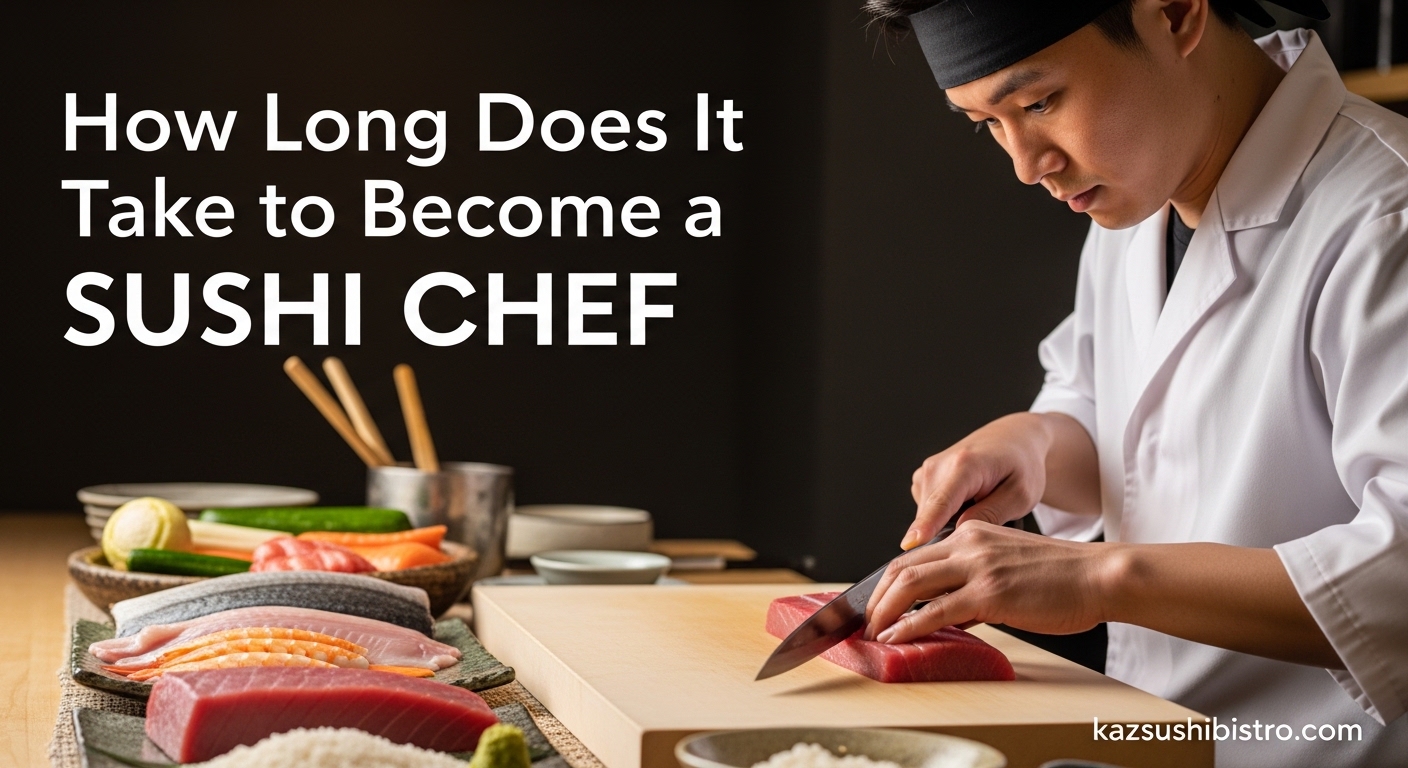
Becoming a sushi chef is a journey that transforms passionate food lovers into masters of one of the world’s most respected culinary arts. I’ve spent years observing and researching the path from novice to itamae, interviewing chefs who trained in both Tokyo’s finest counters and America’s bustling sushi scenes. The question everyone asks is simple, yet the answer reveals a fascinating divide between tradition and modernity.
How long does it take to become a sushi chef depends entirely on which path you choose. Traditional Japanese apprenticeships demand a decade of rigorous training. Modern culinary programs in the West can prepare you for professional work in 1 to 3 years. Home cooks can learn basic sushi making in weeks.
In this guide, I’ll walk you through every training path, from the ancient apprenticeship systems of Japan to accelerated programs designed for 2026‘s fast-paced restaurant industry. You’ll learn what happens at each stage of training, what factors affect your timeline, and how to choose the right path for your goals.
Table of Contents
The Short Answer: Training Timelines at a Glance
Most aspiring chefs want a straightforward answer before diving into details. Here’s what the timeline looks like based on your chosen path:
Traditional Japanese Apprenticeship: 10 years to become a fully qualified itamae. This follows the famous saying “3 years for rice, 8 years for sushi,” with most apprentices spending their first year simply observing and performing menial tasks.
Modern Culinary School Programs: 1 to 4 years depending on program intensity. Certificate programs offer faster tracks, while associate degrees provide more comprehensive training.
Western Restaurant Apprenticeships: 2 to 5 years working under an experienced chef. This hybrid approach combines structured learning with hands-on practice.
Hobbyist or Home Cook Level: 2 weeks to 6 months for basic competency. You can learn to make acceptable sushi for family and friends through online courses and practice.
The traditional path produces chefs with unparalleled depth of knowledge. The modern path gets you working professionally much faster. Neither is inherently better, it depends on your career goals, age, financial situation, and where you plan to work.
How Long Does It Take to Become a Sushi Chef Through Traditional Japanese Training
The traditional path remains the gold standard for purists and those seeking the deepest possible knowledge. This is how sushi masters have been trained for centuries, and it remains largely unchanged even in 2026.
Traditional Training Takes 10 Years Because Mastery Cannot Be Rushed
Traditional Japanese sushi training follows a specific hierarchy and philosophy. You don’t just learn techniques, you absorb a complete culinary culture through years of immersion. The 10-year timeline breaks down into distinct phases, each building upon the last.
The famous phrase among Japanese chefs captures this perfectly: “Shari 3 nen, nigiri 8 nen” (3 years for rice, 8 years for sushi). This means you’ll spend approximately 3 years mastering rice preparation alone before seriously touching fish. Some apprentices spend 5 years on rice before their first nigiri.
This timeline isn’t arbitrary. Rice preparation involves understanding seasonal variations in grain moisture, precise vinegar seasoning ratios, temperature control for different fish pairings, and the subtle art of achieving the perfect texture. Each variable requires thousands of repetitions to internalize.
The Apprenticeship Hierarchy Explains Why Progression Is Slow
Traditional apprenticeships operate on the senpai-kohai (senior-junior) relationship system. When you enter a traditional sushiya, you start at the absolute bottom regardless of your prior culinary education.
Your first year typically involves no sushi preparation at all. You’ll clean the restaurant, wash dishes, scrub floors, and run errands. During this time, you observe everything. You watch how the itamae selects fish, prepares rice, interacts with customers, and maintains their knives.
Year two might bring basic prep tasks: washing vegetables, making dashi, or perhaps learning to prepare gari (pickled ginger). Still no rice or fish handling. The master is testing your patience, work ethic, and commitment before investing serious training time.
Only after proving yourself through menial work do you touch the sacred shari (sushi rice). This progression ensures that when you finally do make sushi, you understand the foundation deeply enough to respect it.
Mental Training Requires As Much Time As Technical Skills
What many outsiders miss is that traditional training develops mental fortitude alongside technical ability. A sushi chef works under constant pressure, every piece served represents their reputation immediately.
The traditional apprenticeship teaches you to perform under scrutiny. You’ll make thousands of rice batches before anyone critiques your work meaningfully. This builds the thick skin needed to handle direct, often harsh, feedback when it finally comes.
Pressure management becomes second nature through years of repetition. When you finally serve customers, the stress doesn’t paralyze you because you’ve already spent years internalizing the basics. This psychological preparation takes time that can’t be compressed.
Master Chefs Confirm That Rushed Training Produces Inferior Results
Jiro Ono, the legendary 3-Michelin-star chef featured in the documentary “Jiro Dreams of Sushi,” embodies the traditional philosophy. He started his apprenticeship at age 9 and continued refining his craft into his 90s. His son, Yoshikazu, who is in his 50s, still works under his father’s guidance.
Rei Masuda, another Michelin-starred itamae, explains that the 10-year timeline exists because sushi involves too many variables to rush. Understanding fish seasons, rice origins, vinegar blends, and customer preferences requires lived experience that accumulates slowly.
Both chefs acknowledge that modern systems can produce competent sushi makers faster. However, they maintain that true itamae status, the ability to create transcendent dining experiences, requires the full traditional investment. The question isn’t whether shortcuts exist, but what quality level you aim to achieve.
Modern Training Paths and Alternative Timelines
Not everyone can spend a decade in unpaid apprenticeship. Fortunately, modern training systems offer legitimate alternatives that can get you working professionally much sooner. These paths sacrifice some depth for accessibility and speed.
Culinary School Programs Can Prepare You in 1 to 4 Years
Formal culinary education has evolved significantly to include sushi specialization. Programs range from intensive certificate courses to full associate degrees. Each offers different timelines and outcomes.
Certificate programs typically run 6 months to 1 year. They focus intensely on practical skills: knife techniques, rice preparation, basic fish handling, and food safety. Graduates can usually find entry-level positions in American sushi restaurants, though they’ll need on-the-job experience to advance.
Associate degree programs span 2 years and include broader culinary education. You’ll learn general kitchen management, nutrition, menu planning, and business skills alongside sushi training. This well-rounded education suits those who might eventually want to open their own restaurant.
Some specialized sushi schools, particularly those with Japanese instructors, offer 3 to 4 year programs that attempt to bridge traditional and modern approaches. These include intensive study of Japanese culinary culture, language instruction, and sometimes study abroad opportunities in Japan.
The main advantage of culinary school is structured, accelerated learning. You pay tuition, but you don’t spend years washing dishes before touching ingredients. The disadvantage is that no classroom can fully replicate the pressure and nuanced feedback of a working sushiya.
Accelerated Training Programs Promise Faster Results With Trade-offs
Bootcamp-style sushi programs have emerged to meet demand from restaurants needing staff quickly. These intensive courses compress months of material into weeks through focused, all-day instruction.
Typical accelerated programs run 4 to 12 weeks. They cover fundamentals rapidly: basic knife skills, rice cooking, standard nigiri and maki preparation, and food safety certification. Some include externships at partner restaurants.
Graduates of these programs can usually pass basic sushi chef hiring tests. They can work in high-volume American sushi restaurants, chain establishments, or casual spots. However, they typically lack the refined technique and deep knowledge for high-end omakase service.
The trade-off is clear: you start earning sooner but hit a skill ceiling faster. Many accelerated graduates eventually seek additional traditional training once they realize what they missed. Still, for career-changers or those needing income quickly, these programs provide a valid entry point.
On-the-Job Training in Western Restaurants Takes 2 to 5 Years
Perhaps the most common path in America is finding work under an experienced itamae and learning as you earn. This combines the traditional mentorship model with modern employment realities.
You might start as a prep cook, kitchen assistant, or server before gradually working into sushi preparation. An experienced head chef will teach you station by station. Rice cooking comes first, then basic prep, then simple rolls, then nigiri, finally omakase service.
The timeline varies enormously based on the chef’s teaching style and your demonstrated aptitude. Some generous mentors advance promising students quickly. Others follow more traditional progression regardless of apparent talent.
This path offers the best of both worlds: income while learning and hands-on mentorship without the extreme hierarchy of Japanese apprenticeships. The quality of training depends heavily on finding a skilled, generous teacher, which requires networking and persistence.
Self-Teaching Works for Hobbyists But Has Professional Limits
For those pursuing sushi as a passion rather than a career, self-teaching through books, online courses, and practice is viable. You can learn acceptable home sushi in weeks to months.
Quality online courses from established chefs provide structured guidance. YouTube channels dedicated to sushi technique offer free visual references. Books by masters like Jiro Ono reveal philosophical insights alongside technical instructions.
The limitation is feedback. Without an experienced eye correcting your knife angles, rice texture, or fish selection, you develop blind spots. Most self-taught enthusiasts plateau at “good for home” level. Professional kitchens require standards that self-teaching rarely achieves.
The Stages of Sushi Chef Training
Whether you choose traditional or modern training, you’ll progress through similar skill stages. Understanding these helps set realistic expectations for your journey.
Stage 1: Foundation and Observation Takes 6 to 12 Months
Every training path begins with observation and basic kitchen work. Even in modern programs, your first weeks involve understanding the environment before handling premium ingredients.
During foundation stage, you’ll master kitchen protocols, food safety procedures, and ingredient identification. You’ll learn to receive and store fish properly, maintain clean workspaces, and support the team’s workflow. This isn’t wasted time, it’s the infrastructure upon which all later skills depend.
In traditional settings, this stage lasts a full year and includes extensive cleaning duties. Modern programs compress it to weeks or months but still emphasize that you cannot rush the observation period. Watching thousands of pieces being made internalizes standards you’ll later apply yourself.
Stage 2: Rice Mastery Typically Requires 1 to 3 Years
Sushi rice (shari) preparation is arguably the most important skill you’ll learn. Traditional training dedicates 2 to 3 years exclusively to rice. Modern programs might spend 2 to 6 months on this foundation.
You’ll learn to wash rice properly, removing excess starch without damaging grains. You’ll master the precise water ratios that vary by rice brand and age. You’ll understand how soaking times affect final texture.
The most complex aspect is seasoning with sushi vinegar (awasezu). The blend of rice vinegar, sugar, and salt must be balanced precisely and applied while rice is at the correct temperature. Too hot and the vinegar evaporates, too cold and it doesn’t absorb properly.
You’ll also learn temperature control. Different fish pair with rice at different temperatures. Tuna might require room-temperature rice while flounder pairs with slightly warm shari. These subtle adjustments take countless repetitions to master.
Stage 3: Knife Skills and Fish Preparation Takes 2 to 5 Years
Once rice is automatic, training shifts to fish handling. This stage terrifies many apprentices because the ingredients are expensive and mistakes are costly.
You’ll start with knife maintenance: sharpening on water stones, honing, and maintaining the specific angles required for different cuts. A sushi knife (yanagiba or deba) represents a significant investment, and proper care extends its life dramatically.
Fish butchering comes next. You’ll learn to break down whole fish, understanding anatomy to maximize yield and quality. Each species requires different approaches: tuna demands long slicing motions, while delicate white fish needs gentle handling.
Curing and aging techniques follow. Many fish benefit from brief aging to develop umami. Others require curing in salt or vinegar. You’ll learn which treatments suit each species and season, building the judgment that distinguishes competent chefs from masters.
Stage 4: Nigiri Formation and Speed Development Takes 3 to 8 Years
The iconic nigiri piece, rice topped with fish, seems simple but requires extraordinary precision. This stage focuses on the physical technique and timing that define professional service.
You’ll practice the basic hand motion thousands of times: the three-finger grip, the rice shaping, the wasabi application, the fish placement, the final compression. Each element must be consistent, every piece identical to the last.
Speed development happens here too. Professional service requires making nigiri in seconds, not minutes. You’ll work during slow periods, then gradually take on more covers as your pace increases. The goal is quality at volume, which takes years to achieve.
Presentation skills also develop during this stage. You’ll learn to arrange pieces on platters, garnish appropriately, and adjust portions based on customer preferences. The visual aspect of sushi matters nearly as much as the taste.
Stage 5: Itame Level and Independence Takes 8 to 10+ Years
Full itamae status means you can run a counter independently, create omakase menus, and train others. This represents the culmination of traditional training.
At this level, you understand ingredient sourcing deeply. You build relationships with fish markets, know seasonal availability intimately, and can adjust menus based on daily arrivals. You can identify quality in a glance and smell.
Customer interaction becomes central. The itamae chats with guests, remembers preferences, paces the meal, and creates a dining experience beyond just food. This social skill develops slowly through years of observation and practice.
Finally, you’re qualified to train others. You can guide apprentices through the same stages you completed, perpetuating the tradition. This responsibility marks true mastery, you’re no longer just executing, you’re preserving and transmitting culinary heritage.
Factors That Affect Your Training Timeline
The timelines I’ve outlined are averages. Your personal journey might be shorter or longer depending on several key factors.
Prior Culinary Experience Can Shorten Training by 1 to 2 Years
Chefs with restaurant backgrounds often progress faster in sushi training. Kitchen experience teaches the rhythm of service, food safety protocols, and physical stamina required for long shifts standing.
However, prior experience can also create bad habits. French knife techniques differ from Japanese approaches. Saucing instincts don’t apply to sushi’s minimalism. Experienced chefs sometimes need to unlearn as much as they learn.
Generally, line cooks with 2+ years experience can expect to shave 6 to 18 months off standard timelines. But they still need the full sushi-specific education, rice preparation doesn’t care about your brigade system knowledge.
Access to Quality Mentorship Determines Progression Speed
The quality of your teacher matters enormously. A master itamae who takes genuine interest in your development accelerates your learning dramatically. They catch errors before they become habits and explain nuances that books miss.
Unfortunately, great mentors are scarce outside Japan. In America, many sushi restaurants employ chefs with limited traditional training themselves. Learning from someone who never completed proper apprenticeship perpetuates skill dilution.
Seek out mentors with verified credentials. Japanese-trained chefs, graduates of respected academies, or those who’ve worked under established masters. Their guidance is worth more than any accelerated program’s certificate.
Geographic Location Creates Training Advantages or Limitations
Where you live significantly affects your training options. Major metropolitan areas with strong Japanese communities, Los Angeles, New York, San Francisco, Seattle, offer better mentorship, ingredients, and employment opportunities.
These cities host authentic sushiya where traditional techniques survive. They have Japanese grocery stores selling proper ingredients. They attract skilled chefs you might learn from. The concentration of resources accelerates education.
Smaller cities might have only Americanized sushi restaurants using shortcuts and non-traditional ingredients. Training in these environments limits your exposure to authentic techniques. You might need to relocate temporarily for serious education.
Personal Dedication and Practice Time Directly Affects Progression
Your timeline depends heavily on how much effort you invest outside formal training. Chefs who practice at home, study obsessively, and seek every learning opportunity progress faster than those who treat training as a clock-punching job.
Consider rice practice. Making one batch daily during work teaches slowly. Making three batches nightly at home, experimenting with ratios and temperatures, accelerates mastery dramatically. The obsessed apprentice outpaces the casual one regardless of raw talent.
Reading Japanese culinary books, visiting fish markets, eating at renowned sushiya for research, all these extracurricular activities compound your formal training. The 10-year traditional timeline assumes this level of immersion. Skipping it extends any path’s duration.
Financial Considerations Force Timeline Adjustments for Many
The reality is that traditional Japanese apprenticeships often pay little or nothing for years. Modern culinary school requires tuition that puts you in debt. These financial pressures force many to choose faster, earning paths over ideal training.
Some aspiring chefs work day jobs while training nights and weekends. This extends their timeline significantly but keeps them financially stable. Others choose accelerated programs specifically to start earning sooner, planning to continue education while employed.
There’s no shame in adjusting your timeline for financial reality. Many excellent working chefs didn’t follow the pure traditional path. They found ways to learn what mattered while supporting themselves, even if it took creativity and persistence.
Essential Skills Every Sushi Chef Must Master
Regardless of training path, certain skills define competent sushi chefs. Understanding these helps you evaluate your progress and focus your learning.
Technical Skills Form the Foundation of Your Craft
Technical proficiency separates professionals from amateurs. These measurable skills take time to develop but can be evaluated objectively.
Rice preparation tops the list. You must produce consistent, properly seasoned, temperature-appropriate shari every time. This sounds simple but requires understanding humidity effects, grain age variations, and subtle seasoning adjustments.
Knife work follows closely. You need clean, precise cuts without tearing flesh. Different fish require different techniques: hiki-zukuri (pull cut) for tuna, sogizukuri (angle cut) for white fish. Your knife skills directly affect texture and appearance.
Fish knowledge encompasses identification, quality assessment, seasonal availability, and proper handling. You must recognize freshness indicators, understand parasite risks, and know which species suit which preparations.
Food safety is non-negotiable when serving raw seafood. HACCP protocols, temperature monitoring, cross-contamination prevention, and proper storage procedures must be automatic. One mistake can end careers or harm customers.
Speed and consistency develop through repetition. Eventually, you must produce identical pieces rapidly during service. This muscle memory takes months or years of daily practice to build.
Mental and Professional Skills Matter As Much As Technique
The intangibles separate good sushi chefs from great ones. These develop slowly through experience and deliberate attention.
Patience and humility enable you to endure the long training periods without frustration. You must accept criticism, repeat tasks thousands of times, and defer gratification for years. These qualities can’t be rushed.
Pressure management becomes crucial during service. The counter is hot, customers watch your every move, and timing matters. You must remain calm, focused, and precise under scrutiny. Some people naturally handle this, others must develop it through exposure.
Hygiene obsession defines professional sushi chefs. You’ll wash your hands hundreds of times per shift. Your workspace must be immaculate. Any lapse risks contamination in a raw food environment.
Customer interaction skills grow throughout your career. Reading tables, remembering regulars, explaining choices, and creating comfortable atmosphere all matter. The best itamae make guests feel welcome and special.
Attention to detail pervades every aspect. Rice grain alignment, fish temperature, plate cleanliness, garnish placement, everything matters. This meticulousness becomes habitual through years of demanding standards.
Career Prospects and Salary Expectations
Understanding the financial realities helps you plan your training investment. Sushi chef careers offer varying rewards depending on your skill level and location.
Salary Ranges Vary Dramatically by Experience and Setting
Entry-level sushi chefs in American restaurants typically earn $28,000 to $40,000 annually. These positions often involve making basic rolls and supporting senior chefs rather than independent counter work.
Mid-level chefs with 3 to 5 years experience can expect $40,000 to $65,000. At this level, you’re trusted with nigiri service, omakase preparation, and possibly some customer interaction. High-volume restaurants in major cities pay at the upper end.
Senior itamae and head chefs command $65,000 to $120,000+. The range depends heavily on restaurant prestige, location, and your reputation. Celebrity chefs at renowned establishments earn significantly more, sometimes $150,000+ with profit sharing.
Traditional Japanese apprenticeships often paid little during training, with the promise of eventual high earnings as a master. Modern Western training requires upfront investment but lets you earn while learning. Consider which financial model suits your situation.
Career Advancement Offers Multiple Directions
Skilled sushi chefs have several advancement paths. Head chef positions at established restaurants offer stability and good income. Opening your own restaurant provides autonomy but adds business risk and management duties.
Consulting work suits experienced chefs who want variety. You might help new restaurants design menus, train staff, or source ingredients. This pays well hourly but requires a strong reputation to secure contracts.
Teaching at culinary schools or offering private classes provides another avenue. As sushi’s popularity grows, demand for qualified instructors increases. This path suits those who enjoy mentoring and want more regular hours than restaurant work.
The Industry Outlook Remains Strong Despite Challenges
Sushi’s popularity shows no signs of declining. American sushi restaurants continue opening, creating steady demand for trained chefs. The cuisine has evolved beyond Japanese communities to mainstream acceptance.
However, competition intensifies. More culinary schools offer sushi programs, increasing the supply of entry-level chefs. Standing out requires either exceptional skill from traditional training or unique specialization that distinguishes you from the masses.
Sustainability concerns also shape the industry’s future. Chefs who understand responsible sourcing, alternative seafood options, and environmental issues will be better positioned as regulations tighten and consumer awareness grows.
Frequently Asked Questions
How long does it take to become a real sushi chef?
Becoming a real sushi chef takes 10 years through traditional Japanese apprenticeship following the ‘3 years rice, 8 years sushi’ philosophy. Modern training paths can prepare you for professional work in 1 to 3 years through culinary school or on-the-job training, though these may not provide the same depth of mastery.
Do sushi chefs make good money?
Experienced sushi chefs can make good money, with senior itamae earning $65,000 to $120,000+ annually. Entry-level positions start around $28,000 to $40,000. High-end restaurants and celebrity chefs can earn significantly more. However, the training period often involves lower wages while building skills and reputation.
Is 35 too late to become a chef?
35 is not too late to become a sushi chef. Many successful chefs started in their 30s, 40s, or even later. While traditional Japanese apprenticeships often begin in teens or early 20s, modern Western training accommodates career-changers. Your maturity and life experience may actually help you handle the pressure and customer interaction aspects of the job.
How much does a sushi chef earn?
Sushi chef earnings vary by experience: entry-level $28,000-$40,000, mid-level $40,000-$65,000, senior $65,000-$120,000+. Head chefs at prestigious restaurants or those with strong reputations can earn $150,000 or more. Tips, bonuses, and profit sharing can supplement base salary significantly in high-end establishments.
How long is a sushi chef apprenticeship?
Traditional Japanese apprenticeships last approximately 10 years, following stages from observation through rice mastery, knife skills, and nigiri formation. Modern apprenticeships in Western restaurants typically take 2 to 5 years, depending on the mentor’s teaching style and your demonstrated progress. Accelerated programs can teach basics in months but don’t provide equivalent depth.
How to become a sushi chef with no experience?
To become a sushi chef with no experience: 1) Research training options and choose between culinary school, apprenticeship, or self-teaching paths. 2) Start with food safety certification and basic knife skills. 3) Begin as kitchen support or prep cook to observe professionals. 4) Practice rice preparation obsessively at home. 5) Seek mentorship from experienced itamae willing to teach. 6) Be patient and commit to the long learning process.
Is it worth it to become a sushi chef?
Becoming a sushi chef is worth it if you’re passionate about Japanese cuisine, patient enough for the training, and comfortable with the physical demands. The career offers creative expression, cultural immersion, and potentially good income at senior levels. However, the long training period and initial low wages require genuine commitment. Consider your financial needs, age, and career goals before committing.
How difficult is it to become a sushi chef?
Becoming a sushi chef is moderately to highly difficult depending on your standards. Basic competency takes months of dedicated practice. Professional readiness requires 1 to 3 years of intensive training. True mastery demands a decade of commitment. The difficulty lies in the precision required, the long training period, physical demands of standing for hours, and the pressure of serving raw food safely to paying customers.
The most common questions reveal consistent concerns about timeline, finances, and feasibility. Understanding that multiple valid paths exist helps you choose the approach matching your circumstances and goals.
Conclusion: Your Path to Becoming a Sushi Chef Starts Today
How long does it take to become a sushi chef ultimately depends on your definition of the title and the depth of mastery you seek. The traditional 10-year path produces unparalleled expertise but requires sacrifice most cannot make. Modern alternatives offer professional competency faster, trading some depth for accessibility.
I’ve outlined the timelines, stages, skills, and realities you need to make an informed decision. Whether you choose culinary school, apprenticeship, or self-directed learning, the journey rewards those who respect the craft’s demands. Sushi preparation connects you to centuries of Japanese culinary tradition while offering creative expression through precise technique.
If you’re serious about this path, start today. Research programs in your area. Visit sushi restaurants and observe the chefs at work. Practice rice preparation at home. Read books by masters like Jiro Ono. Every step moves you closer to the counter, whether that takes you 2 years or 10.
The sushi world needs dedicated practitioners who honor tradition while adapting to modern realities. Your timing, age, and circumstances matter less than your genuine commitment to learning this beautiful, demanding craft. The rice is waiting. The knife is sharp. Your journey begins with the first step you choose to take.