
If you have ever wondered what gives sake its characteristic sweetness, complexity, and that deeply satisfying umami backbone, the answer lies in a humble mold called koji. Koji is the invisible engine driving one of Japan’s most revered alcoholic beverages, and understanding its role fundamentally changes how you appreciate every sip. This article walks you through exactly what koji is, how it works, and why no sake could exist without it.
Table of Contents
What is Koji in Sake Brewing?
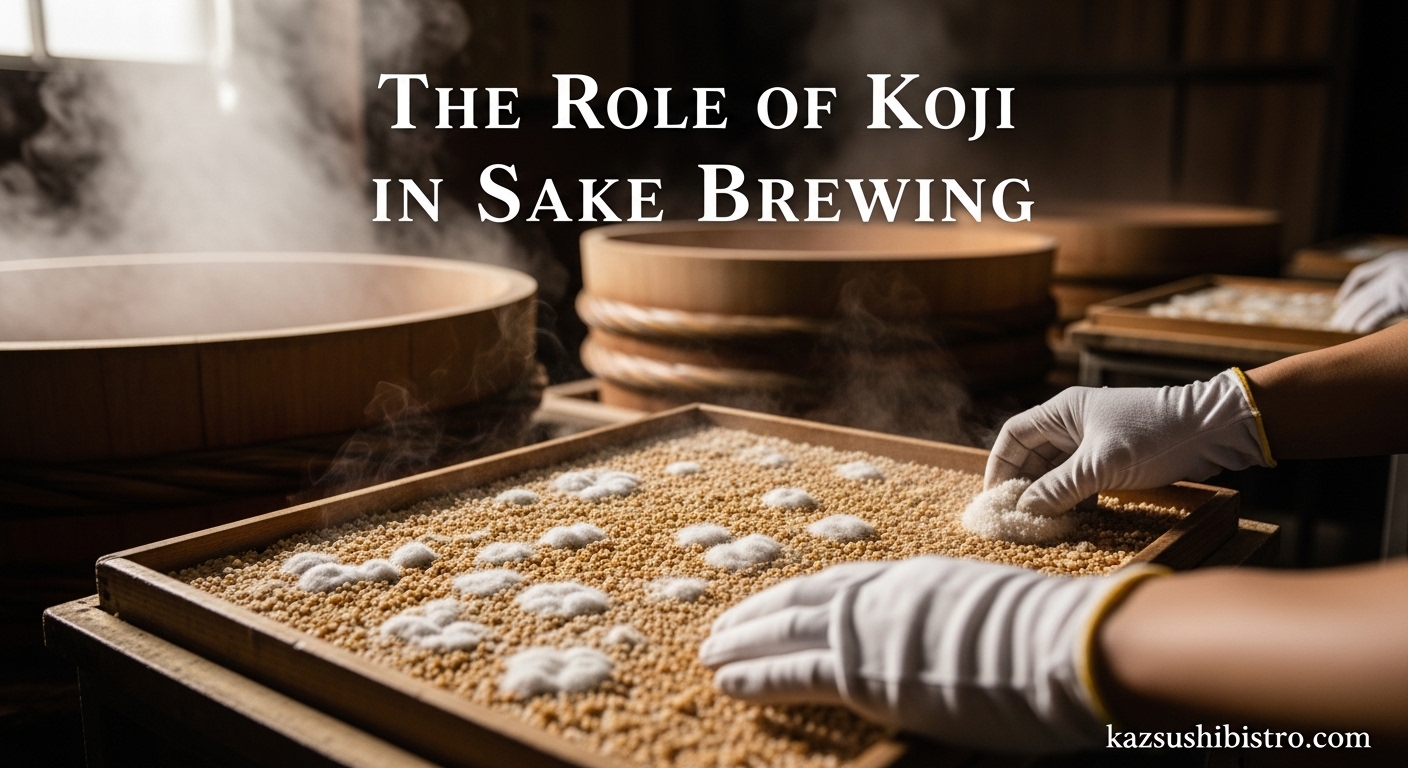
Koji refers to steamed rice that has been inoculated with koji-kin, which are the spores of Aspergillus oryzae, a filamentous fungus cultivated in East Asia for centuries. The mold grows across the surface of the rice grains, producing a white, fuzzy coating that looks almost like delicate cotton. This growth is not a sign of spoilage but rather the precise cultivation of an industrial powerhouse.
Aspergillus oryzae has been used in Japanese food production for over a thousand years, appearing not only in sake but also in miso, soy sauce, and mirin. Its long history reflects both its safety for human consumption and its remarkable enzymatic capabilities. When we talk about sake specifically, koji represents the essential transformation agent that converts inert starch molecules into the fermentable sugars that yeast can later consume.
The term “koji” itself derives from the Japanese word for the organism cultivated on grains, and brewers treat it with particular reverence. Professional sake brewers often call the koji room the “heart of the brewery,” recognizing that the quality of koji directly determines the quality of the final sake. Making great sake begins and ends with making exceptional koji.
How Koji Mold Works in Sake Production 2026
Koji’s primary function in sake brewing is enzymatic saccharification, which means breaking down rice starches into simple sugars that yeast can ferment. The mold produces two critical enzyme types that work in concert. Alpha-amylase cleaves the long chains of starch molecules into shorter dextrins, while glucoamylase then converts those dextrins into glucose.
When sake brewers prepare shubo, the yeast starter, they add koji to a mixture of steamed rice and water. The enzymes released by the growing koji immediately begin their work, creating a sweet liquid that feeds the added yeast. This simultaneous enzymatic conversion and fermentation, known as parallel fermentation, is what distinguishes sake from other alcoholic beverages like beer, where malting and fermentation occur separately.
Compared to beer malting, koji accomplishes the same fundamental goal of starch-to-sugar conversion but through a fundamentally different mechanism. In malting, barley grains are sprouted and dried to develop naturally occurring enzymes. In sake brewing, the Aspergillus oryzae mold is deliberately cultivated on rice to produce a concentrated, controlled enzymatic environment. This allows sake brewers to achieve a more complete saccharification than is typically possible in beer production.
Beyond starch conversion, koji produces additional enzymes that shape sake’s flavor profile. Proteases break down rice proteins into amino acids, contributing to umami and body. Lipases release fatty acids that become aromatic compounds. These enzymatic activities create the complex flavor matrix that distinguishes premium sake from simple rice wine.
The Koji-Making Process Step-by-Step
The koji-making process, known as koji-mai in Japanese, unfolds over approximately 48 to 72 hours. Each phase requires careful attention to temperature, humidity, and the physical handling of the rice. Professional breweries often dedicate entire rooms to koji production, controlling the environment with precision.
Step 1: Steaming the Rice (Jokyo)
The process begins with premium sake-grade rice that has been polished to remove the outer bran layer. The rice is thoroughly washed and then steamed in large batches until it reaches the perfect consistency. Properly steamed rice should be soft enough for the mold to penetrate but firm enough to maintain its grain structure.
Understeamed rice lacks moisture for mold growth, while oversteamed rice becomes too sticky and can suffocate the developing mold. Getting this balance right is fundamental to successful koji production.
Step 2: Inoculation and Mixing (Hikikomi)
After the steamed rice cools to the appropriate temperature, typically around 35 degrees Celsius, brewers sprinkle koji-kin spores across the surface. The mixture is then thoroughly mixed to distribute the spores evenly. This inoculation step requires clean equipment and careful technique, as any competing microorganisms could disrupt koji development.
Some breweries use traditional wooden boxes for this step, while others employ stainless steel containers. Both approaches aim to create the ideal environment for spore germination.
Step 3: Mounding and Rest (Mori)
The inoculated rice is gathered into mounds called korikuchi, which help retain heat and allow the mold to begin growing. The mounds are covered and left to rest, during which time the spores germinate and the mycelium begins spreading across the rice grains. Temperature control during this phase is critical, as the growing mold generates its own heat.
Brewers monitor closely and may adjust the mound size or ventilation to maintain optimal conditions. This hands-on attention is what separates good koji from exceptional koji.
Step 4: Mixing and Aeration (Kirikaeshi)
After the initial growth phase, brewers carefully turn and mix the rice to distribute heat evenly and provide fresh oxygen to the developing mold. This mixing step also prevents the rice from compacting too tightly, which could create anaerobic zones. The number and timing of mixing sessions varies by brewery and style.
More frequent mixing generally produces a more uniformly developed koji. The timing and technique become intuitive with experience.
Step 5: Completion (Dekoji)
The process concludes when the koji has fully colonized the rice grains and reached the desired enzyme activity. The rice should display a characteristic white, fluffy appearance with a fresh, sweet aroma reminiscent of chestnuts or fresh bread. At this point, the koji is either used immediately or carefully dried for storage.
Timing this moment correctly requires experience, as both premature and delayed harvesting can significantly impact the final sake quality. Expert brewers can assess readiness through touch and aroma alone.
Types of Koji and Their Uses
Sake brewers primarily work with two varieties of koji, distinguished by the strain of Aspergillus oryzae used and the conditions under which it is cultivated. Yellow koji is the traditional variety used in sake, miso, and soy sauce production. It produces a yellowish-green tint on the rice due to the conidia, or spore-bearing structures, that form as the mold matures.
Yellow koji tends to produce more proteolytic enzymes, which contribute more heavily to umami development. White koji, a more modern development, produces less pigmentation and is often associated with a cleaner, more delicate flavor profile.
Some breweries use white koji for specific sake styles where they want to emphasize fruity aromatics over deep umami. The choice between yellow and white koji depends on the desired final flavor of the sake and the brewery’s stylistic preferences. A third variety, called black koji, appears in certain regional sake styles and contributes unique flavor compounds.
However, black koji remains relatively uncommon in mainstream sake production. The vast majority of sake brewers stick with yellow koji, believing it provides the best balance of enzymatic activity and flavor development for their purposes.
Temperature and Environment Control
Managing the koji-making environment represents one of the greatest challenges for both professional brewers and home enthusiasts. The optimal temperature range for sake koji development lies between 30 and 35 degrees Celsius. Temperatures below 25 degrees slow mold growth significantly, while temperatures above 40 degrees begin to kill the developing mold.
Forum discussions among home brewers consistently cite temperature control as the most difficult aspect of koji production. Humidity plays an equally critical role, with relative humidity levels around 80 percent being ideal for koji development.
Too dry, and the mold struggles to grow and may produce excessive spores prematurely. Too humid, and the rice can become too wet, promoting bacterial contamination instead of mold growth. Professional breweries install specialized HVAC systems in their koji rooms to maintain these conditions precisely.
Common problems arise when temperature or humidity deviates from optimal ranges. If the environment runs too cool, the koji may develop slowly and produce insufficient enzyme activity, resulting in a sluggish fermentation. If too warm, the mold can overheat, producing a burnt or bitter character in the final sake.
Visual cues like uneven whitening, dark spots, or unpleasant odors indicate environmental stress during development. Troubleshooting these issues requires careful observation and adjustment. Brewers may increase mixing frequency to release excess heat, adjust ventilation to control humidity, or modify the thickness of the rice mounds to manage temperature.
Experienced brewers develop an intuitive sense for these adjustments through years of practice, often relying on hand feel as much as thermometers to assess the koji’s condition. This expertise cannot be rushed.
How Koji Affects Sake Flavor
The enzymes produced by koji fundamentally shape every aspect of sake’s flavor profile, from initial sweetness to long-lasting umami finish. The glucose produced during saccharification provides the sugar that yeast converts to alcohol, but it also contributes direct sweetness to the finished beverage. The balance between residual sweetness and alcohol creates sake’s characteristic smooth, clean taste.
Proteolytic enzymes from koji break down rice proteins into amino acids, which serve multiple functions in sake development. These amino acids feed the yeast during fermentation, influencing which aromatic compounds the yeast produces. They also contribute directly to umami, giving premium sake that savory, satisfying quality that pairs so well with sushi and Japanese cuisine.
Different koji levels produce dramatically different amino acid profiles. The aromatic compounds generated during koji production also set the stage for sake’s distinctive bouquet. During mold growth, various aldehydes and alcohols develop that persist into the final beverage.
In ginjo-style sake, brewers often emphasize these aromatic characteristics by using cooler fermentation temperatures and specially selected yeast strains. This results in fruity, floral notes that have made Japanese sake popular worldwide. Home brewers on forums often report that they can taste the difference between sake made with fresh koji versus older, less active koji.
The enzymatic activity directly correlates with flavor development potential. This is why professional breweries invest so heavily in their koji production facilities and why sake quality varies so dramatically between producers despite using similar base ingredients.
FAQs
What is koji in sake brewing?
Koji is a type of mold (specifically Aspergillus oryzae) that is cultivated on steamed rice. It produces essential enzymes that convert rice starches into fermentable sugars, enabling sake fermentation to occur.
How does koji mold work in sake production?
Koji produces alpha-amylase and glucoamylase enzymes that break down rice starch molecules into glucose and other sugars. This saccharification process creates the fermentable sugars that sake yeast converts to alcohol through parallel fermentation.
What enzymes does koji produce for sake fermentation?
Koji primarily produces alpha-amylase, which breaks long starch chains into shorter dextrins, and glucoamylase, which converts those segments into glucose. It also produces proteases that develop umami flavors and lipases that create aromatic compounds.
How long does koji-making take in sake brewing?
The koji-making process typically takes 48 to 72 hours from inoculation to completion. During this time, the koji mold grows through distinct phases including initial germination, middle-stage mycelium growth, and final maturation with spore production.
The Role of Koji in Sake Brewing: A Summary
Understanding koji transforms sake appreciation from simple drinking into a deeper connection with Japanese fermentation tradition. The mold’s enzymatic activity creates the foundation for sake’s existence, converting raw rice starches into the sugars that become alcohol. Every aroma, every flavor note, every textural element traces back to the quality of koji and the skill of its maker.
The next time you raise a cup of sake, take a moment to consider the 48 to 72 hours of careful cultivation that made it possible. From the steaming of the rice through the meticulous inoculation, the patient monitoring, and the precise harvesting, koji represents countless generations of refinement in Japanese fermentation technology. It is both an ingredient and a process, a living organism and a cultural heritage.
Whether you are a home brewer experimenting with your own sake production or simply a curious enthusiast, understanding koji opens new dimensions of appreciation. The invisible engine driving sake’s complexity deserves recognition, and now you have the knowledge to recognize it. The role of koji in sake brewing is not merely important, it is absolutely fundamental, without which sake itself could not exist.