
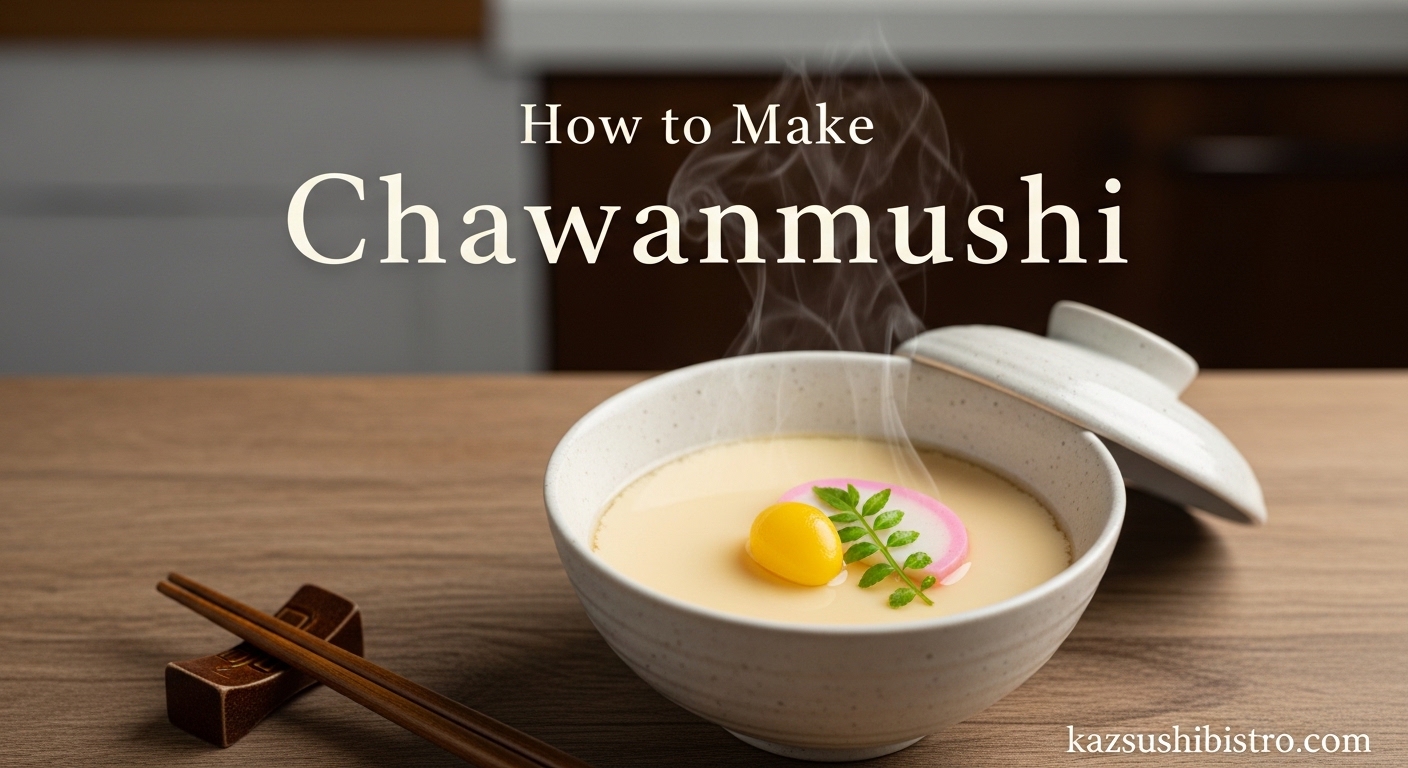
Learning how to make chawanmushi at home transformed my weeknight dinners into something that feels like a special occasion. This silky Japanese steamed egg custard looks elegant and tastes refined, yet it requires just a handful of ingredients and about 35 minutes from start to finish.
I spent months perfecting this chawanmushi recipe after struggling with watery custards and porous textures. The technique I share here produces consistently smooth results every single time. You do not need special equipment or hard-to-find ingredients to achieve restaurant-quality chawanmushi in your own kitchen.
By the end of this guide, you will master the egg to dashi ratio that creates that signature silky smooth texture. You will know exactly how long to cook chawanmushi and how to tell when it is perfectly done. Let us dive into the art of making this classic Japanese dish.
Table of Contents
What is Chawanmushi?
Chawanmushi (茶碗蒸し) translates literally to “tea cup steamed” in Japanese. It is a savory egg custard made by mixing eggs with dashi stock, soy sauce, and mirin, then steaming the mixture gently with various fillings until it sets into a delicate, jiggly texture.
The texture defines chawanmushi. When done correctly, it should be silky smooth, almost velvety, with a subtle wobble when you shake the cup. The surface appears glossy and pore-free. Unlike Western egg custards that are rich and creamy, chawanmushi feels light and ethereal on the tongue.
Traditionally served as part of kaiseki ryori (Japanese multi-course haute cuisine), chawanmushi holds a special place in Japanese culinary culture. It is one of few Japanese dishes eaten with a spoon rather than chopsticks. The small lidded cups trap steam during cooking, creating the perfect environment for the custard to set without collapsing or cracking.
Ingredients for Chawanmushi 2026
The magic of chawanmushi lies in its simplicity. You need just a few core ingredients for the custard base, then you can customize the fillings based on what you have available or what season it is.
Core Custard Ingredients
The foundation of any chawanmushi recipe consists of eggs and dashi stock. The ratio matters more than anything else. I use 3 large eggs weighing approximately 150 grams total, combined with 375 to 450 milliliters of dashi stock.
The egg to dashi ratio of 1:2.5 produces a firmer custard, while 1:3 creates the silky, delicate texture most people prefer. I personally use 1:2.5 for beginners since it is slightly easier to handle, then progress to 1:3 as your confidence grows.
Season your dashi with 1 tablespoon of usukuchi soy sauce (light-colored soy sauce), 1 teaspoon of mirin, and 1/4 teaspoon of salt. These seasonings add depth without overwhelming the delicate egg flavor. If you cannot find usukuchi soy sauce, regular soy sauce works fine, though the color will be slightly darker.
Traditional Fillings
The fillings in chawanmushi create little surprises as you spoon through the custard. Traditional ingredients include:
Chicken tenders: Cut into bite-sized pieces. I prefer chicken tenders over chicken breast because they stay tender and juicy after steaming. Chicken thighs work beautifully too.
Shiitake mushrooms: Fresh shiitake adds an earthy, umami depth. Slice them thinly so they cook through in the short steaming time.
Kamaboko: This Japanese fish cake adds color with its pink and white swirls. Slice it thinly and arrange it on top for visual appeal.
Ginkgo nuts: These add a nutty flavor and beautiful golden color. They are optional but traditional. You can find them at Asian grocery stores, often pre-shelled and vacuum-packed.
Mitsuba: A Japanese herb similar to parsley but with a more delicate flavor. Use it as a garnish right before serving. Regular flat-leaf parsley works as a substitute.
Vegetarian and Simple Substitutions
You can absolutely make chawanmushi without meat or fish. For a vegetarian version, substitute the chicken with extra mushrooms, cubes of firm tofu, or steamed kabocha squash. Replace kamaboko with thinly sliced carrot cut into flower shapes.
For the dashi, use kombu (kelp) dashi instead of bonito-based dashi. Kombu dashi provides plenty of umami without any animal products. You can find instant kombu dashi powder at most Asian grocery stores.
If you cannot find specialty ingredients, do not worry. I have made delicious chawanmushi with just eggs, instant dashi powder, soy sauce, mirin, and sliced shiitake mushrooms. The technique matters more than having every traditional ingredient.
Equipment You Actually Need
Here is good news: you do not need special chawanmushi cups to make this dish. While traditional lidded cups are charming, they are not essential.
I regularly use small ramekins, heatproof mugs, or even small heatproof bowls covered with aluminum foil as lids. A stainless steel plate placed over a regular bowl works perfectly as a lid substitute. The key is creating a seal that traps steam while allowing a tiny bit of ventilation.
How to Make Chawanmushi – Step by Step
Now we get to the actual cooking. Follow these steps carefully for your first successful chawanmushi. I have included tips I learned the hard way after multiple failed attempts.
Step 1: Prepare Your Dashi and Seasonings
Start by preparing 450ml of dashi stock. You can make dashi from scratch by simmering kombu and bonito flakes, or use instant dashi powder dissolved in hot water. Both methods produce excellent results.
Let the dashi cool to room temperature. This step is crucial. If you add hot dashi to cold eggs, you risk partially cooking the eggs and creating lumps. I usually prepare the dashi first, then prep my other ingredients while it cools.
Season the cooled dashi with 1 tablespoon usukuchi soy sauce, 1 teaspoon mirin, and 1/4 teaspoon salt. Stir well to dissolve. Taste the mixture, it should be slightly salty since the eggs will mellow the flavor.
Step 2: Beat the Eggs Properly
Crack 3 large eggs into a large bowl. Here is an important technique: use chopsticks to beat the eggs, not a whisk.
A whisk incorporates too much air, which creates bubbles in your finished custard. Bubbles lead to that porous, spongy texture you want to avoid. Chopsticks allow you to blend the yolks and whites gently without whipping in air.
Beat just until the eggs are uniformly yellow with no streaks of white remaining. About 30 seconds of gentle mixing should do it.
Step 3: Combine Eggs and Dashi
Pour your seasoned dashi into the beaten eggs. Use chopsticks to mix gently, again avoiding vigorous whisking. The mixture will be quite liquid, almost like thin soup. This is exactly right.
If you want to be precise, weigh your eggs and multiply by 2.5 or 3 to get your exact dashi amount. For example, if your eggs weigh 160 grams, use 400-480ml of dashi. Precision helps but is not mandatory for delicious results.
Step 4: Strain the Mixture (Critical Step)
Here is the secret to silky smooth chawanmushi: straining. Set a fine mesh sieve over a large measuring cup or bowl with a pouring spout. Pour the egg mixture through the sieve.
The sieve catches foam, egg white strands, and any unmixed bits. These create lumps and bubbles in the finished custard. Do not skip this step. I learned this lesson after making several batches with uneven texture.
If you see bubbles on the surface of the strained liquid, gently tap the bowl on the counter to release them. Some cooks carefully skim the surface with a spoon. Either method works.
Step 5: Prepare Your Fillings and Cups
Cut your chicken tenders into small bite-sized pieces, about 1/2 inch cubes. Slice your shiitake mushrooms thinly. Cut kamaboko into thin slices.
Arrange your heatproof cups or ramekins on your counter. I use four 6-ounce ramekins for this amount of custard. Divide the chicken, mushrooms, and any other fillings evenly among the cups.
If using chicken, some cooks like to par-cook it briefly in boiling water or microwave it for 30 seconds first. This ensures it cooks through completely. I find that small, thin pieces cook fine during the steaming, but par-cooking gives extra insurance.
Step 6: Fill the Cups
Pour the strained egg mixture over the fillings in each cup. Fill to about 80% full, leaving some space at the top. The custard will expand slightly as it cooks.
Cover each cup with a lid, aluminum foil, or a heatproof plate. If using foil, crimp it around the edges but leave a tiny gap for steam to escape. Traditional chawanmushi cups have small vents in the lid for this purpose.
Step 7: Steam the Custard – Three Methods
Now comes the cooking. You have three options depending on your kitchen equipment. All methods work equally well when done correctly.
Method A: Steaming in a Pot (Most Common)
Fill a pot with about 1 inch of water and bring it to a boil over medium heat. Place a folded kitchen towel at the bottom of the pot, this prevents the cups from rattling and cracking. Arrange your covered cups on the towel.
Reduce heat to low so the water simmers gently, not boils vigorously. Cover the pot with a lid, but leave it slightly ajar to prevent pressure buildup. A chopstick placed between the lid and pot rim works perfectly.
Steam for 18 to 20 minutes. Check for doneness at 18 minutes. The custard should be set around the edges but still have a slight jiggle in the center when you gently shake the cup.
Method B: Using a Steamer Basket
If you have a steamer basket or bamboo steamer, bring water to a boil in the pot below. Place your cups in the steamer basket, then set it over the pot. Cover with the steamer lid, again keeping it slightly ajar.
Steam for 15 to 18 minutes. Steamer baskets often cook slightly faster because steam circulates more freely. Start checking at 15 minutes.
Method C: Oven Steaming
Preheat your oven to 300°F (150°C). Place your filled cups in a deep baking dish. Pour hot water into the baking dish until it reaches halfway up the sides of the cups. This water bath creates steam in the enclosed oven.
Cover the entire baking dish tightly with aluminum foil. Bake for 25 to 30 minutes. This method takes longer but produces very even results with less chance of overcooking.
Step 8: Test for Doneness
Knowing when chawanmushi is done takes practice. Here are three reliable tests:
Insert a bamboo skewer or toothpick into the center of the custard. If clear liquid comes out with the skewer, it is done. If cloudy, eggy liquid comes out, it needs more time.
Gently tilt the cup. The custard should be set throughout without liquid pooling or running. The center can have a slight jiggle, like panna cotta, but should not be liquid.
Look at the surface. It should appear smooth, slightly glossy, and spring back gently when touched with a finger. Pitted or sunken surfaces indicate overcooking.
Remove the cups from heat immediately when done to prevent overcooking. Let them rest for 2 minutes before uncovering.
Cooking Tips for Silky Smooth Chawanmushi
After making chawanmushi dozens of times, I have identified the specific techniques that make the difference between good and exceptional results. These tips address the most common problems people face.
Control Your Heat Precisely
The number one cause of porous, bubbly chawanmushi (called “su” in Japanese) is excessive heat. You want your steaming water at 176-194°F (80-90°C), barely simmering with occasional small bubbles.
Boiling water creates violent steam that agitates the custard, forming bubbles that set into holes. Keep the heat low and steady. If you see rapid bubbling in your pot, turn the heat down immediately.
I use a kitchen thermometer for the first few minutes until I learn what the correct simmer looks like in my pot. Visual cues include gentle movement in the water and occasional small bubbles rising, not a rolling boil.
Strain, Then Strain Again
I cannot emphasize enough how important straining is. The foam and egg white strands you remove are exactly what create the lumpy, uneven texture that disappoints home cooks.
Use a fine mesh sieve, not a colander with large holes. The mesh should be fine enough that the liquid flows through slowly. If your sieve is too coarse, line it with cheesecloth or a paper towel.
After straining, let the mixture sit for 2 minutes. Any remaining bubbles will rise to the surface where you can skim them off with a spoon.
Room Temperature Ingredients Matter
Using room temperature eggs and dashi helps the custard cook evenly. Cold eggs straight from the refrigerator can cause the outer edges to set before the center cooks through.
Take your eggs out 30 minutes before cooking, or place them in warm water for 5 minutes to take the chill off. Cool your dashi to room temperature or slightly warm, never hot or cold.
The Lid Technique
Traditional chawanmushi cups have lids that sit loosely, allowing just enough steam to escape. When using foil or alternative lids, mimic this by not sealing completely airtight.
If using aluminum foil, crimp three sides tightly but leave one corner slightly loose. This tiny vent prevents pressure buildup that can cause the custard to puff up then collapse.
Some cooks place a clean kitchen towel between the pot lid and pot rim. The towel absorbs condensation that would otherwise drip onto the custard surface and create water spots.
Respect the Ratios
The egg to liquid ratio determines texture more than any other factor. Here is a quick reference:
For firm, easy-to-handle chawanmushi (good for beginners): use 1 part egg to 2.5 parts dashi. For 3 eggs (150g), use 375ml dashi.
For silky, delicate, restaurant-style chawanmushi: use 1 part egg to 3 parts dashi. For 3 eggs (150g), use 450ml dashi.
Do not exceed 1:3.5 ratio or the custard will be too loose to set properly. Conversely, ratios below 1:2 create dense, quiche-like custards that lack the characteristic ethereal texture.
Troubleshooting Common Problems
Even experienced cooks occasionally produce chawanmushi with issues. Here is how to diagnose and fix the most common problems based on what I have learned from my own mistakes and forum discussions.
Why is My Chawanmushi Not Smooth?
Porous chawanmushi with visible holes (su) results from one of four causes. First, your heat was too high. Keep the steaming water at a gentle simmer, never a rolling boil.
Second, you may have skipped straining the egg mixture. Always pass the mixture through a fine mesh sieve to remove foam and egg white strands.
Third, you may have whisked too vigorously when beating eggs. Use chopsticks and mix gently to minimize air incorporation.
Fourth, you may have overcooked the custard. Start testing for doneness at 15 minutes and remove from heat as soon as a skewer comes out clean.
Watery or Separated Chawanmushi
If your custard has a watery layer at the bottom or appears separated, it was undercooked. The egg proteins did not fully coagulate and bind with the liquid.
Return the cups to the steamer for 3 to 5 additional minutes. Test again with a skewer. Clear liquid indicates doneness.
Another cause can be too-high egg to liquid ratio. If you used significantly more than 3 parts liquid to 1 part egg, the custard may not set firmly enough.
Rubbery or Tough Texture
Overcooking produces rubbery, tough chawanmushi with a dry surface. The proteins in the egg tighten excessively when exposed to heat for too long.
Set a timer and start checking early. Chawanmushi continues cooking from residual heat after you remove it, so it is better to slightly undercook than overcook.
High heat can also cause toughness. Keep your steaming temperature low and gentle throughout the cooking process.
Variations and Dietary Adaptations
Once you master the basic technique, experiment with different flavors and adaptations. Here are variations I make regularly.
Vegetarian Chawanmushi
Replace chicken with shiitake mushrooms, shimeji mushrooms, or cubes of firm tofu. Use kombu dashi instead of bonito dashi. The result is equally satisfying and umami-rich.
Simple Minimalist Version
For an everyday side dish, I sometimes make chawanmushi with just eggs, instant dashi, soy sauce, and sliced shiitake mushrooms. It takes 10 minutes to prep and feels special without requiring specialty shopping.
Soft Diet Adaptation
I discovered chawanmushi is perfect for people needing soft, easy-to-swallow foods. A family member with neurological difficulties finds it ideal because the texture is smooth and requires no chewing.
For soft diet purposes, use the 1:3 ratio for extra tenderness. Omit any ingredients that require chewing, such as ginkgo nuts or chewy mushroom stems. Stick to soft chicken, silken tofu, or finely chopped vegetables.
Frequently Asked Questions
How long do you cook chawanmushi?
Chawanmushi typically cooks for 15 to 20 minutes depending on your method and cup size. Pot steaming takes 18-20 minutes. Steamer baskets cook faster at 15-18 minutes. Oven steaming requires 25-30 minutes. Smaller cups cook faster than larger ones. Test for doneness at the shorter end of the range by inserting a skewer into the center.
How to tell if chawanmushi is done?
Insert a bamboo skewer or toothpick into the center of the custard. If clear liquid comes out, it is done. If cloudy liquid appears, continue cooking. Alternatively, gently tilt the cup. The custard should be set throughout with no liquid pooling. The center can have a slight jiggle like panna cotta, but should not be watery.
What is the ratio of eggs to liquid in chawanmushi?
The ideal egg to dashi ratio is 1:2.5 to 1:3. For every 1 part egg by weight, use 2.5 to 3 parts dashi stock. For example, 150 grams of eggs pairs with 375-450ml of dashi. A 1:2.5 ratio produces firmer custard suitable for beginners. A 1:3 ratio creates the silky, delicate texture preferred in restaurants. Do not exceed 1:3.5 or the custard may not set properly.
Why is my chawanmushi not smooth?
Porous, bubbly chawanmushi (called su) results from high heat, skipped straining, or over-mixing. Keep steaming water at 176-194°F (80-90°C), never boiling. Always strain the egg mixture through a fine mesh sieve to remove foam. Beat eggs gently with chopsticks rather than a whisk to minimize air bubbles. Start testing for doneness at 15 minutes to avoid overcooking.
Can you reheat chawanmushi?
Yes, you can reheat chawanmushi, though it is best enjoyed fresh. To reheat, place the cup in a steamer or pot with simmering water for 5 to 7 minutes until warmed through. Microwave reheating works in 30-second intervals at 50% power, though the texture may become slightly rubbery. Refrigerated chawanmushi keeps for 2 days. Do not freeze as the texture breaks down.
Conclusion
Learning how to make chawanmushi at home opens up a world of elegant Japanese cooking that is far more accessible than it appears. The keys to success are simple: use the correct egg to dashi ratio, strain your mixture, and steam gently over low heat.
I encourage you to try this chawanmushi recipe this week. Start with basic ingredients you already have, focus on mastering the technique, and soon you will be creating silky, restaurant-quality Japanese steamed egg custard that impresses every time.