
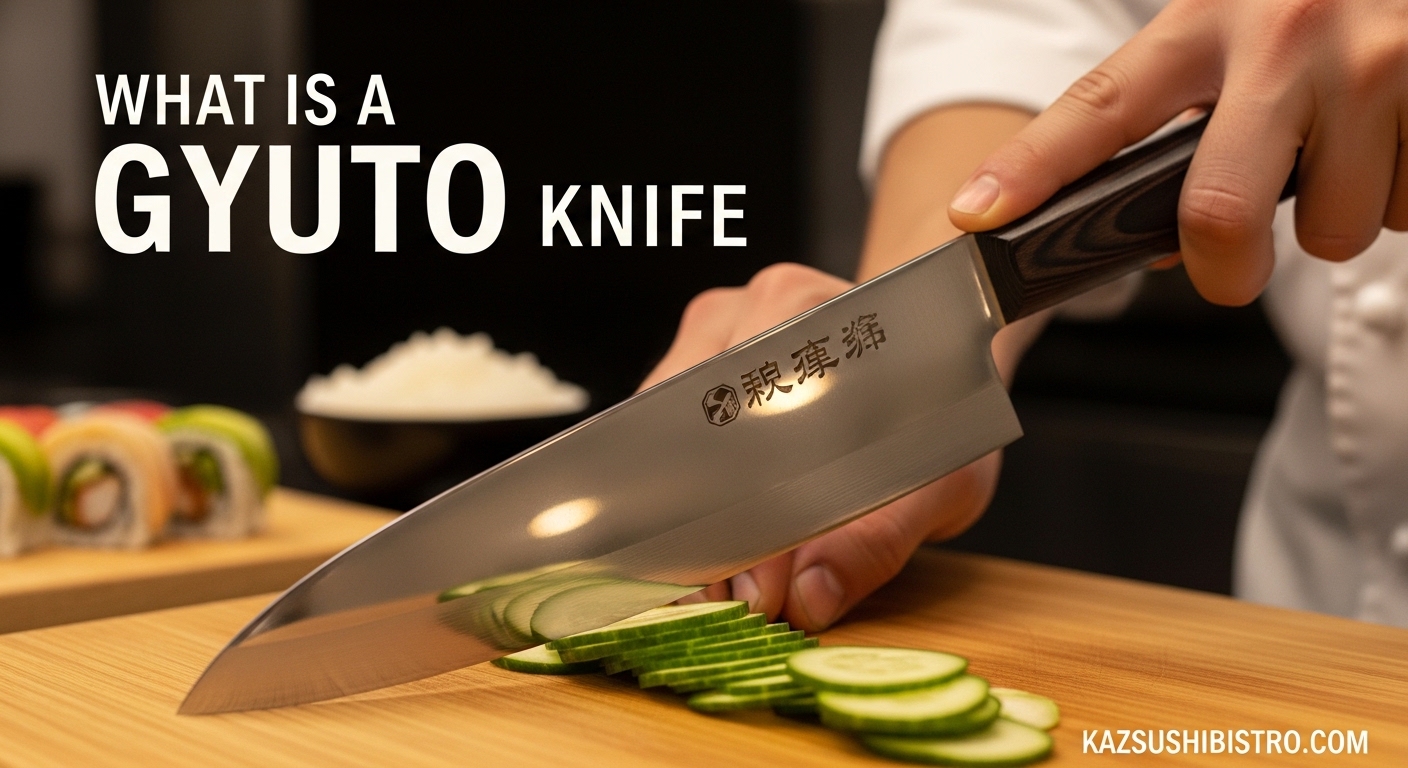
A Gyuto knife is the Japanese equivalent of a Western chef’s knife, distinguished by its thinner, lighter blade made from harder steel. The name translates to “cow sword” or “beef knife” in Japanese (牛刀), reflecting its original purpose for cutting beef. These versatile tools hold a sharper edge longer than traditional European chef’s knives.
I’ve spent years working in professional kitchens and testing Japanese cutlery, and the Gyuto remains my go-to recommendation for home cooks ready to upgrade from standard Western knives. It represents the perfect balance of Japanese craftsmanship adapted for the techniques most of us use daily.
Table of Contents
What Is a Gyuto Knife 2026
The Gyuto emerged during Japan’s Meiji era (1868-1912) when Western culinary influences began transforming Japanese cooking. Chefs needed a knife capable of handling beef, which was becoming more common in the Japanese diet. Traditional Japanese knives like the Deba or Usuba were designed for fish and vegetables, not the heavier demands of meat preparation.
Japanese blacksmiths adapted the Western chef’s knife form but applied their centuries of blade-making expertise. The result was something entirely new: a knife with the versatility of a European chef’s knife but the precision, sharpness, and lightweight handling that Japanese steelcraft is famous for.
When someone asks me “what does gyuto mean,” I always share the literal translation first. The characters 牛 (gyu) meaning “cow” or “beef” and 刀 (to) meaning “sword” or “knife” combine to create a name that tells you exactly what this blade was designed to do. It’s a beef knife, a cow sword, and ultimately an all-purpose kitchen workhorse.
The modern Gyuto has evolved beyond its meat-cutting origins. Today it serves as the primary multi-purpose knife in both professional kitchens and home cooking spaces throughout Japan and increasingly worldwide. Its popularity in Western markets has exploded over the past decade as more cooks discover the benefits of Japanese cutlery.
Gyuto vs Santoku: What’s the Difference
The Santoku versus Gyuto debate comes up constantly in cooking forums, and I understand the confusion. Both are Japanese all-purpose knives, but they handle differently and excel at different tasks. Understanding these differences helps you choose the right tool for your cooking style.
A Gyuto features a longer blade with a more pronounced curve along the cutting edge, typically measuring between 210mm and 270mm. The blade profile has a flatter section toward the heel that transitions into a gentle belly curve toward the tip. This shape supports multiple cutting techniques.
The Santoku, by contrast, has a shorter blade (typically 165mm to 180mm) with a much flatter profile and a rounded sheep’s foot tip. The name Santoku means “three virtues” or “three uses,” traditionally referring to its ability to handle meat, fish, and vegetables.
For cooks who primarily use a push-cutting or pull-cutting motion, the Santoku’s flatter profile works beautifully. But if you prefer the rocking motion common in Western cooking, the Gyuto’s curved belly makes that technique possible. I reach for my Gyuto when I need to rock chop herbs or mince garlic.
The Gyuto’s pointed tip also provides more precision for detailed work. You can use the tip to remove silverskin from meat or make precise cuts around joints when breaking down poultry. The Santoku’s rounded tip limits this kind of articulate cutting.
Most professional chefs I know own both knives, but if you’re choosing just one, consider your cooking style. Do you rock chop frequently? The Gyuto wins. Do you work in tight spaces with smaller cutting boards? The shorter Santoku might suit you better. Do you need precision tip work? Go with the Gyuto.
Key Features of a Gyuto Knife
Several distinct characteristics set a Gyuto apart from other chef’s knives. Understanding these features helps explain why this knife performs differently than the German or French knives many cooks grew up using.
Thinner Blade Profile
Gyuto knives typically feature thinner blade stock than Western equivalents, usually measuring between 2mm and 3mm at the spine near the handle. This thinness, combined with a more acute edge angle (usually 15 degrees per side versus 20 degrees on Western knives), creates less resistance when cutting.
The result is cleaner cuts with less wedging, particularly noticeable when slicing through dense vegetables. Your carrots won’t split, and onions cut cleanly without the crushing that duller, thicker blades cause.
Harder Steel Construction
Japanese Gyuto knives use steel hardened to 60-66 HRC on the Rockwell hardness scale. Compare that to most Western chef’s knives at 54-58 HRC. This harder steel can take a sharper, more acute edge and maintain that edge significantly longer.
The trade-off is that harder steel is more brittle. This is why you should never use a Gyuto on frozen foods, bones, or hard squash. The blade can chip under impact or twisting force. I’ve seen a beautiful carbon steel Gyuto lose its tip to a butternut squash. Respect the steel’s limitations.
Double Bevel Edge
Unlike traditional Japanese knives such as the Yanagiba or Deba, which feature single bevel edges, the Gyuto is a double bevel knife. Both sides of the blade are ground symmetrically, making it approachable for right-handed and left-handed users alike.
This double bevel design also makes sharpening more familiar to anyone experienced with Western knives. You sharpen both sides equally, typically at a 15-degree angle per side, creating a total edge angle of 30 degrees.
Handle Options: Wa vs Yo
Gyuto knives come with two main handle styles. The wa-handle is the traditional Japanese style, typically made from wood (magnolia, walnut, or rosewood) and featuring an octagonal, D-shaped, or oval cross-section. These handles are lighter and often preferred by users who grip the blade pinch-style.
The yo-handle follows Western conventions: heavier, riveted handles made from composite materials, pakkawood, or stabilized wood. These offer a familiar grip for cooks transitioning from European knives and provide better balance for those who prefer a handle grip.
Blade Length Considerations
The most common Gyuto lengths are 210mm (8.3 inches), 240mm (9.4 inches), and 270mm (10.6 inches). For home cooks, I typically recommend 210mm or 240mm. The 210mm offers maneuverability on smaller cutting boards, while 240mm provides more cutting edge for larger tasks.
The 270mm length is popular with professional chefs who work with large quantities and need the extra blade real estate. For most home kitchens, this length can feel unwieldy and may exceed your cutting board space.
What Is a Gyuto Knife Used For
The Gyuto serves as a true all-purpose kitchen knife capable of handling approximately 90% of your cutting tasks. Its versatility explains why many cooks choose it as their primary blade, supplementing with specialized knives only for specific tasks.
Vegetable Preparation
The Gyuto excels at all vegetable work. The thin blade slices tomatoes without crushing them. It dices onions with clean, precise cuts. The sharp edge glides through carrots without the cracking or splitting common with duller knives. For fine vegetable work like julienne cuts or brunoise dicing, the Gyuto’s precision shines.
I use mine for everything from rough-chopping kale to creating paper-thin cucumber slices. The combination of a thin blade and sharp edge means you use less force, reducing hand fatigue during extended prep sessions.
Protein Work
True to its name as a “cow sword,” the Gyuto handles meat beautifully. It slices through cooked steaks with clean, even cuts. The pointed tip helps remove silverskin from tenderloin or trim fat from pork. When breaking down whole chickens, the tip maneuvers around joints precisely.
For fish butchery, the Gyuto can fillet smaller specimens, though dedicated fish knives like the Yanagiba or Deba work better for larger fish. I use my Gyuto to portion fish fillets and remove skin from salmon.
What NOT to Cut
Despite its versatility, the Gyuto has limitations. Never use it on frozen foods. The hard, brittle steel will chip when forced through ice crystals. Don’t cut through bones, cartilage, or hard squash rinds. These tasks belong to heavier, softer knives designed for impact.
Whole coconuts, pineapple cores, and frozen meat all pose risks to your blade. I keep a sturdy Western chef’s knife or a cleaver handy for these abuse tasks, preserving my Gyuto for the precision work it does best.
How to Use a Gyuto Knife: Cutting Techniques
Learning proper technique helps you get the most from your Gyuto. The knife’s design supports several cutting methods, each suited to different tasks.
Push Cutting
Push cutting involves moving the knife forward and down through the food in a single motion. This technique works well for vegetables and boneless proteins. The Gyuto’s thin profile and sharp edge make push cutting effortless.
Hold the knife with a pinch grip (thumb and forefinger on the blade, remaining fingers on the handle). Place the tip on the cutting board, lift the heel, and push forward through the food. This technique gives you excellent control and precise cuts.
Pull Cutting
Pull cutting draws the knife backward through food. Some cooks naturally prefer this motion. The Gyuto’s sharp edge bites into food with minimal pressure, making pull cutting smooth and efficient.
This technique works particularly well for slicing proteins. Draw the blade through that roast beef in one smooth pull rather than sawing back and forth. The result is cleaner slices with less damage to the meat’s texture.
Rock Chopping
Can you rock chop with a Gyuto? Absolutely. While the Gyuto’s curve is gentler than a Western chef’s knife, the belly still supports rocking motions. The curved section near the tip allows you to rock the blade while the heel stays anchored.
This makes the Gyuto uniquely versatile among Japanese knives. You get the benefits of Japanese steel and craftsmanship without sacrificing the rocking technique many Western cooks learned first. I rock chop herbs, mince garlic, and dice shallots with my Gyuto regularly.
The key is using the curved portion of the blade, not the flat heel section. Place the tip on the board and rock the blade through the food using a motion from your wrist, not your shoulder. Keep your fingers tucked and use your knuckles to guide the blade.
Slicing and Dicing
For slicing tasks, use the full length of the blade in a smooth, continuous motion. Let the knife do the work. The weight of a 240mm Gyuto is sufficient to power through most slicing without additional downward pressure.
When dicing, the flat heel section provides stability for the vertical cuts. Use the tip for the horizontal slicing that creates uniform dice. The Gyuto’s profile supports both motions efficiently.
Blade Materials and Steel Types
Choosing the right steel type for your Gyuto affects performance, maintenance requirements, and longevity. Understanding the options helps you match the knife to your needs and maintenance willingness.
Carbon Steel
Traditional Japanese carbon steels like Aogami (Blue Steel) and Shirogami (White Steel) offer exceptional sharpness and edge retention. These steels can achieve incredibly acute edges that slice through food with almost no resistance.
The downside is maintenance. Carbon steel reacts with acidic foods and moisture, developing a patina or potentially rusting if neglected. You must clean and dry your knife immediately after use. Some cooks enjoy this relationship with their tools; others find it burdensome.
Aogami Blue Steel contains added tungsten and chromium for improved toughness and slightly better corrosion resistance than pure carbon. Shirogami White Steel is essentially pure carbon with minimal additives, offering maximum sharpness potential but requiring the most care.
Stainless Steel
Modern stainless options like VG-10, SG2 (Super Gold 2), and Ginsan offer excellent performance with minimal maintenance. These steels resist corrosion and staining, making them ideal for busy home kitchens where immediate cleaning isn’t always practical.
VG-10, popular in many mid-range Japanese knives, offers good edge retention and reasonable toughness. SG2, a powdered metallurgy steel, achieves higher hardness (63-65 HRC) with excellent edge stability. These steels won’t achieve the absolute peak sharpness of carbon, but they require far less attention.
Stainless-Clad Carbon
A popular compromise combines carbon steel cores with stainless steel outer layers. You get the sharpness of carbon where it matters (the edge) with the easier maintenance of stainless on the blade faces. This construction, called “san-mai” or three-layer, represents an excellent choice for cooks wanting carbon performance without full carbon maintenance.
Many workhorse Gyuto knives use this construction. The carbon core creates the edge while the stainless cladding protects the blade. You still need to care for the exposed carbon at the edge, but the maintenance burden is reduced.
Understanding HRC Hardness
The Rockwell Hardness Scale (HRC) measures steel hardness. Higher numbers mean harder steel that can take sharper edges but is more brittle. Most Gyuto knives fall between 60 and 66 HRC.
For beginners, I recommend staying in the 60-62 HRC range. These knives are more forgiving of rough handling and easier to sharpen. As you develop better knife skills and maintenance habits, moving to 63-66 HRC steels rewards you with superior edge retention and sharpness.
Care and Maintenance Tips
Proper care extends your Gyuto’s lifespan and maintains its performance. These practices address the most common concerns new Japanese knife owners express.
Cleaning and Drying
Always hand wash your Gyuto with mild soap and warm water immediately after use. Never leave it in the sink or put it in the dishwasher. The harsh chemicals, high heat, and banging around will damage the blade and handle.
Drying is crucial, especially for carbon steel. Use a clean towel to remove all moisture immediately after washing. Some carbon steel owners apply a thin layer of food-safe oil (camellia oil is traditional) to protect the blade during storage.
Storage Solutions
Store your Gyuto in a way that protects the edge. Magnetic knife strips work well if the magnet is strong enough to hold the knife securely. Knife blocks are fine if the slots fit properly. Blade guards (called saya) offer excellent protection for drawer storage.
Never store a Gyuto loose in a drawer where it bangs against other utensils. The hard steel edge chips easily on contact with other metal or ceramic objects.
Cutting Board Selection
Your cutting board matters significantly. End-grain wood boards are ideal, being gentle on edges and self-healing. Edge-grain wood and quality rubber boards also work well. Avoid glass, marble, bamboo, or hard plastic boards that dull edges quickly.
I recommend investing in a quality end-grain maple or walnut board at least 16 inches wide. This gives you adequate workspace while protecting your knife investment. A good board paired with proper technique means less frequent sharpening.
Basic Sharpening Guidance
Even the best steel dulls with use. Learn to use whetstones for sharpening. Start with a 1000-grit stone for edge maintenance and a 3000-5000 grit stone for polishing. The investment in stones and skill pays dividends in knife performance.
Between full sharpenings, a ceramic honing rod or leather strop helps maintain the edge. These tools realign the microscopic teeth on the blade edge without removing significant steel. I strop my Gyuto every few uses and touch up on stones monthly.
Frequently Asked Questions
What’s the difference between santoku and Gyuto?
The main differences are blade length and profile. A Gyuto has a longer blade (210-270mm) with a gentle curve supporting rock chopping, while a Santoku has a shorter, flatter blade (165-180mm) optimized for push cutting. The Gyuto’s pointed tip provides more precision for detailed work compared to the Santoku’s rounded sheep’s foot tip. Choose a Gyuto for versatility and rocking motions; choose a Santoku for compact spaces and straight chopping.
What was Anthony Bourdain’s favorite knife?
Anthony Bourdain famously recommended the Global G-2 8-inch chef’s knife as his favorite all-purpose kitchen blade. While not a traditional Japanese Gyuto, the Global G-2 incorporates Japanese design elements including a thin, hard blade and lightweight construction. Bourdain appreciated its versatility, ease of maintenance, and reasonable price point for professional and home cooks alike.
What is the difference between a chef’s knife and a Gyuto?
While both serve as all-purpose kitchen knives, several key differences exist. Gyuto knives feature thinner blade profiles (2-3mm spine thickness vs 3-4mm for Western knives), harder steel (60-66 HRC vs 54-58 HRC), and more acute edge angles (15 degrees per side vs 20 degrees). This makes Gyuto knives sharper with better edge retention but more brittle and requiring gentler handling. Western chef’s knives are typically more robust and forgiving for heavy tasks.
Can you rock chop with a Gyuto?
Yes, you can rock chop with a Gyuto, though the motion differs slightly from Western chef’s knives. The Gyuto’s blade has a gentler curve with a flatter heel section and curved belly toward the tip. Focus the rocking motion on the curved portion near the tip while keeping the heel anchored. This technique works beautifully for mincing herbs, garlic, and shallots. The Gyuto uniquely bridges Japanese precision with Western rocking technique.
Conclusion
The Gyuto knife represents the perfect marriage of Japanese blade-making tradition and versatile kitchen utility. As a Japanese chef’s knife with Western-inspired versatility, it handles 90% of kitchen tasks with precision and grace.
Whether you’re a home cook upgrading from dull supermarket knives or a professional seeking your next workhorse blade, the Gyuto offers something special. The combination of a thinner profile, harder steel, and balanced design creates a cutting experience that makes cooking more enjoyable.
If you’re considering your first Japanese knife in 2026, start with a 210mm or 240mm Gyuto in stainless or stainless-clad carbon steel. Learn proper care, invest in a quality cutting board, and practice the techniques described here. Your Gyuto will reward you with years of exceptional performance.