
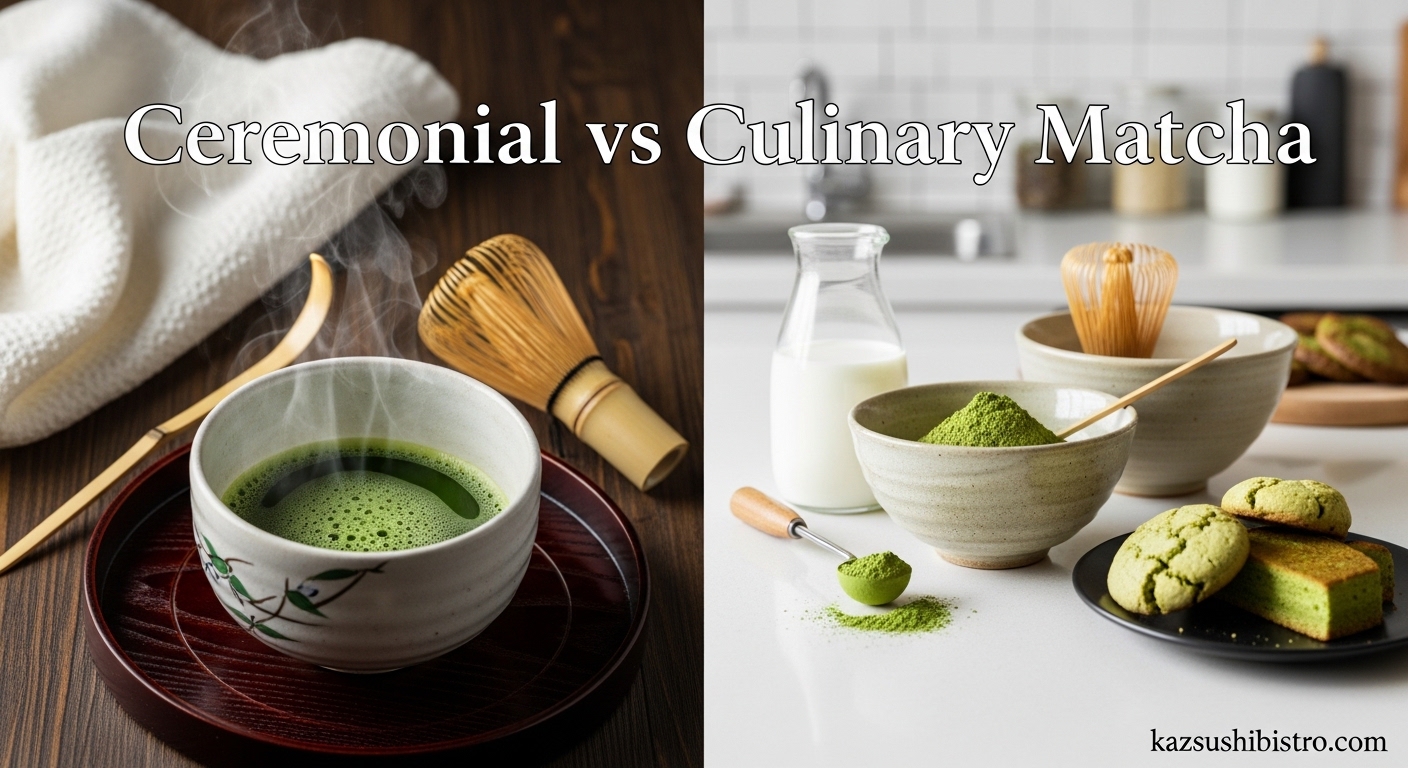
Matcha has exploded in popularity over the past decade, appearing everywhere from specialty tea shops to mainstream coffee chains. But if you’ve stood in the tea aisle staring at cans labeled “ceremonial grade” and “culinary grade,” you’re not alone in feeling confused.
The difference between ceremonial vs culinary matcha comes down to harvest timing, leaf quality, and intended use. Ceremonial grade uses the youngest first-harvest leaves for a smooth, umami-rich flavor meant to be enjoyed straight, while culinary grade comes from later harvests with a stronger, more bitter taste designed for mixing into lattes, baking, and cooking.
I’ve spent years researching Japanese tea traditions and working with tea farmers to understand what really separates these grades. This guide will cut through the marketing noise and help you choose the right matcha for your needs.
Table of Contents
What is Matcha?
Matcha is a powdered green tea made from shade-grown tea leaves. The tea plant, Camellia sinensis, is the same species used for all true teas, but matcha undergoes unique processing that sets it apart.
About three weeks before harvest, farmers cover the tea plants with shade cloth or bamboo mats. This shading process triggers the leaves to produce more chlorophyll and amino acids, particularly L-theanine, which gives matcha its distinctive umami flavor and calm energy.
After harvesting, the leaves are steamed to stop oxidation, dried, and then stone-ground into a fine powder called tencha. This stone-ground powder is what we know as matcha. Unlike regular tea where you steep leaves and discard them, with matcha you’re consuming the entire leaf.
Ceremonial vs Culinary Matcha: The Fundamental Difference 2026
The terms “ceremonial” and “culinary” are actually Western marketing classifications rather than official Japanese grades. In Japan, matcha quality is evaluated on a spectrum based on multiple factors including harvest timing, color, aroma, and taste.
That said, these terms have become useful shorthand for understanding matcha quality in international markets. Let me break down what each grade really means.
What is Ceremonial Grade Matcha?
Ceremonial grade represents the highest quality matcha available. It’s made from the youngest tea leaves and buds harvested during the first flush in early spring. This first harvest, known as shin cha or “new tea,” produces leaves with the highest concentration of amino acids and the most vibrant green color.
The leaves destined for ceremonial grade are carefully selected and processed with meticulous attention to detail. After shading for 20-30 days, only the tenderest leaves are picked. These leaves are then steamed, dried, and stone-ground using traditional granite mills that produce only about 30-40 grams of powder per hour.
Color: Ceremonial grade matcha has a vibrant, electric green color that practically glows. This bright green comes from the high chlorophyll content developed during the shading period. Lower quality matcha will appear dull, olive-green, or even yellowish.
Flavor: When prepared correctly, ceremonial grade offers a complex flavor profile dominated by umami—the same savory taste found in mushrooms and seaweed. You’ll notice subtle sweetness with minimal bitterness. The texture should be smooth and creamy, with a pleasant vegetal character that some describe as fresh grass or spinach.
Texture: High-quality ceremonial matcha feels like talcum powder between your fingers. When whisked with hot water, it creates a smooth, frothy layer on top without clumping. This froth, called ukocha, is essential to the traditional tea ceremony experience.
Regional Origins: The most prestigious ceremonial matcha comes from specific regions in Japan. Uji in Kyoto Prefecture is perhaps the most famous, but Yame in Fukuoka and Nishio in Aichi also produce exceptional ceremonial grade. These regions have ideal climate and soil conditions, plus centuries of tea-growing expertise.
What is Culinary Grade Matcha?
Culinary grade matcha comes from later harvests—the second, third, or even fourth flush of the growing season. These more mature leaves have developed differently. They contain more catechins (which contribute bitterness) and fewer amino acids (which provide sweetness and umami).
Harvest Timing: While ceremonial grade uses those precious first-harvest leaves, culinary grade comes from leaves harvested in summer or early fall. By this time, the tea plants have received more sunlight, producing leaves that are coarser and more bitter.
Flavor Profile: Culinary grade has a stronger, more astringent taste with pronounced bitterness. This intensity is actually an advantage when cooking with matcha, as the flavor needs to stand up to other ingredients like milk, sugar, flour, and chocolate.
Color: You’ll notice culinary grade matcha has a duller, more olive-green color compared to the vibrant emerald of ceremonial grade. This doesn’t indicate poor quality—it simply reflects the different harvest time and leaf maturity.
Particle Size: Culinary grade is often ground slightly coarser than ceremonial grade. This affects how it dissolves in liquid and contributes to baked goods. The coarser texture helps prevent matcha from clumping when mixed with dry ingredients in recipes.
Best Uses: Culinary grade shines in applications where matcha is just one flavor among many. Think matcha lattes, smoothies, baked goods like cookies and cakes, ice cream, and even savory dishes. The robust flavor holds its own against milk, sweeteners, and other strong flavors.
Key Differences Between Ceremonial and Culinary Matcha
Let me break down the main differences side by side so you can see exactly what sets these grades apart:
Harvest Timing: Ceremonial grade uses first-harvest spring leaves, while culinary grade comes from later harvests in summer and fall. The earlier harvest produces more delicate leaves with higher amino acid content.
Leaf Selection: Ceremonial grade uses only the youngest leaves and buds. Culinary grade includes more mature leaves from the same plant.
Flavor Profile: Ceremonial grade offers smooth, umami-rich flavor with subtle sweetness and minimal bitterness. Culinary grade delivers stronger, more astringent taste with pronounced bitterness.
Color: Ceremonial grade displays vibrant, electric green color. Culinary grade appears duller with olive-green tones.
Texture: Ceremonial grade has ultra-fine, talcum-powder consistency. Culinary grade is slightly coarser but still fine enough for most applications.
Price: Ceremonial grade typically costs 2-3 times more than culinary grade due to the limited first-harvest supply and careful processing.
Intended Use: Ceremonial grade is designed for traditional preparation with hot water only. Culinary grade is formulated for mixing with other ingredients.
When to Use Ceremonial Grade Matcha
I recommend ceremonial grade when you want to experience matcha in its purest form. This is the grade to choose for traditional Japanese tea ceremony or simply for enjoying matcha straight with hot water.
If you’re new to matcha and want to understand what high-quality matcha tastes like, start with ceremonial grade. The smooth, complex flavor will help you appreciate what makes this tea so special. Once you’ve tasted good ceremonial matcha, you’ll have a baseline for understanding quality differences.
Ceremonial grade is also worth the investment if you drink matcha daily as a mindfulness practice or for its health benefits. The superior taste makes the experience more enjoyable, and the higher L-theanine content may provide more noticeable calming effects.
Traditional Preparation: Prepare ceremonial grade with water heated to 175°F (80°C)—not boiling. Use about 2 grams (1 teaspoon) of powder and 2-3 ounces of water. Whisk vigorously in a zigzag motion with a bamboo whisk called a chasen until frothy.
When to Use Culinary Grade Matcha
Culinary grade is actually the better choice for most mixed applications. When you’re making a matcha latte with milk and sweetener, the subtle nuances of ceremonial grade get lost anyway. Why pay more when you won’t taste the difference?
For baking, culinary grade is ideal. The stronger flavor stands up to flour, butter, sugar, and chocolate. I’ve tested both grades in matcha cookies, and the culinary version actually produced a more pronounced matcha flavor in the final product.
Smoothies are another perfect use for culinary grade. When blended with fruits, yogurt, protein powder, and other ingredients, the robust matcha flavor remains perceptible. Culinary grade also tends to be more economical, which matters when you’re using larger quantities in recipes.
Practical Applications: Use culinary grade for matcha lattes, frappes, smoothies, baked goods (cookies, cakes, muffins, bread), ice cream, puddings, truffles, and even savory dishes like matcha-seasoned nuts or sauces.
How to Identify Quality Matcha
Regardless of grade, here’s how to assess matcha quality before you buy:
Color: Look for vibrant green. Dull, yellowish, or brownish tones indicate age or lower quality. The color should be consistent without visible stems or veins.
Aroma: Open the container and smell. High-quality matcha has a fresh, grassy aroma with vegetal notes. Avoid matcha that smells musty, dusty, or stale.
Origin: Japanese matcha is generally superior to matcha from other countries. Look for specific regions like Uji, Kyoto, Yame, or Nishio. Avoid matcha that simply says “Asian blend” or doesn’t specify origin.
Packaging: Matcha degrades quickly when exposed to light, air, and moisture. Look for opaque, airtight packaging. Tins with inner seals are ideal. Clear jars that let light in are a red flag.
Price: While not always true, extremely cheap matcha is rarely good quality. If it seems too good to be true, it probably is. However, don’t assume the most expensive option is automatically the best—evaluate other factors first.
Color Test: When mixed with water, high-quality matcha creates a vibrant green suspension that stays green. Lower quality matcha may turn brownish or separate quickly.
The Japanese Perspective on Grading
Here’s something most guides won’t tell you: the terms “ceremonial grade” and “culinary grade” don’t actually exist in traditional Japanese tea classification. These are Western marketing terms created to help consumers understand quality differences.
In Japan, matcha is evaluated on a spectrum based on multiple factors. The highest quality matcha is used for tea ceremonies, but there’s no official “ceremonial grade” designation. Instead, Japanese tea houses evaluate matcha based on color, aroma, taste, origin, and harvest timing.
This means some matcha labeled “ceremonial grade” outside Japan might not meet the standards of actual tea ceremony practitioners in Japan. Conversely, some “culinary grade” matcha might be perfectly acceptable for casual drinking.
Understanding this helps you look beyond labels and evaluate matcha based on actual quality indicators rather than marketing terms. The best approach is to taste for yourself and decide what you enjoy.
Storage and Freshness
Proper storage is crucial for maintaining matcha quality, especially for ceremonial grade. Matcha degrades quickly when exposed to light, air, heat, and moisture.
Storage Tips: Store matcha in an airtight container in the refrigerator or freezer. Let it come to room temperature before opening to prevent condensation. Use within 2-3 months of opening for best flavor.
Freshness Indicators: Check the production date if available. Fresher matcha will have brighter color and stronger aroma. If your matcha has turned dull or brownish, it’s past its prime.
Buying Strategy: Buy smaller quantities more frequently rather than bulk containers. This ensures you’re always using fresh matcha, which is especially important for ceremonial grade where flavor nuances matter.
Health Benefits Comparison
Both ceremonial and culinary grade matcha come from the same plant and offer similar health benefits. The main compounds—catechins like EGCG, L-theanine, and caffeine—are present in both grades.
Antioxidants: Matcha is exceptionally high in antioxidants, particularly EGCG. Some studies suggest culinary grade may actually have slightly higher catechin content due to the more mature leaves, though the difference is minimal.
L-theanine: This amino acid, which promotes calm focus, is more concentrated in ceremonial grade due to the first-harvest leaves. However, both grades contain enough to provide the characteristic matcha energy.
Caffeine: Both grades have similar caffeine content. The difference in how you feel comes from L-theanine balancing the caffeine, which is present in both grades.
The bottom line: both grades offer health benefits. Choose ceremonial for taste experience and culinary for cooking convenience, knowing either choice supports your wellness goals.
Price Expectations
Understanding typical pricing helps you assess value:
Ceremonial Grade: Expect to pay between $25-60 for 30 grams (1 ounce) of quality ceremonial matcha. Premium ceremonial from famous regions like Uji can cost even more. This breaks down to roughly $0.80-2.00 per cup.
Culinary Grade: Quality culinary grade typically costs $10-25 for 30-40 grams. Since you use more in recipes, the per-serving cost is often similar to ceremonial when used in lattes or baked goods.
Value Consideration: Think about cost per use rather than upfront price. A $40 tin of ceremonial matcha that provides 30 servings of daily tea costs about $1.33 per cup—less than many coffee shop drinks.
Common Questions About Matcha Grades
What is better, culinary grade or ceremonial grade matcha?
Neither grade is inherently better—each serves different purposes. Ceremonial grade offers superior flavor for drinking straight, while culinary grade is specifically formulated for cooking and mixing. If you want to experience matcha’s full flavor complexity, choose ceremonial. If you’re making lattes or baking, culinary grade is actually the better choice.
What is the 30/20/10 rule for matcha?
The 30/20/10 rule refers to optimal matcha preparation: 30 grams of matcha powder, 20 seconds of whisking time, and 10 seconds to drink while fresh. This traditional guideline ensures proper froth and optimal flavor. While not mandatory, following these proportions helps beginners achieve consistent results. The key is using enough powder and whisking vigorously to create that signature frothy layer.
Is Starbucks matcha ceremonial grade or culinary grade?
Starbucks uses culinary grade matcha in their beverages. Their matcha blend also contains sugar, which masks the natural flavor profile. Most coffee shops use culinary grade because it’s more economical and the flavor differences become imperceptible when mixed with milk, sweeteners, and syrups. This is actually appropriate—using ceremonial grade in sweetened commercial drinks would be wasteful since its subtle nuances would be lost.
Can you drink culinary grade matcha straight?
You can drink culinary grade matcha straight, but the experience will be quite different from ceremonial grade. Culinary matcha has stronger bitterness and astringency that most people find unpleasant without milk or sweetener. If you want to try it, use less powder than usual and consider adding a touch of honey or preparing it as a latte. For regular straight drinking, ceremonial grade provides a much more enjoyable experience.
Does matcha lower cortisol?
Matcha may help lower cortisol levels due to its unique combination of L-theanine and caffeine. L-theanine promotes relaxation without drowsiness, which can counteract stress hormones. Studies suggest matcha creates a calm, focused state rather than the jitters associated with coffee. While more research is needed, many people report reduced stress and improved mental clarity from regular matcha consumption.
Is ceremonial grade matcha healthier than culinary grade?
Both grades offer similar health benefits because they come from the same plant. Ceremonial grade has slightly more L-theanine due to first-harvest leaves, while culinary grade may have marginally more catechins from mature leaves. The difference is minimal for most people. Choose based on how you plan to use it rather than perceived health advantages. Either way, you’re getting antioxidants, amino acids, and beneficial compounds.
Making Your Choice: Ceremonial vs Culinary Matcha
After comparing ceremonial vs culinary matcha grades, the right choice depends on how you plan to use it:
Choose Ceremonial Grade If: You want to drink matcha straight with hot water, you’re interested in traditional tea ceremony, you appreciate subtle flavor nuances, or you drink matcha daily as a mindfulness practice.
Choose Culinary Grade If: You primarily make matcha lattes, smoothies, or baked goods, you’re on a budget, you’re new to matcha and want to experiment, or you cook with matcha frequently.
Consider Both: Many matcha enthusiasts keep both grades on hand—ceremonial for daily drinking and culinary for recipes. This gives you flexibility without wasting expensive ceremonial grade in applications where its subtleties would be lost.
Conclusion: Ceremonial vs Culinary Matcha Grades
Understanding the difference between ceremonial vs culinary matcha grades helps you make informed choices and get the best value for your needs. Remember that these are Western marketing terms rather than official Japanese classifications, but they provide useful guidance for selecting matcha.
Ceremonial grade delivers the refined, complex taste experience that makes matcha special when enjoyed straight. Culinary grade offers robust flavor that stands up to cooking and mixing at a more accessible price point. Both have their place in a well-stocked kitchen.
Start by considering how you’ll use matcha most often, then choose the appropriate grade. Don’t be afraid to experiment with both to discover what you prefer. After all, the best matcha is the one you enjoy drinking and fits your lifestyle.