
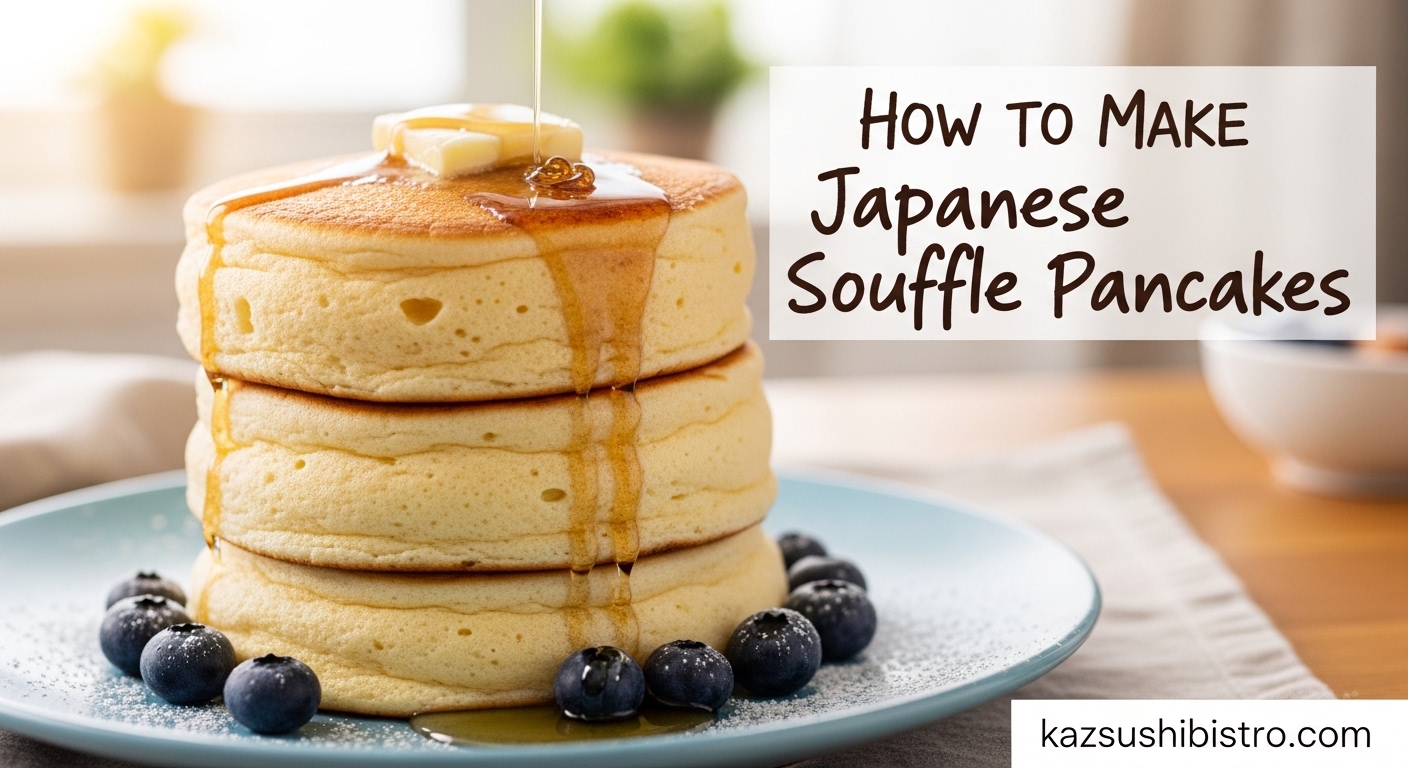
There’s something almost magical about watching a stack of Japanese souffle pancakes rise tall above the rim of a frying pan. I still remember my first bite at a tiny cafe in Tokyo’s Shibuya district – those cloud-like pillows of sweetness that seemed to dissolve on my tongue, leaving behind nothing but pure joy and a desperate desire to recreate them at home.
Japanese souffle pancakes are unlike any breakfast you’ve experienced before. Unlike regular pancakes that rely on baking powder for lift, these towering delights use a souffle technique where whipped egg whites – called meringue – are folded into the batter. The result is a pancake that stands over an inch tall, jiggles when you shake the plate, and delivers that signature cotton-soft texture that has made them a social media sensation.
In this complete guide, I’ll walk you through everything I’ve learned from months of testing, including the science behind why these techniques work and the exact troubleshooting steps for every common failure. Whether you’re making these fluffy Japanese pancakes for a special weekend brunch or trying to impress someone on Valentine’s Day, this recipe will give you cafe-quality results.
Table of Contents
What Are Japanese Souffle Pancakes?
Japanese souffle pancakes, also known as fluffy pancakes or cloud pancakes, originated in Japan during the early 2026 and quickly became a staple of trendy Tokyo cafes. Unlike American pancakes that rely primarily on chemical leaveners like baking powder, souffle pancakes use the same technique as classic French souffles – incorporating whipped egg whites to create structure and lift.
The difference between regular pancakes and souffle pancakes comes down to three key factors: the batter composition, the cooking method, and the resulting texture. Regular pancakes use a simple pourable batter that spreads across the pan. Souffle pancake batter is thick and mounded, requiring you to stack it in layers. Regular pancakes cook quickly over medium heat. Souffle pancakes require low, slow cooking with steam to set the interior without collapsing.
The texture difference is dramatic. Regular pancakes are flat, slightly chewy, and dense. Japanese souffle pancakes are tall, airy, and so delicate they practically melt in your mouth. When you cut into a properly made souffle pancake, you’ll hear a gentle hiss as trapped steam escapes – that’s the sound of success.
Ingredients and Equipment
Precision matters when making souffle pancakes. The balance between structure and airiness is delicate, and substitutions can significantly affect your results. Here’s exactly what you need and why each ingredient matters.
Ingredients (Makes 3-4 pancakes)
Egg yolks (2 large): Provide richness, color, and help emulsify the batter. Room temperature yolks blend more smoothly.
Whole milk (2 tablespoons): Adds moisture and helps create a tender crumb. You can substitute with low-fat milk, but avoid skim.
Cake flour (3 tablespoons): The lower protein content creates less gluten, resulting in a more tender pancake. This is crucial for the melt-in-mouth texture.
Large egg whites (2): The foundation of your meringue. These must be completely free of yolk, oil, or any residue, or they won’t whip properly.
Granulated sugar (1.5 tablespoons): Stabilizes the meringue and adds sweetness. The sugar helps create glossy, stable peaks.
Cream of tartar or lemon juice (1/4 teaspoon): Acid stabilizes the egg white proteins, helping your meringue hold its structure longer.
Vanilla extract (1/4 teaspoon, optional): Adds flavor depth without affecting the structure.
How to Make Cake Flour Substitute
If you don’t have cake flour, you can make your own by combining all-purpose flour with cornstarch. For this recipe, measure 2.5 tablespoons of all-purpose flour and remove half a tablespoon. Replace that half tablespoon with cornstarch. Sift together twice to ensure even distribution. The cornstarch dilutes the protein content, mimicking the properties of cake flour.
Essential Equipment
Nonstick frying pan with lid: A 10-inch nonstick pan works best. The lid is non-negotiable – you need it to trap steam. Avoid cast iron as it retains too much heat.
Hand mixer or stand mixer: While you can whip meringue by hand, it takes approximately 8-10 minutes of continuous whisking. An electric mixer makes this significantly easier and more consistent.
Ring molds (optional but helpful): 3-inch metal ring molds help contain the batter and create perfect cylindrical shapes. You can make souffle pancakes without ring molds if your batter is thick enough, but the results will be slightly less uniform.
Offset spatula: Essential for flipping without breaking the delicate structure.
Piping bag or large spoon: For transferring batter into rings or shaping mounded pancakes.
Electric griddle (alternative): Set to 250-275F (120-135C) for consistent temperature control. This is lower than most griddle minimums, so test with a small amount of batter first.
How to Make Japanese Souffle Pancakes: Step-by-Step Recipe
Now for the main event. Follow these steps exactly for your first attempt, then use the tips section to refine your technique. Total time from start to finish is approximately 30 minutes.
Step 1: Prepare Your Egg Whites (15 Minutes Before)
Separate your eggs carefully, ensuring no yolk contaminates the whites. Even a tiny speck of yolk or oil residue will prevent proper whipping. Place the egg whites in a clean, dry metal or glass bowl and put them in the freezer for exactly 15 minutes.
This freezing technique, which I learned from testing multiple recipes, creates a partially frozen edge around the whites. The cold temperature helps the proteins whip up with more volume and creates a more stable meringue that holds its shape longer. Don’t skip this step – it’s one of the secrets to consistently fluffy results.
Step 2: Create the Yolk Batter
While the egg whites chill, prepare your yolk batter. In a medium bowl, whisk together the two egg yolks, milk, and vanilla extract until smooth. The mixture should be pale yellow and slightly frothy.
Sift the cake flour directly into the yolk mixture. Sifting prevents lumps and incorporates air. Whisk gently until just combined – do not overmix. The batter should be thick but pourable, similar to heavy cream. If it’s too thick, add a teaspoon of milk. If too thin, add a pinch more flour.
Step 3: Whip the Meringue to Stiff Peaks
Remove your egg whites from the freezer. They should have a thin layer of ice crystals around the edges. Add the cream of tartar or lemon juice. Using your hand mixer on medium speed, begin whipping the whites.
After about 30 seconds, when the whites turn foamy, gradually add the sugar one teaspoon at a time while continuing to whip. Adding sugar slowly allows it to dissolve properly and creates a glossy, stable meringue.
Continue whipping on medium-high speed for 3-4 minutes until you reach stiff peaks. You’ll know you’ve achieved stiff peaks when you lift the beaters and the meringue stands straight up without curling. When you tilt the bowl, the meringue should not slide. The texture should be glossy and smooth, not grainy or weeping liquid.
Step 4: Fold the Meringue Into the Batter
This is the most critical step. Working quickly but gently, add one-third of the meringue to your yolk batter. Use a silicone spatula to fold the mixture together with a scooping motion – cut down through the center, scrape across the bottom, and fold up the side. Rotate the bowl a quarter turn and repeat.
The goal is to incorporate the meringue without deflating the air bubbles. Be gentle but efficient – this step should take no more than 30 seconds for the first addition. Once the first third is incorporated, add the remaining meringue in two more batches, folding until just combined. The final batter should be thick, airy, and hold its shape when scooped.
Step 5: Preheat the Pan and Prepare Ring Molds
Heat your nonstick pan over the lowest possible heat setting for 3-4 minutes. If using an electric griddle, set it to 250-275F (120-135C). The pan should feel warm but not hot when you hold your hand 2 inches above the surface.
If using ring molds, lightly grease the inside with oil using a paper towel. Grease the pan surface as well with a minimal amount of oil – too much will prevent the pancakes from climbing the sides. Place the rings in the pan to preheat slightly.
Step 6: Cook with the Steam Method
Fill each ring mold halfway with batter, or if cooking free-form, mound the batter into a tall pile about 3 inches in diameter. The batter should be thick enough to hold its shape. If it spreads immediately, your batter is too thin and the pancakes won’t rise tall.
Immediately add 1 tablespoon of water to the empty spaces in the pan, then cover with the lid. The water creates steam that cooks the interior while keeping the exterior from drying out. This is essential for the characteristic fluffy texture.
Cook for 6-7 minutes without lifting the lid. The first side is crucial – this is when most of the rising happens. Resist the urge to peek. After 6-7 minutes, the bottom should be golden and set while the top will still look wet and uncooked.
Step 7: Flip and Finish
Remove the lid carefully, avoiding dripping condensation onto the pancakes. If using ring molds, run a thin knife around the inside edge to loosen, then lift the rings off.
Using your offset spatula, gently slide under each pancake and flip in one smooth motion. The flipped side should be golden brown. If the pancake collapses during flipping, it wasn’t cooked long enough on the first side.
Add another tablespoon of water to the pan, cover again, and cook for 4-5 minutes on the second side. The second side takes less time because the interior is mostly set.
Step 8: Serve Immediately
Transfer the pancakes directly to plates. They will begin deflating within minutes as the steam escapes, so serve immediately. Top with your choice of toppings and enjoy while warm for the full cloud-like experience.
The Science Behind the Fluff
Understanding why these techniques work will make you a better cook and help you troubleshoot when things go wrong. The magic of Japanese souffle pancakes comes down to protein chemistry, heat transfer, and steam physics.
Why Meringue Creates Lift
When you whip egg whites, you’re physically forcing air into the protein structure. The proteins in egg whites (primarily ovalbumin and ovotransferrin) unfold and create a network that traps air bubbles. These bubbles expand when heated, creating the lift that makes souffle pancakes tower above regular ones.
The sugar you add serves two purposes. First, it stabilizes these proteins, making the foam structure more resilient. Second, it increases the viscosity of the foam, creating smaller, more uniform bubbles that result in a finer texture. Without sugar, the meringue collapses more easily when folded and cooked.
Why Low Heat Is Essential
Souffle pancakes fail most often because the heat is too high. When heat hits the batter quickly, the exterior proteins coagulate and set before the interior has time to expand. This creates a solid shell that traps expanding steam – which then bursts and collapses the pancake.
Low heat allows the interior to cook gradually as the pancake rises. The proteins coagulate slowly, building internal structure while the air bubbles expand. By the time the exterior sets, the interior is fully cooked and structurally sound. This is why patience at low heat produces taller, more stable pancakes.
Why Steam Matters
The steam you create by adding water to the pan serves multiple functions. First, it transfers heat to the pancake’s interior more efficiently than dry air, ensuring the center cooks through. Second, it keeps the surface moist and flexible, allowing the pancake to expand upward without cracking.
Third, and most importantly, the steam contributes to leavening. As water in the batter turns to steam, it expands approximately 1,600 times in volume. This additional lift helps the pancakes reach their maximum height. The covered pan traps this steam, creating a miniature oven environment.
Why Cake Flour Makes a Difference
Cake flour contains less protein (about 7-9%) compared to all-purpose flour (10-12%). When you mix flour with liquid and stir, proteins form gluten strands. Less protein means less gluten, which means a more tender, delicate crumb.
In souffle pancakes, excess gluten creates chewiness and adds weight that can compress the air bubbles. Cake flour allows the structure to remain light and tender while still providing enough starch to hold the shape. The result is that characteristic melt-in-mouth texture that makes these pancakes special.
Why Pancakes Deflate
All souffle pancakes deflate to some degree as they cool – this is normal and expected. The air bubbles that expanded during cooking contract as they cool, and steam condenses back to water. However, excessive deflation indicates problems with cooking time or heat level.
If pancakes deflate completely, they were likely undercooked in the center. The protein structure wasn’t fully set, so it couldn’t hold its shape when removed from heat. If they collapse during flipping, the first side needed more time to develop structure before supporting the weight of being turned over.
9 Pro Tips for Perfect Results Every Time
After dozens of batches and countless experiments, these are the techniques that consistently produce the best results. Print this section and keep it handy while cooking.
Tip 1: Freeze Your Egg Whites for 15 Minutes – This partially freezes the edges, creating more volume and a more stable meringue. Don’t freeze completely – you want ice crystals around the edge, not solid whites.
Tip 2: Stabilize with Cream of Tartar or Lemon Juice – The acid helps the egg white proteins hold their structure longer. This is especially important if your kitchen is warm or humid, or if you’re making multiple batches.
Tip 3: Fold Gently but Efficiently – The longer you take folding, the more air you lose. Aim to incorporate the meringue in 30-45 seconds total across all three additions. Use a scooping motion, not stirring.
Tip 4: Keep the Batter Thick – When you scoop batter, it should mound and hold its shape. If it flows like regular pancake batter, your meringue has deflated too much or your proportions are off.
Tip 5: Preheat the Pan Properly – A cold pan causes the batter to spread before it starts rising. Preheat on low for at least 3-4 minutes. The pan should feel warm, not hot, when you hold your hand above it.
Tip 6: Add Water Immediately – Have your water measured and ready. As soon as the batter hits the pan, add water and cover. Every second of lost steam affects your final height.
Tip 7: Don’t Peek – Lifting the lid releases steam and heat, causing uneven cooking and potential collapse. Trust the timing. If your heat is truly on low, 6-7 minutes won’t burn the first side.
Tip 8: Use the Lowest Heat Setting – Even “low” on some stoves may be too high. If your pancakes are browning too quickly or collapsing, use a heat diffuser or move the pan on and off the burner.
Tip 9: Serve Immediately – These pancakes wait for no one. Have your plates, toppings, and coffee ready before you start cooking. The difference between a pancake served at 30 seconds and 3 minutes is significant.
Troubleshooting Guide: Real Solutions to Common Problems
I’ve collected these solutions from my own failures and from reading hundreds of Reddit posts where home cooks shared their struggles. If you’re having trouble, you’re not alone – and there’s almost always a fix.
Problem: Pancakes Deflate Immediately After Cooking
Cause: Undercooked interior or heat too high causing structure failure.
Solution: Cook the first side longer – try 8 minutes instead of 6. Check that your heat is truly on the lowest setting. The pancakes should be mostly set before flipping. You can test doneness by gently touching the top – it should feel firm and spring back slightly.
Problem: Pancakes Aren’t Fluffy Enough
Cause: Meringue not whipped to true stiff peaks, or meringue deflated during folding.
Solution: Whip the meringue longer – most beginners stop too early. True stiff peaks should stand straight up without curling. When folding, use the scooping technique and work quickly. If your kitchen is warm, place the bowl of meringue over an ice bath while working.
Problem: Burned Outside, Raw Inside
Cause: Heat too high or pan not preheated properly.
Solution: This is the most common failure I see reported on Reddit. Turn your heat down to the absolute lowest setting, or use a heat diffuser. Preheat longer to ensure even temperature. Electric griddle users should verify actual surface temperature with an infrared thermometer – many run hotter than the dial indicates.
Problem: Pancakes Stick to the Pan
Cause: Insufficient greasing or pan not truly nonstick.
Solution: Use a well-seasoned nonstick pan. Lightly grease with oil, then wipe out excess with a paper towel – you want a thin film, not pooled oil. Butter contains milk solids that can stick, so use neutral oil like canola or vegetable oil.
Problem: Pancakes Collapse During Flipping
Cause: First side not cooked long enough, or flipping technique too rough.
Solution: Extend first-side cooking to 7-8 minutes. Use a thin, wide offset spatula and slide it fully under the pancake before lifting. Flip in one confident motion without hesitating halfway. If a pancake starts to collapse, you can sometimes save it by immediately flipping it back and cooking longer.
Problem: Second Batch Comes Out Worse Than First
Cause: Meringue sitting too long, or pan too hot from first batch.
Solution: As one Reddit user noted after multiple attempts, “The meringue doesn’t hold forever.” Work quickly and cook all pancakes in one batch if possible. If you must do multiple batches, rewhip the meringue briefly before using. Let the pan cool slightly between batches or rinse with cold water and reheat.
Problem: Pancakes Spread Too Much and Don’t Rise Tall
Cause: Batter too thin, pan not preheated, or heat too low.
Solution: The batter should mound, not flow. If it’s spreading immediately, your meringue has lost too much air or your ratios are off. Preheat the pan properly – a cold pan causes spreading before the structure sets. If you’re cooking free-form without rings, the batter thickness is even more critical.
Problem: Meringue Won’t Whip
Cause: Egg whites contaminated with yolk, oil, or residue; or bowl not clean.
Solution: This is the most frustrating failure because you have to start over. Any fat – yolk, oil, or even residual soap – prevents proteins from forming the necessary bonds. Use a glass or metal bowl (plastic can hold grease), and wipe with vinegar before use if you’ve had this problem before.
Delicious Variations and Serving Suggestions
Once you’ve mastered the basic recipe, experiment with these variations to create your own signature souffle pancakes.
Matcha Green Tea Souffle Pancakes
Add 1 teaspoon of high-quality matcha powder to the cake flour before sifting. The matcha should be culinary grade, not ceremonial. This creates beautiful green pancakes with subtle tea flavor. Serve with white chocolate sauce and sweetened adzuki beans for an authentic Japanese cafe experience.
Chocolate Souffle Pancakes
Sift 1 tablespoon of unsweetened cocoa powder with the cake flour. Fold in 1 tablespoon of mini chocolate chips with the final meringue addition for chocolate pockets throughout. Serve with fresh raspberries and whipped cream.
Strawberry Shortcake Style
Add 1/4 teaspoon of almond extract to the yolk batter. Layer cooked pancakes with macerated strawberries and whipped cream. The almond flavor complements the berries beautifully.
Classic Japanese Cafe Style
Serve your souffle pancakes with a pat of salted butter, a drizzle of maple syrup, and a dusting of powdered sugar. Add fresh seasonal fruit on the side – strawberries in spring, peaches in summer.
Topping Ideas
The classic choice is a generous dollop of freshly whipped cream with maple syrup. For something different, try sweetened condensed milk drizzle, Nutella spread, lemon curd, or caramel sauce with sea salt.
Fresh fruit elevates the presentation and adds acidity to balance the sweetness. Strawberries, blueberries, sliced bananas, or kiwi work beautifully. For crunch, add toasted nuts or a sprinkle of granola.
Japanese Beverage Pairings
Complete your Japanese cafe experience with traditional beverages. A matcha latte made with ceremonial grade powder and steamed milk complements the sweetness perfectly. For something different, try iced hojicha (roasted green tea) latte, which has nutty, caramel notes that pair wonderfully with souffle pancakes.
Black coffee or cafe au lait are classic choices that cut through the richness. For a special occasion, a small glass of cold brew with cream creates a sophisticated pairing.
Scaling the Recipe and Make-Ahead Tips
Can you make these ahead for a crowd? The short answer is that souffle pancakes are best served immediately, but there are strategies for managing larger batches.
Doubling or Tripling the Recipe
You can scale the recipe, but work in separate batches for the meringue. Whipping 6-8 egg whites at once can be done, but the folding becomes more challenging and you’re more likely to deflate the batter. I recommend making separate batches of meringue and yolk batter, then combining in stages.
If you must make one large batch, use a very large bowl for folding and work with a partner – one person holding the bowl steady while the other folds. The larger volume means more time folding, so work as quickly as possible.
Keeping Pancakes Warm
While cooking multiple batches, keep finished pancakes warm in a 200F (95C) oven. Place them on a wire rack over a baking sheet – the rack prevents condensation from making the bottom soggy. They’ll hold for 10-15 minutes but will deflate somewhat.
Do not stack pancakes while keeping warm – the weight of upper pancakes compresses the lower ones. Keep them in a single layer, even if this means using multiple racks or batches.
Can You Make Them Ahead?
Souffle pancakes don’t store well. The texture depends on steam and air bubbles that dissipate as they cool. Refrigerated pancakes become rubbery, and reheating collapses what little structure remains.
If you must prepare ahead, make the yolk batter up to 2 hours in advance and refrigerate covered. Whip the meringue and combine just before cooking. Even this compromise affects the final texture, but it’s better than making everything ahead.
Freezing Cooked Pancakes
While not recommended, you can freeze cooked souffle pancakes for up to 1 month. Wrap individually in plastic wrap, then foil. Reheat from frozen in a 300F (150C) oven for 10-12 minutes. They won’t regain their original height, but the flavor remains good. Think of frozen souffle pancakes as a different dish – more like a Japanese-style pancake cake than the cloud-like original.
Frequently Asked Questions
How do you make fluffy Japanese souffle pancakes?
Make fluffy Japanese souffle pancakes by whipping egg whites into stiff-peak meringue and folding them gently into a yolk-based batter. Cook over low heat (300F/150C) with steam for 6-7 minutes per side. The key techniques are: freeze egg whites for 15 minutes before whipping, fold meringue quickly without deflating, and cook covered with added water to create steam.
What is the difference between Japanese souffle pancakes and regular pancakes?
Japanese souffle pancakes use whipped egg white meringue for lift, while regular pancakes rely on baking powder. Souffle pancakes are 2-3 times taller, have a cloud-like airy texture, and cook low and slow with steam. Regular pancakes are flat, denser, and cook quickly over medium heat. The souffle technique creates the signature jiggly, melt-in-mouth texture.
Why are my Japanese souffle pancakes not fluffy?
Pancakes that aren’t fluffy usually result from meringue that wasn’t whipped to true stiff peaks, or meringue that deflated during folding. Make sure meringue stands straight up without curling when you lift the beaters. Fold gently but quickly using a scooping motion, not stirring. Warm kitchens cause faster deflation – work efficiently or chill your bowl over ice.
Why do Japanese souffle pancakes deflate?
Souffle pancakes naturally deflate somewhat as they cool because steam condenses and air bubbles contract. However, complete collapse indicates undercooking – the protein structure wasn’t fully set. Cook the first side for 7-8 minutes to ensure the interior is set before flipping. Heat that’s too high causes the exterior to set before the interior expands, leading to structural failure.
What temperature to cook Japanese souffle pancakes?
Cook souffle pancakes over low heat at approximately 300F/150C. On a stovetop, use the lowest setting and preheat for 3-4 minutes. On an electric griddle, set to 250-275F (120-135C). If pancakes brown too quickly or collapse, reduce heat further. Use a heat diffuser if your stove’s lowest setting is still too hot.
Do you need baking powder for Japanese souffle pancakes?
No, traditional Japanese souffle pancakes do not need baking powder. The lift comes entirely from whipped egg white meringue. Some recipes include a small amount for extra insurance, but it’s not necessary if your meringue technique is correct. The meringue provides significantly more lift than chemical leaveners could achieve.
How do you make meringue for Japanese pancakes?
Whip cold egg whites with cream of tartar on medium speed until foamy, then gradually add sugar while continuing to whip. Beat until stiff peaks form – when you lift the beaters, the meringue should stand straight up without curling. Freezing egg whites for 15 minutes before whipping creates more volume and stability. The process takes 3-4 minutes with an electric mixer.
Can you make Japanese souffle pancakes without a ring mold?
Yes, you can make souffle pancakes without ring molds if your batter is thick enough to hold its shape. The batter should mound and not spread when placed in the pan. While rings help create perfect cylinders, free-form pancakes will be slightly less uniform but equally delicious. Preheat the pan thoroughly to help set the shape quickly before spreading occurs.
How long do Japanese souffle pancakes take to cook?
Japanese souffle pancakes take 10-12 minutes total cooking time. Cook the first side covered with steam for 6-7 minutes, flip, then cook the second side covered for 4-5 minutes. The longer first side cooking is essential for structure development. Resist the urge to rush – low and slow is the key to tall, stable pancakes.
Why do you add water to Japanese souffle pancakes?
Water added to the pan creates steam that cooks the interior efficiently while keeping the surface moist and flexible. The steam contributes to leavening as water in the batter expands approximately 1,600 times when turning to steam. The covered pan traps this steam, creating a moist cooking environment that prevents the exterior from drying and cracking before the interior sets.
Additional Reader Questions
Can I use a stand mixer instead of a hand mixer? Yes, a stand mixer with the whisk attachment works beautifully. Use medium speed and follow the same timing. The stand mixer actually creates more consistent results because it maintains steady speed.
Why did my second side not brown as well? The second side always browns less because the pancake is mostly cooked through and the pan temperature drops when you add water after flipping. This is normal and expected – the second side is typically lighter in color.
Can I add mix-ins like chocolate chips or fruit? Add mix-ins when folding the final third of meringue, distributing them evenly without over-mixing. Fold them in with the meringue. Avoid adding more than 2 tablespoons of mix-ins or the batter becomes too heavy.
Is there a vegan version? Traditional souffle pancakes require eggs for structure. Aquafaba (chickpea liquid) can be whipped like egg whites, but the results are less stable. I haven’t found a vegan version that truly replicates the original texture.
Mastering Japanese souffle pancakes takes practice, but the reward is worth every attempt. Each batch teaches you something new about your equipment, your technique, and the subtle variables that affect the outcome. Start with this recipe exactly as written, then use the troubleshooting section to refine your approach.
The first time you plate a stack of tall, jiggly souffle pancakes and hear that satisfied gasp from someone taking their first bite, you’ll understand why these have become a global phenomenon. There’s something deeply satisfying about transforming simple eggs and flour into something that seems to defy gravity.
Gather your ingredients, preheat that pan, and prepare to amaze yourself. Your cloud-like Japanese souffle pancakes are waiting.