
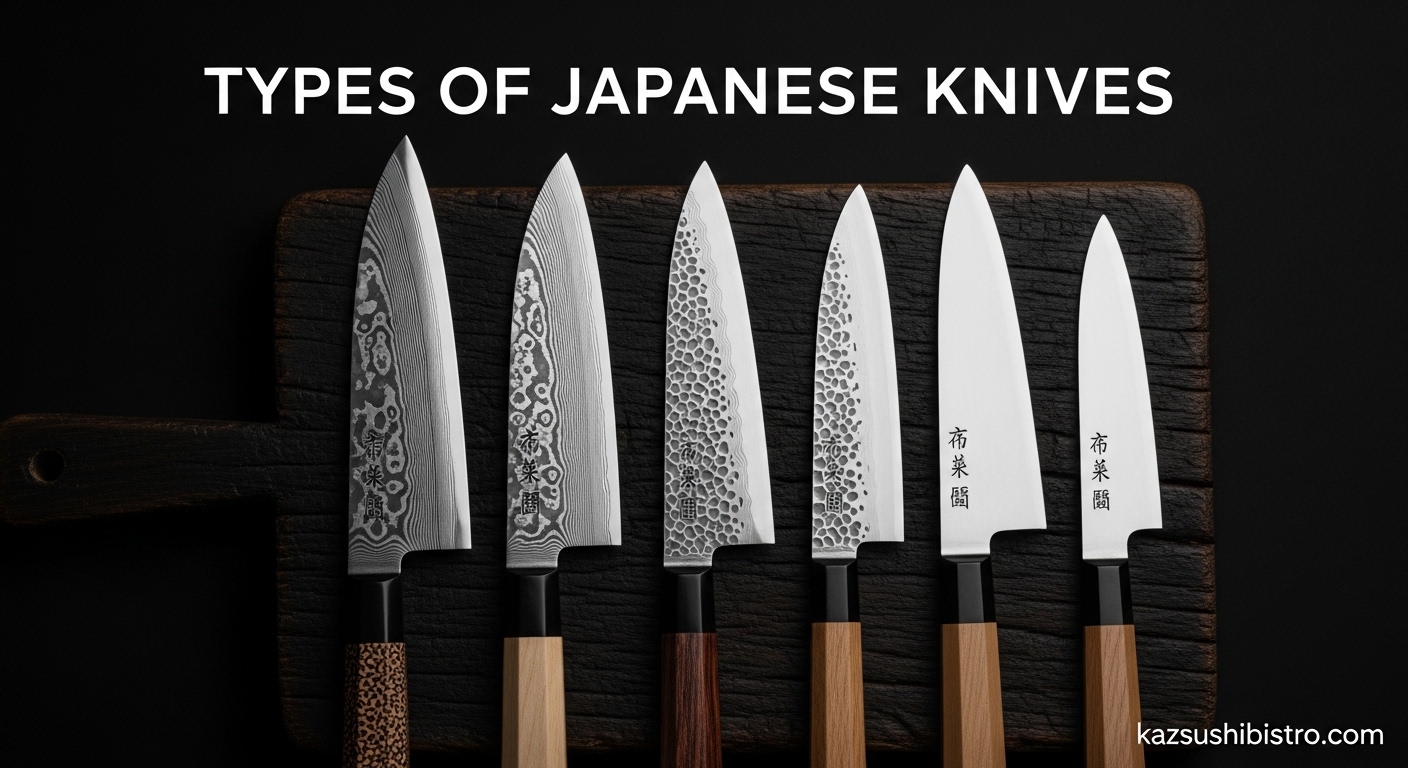
Japanese kitchen knives represent centuries of craftsmanship that trace directly back to samurai sword-making traditions. At KAZ Sushi Bistro, we understand that the right blade transforms cooking from a chore into an art form. Understanding the types of Japanese knives and their uses helps you select tools that match your cooking style, skill level, and culinary ambitions.
Unlike Western knives designed for versatility, Japanese knives evolved as specialized instruments. Each blade shape, steel type, and edge geometry serves a specific purpose. From the delicate slices of sashimi to the precise vegetable cuts for kaiseki cuisine, Japanese knife makers, called shokunin, have perfected their craft over generations.
This guide explores 11 distinct Japanese knife types, explaining their unique characteristics, traditional uses, and which blades deserve a place in your kitchen. Whether you are building your first knife collection or seeking to understand the tools behind professional sushi preparation, you will find practical answers here.
Table of Contents
The Classic Trio: Deba, Usuba, and Yanagiba 2026
The great classic trio of Japanese knives consists of three blades essential for traditional Japanese cuisine: the Deba for fish butchery, the Usuba for vegetable preparation, and the Yanagiba for slicing sashimi. These three knives form the foundation of any serious Japanese kitchen.
Professional Japanese chefs traditionally learned these three blades before expanding their collection. Each represents a specific cutting discipline, and together they handle the majority of tasks in kaiseki and sushi preparation. Understanding this trio provides insight into how Japanese cuisine approaches ingredients with precision and respect.
The Deba features a thick, heavy blade designed for cutting through fish heads and bones. Its robust spine prevents chipping when breaking down whole fish. The Usuba possesses a thin, single-bevel edge perfect for the katsuramuki rotary peeling technique and precise vegetable work. The Yanagiba showcases a long, willow-leaf-shaped blade that creates clean, single-motion cuts through raw fish for sashimi and nigiri.
Multi-Purpose Knives
While traditional Japanese cuisine relies on specialized blades, modern home cooks and professional chefs often prefer versatile knives that handle multiple tasks. These multi-purpose Japanese knives blend traditional craftsmanship with practical flexibility.
Gyuto: The Japanese Chef’s Knife
The Gyuto, whose name translates to “cow sword,” emerged during the Meiji era as Japan opened to Western influence. This Japanese interpretation of the European chef’s knife has become the most popular all-purpose blade for both professional chefs and home cooks.
Gyuto blades typically range from 180mm to 300mm in length, with 210mm and 240mm being the most common sizes. The blade features a slight curve toward the tip, allowing both rocking motions for mincing and push-cutting techniques favored in Japanese cuisine. The spine tapers toward the tip, creating a distal taper that improves balance and cutting performance.
Most Gyuto knives feature double-bevel edges, making them accessible to beginners while maintaining the thin, hard steel characteristics of Japanese blades. The profile works equally well for slicing meat, dicing vegetables, and mincing herbs. For cooks seeking one knife to handle 90% of kitchen tasks, the Gyuto represents the ideal starting point.
Santoku: The Three Virtues
The Santoku, meaning “three virtues” or “three uses,” excels at slicing, dicing, and mincing. This compact knife emerged in post-war Japan as a home cook’s alternative to the longer Gyuto, designed specifically for smaller Japanese kitchens and hands.
Santoku blades typically measure 160mm to 180mm, featuring a sheep’s foot tip that creates a nearly straight edge profile. Unlike the curved Gyuto, the Santoku favors push-cutting and pull-cutting motions over rocking. The shorter length provides excellent control for precise vegetable work.
Home cooks particularly appreciate the Santoku’s approachable size and weight. The blade height provides knuckle clearance for comfortable chopping, while the compact profile stores easily in crowded drawers. For those primarily cooking Japanese or Asian cuisine with lots of vegetable preparation, the Santoku often proves more practical than a longer chef’s knife.
Bunka: The Versatile Alternative
The Bunka knife represents a fascinating evolution in Japanese blade design, combining elements of both Santoku and Nakiri with a distinctive reverse tanto tip. Originally popular in the mid-20th century, the Bunka experienced a resurgence in 2026 as modern cooks discovered its unique capabilities.
The reverse tanto tip provides a sharp point for precision work and scoring proteins, while the mostly flat profile excels at push-cutting vegetables. Bunka blades typically measure 165mm to 180mm, placing them in the same compact category as Santoku knives. The triangular tip penetrates ingredients easily, making the Bunka particularly effective for breaking down chicken or scoring fish.
For cooks seeking something distinctive yet practical, the Bunka offers personality without sacrificing function. The blade handles both vegetable prep and protein work competently, making it an excellent second knife for those who already own a Gyuto.
Vegetable Knives
Japanese cuisine treats vegetables with the same respect as proteins, demanding precise cuts that showcase texture and freshness. Two primary knife types handle vegetable preparation: the accessible Nakiri for home cooks and the professional Usuba for skilled chefs.
Nakiri: The Home Cook’s Vegetable Knife
The Nakiri features a rectangular profile with a completely straight edge, designed exclusively for push-cutting vegetables. Unlike curved blades that rock through ingredients, the Nakiri’s flat edge makes full contact with the cutting board, ensuring clean, complete cuts through delicate produce.
Most Nakiri knives feature double-bevel edges, making them accessible to beginners while maintaining the thin, sharp characteristics of Japanese blades. Blade lengths typically range from 150mm to 180mm, with tall profiles providing excellent knuckle clearance. The rectangular shape works particularly well for julienning vegetables and chopping herbs.
Home cooks often debate whether a Nakiri is necessary if they already own a Gyuto or Santoku. The answer depends on your cooking style. If you prepare large quantities of vegetables regularly, the Nakiri’s specialized design reduces fatigue and improves consistency. For vegetarian or plant-based cooks, this blade becomes essential.
Usuba: The Professional’s Choice
The Usuba, meaning “thin blade,” represents the professional evolution of the vegetable knife concept. Unlike the double-bevel Nakiri, the Usuba features a single-bevel edge that creates incredibly precise cuts with a polished, mirror-like finish on the vegetable surface.
The single-bevel design allows for the katsuramuki technique, where a chef rotates a cylindrical vegetable while peeling a continuous paper-thin sheet. This technique, essential for traditional Japanese cuisine, produces translucent vegetable sheets used for wraps, garnishes, and decorative cuts. The Usuba’s thin, straight edge also excels at kenzutsu, the square-cut technique fundamental to kaiseki presentation.
Regional variations exist between Tokyo-style Azumagata Usuba with squared tips and Osaka-style Kamagata Usuba with crescent-shaped tips. The Kamagata excels at delicate tip work, while the Azumagata provides more robust performance for general vegetable prep. Both require significant skill to use effectively, making the Usuba primarily a professional tool rather than a beginner’s knife.
Fish and Sashimi Knives
Japanese cuisine’s relationship with fish demands blades that handle everything from breaking down whole fish to creating paper-thin sashimi slices. These knives showcase the pinnacle of Japanese blade-making craft, with each designed for a specific stage of fish preparation.
Yanagiba: The Sashimi Master
The Yanagiba, meaning “willow leaf,” represents the definitive sashimi knife. Its long, narrow blade with a single-bevel edge creates the clean, smooth cuts essential for presenting raw fish at its best. The blade length, typically 270mm to 300mm for professionals, allows the entire cut to happen in one pulling motion.
The single-bevel design creates what chefs call a “concave grind” on the back side, preventing fish from sticking to the blade while reducing friction. This geometry produces the mirror-like finish on cut surfaces that characterizes professional sashimi. The slight curve along the blade’s length helps maintain contact with the fish throughout the slicing motion.
Regional variations include the Takobiki from Tokyo, with a squared tip historically used for cutting octopus, and the Fugubiki for fugu preparation, featuring an extremely thin blade and pronounced curve. For sushi enthusiasts building a traditional collection, the Yanagiba ranks as essential equipment alongside the Deba.
Deba: The Butcher’s Heavy Blade
The Deba stands apart from other Japanese knives with its thick, heavy spine and robust construction. Designed for breaking down whole fish, this knife cuts through heads and bones while maintaining the precision needed for filleting. The blade’s weight does the work, reducing the effort required for tough cuts.
Traditional Deba knives feature single-bevel edges with a substantial spine that tapers toward the edge. Blade lengths range from 120mm for small fish to 210mm for larger species. The knife’s heft makes it unsuitable for delicate slicing but indispensable for fish butchery.
Several subtypes serve specific purposes. The Hon-deba represents the standard heavy-duty version. The Ko-deba features a shorter blade for small fish and detailed work. The Yo-deba offers a double-bevel Western-style variation that some find easier to control. Professional kitchens typically maintain multiple Deba sizes to match different fish species.
Sujihiki: The Carving Knife
The Sujihiki serves as the Japanese equivalent of a Western slicing or carving knife, designed for portioning cooked proteins and preparing crudo. Unlike the single-bevel Yanagiba, the Sujihiki features a double-bevel edge that appeals to cooks familiar with Western knives.
Blade lengths typically range from 240mm to 360mm, with long, narrow profiles that minimize friction when slicing through meat or fish. The double-bevel design makes sharpening more familiar for Western-trained cooks while maintaining the thin, acute edge angles characteristic of Japanese blades.
For home cooks who prepare roasts or frequently portion cooked fish, the Sujihiki offers more versatility than the highly specialized Yanagiba. Many professional kitchens use Sujihiki knives for both cooked proteins and raw fish preparation, making them practical multi-purpose slicers.
Specialty and Utility Knives
Beyond the main categories, several specialty knives serve specific purposes in Japanese kitchens. These blades often complete a collection, handling tasks that larger knives cannot manage effectively.
Petty: The Paring Knife
The Petty knife serves as the Japanese utility or paring knife, typically measuring 90mm to 150mm. This small blade handles detailed work that larger knives struggle with: peeling fruit, trimming vegetables, scoring proteins, and creating garnishes.
Most Petty knives feature double-bevel edges, making them accessible and practical for any skill level. The compact size provides excellent control for precision tasks. Many cooks consider the Petty the second most important knife after their primary chef’s knife.
For those building a Japanese knife collection, the Petty often follows the primary blade purchase. Its versatility extends beyond Japanese cuisine into general kitchen tasks, making it a practical addition regardless of your cooking style.
Kiritsuke: The Executive Knife
The Kiritsuke commands respect as both a functional tool and a status symbol in Japanese kitchens. Traditionally reserved for executive chefs, this versatile knife combines elements of both Yanagiba and Usuba in a single blade with a distinctive sword-like shape.
The Kiritsuke features a long blade, typically 240mm to 300mm, with a chisel-tip design and single-bevel edge. The forward portion handles slicing tasks similar to a Yanagiba, while the rear section manages vegetable work like an Usuba. This hybrid design requires significant skill to master, as the different blade sections demand different techniques.
In traditional Japanese restaurants, only the head chef wields the Kiritsuke, symbolizing their authority and expertise. Modern variations include double-bevel versions that sacrifice some cutting performance for accessibility. For collectors and serious enthusiasts, the Kiritsuke represents a challenging but rewarding blade to master.
Honesuki: The Poultry Specialist
The Honesuki serves as the Japanese poultry boning knife, featuring a distinctive triangular blade shape that excels at breaking down chicken and other birds. Unlike Western boning knives with flexible blades, the Honesuki uses a rigid, sturdy construction that powers through joints.
The single-bevel edge, typically on the right side for right-handed users, allows precise cuts close to bone while the triangular shape provides leverage for separating joints. Blade length usually measures around 150mm, compact enough for detailed work but substantial enough for cutting through cartilage.
Cooks should not confuse the Honesuki with the Hankotsu, another Japanese boning knife designed specifically for hanging meat. The Honesuki’s triangular profile suits poultry specifically, while the Hankotsu works better for red meat butchery. For home cooks who frequently break down whole chickens, the Honesuki proves invaluable.
Understanding Bevel Types: Single vs Double
One of the most important distinctions among Japanese knives concerns bevel type. Understanding whether a knife has a single or double bevel helps predict its cutting characteristics, maintenance requirements, and ideal use cases.
Double-bevel knives, like most Western blades, feature symmetrical edges ground on both sides of the blade. These knives cut straight down and feel familiar to most cooks. Single-bevel knives, also called chisel-ground blades, have an edge ground on only one side, creating asymmetrical cutting behavior that slices with a steering motion.
Single-bevel knives offer superior precision and create cleaner cuts on delicate ingredients. The flat back side releases food easily and creates a polished surface on cut vegetables or fish. However, single-bevel knives require more skill to use effectively, as they tend to steer away from the bevel side during cuts. They also demand specialized sharpening techniques.
For beginners, double-bevel Japanese knives provide an excellent entry point. The Gyuto, Santoku, Nakiri, and Sujihiki all come in double-bevel versions that maintain Japanese steel quality while offering familiar handling. As skills develop, adding single-bevel specialty knives like the Yanagiba or Deba opens new possibilities for precision work.
Steel Types and Construction
Japanese knife performance depends heavily on steel composition and heat treatment. Understanding the differences between carbon steel, stainless steel, and Damascus patterns helps you choose blades that match your maintenance habits and performance priorities.
Carbon steel, including white steel (shirogami) and blue steel (aogami), represents the traditional choice for Japanese knives. These alloys take an extremely sharp edge and maintain it longer than stainless alternatives. However, carbon steel reacts with acidic ingredients and moisture, developing a dark patina and potentially rusting if neglected. Cooks who enjoy maintenance rituals and prioritize cutting performance often prefer carbon steel.
Stainless steel options, such as VG-10 and SG2/R2, offer corrosion resistance that appeals to busy home cooks and professional kitchens. Modern stainless formulations approach carbon steel sharpness while requiring minimal care. VG-10, in particular, has gained popularity as a reliable stainless steel that balances edge retention with durability.
Damascus steel refers not to a specific alloy but to a layered construction technique where different steels are folded together, creating distinctive patterns on the blade surface. These patterns, called suminagashi or kasumi depending on the technique, primarily serve aesthetic purposes while the cutting edge consists of a hard steel core. Damascus knives often command higher prices for their visual appeal, though performance depends on the core steel quality.
Rockwell hardness ratings, expressed as HRC, indicate steel hardness and edge retention potential. Japanese knives typically range from 58 HRC for tougher, more forgiving blades to 65+ HRC for extreme edge retention at the cost of brittleness. Harder steels cut longer but chip more easily if misused.
Japanese Knife Comparison Table
The following table summarizes the key characteristics of all Japanese knife types covered in this guide. Use this reference to compare blade lengths, bevel types, primary uses, and appropriate skill levels when planning your collection.
| Knife Type | Blade Length | Bevel Type | Primary Use | Skill Level |
|---|---|---|---|---|
| Gyuto | 180-300mm | Double | All-purpose cooking | Beginner |
| Santoku | 160-180mm | Double | Vegetables, general prep | Beginner |
| Bunka | 165-180mm | Double | All-purpose with precision | Intermediate |
| Nakiri | 150-180mm | Double | Vegetable chopping | Beginner |
| Usuba | 180-240mm | Single | Professional vegetable work | Advanced |
| Deba | 105-210mm | Single | Fish butchery | Advanced |
| Yanagiba | 210-360mm | Single | Sashimi slicing | Advanced |
| Sujihiki | 210-360mm | Double | Slicing cooked proteins | Intermediate |
| Petty | 90-150mm | Double | Utility and detail work | Beginner |
| Kiritsuke | 240-300mm | Single | Executive chef all-purpose | Advanced |
| Honesuki | 150mm | Single | Poultry boning | Advanced |
How to Choose the Right Japanese Knife
Selecting your first Japanese knife requires honest assessment of your cooking habits, maintenance commitment, and skill level. The right choice sets you up for years of satisfaction, while the wrong choice may gather dust in a drawer.
For beginners entering the world of Japanese knives, the Gyuto or Santoku offers the most practical starting point. Choose the Gyuto if you prefer a longer blade for rocking motions and handle larger quantities of protein. Select the Santoku if you work primarily with vegetables in smaller quantities and prefer push-cutting techniques. Both knives feature double-bevel edges that feel familiar while introducing you to Japanese steel quality.
Sushi enthusiasts building a collection for home preparation should prioritize the Yanagiba as their first single-bevel knife. The 270mm length suits most home preparation needs, and learning proper slicing technique with a Yanagiba transforms your sashimi quality. Pair this with a Gyuto for general prep, and add a Petty for detailed work before considering the Deba for whole fish butchery.
Handle type represents another important consideration. Wa handles, the traditional Japanese octagonal or D-shaped handles, provide lightweight balance and easy replacement. Yo handles, the Western-style riveted handles, feel familiar to cooks trained on European knives. Neither is objectively better, but the choice affects how the knife balances in your hand.
Budget considerations should include not just the knife purchase but also sharpening equipment. Japanese knives require regular maintenance on whetstones to perform their best. Factor in the cost of stones ranging from 1000 grit for repairs to 6000+ grit for polishing, along with the time investment to learn proper technique.
Building Your Japanese Knife Collection
Rather than buying a complete set at once, most experienced cooks recommend building a Japanese knife collection gradually. This approach allows you to develop skills with each blade before adding complexity, while spreading costs over time.
Start with one versatile knife, either a 210mm Gyuto or 165mm Santoku depending on your preferences. Use this knife exclusively for several months to understand its characteristics and limitations. During this period, invest in quality sharpening stones and learn to maintain your edge properly.
Your second purchase should address the tasks your primary knife handles poorly. Most cooks add a Petty knife for detailed work and a Nakiri if they prepare lots of vegetables. Alternatively, sushi enthusiasts might add a Yanagiba before a Petty to prioritize their primary interest.
The essential three-knife collection for home cooks typically includes a Gyuto for general work, a Nakiri for vegetables, and a Petty for detail tasks. This combination handles 99% of kitchen needs while remaining manageable to maintain. Professional chefs and dedicated enthusiasts eventually expand into specialty knives like the Deba, Usuba, and Kiritsuke as their skills and needs dictate.
Frequently Asked Questions
What type of Japanese knife should I get?
Start with a Gyuto or Santoku as your first Japanese knife. The Gyuto works best if you cook large quantities or prefer rocking motions. Choose the Santoku if you primarily prepare vegetables and prefer push-cutting. Both feature double-bevel edges that feel familiar to Western-trained cooks while delivering Japanese steel performance.
Which is better, santoku or gyuto?
Neither is objectively better. The Gyuto excels at protein work and rocking cuts with its curved profile and longer blade. The Santoku offers better control for vegetable prep with its compact size and straight edge. Many cooks eventually own both, using the Gyuto as their primary knife and the Santoku for quick vegetable tasks.
What is the Holy Trinity of knives?
The Holy Trinity of Japanese knives, also called the Classic Trio, consists of the Deba for fish butchery, the Usuba for vegetable preparation, and the Yanagiba for slicing sashimi. These three blades form the foundation of traditional Japanese cuisine and represent the essential knives for kaiseki and sushi preparation.
Should I get Japanese or Western knives?
Japanese knives offer harder steel, thinner blades, and superior edge retention ideal for precision tasks. Western knives provide durability, versatility, and easier maintenance for heavy-duty work. Many cooks maintain both types, using Japanese knives for detail work like slicing and mincing, and Western knives for heavy tasks like breaking down chicken or cutting through hard squash.
What is Anthony Bourdain’s favorite Japanese knife?
Anthony Bourdain famously preferred the Global G-2 8-inch Gyuto, which he called his ‘desert island knife.’ The Global G-2 features a distinctive all-stainless construction with a unique handle design, offering a different aesthetic and feel compared to traditional Japanese knives with wooden handles.
Conclusion
Understanding the types of Japanese knives and their uses opens a world of precision cooking that transforms everyday meals into culinary experiences. From the versatile Gyuto to the specialized Yanagiba, each blade represents generations of craftsmanship and a specific approach to ingredients.
The journey into Japanese knives rewards patience and practice. Start with one quality blade that matches your cooking style, learn to maintain it properly, and expand your collection as skills develop. Whether you are a home cook seeking better tools or a sushi enthusiast pursuing authenticity, the right Japanese knife elevates your cooking in ways you will appreciate with every cut.
At KAZ Sushi Bistro, we believe that understanding your tools is the first step toward culinary mastery. We invite you to experience the difference that proper technique and quality blades make, both in your home kitchen and at our restaurant where these traditions come alive in every dish we serve.