
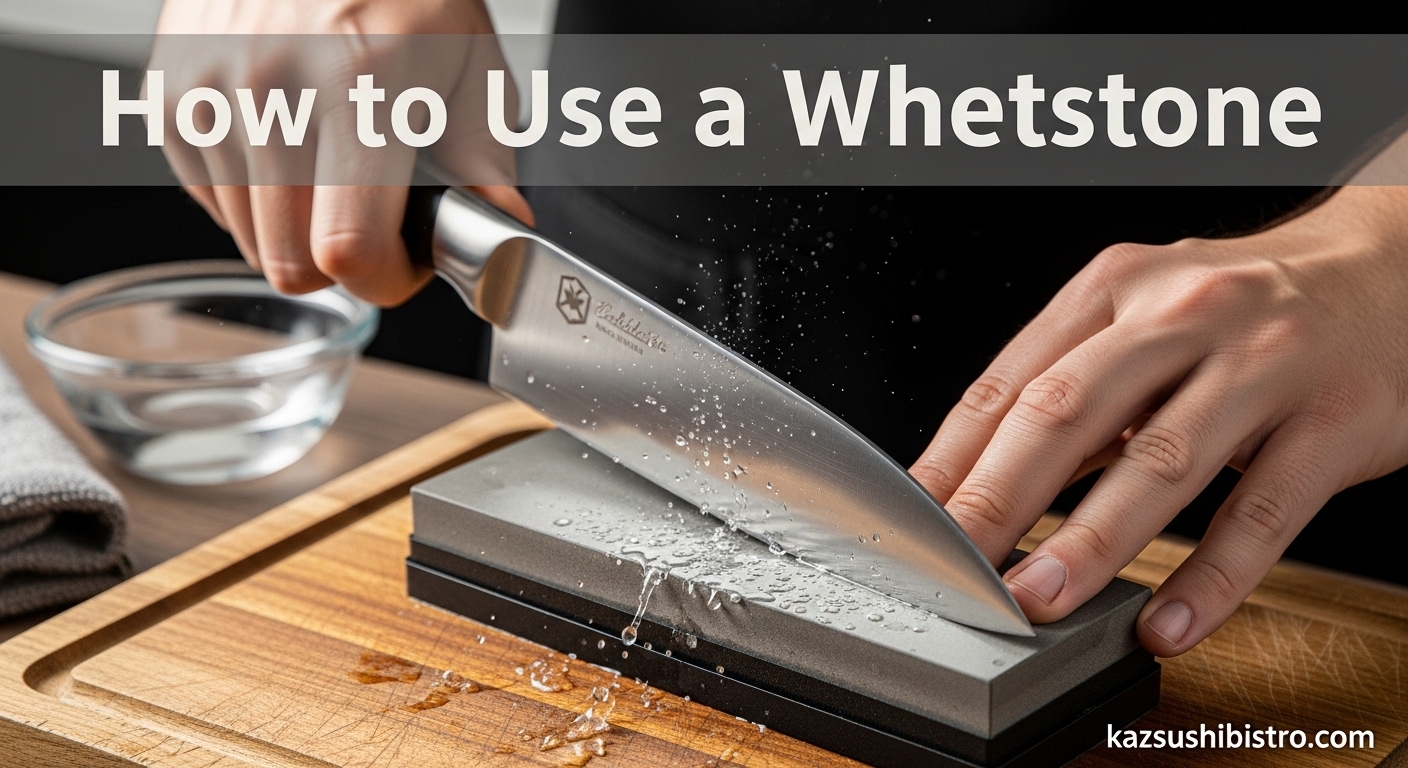
Learning how to use a whetstone changed everything about how I cook. Before I discovered proper knife sharpening, I struggled with dull blades that crushed tomatoes instead of slicing them cleanly. A dull knife is actually more dangerous than a sharp one because it requires more force and can slip unpredictably.
I spent three months practicing on cheap knives before touching my expensive chef’s knife. Through countless mistakes and ruined edges, I finally developed a system that works every time. In this guide, I will share everything I learned about whetstone sharpening so you can avoid the frustration I experienced.
You will learn the exact step-by-step process to take any knife from dull to razor-sharp. We will cover the proper soaking times, how to find the correct 15-20 degree angle, and how to detect the burr that tells you when to flip the blade. By the end, you will have the confidence to maintain your knives at professional sharpness levels.
Table of Contents
What Is a Whetstone?
A whetstone is an abrasive block used to sharpen steel blades by grinding away small amounts of metal. The name comes from the word whet, which means to sharpen, not from any requirement to wet the stone. These stones have been used for centuries to maintain everything from kitchen knives to woodworking tools.
Most modern whetstones are made from synthetic materials like aluminum oxide or silicon carbide bonded into a block. Some premium stones use natural quarried materials like Japanese waterstones. Both types work by wearing away the dull edge of your blade to create a new, sharp cutting surface.
You might hear people call them waterstones or sharpening stones. A waterstone is technically a specific type of whetstone that requires soaking before use. The terms are often used interchangeably, but understanding the distinction helps when shopping for your first stone.
Using a whetstone gives you more control than any electric sharpener or pull-through device. It removes the least amount of metal while creating the sharpest possible edge. This extends the life of your knives and gives you cutting performance that factory edges cannot match.
Tools and Materials You Will Need
Before you start sharpening, gather these essential items. Having everything ready prevents interruptions that could affect your technique.
Required Items:
- A whetstone (1000/6000 grit combination stone recommended for beginners)
- Container large enough to soak your stone
- Clean towel or non-slip mat
- Your knife
- Water for lubrication
Optional but Helpful:
- Angle guide or sharpening guide clip
- Permanent marker for the Sharpie trick
- Stone flattening plate or lapping stone
- Cut-resistant glove for your non-knife hand
I recommend starting with a double-sided combination stone with 1000 grit on one side and 6000 grit on the other. This gives you everything you need to both repair dull edges and refine them to razor sharpness. A 1000 grit stone alone works fine, but you will need a finer grit to achieve that polished, professional edge.
How to Use a Whetstone: Step-by-Step Guide
Follow these nine steps in order for consistent results every time. I developed this process after testing different methods over hundreds of sharpening sessions.
Step 1: Soak Your Whetstone
Place your whetstone in a container of water and let it soak until bubbles stop rising. This typically takes 10 to 15 minutes for most stones. The bubbles indicate air escaping from the porous stone material as water penetrates the surface.
Some modern stones are labeled splash-and-go and do not require soaking. These stones only need a splash of water on the surface before use. Check your stone’s instructions, but when in doubt, soaking for 10 minutes will not hurt any whetstone.
The water serves two purposes. It carries away the metal particles you grind off the blade. It also prevents the stone from clogging with steel residue, which would reduce its sharpening effectiveness.
Step 2: Set Up Your Sharpening Station
Find a stable, flat surface at a comfortable working height. A kitchen counter at standard height works well for most people. Place your wet towel or non-slip mat on the surface to prevent the stone from sliding during use.
Position the stone with the coarse grit facing up if you are starting with a dull blade. The stone should be parallel to the edge of your counter for comfortable arm movement. Keep a small container of water nearby to re-wet the stone surface as needed.
Good lighting is essential. You need to see the edge of your blade clearly to maintain the correct angle. A desk lamp or under-cabinet lighting makes a significant difference in your ability to see what you are doing.
Step 3: Find the Correct Sharpening Angle
Maintaining a consistent angle is the most critical part of sharpening. Most kitchen knives use either a 15-degree angle for Asian-style knives or a 20-degree angle for Western-style knives.
Here is a simple method to find these angles without any special tools. Hold your knife blade perpendicular to the stone at a 90-degree angle. Cut that angle in half to 45 degrees by visual estimation. Cut the 45-degree angle in half again to get approximately 22.5 degrees. Tilt back slightly for 20 degrees, or forward slightly for 15 degrees.
Another reliable method uses coins. Stack two nickels under your blade to approximate 20 degrees. Stack two dimes to approximate 15 degrees. The exact measurement matters less than consistency. Pick an angle and stick with it throughout the sharpening process.
Lock your wrist and move from your shoulder to maintain this angle. Wrist movement causes the angle to change, resulting in a rounded, ineffective edge. Practice the motion several times without pressure to build muscle memory before touching the stone.
Step 4: Begin Sharpening the First Side
Place your knife on the stone with the edge facing away from you. The heel of the blade (the part closest to the handle) should touch the stone first. Maintain your chosen angle throughout this process.
Apply gentle pressure with two or three fingers on the blade. Push the knife across the stone in a sweeping motion from heel to tip. You can either push away from you or pull toward you; both methods work equally well when done correctly.
I prefer the pushing motion because it feels more controlled. Start at the heel and push forward while simultaneously sliding the blade across the stone so the tip reaches the end as you finish the stroke. This covers the entire edge in one smooth movement.
Repeat this motion 10 to 15 times on the first side. You should hear a consistent scratching sound as the blade contacts the stone. If the sound changes dramatically, check your angle and pressure.
Step 5: Check for the Burr
The burr is a small ridge of metal that forms on the opposite side of the edge you are sharpening. It indicates that you have ground steel all the way to the apex of the edge. Feeling for this burr tells you when to switch sides.
To check for the burr, gently run your fingertip across the blade on the side opposite to where you were sharpening. Move perpendicular to the edge, not along it. The burr feels like a rough, raised lip of metal that catches your finger.
If you do not feel a burr after 15 to 20 strokes, continue sharpening with light pressure. Check again every 5 to 10 strokes. The number of strokes needed varies based on steel hardness, dullness level, and stone grit. Soft steel forms a burr faster than hard steel.
Do not rush this step. Raising a proper burr on the entire edge ensures you have sharpened all the way to the apex. Without a burr, you have not reached the edge yet and your knife will not be sharp.
Step 6: Sharpen the Second Side
Flip your knife and place the other side of the blade against the stone. Maintain the exact same angle you used on the first side. Consistency between sides creates a symmetrical, strong edge.
Use the same number of strokes on this side as you used on the first side. If you did 20 strokes to raise the burr on the first side, do 20 strokes on the second side. This removes the burr you formed and begins creating a new one on the opposite side.
Check for a burr on the first side after your initial strokes. Once you feel it, you have successfully sharpened both sides to meet at the center. The edge should now feel smoother when you test it gently with your fingertip.
At this point, your knife should be significantly sharper than when you started. It may even be sharp enough for most kitchen tasks. However, continuing to finer grits will refine the edge further.
Step 7: Progress to Finer Grit
If you are using a combination stone, flip it to the finer grit side. Rinse the stone surface first to remove any coarse grit particles that could scratch your refined edge. Wet the surface thoroughly before continuing.
Repeat the sharpening process on the fine grit side using fewer strokes. Start with 10 strokes per side and check your edge. The fine grit polishes the edge and removes the deep scratches left by the coarse grit.
Work your way up through finer grits if you have multiple stones. A typical progression might be 1000 grit, then 3000 grit, then 6000 grit for a razor finish. Each step should use fewer strokes than the previous one.
On the finest grit, use very light pressure. Let the stone do the work. Heavy pressure at this stage can actually round off your edge and reduce sharpness. Think of this stage as polishing rather than grinding.
Step 8: Test for Sharpness
Several reliable methods exist to test if your knife is truly sharp. The paper test is the most common. Hold a sheet of printer paper vertically and slice down through it. A sharp knife will cut cleanly without tearing or snagging.
The tomato test works well for kitchen knives. Place a ripe tomato on your counter and try to slice it without holding the tomato steady. A truly sharp blade will bite into the skin immediately without squashing the fruit.
Visual inspection under good light can also reveal sharpness. Look directly at the edge from the side. A dull edge reflects light and appears as a bright line. A sharp edge is too thin to reflect light and will appear as a black line.
Arm hair testing is another method, though I recommend caution. A razor-sharp knife will shave hair cleanly. Only attempt this if you are confident in your sharpening results and your ability to control the blade.
Step 9: Clean and Store Your Equipment
Rinse your whetstone under running water to remove metal particles and slurry. Pat it dry with a towel. Store stones flat in a dry place to prevent warping or cracking.
Never store stones while they are still wet. Trapped moisture can damage synthetic stones and promote mold growth. Some stones benefit from occasional flattening with a lapping plate to maintain an even surface.
Wash your knife with warm soapy water to remove any metal residue. Dry it thoroughly before storing. A drop of food-safe mineral oil on carbon steel blades prevents rust.
Your sharpening session is complete. With practice, this entire process takes 10 to 15 minutes per knife. Regular maintenance sharpening takes even less time because you are maintaining an edge rather than repairing a dull one.
Understanding Whetstone Grit Sizes
Whetstones come in various grit sizes that determine how aggressively they remove metal. Understanding these ranges helps you choose the right stone for each task.
| Grit Range | Category | Best For |
|---|---|---|
| 200-600 | Coarse | Repairing chips, reprofiling damaged edges |
| 800-2000 | Medium | Regular sharpening, maintaining edges |
| 3000-5000 | Fine | Refining edges, preparing for polishing |
| 6000-10000+ | Ultra-Fine | Polishing, creating razor edges |
Coarse grit stones in the 200 to 600 range remove metal quickly. Use these only when you need to repair significant damage or reprofile an edge that has been sharpened at the wrong angle for years. These stones leave deep scratches that finer grits must remove.
Medium grit stones from 800 to 2000 do the actual sharpening work. A 1000 grit stone is the standard starting point for most kitchen knives. This grit creates a sharp edge suitable for most tasks while removing minimal metal.
Fine grit stones from 3000 to 5000 refine the edge and remove scratches from coarser stones. These create edges that slice cleanly through delicate items like fish and herbs. Most home cooks stop at this range for daily kitchen knives.
Ultra-fine grit stones above 6000 polish the edge to mirror finishes. These are primarily used for razors and specialty knives where absolute sharpness matters. Japanese sushi chefs often use 8000+ grit stones for their yanagiba knives.
Pro Tips and Common Mistakes to Avoid
After sharpening knives for several years, I have made every mistake possible. Here are the most common errors beginners make and how to avoid them.
Common Beginner Mistakes
Inconsistent angle is the number one problem for beginners. Even small variations in angle create a rounded bevel instead of a sharp edge. Practice the muscle memory of holding your angle before working on expensive knives.
Using too much pressure is another frequent error. Heavy pressure removes more metal than necessary and can damage your stone. Let the abrasive surface do the work. Light, consistent pressure produces better edges.
Skipping grit levels causes problems when moving from coarse to fine. You must fully remove the scratches from each grit before progressing. If you still see deep scratches after fine grit sharpening, return to the previous grit.
Expert Techniques
The Sharpie marker trick helps beginners verify their angle. Color the entire bevel of your knife with a permanent marker before sharpening. After a few strokes, check where the marker wore off. If it removed evenly across the bevel, your angle is correct.
Focus on shoulder movement rather than wrist or elbow. Your shoulder provides a more stable pivot point for maintaining consistent angles. Lock your wrist and elbow, then move your entire arm as a unit.
Flatten your stones regularly using a flattening plate or coarse diamond plate. Stones wear down in the center with use, creating a dished surface that rounds your edges rather than sharpening them. Check flatness by laying a straight edge across your stone.
Safety Precautions
Always keep your fingers on the spine of the knife, never near the edge. Use slow, controlled movements rather than rushing. A cut from a sharpening knife is often worse than a cut from a dull knife because the edge is razor sharp.
Consider wearing a cut-resistant glove on your non-knife hand. These gloves provide protection while still allowing you to feel the burr. They are inexpensive insurance against serious injury.
Work over a towel or in a sink to catch any dropped knives. Never try to catch a falling knife. Step back and let it fall. A damaged knife edge can be fixed; a damaged hand cannot.
Frequently Asked Questions
How to use whetstone for beginners?
Start with a 1000/6000 grit combination stone. Soak the stone for 10-15 minutes, find a 15-20 degree angle using the coin method, and practice the sharpening motion slowly. Do 10-20 strokes per side until you feel a burr, then switch sides. Test sharpness by slicing paper.
Are you supposed to wet a whetstone?
Yes, most whetstones require soaking in water for 10-15 minutes until bubbles stop rising. However, splash-and-go stones only need water on the surface. The water lubricates the stone and carries away metal particles. Never use oil on a waterstone.
Do you pull or push the blade on a whetstone?
Both methods work equally well. Push away from you or pull toward yourself while maintaining a consistent angle and sweeping from heel to tip. The key is smooth, controlled motion rather than the direction. Choose whichever feels more natural to you.
How long do you let a whetstone sit in water?
Soak your whetstone for 10 to 15 minutes or until bubbles stop rising from the surface. Splash-and-go stones do not require soaking. Keep the stone wet during sharpening by adding water as needed. Never let the stone dry out mid-session.
What angle should I hold my knife on a whetstone?
Hold Asian-style knives at approximately 15 degrees and Western-style knives at 20 degrees. Use the 90-45-22.5 method to estimate these angles without tools. Consistency matters more than the exact angle. Always maintain the same angle throughout sharpening.
How do I know when my knife is sharp enough?
Test by slicing a sheet of paper vertically. A sharp knife cuts cleanly without tearing. You can also slice a tomato without squashing it, or look for a black line when viewing the edge under light. The knife should shave arm hair cleanly if razor-sharp.
Final Thoughts
Learning how to use a whetstone takes time and practice, but the results are worth every minute. A properly sharpened knife transforms cooking from a chore into a pleasure. You will work faster, safer, and with more precision when your blades are maintained correctly.
Start with inexpensive knives to build your skills without fear of damaging something valuable. Practice the motions until they feel natural. Focus on maintaining a consistent angle above all else.
Remember that sharpening is a maintenance task, not a one-time fix. Touch up your knives every few weeks depending on use. Regular maintenance takes five minutes and keeps your edges in peak condition. Your future self will thank you every time you slice a ripe tomato with effortless precision.