
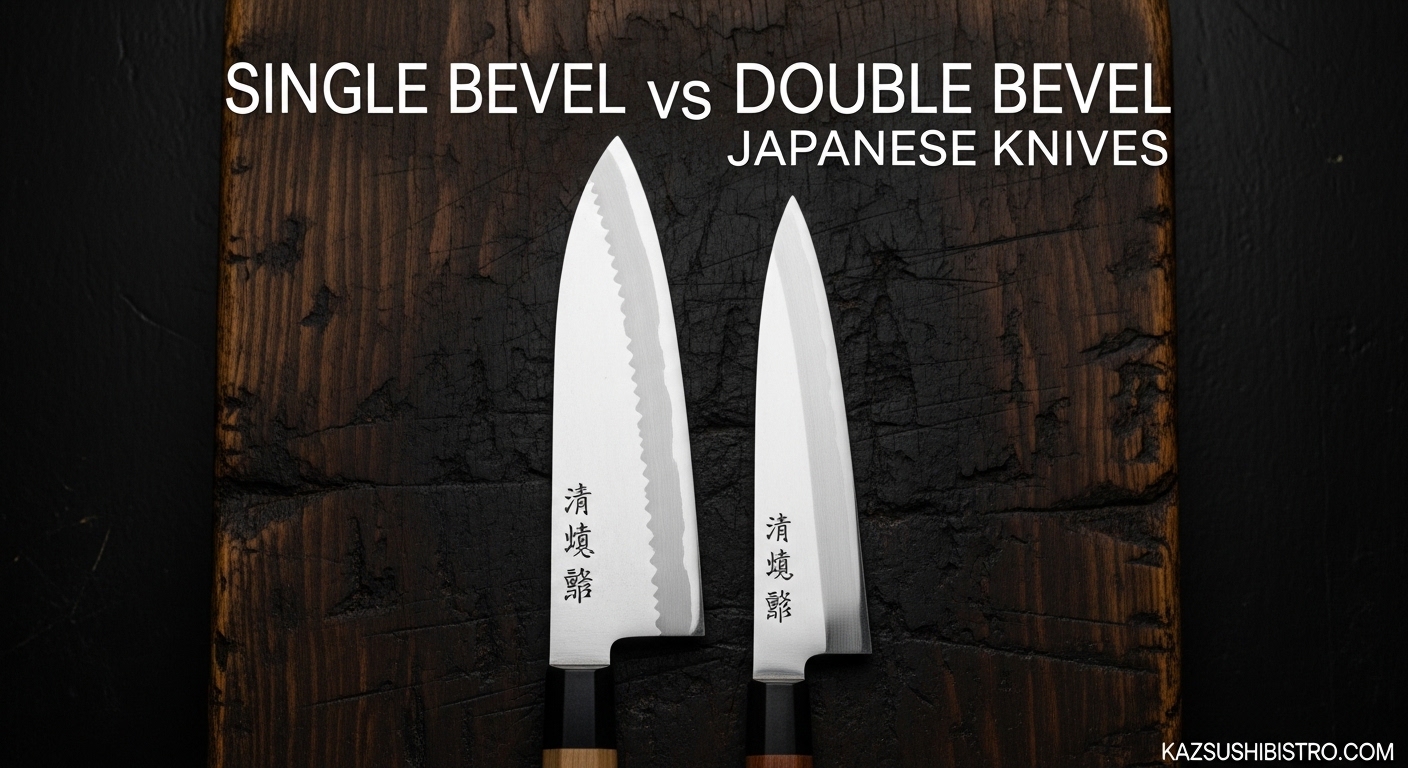
A knife bevel is the angled surface ground onto the blade to form the cutting edge. If this angle exists on both sides of the blade, you have a double bevel knife. If the angle exists on only one side with the opposite side remaining flat or concave, you have a single bevel knife. This fundamental difference in blade geometry completely changes how the knife cuts, what it excels at, and who should use it.
After spending 8 years working in professional kitchens and teaching knife skills workshops, I have watched hundreds of home cooks struggle with single bevel knives they bought after watching sushi chefs on YouTube. I have also seen professionals transform their sashimi prep with the right single bevel blade. The choice between single bevel vs double bevel japanese knives is not about which is superior. It is about matching the tool to your skills, your cooking style, and the specific tasks you perform most often.
In this guide, I will explain exactly what separates these two knife types, which Japanese knife styles fall into each category, and how to choose the right one for your kitchen. You will learn why most Japanese home cooks use double bevel knives, why sushi chefs insist on single bevels, and which one deserves your money 2026.
Table of Contents
What Is a Knife Bevel?
The bevel is the slanted surface on a knife blade that tapers down to create the cutting edge. Think of it as the angled ramp that leads to the sharp point where the actual cutting happens. Without this angled geometry, a blade would be too thick to slice cleanly through food.
Many people confuse the bevel with the edge itself. The edge is the actual line where the two bevels meet and do the cutting. The bevel is the larger surface leading up to that edge. On a typical kitchen knife, you can see the bevel as the shiny angled section near the cutting edge, distinct from the flat face of the blade.
The angle of this bevel, measured in degrees, determines how sharp and durable your knife will be. Steeper angles create finer edges but sacrifice durability. Shallower angles create stronger edges but reduce cutting precision. Most Japanese knives use angles between 10 and 20 degrees per side, significantly sharper than typical Western knives at 20 to 25 degrees.
Bevel geometry also affects how a knife moves through food. A single bevel knife, with its asymmetrical design, naturally pushes the cut material away from the flat side. A double bevel knife, with symmetrical angles on both sides, cuts straight down without pushing food to either side. This seemingly small difference becomes massive when you are trying to cut paper-thin slices of raw fish or chop vegetables quickly without them sticking to the blade.
Understanding Single Bevel Knives 2026
Single bevel knives are sharpened on only one side of the blade. The cutting side has an angled bevel ground to a precise degree, while the back side remains flat or slightly concave. This asymmetrical design creates unique cutting properties that make these knives indispensable for specific tasks in Japanese cuisine.
Design Features: Ura-suki and Shinogi-suji
The back side of a single bevel knife features a concave grind called the ura-suki. This hollowed-out surface serves multiple purposes. It reduces friction as the knife moves through food, prevents delicate proteins from sticking to the blade, and creates a natural air pocket that helps release sliced ingredients. When you look at the back of a quality single bevel knife, you will notice this subtle concavity that distinguishes it from a completely flat surface.
On the beveled side, you will often see a distinct ridge line called the shinogi-suji. This line separates the flat upper portion of the blade from the angled bevel below. On traditional Japanese knives, the area above this line is often left with a matte finish while the bevel is polished, creating a visible boundary. The shinogi-suji position affects how the knife releases food and how it feels during cutting.
The edge geometry itself is essentially chisel-like. Because only one side is angled, the edge forms an asymmetrical triangle rather than a symmetrical V. This asymmetry means the knife naturally pulls toward the beveled side during cutting. Right-handed single bevel knives have the bevel on the right side, pulling the blade slightly right as you cut. Left-handed versions reverse this geometry, with the bevel on the left side.
Best Uses and Applications
Single bevel knives excel at three specific techniques that define traditional Japanese cuisine. The first is katsuramuki, the rotary peeling of cylindrical vegetables like daikon into continuous paper-thin sheets. Only a single bevel knife can perform this technique effectively because the flat back rides against the vegetable while the beveled edge slices. You cannot perform katsuramuki with a double bevel knife.
The second technique is precise sashimi preparation. The yanagiba, the classic single bevel sashimi knife, creates those mirror-finish slices you see at high-end sushi restaurants. The single bevel design allows the blade to glide through fish in one smooth drawing motion, leaving a clean cut that preserves the delicate texture of raw protein. The asymmetrical edge actually helps separate the slice from the fish fillet without tearing.
The third application is heavy-duty butchery of fish and poultry using knives like the deba. Despite being single bevel, the deba is thick and robust, designed to cut through small fish bones and joints. The single bevel geometry provides the control needed for precise cuts near bones without the blade wandering. Professional Japanese kitchens use deba knives for breaking down whole fish because the single bevel allows controlled, accurate cuts that preserve yield.
The usuba, another single bevel specialist, is designed specifically for vegetable work in professional kitchens. Its thin blade and single bevel geometry excel at the precise cuts required for Japanese vegetable preparation. However, the usuba requires significant skill and is rarely the right choice for home cooks.
Sharpening Requirements
Sharpening a single bevel knife is significantly more complex than sharpening a double bevel. You must maintain three distinct surfaces: the flat back (ura), the primary bevel, and the cutting edge itself. The back must remain perfectly flat to maintain proper geometry, which requires specific sharpening stones and techniques.
The sharpening angle for the beveled side typically ranges from 10 to 15 degrees, much steeper than most Western knives. This fine angle creates the exceptional sharpness single bevel knives are known for, but it also means the edge is more delicate and requires more frequent maintenance. Professional chefs who use single bevel knives daily often touch up the edge every few days.
The back side requires special attention. You must periodically flatten the ura-suki on a coarse stone to maintain the concave geometry. If you let the back become rounded or uneven, the knife will not cut straight and may even damage food rather than slice it. Many users send their single bevel knives to professional sharpeners (togishi) rather than attempt this maintenance themselves.
Understanding Double Bevel Knives
Double bevel knives are ground and sharpened on both sides of the blade, creating a symmetrical V-shaped edge. This is the standard design for most Western knives and, contrary to popular belief, the majority of Japanese knives sold for home use. The symmetrical geometry makes these knives intuitive to use and significantly easier to maintain.
Design Features and Blade Geometry
The defining feature of a double bevel knife is symmetrical grinding on both sides. Each side is typically ground to the same angle, usually between 10 and 20 degrees, creating a total edge angle of 20 to 40 degrees. Some Japanese double bevel knives use asymmetrical angles, such as 70/30 or 60/40 splits, favoring one side slightly while still maintaining double bevel functionality.
The edge cross-section of a double bevel knife is often described as hamaguri-ba, meaning clam-shaped. Rather than a straight V, the edge curves slightly, creating a stronger, more durable cutting surface while still maintaining sharpness. This geometry is particularly common on gyuto and santoku knives designed for heavy kitchen use.
Some double bevel knives feature a micro-bevel or kobatsuke, a tiny secondary bevel at the very edge that adds strength without significantly reducing sharpness. This micro-bevel makes the edge more durable for everyday cooking tasks that might chip a finer edge. You can see this as a faint line right at the cutting edge when held in good light.
Best Uses and Applications
Double bevel knives are the workhorses of both Japanese and Western kitchens. They handle 90% of kitchen tasks without the learning curve or maintenance demands of single bevel knives. This versatility makes them the right choice for most home cooks and even many professional chefs who value efficiency over specialized performance.
The gyuto, essentially the Japanese equivalent of a Western chef knife, is almost always double bevel. Its curved edge profile allows both slicing and rocking cuts, making it suitable for everything from chopping herbs to breaking down chicken. Professional chefs in busy kitchens often prefer double bevel gyutos because they handle diverse tasks without requiring constant technique adjustment.
The santoku, the most popular Japanese knife for home cooks worldwide, is also double bevel. Its flatter edge profile excels at up-and-down chopping motions for vegetables, while the sheep’s foot tip provides safety and control. The nakiri, a vegetable specialist with a flat edge and squared tip, is another double bevel design that offers excellent performance for plant-based cooking without single bevel complexity.
Even some traditionally single bevel tasks can be performed adequately with double bevel knives. A skilled cook can prepare respectable sashimi with a sharp double bevel sujihiki. While the result may not match the mirror finish of a yanagiba slice, it satisfies most home cooking needs. This reality explains why double bevel knives dominate home kitchens in Japan just as they do elsewhere.
Sharpening Requirements
Sharpening a double bevel knife is straightforward and forgiving. You sharpen both sides at the same angle, typically 15 to 20 degrees per side, alternating strokes to maintain symmetry. The process is intuitive: form a burr on one side, form a burr on the other side, then remove the burr with light alternating strokes.
Because both sides are beveled, you do not need to worry about maintaining a perfectly flat back surface. You simply focus on keeping the angles consistent on both sides. This forgiving nature means double bevel knives are more accessible for home sharpeners learning whetstone techniques. Even imperfect sharpening usually produces a functional edge.
The edge durability of double bevel knives also means they require less frequent sharpening. A typical home cook might sharpen a double bevel gyuto once every few weeks or even monthly, depending on use. Professional cooks might sharpen weekly. This lower maintenance requirement makes double bevel knives more practical for everyday use.
Single vs Double Bevel: Side-by-Side Comparison
Choosing between single and double bevel requires understanding how each performs across key criteria. This comparison breaks down the practical differences you will notice in daily use.
| Feature | Single Bevel | Double Bevel |
|---|---|---|
| Cutting Action | Asymmetrical, pulls to one side | Symmetrical, cuts straight down |
| Maximum Sharpness | Higher potential sharpness | Very sharp, slightly less fine |
| Learning Curve | Steep, requires technique adjustment | Gentle, intuitive for most users |
| Sharpening Difficulty | Complex, three surfaces to maintain | Simple, symmetrical approach |
| Versatility | Specialized for specific tasks | General purpose, handles diverse tasks |
| Handedness | Right and left versions required | Ambidextrous design |
| Best For | Sashimi, katsuramuki, precise cuts | Everyday cooking, general prep |
| Maintenance Frequency | High, requires regular upkeep | Moderate, forgiving of neglect |
| Price Entry Point | Higher, specialist tools | Wide range, budget options available |
| Typical User | Sushi chefs, enthusiasts | Home cooks, professional line cooks |
Looking at sharpness specifically, single bevel knives can achieve finer edges because the asymmetrical geometry allows for a more acute included angle. However, this extreme sharpness comes at the cost of durability and ease of use. The single bevel edge is more fragile and requires better technique to avoid damage.
Food release is another differentiator. The ura-suki concavity on single bevel knives creates an air pocket that prevents food from sticking, particularly important for wet ingredients like raw fish. Double bevel knives often have blade finishes or granton edges to address sticking, but the physics favor single bevel designs for food release.
For straight cutting performance, double bevel knives win for most users. The symmetrical design cuts straight down without steering. Single bevel knives naturally pull toward the beveled side, which skilled users can use to their advantage but beginners find frustrating. This steering effect makes single bevel knives challenging for tasks requiring straight cuts through dense materials.
Which Knife Should You Choose?
The right choice depends on your cooking style, skill level, and patience for maintenance. Here is my decision framework based on years of teaching and professional experience.
Choose Double Bevel If…
- You cook diverse cuisines beyond Japanese food
- You are buying your first quality Japanese knife
- You prefer low-maintenance kitchen tools
- You use rocking cutting motions frequently
- You want one knife that handles most tasks
- You are left-handed and want readily available options
- You sharpen your own knives and are still learning
A double bevel gyuto or santoku will serve 95% of home cooks better than any single bevel alternative. You sacrifice the extreme precision of a yanagiba for sashimi, but you gain versatility and ease of use that makes cooking more enjoyable daily. Most Japanese home cooks use double bevel knives exclusively for this reason.
Choose Single Bevel If…
- You prepare sashimi or sushi weekly or more
- You practice traditional Japanese vegetable techniques
- You enjoy the ritual and precision of specialized tools
- You are willing to invest time in learning proper technique
- You have access to professional sharpening services
- You are right-handed (left-handed options are limited and expensive)
- You already own quality double bevel knives for general tasks
Single bevel knives are specialist tools, not generalists. Buying a yanagiba as your only good knife is like buying a race car as your daily driver. Beautiful and capable in the right context, but frustrating for grocery runs. Own a quality double bevel gyuto first, then add single bevel specialists as your skills and interests develop.
My Specific Recommendations by Skill Level
For beginners, start with a double bevel gyuto in the 210mm to 240mm range or a santoku around 180mm. These knives teach proper technique without the steering issues of single bevels. Brands like Tojiro, Fujiwara, and entry-level lines from Masakage offer excellent value around $100 to $150.
For intermediate cooks who have mastered basic knife skills and own a good double bevel knife, consider adding a single bevel yanagiba if you prepare raw fish regularly. Start with a 270mm yanagiba in white carbon steel or Ginsan stainless from reputable makers like Sakai Takayuki or Masamoto. Budget $200 to $400 for a knife that will last decades with care.
For professionals and serious enthusiasts, build a complete kit. Own double bevel knives for general prep and single bevel specialists for specific tasks. A professional Japanese kitchen will have gyutos for line work, yanagibas for sashimi, deba for fish butchery, and usubas for vegetables. Each tool has its place.
Frequently Asked Questions
Are Japanese knives single or double bevel?
The vast majority of Japanese knives are double bevel. Popular styles like gyuto, santoku, nakiri, and petty knives are almost always double bevel. Single bevel knives are specialist tools used primarily for traditional Japanese techniques like sashimi preparation and katsuramuki. Most home cooks in Japan use double bevel knives for everyday cooking.
Is double bevel better than single bevel?
Neither is objectively better. Double bevel knives are better for everyday cooking and beginners due to their versatility and ease of use. Single bevel knives are better for specific tasks like sashimi preparation where extreme precision matters. The best choice depends on your cooking style, skill level, and patience for maintenance.
Is a single bevel knife better?
Single bevel knives can achieve sharper edges and excel at specialized tasks like cutting sashimi and performing katsuramuki. However, they are harder to use and maintain than double bevel knives. For general kitchen work, a single bevel knife is not better and often performs worse due to steering issues and fragility.
Why are single bevel knives harder to use?
Single bevel knives pull toward the beveled side during cutting, causing steering that makes straight cuts difficult until you adapt your technique. They are also more fragile with thinner, sharper edges that chip easily if misused. The asymmetrical design requires right or left-handed versions, and sharpening them demands more skill and maintenance.
What is the difference between single bevel and double bevel knives?
Single bevel knives are sharpened on one side only, creating an asymmetrical edge that pulls during cutting but excels at precise tasks. Double bevel knives are sharpened on both sides symmetrically, cutting straight down and handling diverse kitchen tasks easily. Single bevels are specialist tools for Japanese cuisine techniques, while double bevels are versatile workhorses.
Can beginners use single bevel knives?
Beginners can use single bevel knives, but most will find the learning curve frustrating. The steering effect requires technique adjustment, and the delicate edges are easily damaged by improper cutting boards or technique. I recommend starting with double bevel knives and transitioning to single bevel only after developing solid knife skills and understanding proper maintenance.
What angle do you sharpen single bevel knives?
Single bevel knives are typically sharpened at 10 to 15 degrees on the beveled side. The flat back side should not be sharpened at an angle but rather kept flat, though you may polish the very edge slightly. Maintaining this asymmetrical geometry is crucial for proper single bevel performance.
What angle do you sharpen double bevel knives?
Double bevel Japanese knives are typically sharpened at 15 to 20 degrees per side, creating a total edge angle of 30 to 40 degrees. Some asymmetric double bevel knives use different angles per side, such as 70/30 or 60/40 splits. Consistency between both sides matters more than the exact angle chosen.
Conclusion
Understanding single bevel vs double bevel japanese knives comes down to matching the tool to your needs. Double bevel knives offer the versatility and ease that most cooks need daily. Single bevel knives provide the precision that specialists require for traditional techniques. Neither is superior in absolute terms. Both deserve respect for the specific problems they solve.
If you are building your first serious knife collection, start with a quality double bevel gyuto or santoku. Master the fundamentals of cutting technique and sharpening on this forgiving platform. Once you have developed solid skills and identified specific gaps in your toolkit, consider adding a single bevel specialist like a yanagiba for sashimi or an usuba for vegetable work. The journey from double bevel generalist to single bevel specialist is one of the rewarding paths in culinary craft.
The best knife is the one you actually use and maintain properly. A $50 double bevel knife that sees daily action beats a $500 single bevel knife that sits in a drawer because you are afraid to damage it. Choose wisely, maintain diligently, and enjoy the pleasure of working with well-crafted tools that make cooking more satisfying.