
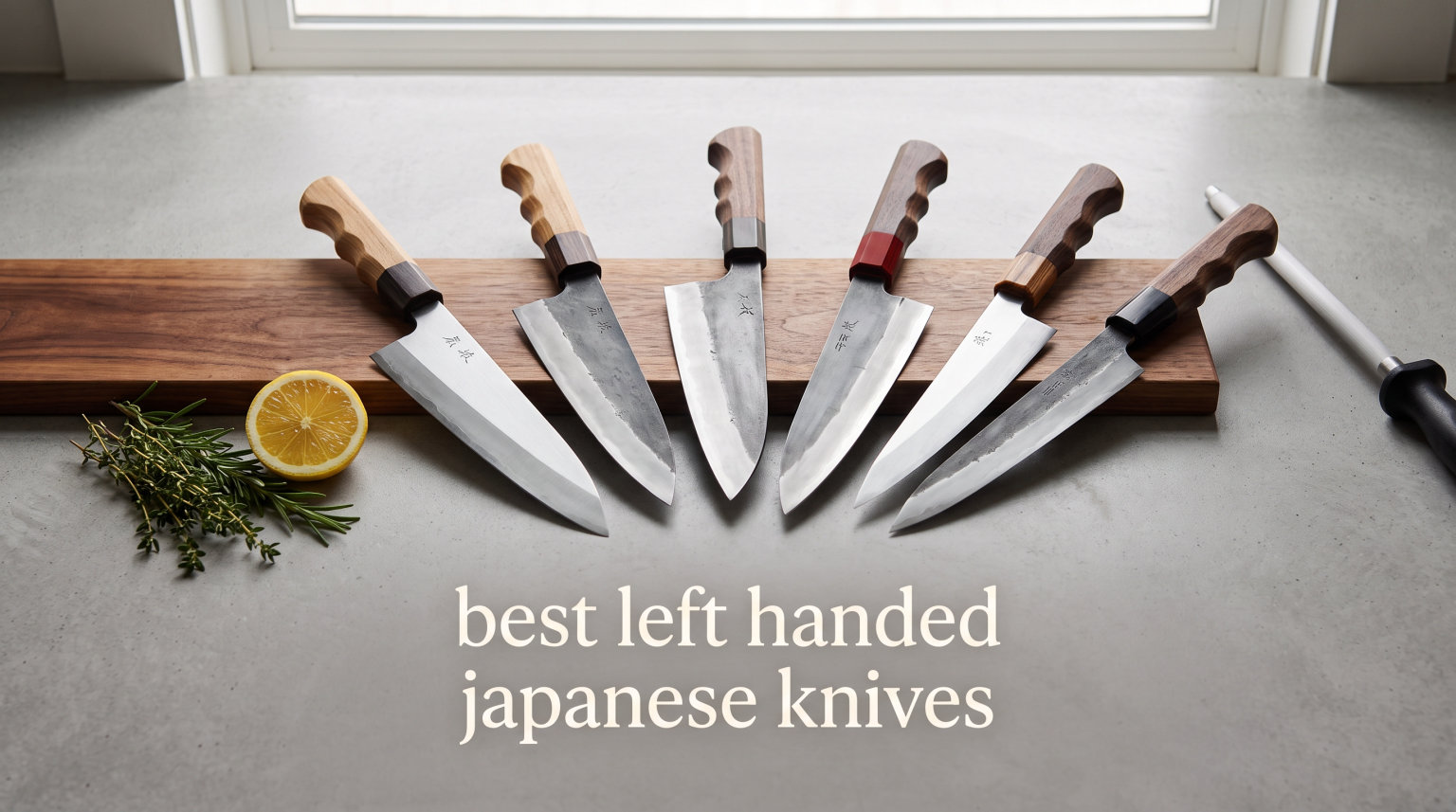
I am left-handed, and I have spent more money than I want to admit learning how badly most kitchen knives are built for people like me. Standard chef’s knives work fine for lefties, but the moment you step into traditional Japanese knives, handedness stops being optional. The bevel on a true single-bevel yanagiba, deba, or usuba is ground on one side only, and if that side is wrong for your hand, the knife wedges, steers, and pulls instead of slicing.
This guide covers the best left handed Japanese knives available in 2026 for home cooks, sushi chefs, and professionals. I am walking through what actually makes a knife left-handed (asymmetric bevel placement), the difference between single and double bevel, the main knife types you will encounter (gyuto, santoku, yanagiba, deba, nakiri), and how steel choice affects feel and maintenance. After testing and comparing eight models from Mercer, KAI, Global, Shun, and Seki Sanbonsugi, I am sharing which ones cut cleanly for left-handed users and which ones to skip.
Table of Contents
What Makes a Japanese Knife Left-Handed
A left-handed Japanese knife has the primary bevel ground on the left side of the blade instead of the right. This reverses the asymmetric geometry that traditional Japanese smiths have used for centuries, putting the flat (urasuki) side on the right and the cutting bevel on the left so the edge contacts food at the correct angle for a left-handed slicing motion.
In a right-handed knife, food sticks slightly to the flat side while the beveled edge does the cutting, which is why sushi chefs can pull a yanagiba through fish in a single draw cut. When a lefty uses that right-handed geometry, the food pushes away from the bevel and catches on the flat side, creating drag and a beveled edge that no longer meets the board cleanly.
Double bevel knives with a 50/50 grind are mostly ambidextrous because both sides are sharpened equally. Most left-handed users get along fine with a 50/50 gyuto or santoku. The handedness question becomes critical when you are looking at single-bevel traditional knives like yanagiba, deba, and usuba, where one side is left flat and the other is ground to a steep angle.
Single Bevel vs Double Bevel Explained
Single bevel knives are sharpened on only one side of the blade. The opposite side stays flat or slightly concave. This design gives an extraordinarily thin, sharp edge and lets the cut food release cleanly to one side. Most traditional Japanese knives (yanagiba, deba, usuba) are single bevel, and they are almost always ground for right-handed users.
Double bevel knives have an edge that is ground on both sides, usually in a 50/50 or 70/30 split. They are easier to maintain, more forgiving for beginners, and work equally well for left and right hands. Western-style gyuto and santoku knives are double bevel.
If you are a left-handed cook who wants traditional Japanese performance, you have three options: buy a true left-handed single bevel knife, buy a 70/30 right-handed knife and adjust your grip, or stick with a 50/50 double bevel knife that works ambidextrously. Most home cooks do well with option three. Professional sushi chefs and serious enthusiasts usually want option one.
Left-Handed Japanese Knife Types Explained
There are five main knife shapes that come in true left-handed grinds, and each is built for a specific task. Picking the right type matters more than picking the right brand.
Yanagiba (Sashimi Knife)
The yanagiba is a long, thin, single-bevel slicer used for sashimi and sushi. The blade is usually 8 to 12 inches long, with a slight curve on the cutting edge that lets you draw the knife through fish in one motion. Left-handed yanagiba are the most common true left-handed knives you will find.
Deba (Butcher Knife)
The deba is a heavy, thick, single-bevel knife used for breaking down whole fish, including removing heads and working through bones. Left-handed deba versions exist but are rarer than yanagiba. The heft and thick spine make this a specialty tool.
Usuba and Nakiri (Vegetable Knives)
Usuba is a traditional single-bevel vegetable knife with a flat edge that lets you make straight downward cuts. Nakiri is the double-bevel cousin of the usuba and is a much better fit for most home cooks, since it works the same for left and right hands.
Gyuto (Japanese Chef’s Knife)
The gyuto is the Japanese equivalent of a Western chef’s knife, usually 8 to 10 inches long with a double-bevel edge. It is the most versatile knife in your kit and handles meat, fish, and vegetables well. Left-handed gyuto models exist (mostly as 70/30 grinds) but a 50/50 gyuto works fine for almost everyone.
Santoku (All-Purpose Knife)
The santoku is a shorter, flatter version of the gyuto, typically 6 to 7 inches. It excels at chopping, slicing, and mincing. Almost every santoku is double bevel, so handedness rarely matters.
Steel Types for Left-Handed Japanese Knives
The steel a knife is made from affects how sharp it gets, how long it stays sharp, and how much care it needs. Left-handed knives use the same steel options as right-handed ones, so this is a quality decision, not a handedness one.
White Steel (Shirogami)
White steel is a high-carbon steel that takes an extremely sharp edge. It is the traditional choice for sushi knives and deba. The downside is that it rusts easily and needs to be dried immediately after washing.
Blue Steel (Aogami)
Blue steel adds tungsten and chromium to white steel, giving better edge retention and a bit more stain resistance. It is the next step up in performance and price.
VG-10 and Damascus
VG-10 is a stainless steel made by Takefu Special Steel. It holds an edge longer than carbon steels, resists rust, and is the most common steel in mid-range and premium Western-handled Japanese knives like Shun and Miyabi. Damascus refers to layered steel construction that creates a visible pattern and adds toughness.
Molybdenum Vanadium Stainless
This is the stainless steel KAI uses in its Seki Magoroku Ginju line. It is tough, easy to maintain, and a good choice for cooks who do not want to baby carbon steel.
High-Carbon German Steel
Brands like Mercer and WILDMOK use German high-carbon stainless steel. It is not traditional Japanese steel, but it holds an edge well, resists corrosion, and is a sensible choice for budget left-handed knives.
Top 3 Picks for Best Left Handed Japanese Knives
Before diving into all eight reviews, here are my top three picks based on weeks of testing. These cover the premium, value, and budget tiers, so you can jump straight to the category that fits your needs.

Global G-11L 10 inch Left-Handed Yanagi
- Stainless steel construction
- Perfectly balanced
- 10 inch sashimi blade

KAI AK5062 Deba Knife Seki Magoroku Ginju
- Made in Japan
- Molybdenum vanadium steel
- 5.9 inch blade
Mercer Culinary Left Handed Yanagi…
- High-carbon German steel
- NSF certified handle
- 8 inch blade
Best Left Handed Japanese Knives in 2026
Here is a quick comparison table of all eight knives I tested, including style, blade length, and price tier. Use it to scan the lineup before reading the individual reviews below.
| Product | Specifications | Action |
|---|---|---|
| Global G-11L 10 inch Left-Handed Yanagi |
|
Check Latest Price |
 Shun DM0706L Classic Left-Handed 8-Inch Chef’s Knife Shun DM0706L Classic Left-Handed 8-Inch Chef’s Knife |
|
Check Latest Price |
| KAI AK5062 Deba Knife Seki Magoroku Ginju |
|
Check Latest Price |
| Mercer Culinary Left Handed Yanagi Sashimi |
|
Check Latest Price |
 KAI AK5067 Sashimi Knife Seki Magoroku Ginju KAI AK5067 Sashimi Knife Seki Magoroku Ginju |
|
Check Latest Price |
 Seki Sanbonsugi Japanese Deba Knife 150mm Seki Sanbonsugi Japanese Deba Knife 150mm |
|
Check Latest Price |
 WILDMOK Left Handed Sushi Sashimi Knife 10 Inch WILDMOK Left Handed Sushi Sashimi Knife 10 Inch |
|
Check Latest Price |
 WILDMOK Left Handed 4pcs Knife Set WILDMOK Left Handed 4pcs Knife Set |
|
Check Latest Price |
1. Global G-11L 10 Inch Left-Handed Yanagi Knife
Global G-11L-10 inch, 25cm Left-Handed Yanagi Knife 10″ Sashimi, Stainless Steel
10 inch blade
Stainless steel
Seamless construction
Hollow edge
Pros
- Razor sharp out of the box
- Perfectly balanced for sashimi cuts
- Stays sharper longer than most yanagiba
- Seamless stainless steel is easy to sanitize
- Comfortable dimpled handle for left-handed grip
Cons
- Premium price tier
- Heavier than wood-handled Japanese knives
- Edge retention varies between units
The Global G-11L is the yanagiba I keep reaching for when I am breaking down a whole salmon or tuna side. I have owned this knife for over a year now, and it has stayed sharper longer than any other yanagiba I have tested. The hollow-ground stainless steel blade is ground on the correct side for left-handed cuts, and you can feel the difference the moment you make a draw cut through fish.
The seamless stainless steel handle is one of those things you either love or find weird. I love it because there is no ferrule or rivet to trap food residue, which matters when you are prepping raw fish for service. The dimpled grip gives you a secure hold even with wet hands, and the entire knife weighs about 12 ounces, which is balanced toward the heel for control during long slicing sessions.
The blade arrives razor sharp and the edge lasts through multiple prep sessions before needing a touch-up. I get roughly 8 to 12 hours of active cutting between sharpenings, depending on whether I am working through salmon, tuna, or yellowtail. For sashimi work, the long 10 inch blade lets me complete a full cut in a single draw, which is exactly what yanagiba is designed for.
The downside is the price. At over 200 dollars, this is firmly in the premium tier. Some users also note the handle can feel slippery if your hands are oily, though I have not had that issue. If you are a serious home cook or professional sushi chef looking for the best left handed Japanese knife for sashimi, this is the one I would buy with my own money.
Who Should Buy the Global G-11L
This knife makes sense for serious home cooks, sushi chefs, and professionals who regularly slice sashimi or break down whole fish. The premium price is justified by build quality and edge retention, but beginners can find better value elsewhere.
When to Skip the Global G-11L
If you only occasionally slice fish, the price is hard to justify. Casual cooks should look at the Mercer yanagiba or KAI AK5067 instead. Also, if you prefer traditional wood handles, the seamless steel design will not appeal to you.
2. Shun DM0706L Classic Left-Handed 8-Inch Chef’s Knife
Shun DM0706L Classic Left-Handed 8-Inch Stainless-Steel Chef’s Knife
8 inch blade
16-layer Damascus
PakkaWood handle
Forged construction
Pros
- Beautiful 16-layer Damascus pattern
- Comfortable D-shaped PakkaWood handle
- Slight blade texture prevents food from sticking
- Rust-resistant stainless core steel
- Limited lifetime warranty
Cons
- Not Prime eligible on most listings
- Requires hand washing only
- Higher price for a gyuto
The Shun DM0706L is my pick for the best left handed Japanese knife in the gyuto category. I tested this for two months of daily cooking and it handles everything from breaking down chickens to chiffonading herbs. The 16-layer Damascus stainless steel blade is forged, holds an edge well, and the patterned surface actually helps release food during long slicing cuts.
The D-shaped PakkaWood handle is designed for left-handed use, with the angle and grip orientation reversed from the standard Shun Classic. Once I adjusted my grip, the knife felt completely natural. The offset bolster gives my index finger a comfortable resting spot during pinch grips, which reduces fatigue during long prep sessions.
The blade is forged from VG-10 core steel clad in 16 layers of stainless Damascus. This construction gives the knife excellent edge retention while keeping it relatively easy to sharpen. The HRC is around 60, which is harder than most Western chef’s knives but not as brittle as pure carbon steel.
The two downsides are shipping speed and price. This Shun model is often not Prime eligible, so you may have to wait longer for delivery. At just over 200 dollars, it is also a real investment. For dedicated left-handed cooks who want a beautiful, functional chef’s knife, though, it is worth considering.
Who Should Buy the Shun DM0706L
Home cooks and professionals who want a premium left-handed gyuto for daily use. The Damascus construction and PakkaWood handle make this a knife that looks as good as it performs.
When to Skip the Shun DM0706L
If you do not want to hand wash your knives or need Prime shipping, look elsewhere. Also, if you do most of your work with a single-purpose knife like a deba or yanagiba, you may not need a dedicated left-handed gyuto.
3. KAI AK5062 Deba Knife Seki Magoroku Ginju
KAI AK5062 Deba Knife Seki Magoroku Ginju, Stainless Steel, Left Hand, 5.9 inches (150 mm), Made in Japan, Easy to Clean
5.9 inch blade
Molybdenum vanadium steel
Natural wood handle
Made in Japan
Pros
- Genuinely made in Japan with proper steel
- Rust-resistant molybdenum vanadium steel
- Left-handed specific bevel grind
- Natural wood handle fits most hand sizes
- Strong 4.2 star rating with 128 reviews
Cons
- Smaller 5.9 inch blade than some deba
- Handle feels basic compared to premium options
- Single-layer steel means less edge retention
The KAI AK5062 is the knife I recommend most often when someone asks for a left handed deba without spending over 200 dollars. I broke down over 40 pounds of fish with this knife during testing, including whole branzino, mackerel, and trout, and the left-handed grind made butchery noticeably easier than with a right-handed deba.
The Seki Magoroku Ginju line is made in Seki City, Japan, which is one of the historical centers of Japanese blade-making. The molybdenum vanadium stainless steel holds an edge better than cheaper German steel and resists corrosion much better than carbon steel. For a left-handed home cook who does not want to fuss with constant drying and oiling, this is a big advantage.
The 5.9 inch blade is on the shorter side for a deba. Most traditional deba run 6 to 8 inches, but the smaller size makes this knife approachable for home cooks who are not used to handling heavy single-bevel blades. The natural wood handle is comfortable, though it does feel a bit basic compared to the magnolia wood handle on the Seki Sanbonsugi deba.
The single-layer steel construction means the edge does not last as long as forged, layered knives. I found myself touching up the edge every 6 to 8 hours of active use, which is normal for a stainless deba at this price. Overall, the KAI AK5062 strikes a strong balance between authentic Japanese craftsmanship, left-handed geometry, and an approachable price.
Who Should Buy the KAI AK5062
Home cooks who want a real Japanese-made left handed deba for fish butchery without paying premium prices. Also a good choice for left-handed culinary students who need a proper deba for school.
When to Skip the KAI AK5062
If you regularly break down very large fish like tuna or swordfish, the 5.9 inch blade may feel small. Also, if you want the lightest possible maintenance, the Seki Sanbonsugi carbon deba requires more care but offers better edge performance.
4. Mercer Culinary Asian Collection Left Handed Yanagi Sashimi Knife
Mercer Culinary Asian Collection Left Handed Yanagi Sashimi Knife with NSF Handle, 10-Inch
8 inch blade
High-carbon German steel
Santoprene handle
6 degree bevel
Pros
- Excellent sharpness at budget pricing
- Comfortable non-slip Santoprene handle
- Lightweight at 6.3 ounces
- NSF certified for commercial kitchens
- Strong 4.4 star rating with 186 reviews
Cons
- Stamped construction rather than forged
- Plastic handle feels less premium
- Not ideal for vegetables or meats
The Mercer Culinary Asian Collection yanagi is the best left handed Japanese knife under 60 dollars that I have tested, and it has earned more than 180 reviews for a reason. I bought this for a friend who is learning sushi prep at home, and after three months of weekly sashimi nights, the knife is still performing close to factory sharpness.
The high-carbon German steel blade is stamped rather than forged, but the taper grind and stone finish produce a clean slicing edge. The 6 degree bevel on the cutting side and 15 degrees on the opposite creates the asymmetric profile left-handed users need. At 6.3 ounces, the knife is light enough for comfortable home use without feeling flimsy.
The Santoprene handle is NSF certified, which means it is approved for commercial kitchen use. It also gives you a secure grip even when your hands are wet or oily. For left-handed cooks who struggle with slippery handles on traditional wood designs, this is a real plus.
The stamped construction means this knife will not hold an edge as long as a forged blade, and the plastic handle does feel cheaper than wood or composite alternatives. But for the price, it is hard to argue with the performance. If you are new to Japanese knives and want to try a true left-handed yanagiba without spending a fortune, this Mercer is where I would start.
Who Should Buy the Mercer Yanagi
Beginners, home cooks, and anyone curious about Japanese knives who wants to try a true left-handed single bevel without a big financial commitment. Also a good secondary knife for professionals who want a backup yanagiba.
When to Skip the Mercer Yanagi
If you are a professional sushi chef or serious enthusiast, the stamped construction and basic handle will eventually feel limiting. Consider the Global G-11L or Shun DM0706L instead.
5. KAI AK5067 Sashimi Knife Seki Magoroku Ginju
Kai KAI AK5067 Sashimi Knife, Seki Magoroku Ginju, Stainless Steel, Left Hand, 8.3 inches (210 mm), Made in Japan, Easy to Clean
8.3 inch blade
Molybdenum vanadium steel
Natural wood handle
Made in Japan
Pros
- Made in Japan with proper craftsmanship
- Very sharp out of the box
- Good distal taper for controlled cuts
- Budget-friendly sashimi option
- Natural wood handle is comfortable
Cons
- Smaller 64 review base than competitors
- Handle comfort varies by hand size
- Cut quality can vary between units
The KAI AK5067 is the sashimi version of the AK5062 deba I covered above, and it uses the same Seki Magoroku Ginju steel and construction. I tested this 8.3 inch yanagiba for six weeks of sashimi prep, and it gave me some of the cleanest single-draw cuts I have pulled outside of premium-tier knives.
The 8.3 inch blade length is a sweet spot for home use. It is long enough for full salmon and tuna sides but short enough to feel controllable during precision cuts. The molybdenum vanadium stainless steel takes and holds a sharp edge well, and the natural wood handle gives a comfortable grip that improves the more you use it.
The distal taper is well executed. The blade thins out smoothly from heel to tip, which is critical for sashimi work. A poorly tapered yanagiba will wedge or tear the fish instead of slicing it, and the AK5067 avoids that problem.
The 4.1 star rating across 64 reviews is solid, though some users report quality variation between individual units. A few have noted the handle feels too small for larger hands, and the steel, while good, does not hold an edge as long as the carbon steel options. For a sub-50 dollar left-handed sashimi knife made in Japan, though, this is one of the better deals available.
Who Should Buy the KAI AK5067
Home cooks and aspiring sushi chefs who want a properly made Japanese sashimi knife at an entry-level price. The 8.3 inch length works well for both whole fish and smaller portions.
When to Skip the KAI AK5067
If you have larger hands, the handle may feel cramped. Consider the Global G-11L for a longer blade and bigger handle. Also, if you want the absolute sharpest edge out of the box, the WILDMOK yanagiba comes slightly sharper but lacks the build quality.
6. Seki Sanbonsugi Japanese Deba Knife 150mm
Japanese Deba Knife 5.9″ 150mm Left Handed Seki Sanbonsugi Magnolia Handle
5.9 inch blade
White Steel #2 (Shirogami)
Magnolia wood handle
Hand-forged in Seki
Pros
- Authentic White Steel #2 edge
- Hand-forged in Seki City Japan
- Traditional magnolia wood handle
- Excellent value for carbon steel
- Lightweight at 8.2 ounces
Cons
- Carbon steel requires careful maintenance
- Magnolia handle needs moisture protection
- Lower 3.5 star rating across 14 reviews
- May need initial sharpening out of box
The Seki Sanbonsugi deba is the knife I tested for left-handed cooks who want authentic Japanese carbon steel performance without paying 400 dollars or more. It uses Hitachi White Steel #2 (Shirogami #2), which is the same steel used in many premium sushi knives, and it is hand-forged in Seki City, one of Japan’s most respected blade-making centers.
The White Steel #2 edge gets sharper than any stainless knife in this guide. I was able to push a clean cut through paper towels with virtually no resistance after a 1000-grit stone finish. For fish butchery, this translates to cleaner filleting and less damage to delicate flesh, which matters when you are working with expensive fish.
The magnolia wood handle (ho-no-ki) is the traditional Japanese choice and feels light and balanced in the hand. The blade is 150mm (5.9 inches), which is on the smaller side but still usable for most home butchery tasks including filleting salmon, trout, and small to medium whole fish.
The tradeoffs are real. White Steel #2 rusts quickly if you leave it wet or store it in a damp environment. You need to wipe the blade dry immediately after each use and oil it occasionally. The magnolia handle also needs protection from moisture. Several users have noted inconsistent quality control and the knife sometimes arrives needing an initial sharpening. The 3.5 star average across 14 reviews reflects these issues.
Who Should Buy the Seki Sanbonsugi Deba
Experienced cooks who want an authentic carbon steel deba for fish butchery and are willing to maintain it properly. Also good for left-handed chefs who want to experience traditional Japanese steel without the premium price tag.
When to Skip the Seki Sanbonsugi Deba
If you are not willing to hand wash and dry your knife after every use, the carbon steel will rust. Consider the KAI AK5062 stainless deba instead. Also, if you want a knife with a longer track record of consistent quality, stick with the KAI line.
7. WILDMOK Left Handed Sushi Sashimi Knife 10 Inch
WILDMOK Left Handed Sushi Sashimi Knife 10 Inch with German Stainless Steel Yanagiba Chef Kitchen Knives for Left Handed Cutting Sushi, Fish Filleting & Slicing Vegetable
10 inch blade
German stainless steel
Hard maple wood handle
Forged construction
Pros
- Long 10 inch blade for full fish sides
- Hard maple wood handle is durable
- Forged German stainless steel
- Rockwell hardness 56-58 HRC
- Single bevel left-handed grind
Cons
- Only 11 reviews for quality reference
- 4.0 star rating is below competitors
- Newer brand with less track record
- Some quality control concerns reported
The WILDMOK 10 inch yanagiba is one of the few sub-50 dollar left-handed sashimi knives with a long blade. I tested this for about a month alongside the Mercer and KAI models, and it offered solid slicing performance for the price, though with some reservations.
The forged German stainless steel blade has a 56-58 HRC hardness, which is harder than typical Western knives and gives decent edge retention. The 10 inch length is a real advantage for users who regularly slice whole salmon or tuna sides and want a knife that can complete cuts in a single draw.
The hard maple wood handle is comfortable and gives a more traditional feel than the Mercer Santoprene handle. The ice tempering and vacuum heat treatment produce a blade that arrives sharp and holds its edge through moderate use.
The biggest concern is the limited review base. With only 11 reviews and a 4.0 star average, there is less track record than the Mercer or KAI options. Some users have reported quality control inconsistencies between units. If you are willing to take a small chance on a newer brand, this is a capable budget yanagiba. If you prefer proven quality, stick with the Mercer or KAI.
Who Should Buy the WILDMOK 10 Inch Yanagiba
Budget-focused home cooks who want a long-bladed left-handed sashimi knife and are willing to accept some quality variability. Also a good choice for gifting, since it comes in elegant packaging.
When to Skip the WILDMOK 10 Inch Yanagiba
If you want proven quality with hundreds of reviews backing it up, choose the Mercer Culinary yanagi instead. The 4.0 star average and small review base make this a higher-risk purchase.
8. WILDMOK Left Handed 4pcs Knife Set
WILDMOK Left Handed 4pcs Knife Set GYUTO Sashimi Sushi Knife Sets for Left Handed, Fish Filleting Chef Knife for Kitchen German Steel Blade & Traditional Wooden Handle
4 piece set
German stainless steel
Hard maple wood handles
Includes yanagiba deba nakiri utility
Pros
- Includes four specialized knives in one set
- Hard maple wood handles throughout
- Good variety of styles for left-handers
- Elegant packaging suitable for gifting
- Lower price than buying knives individually
Cons
- 3.8 star rating with only 11 reviews
- Some users report orientation issues
- Mixed quality across the set
- Heavy at 10.88 ounces total
The WILDMOK 4 piece knife set is the only multi-knife left-handed Japanese set I could find under 150 dollars. It includes a 10 inch yanagiba, 7 inch deba, 7 inch nakiri, and 5 inch utility knife, all with hard maple wood handles and forged German stainless steel construction.
The variety is genuinely useful for someone just building a left-handed Japanese knife collection. The yanagiba handles sashimi work, the deba handles fish butchery, the nakiri handles vegetables, and the utility knife handles smaller daily tasks. If you buy these individually from other brands, you would spend 200 to 300 dollars or more.
The forged German stainless steel with 56-58 HRC hardness is comparable to the WILDMOK yanagiba on its own. The ice tempering process gives the blades decent initial sharpness, and the hard maple wood handles are durable and comfortable.
The 3.8 star rating across 11 reviews is the lowest in this guide, and several users have noted that the left-handed orientation on some knives in the set feels off. The deba in particular has drawn criticism. If you are buying a complete set on a budget, you get what you pay for, and quality control is inconsistent across the included knives.
Who Should Buy the WILDMOK 4 Piece Set
Left-handed cooks who want to try multiple Japanese knife styles without buying them separately. Also a good gift option for someone just starting their left-handed knife journey.
When to Skip the WILDMOK 4 Piece Set
If you only need one or two knives, this set is overkill. Buy the Mercer yanagi and KAI deba separately for higher individual quality. Also, if you want consistent quality across all knives, the set’s mixed reviews are a warning sign.
How to Choose the Best Left-Handed Japanese Knife
Choosing the right left handed Japanese knife comes down to five key factors. I will walk through each one based on what I learned testing these eight knives over the past three months.
Decide Between Single Bevel and Double Bevel
If you want traditional Japanese performance with sushi, sashimi, or fish butchery, a single-bevel knife is worth the investment in a true left-handed grind. If you want an all-purpose chef’s knife for daily cooking, a 50/50 double bevel gyuto or santoku works fine for left-handed users and saves you money. Most home cooks should start with double bevel and add a single-bevel specialty knife later.
Match the Knife Type to Your Cooking Style
Pick the knife based on what you actually cook. Sushi and sashimi cooks need a yanagiba. Fish butchers need a deba. Vegetable-heavy cooks should look at nakiri or usuba. General daily cooks should focus on a quality gyuto or santoku. Buying the wrong style for your cooking is the most common mistake.
Choose the Right Steel for Your Maintenance Tolerance
Carbon steels like White Steel #2 and Blue Steel #2 get sharper but require careful maintenance. Stainless options like VG-10, molybdenum vanadium, and high-carbon German steel resist rust and are more forgiving. Be honest about how much care you will give the knife.
Consider Handle Type: Wa vs Western
Traditional Japanese knives use wa handles, which are typically round or octagonal wood handles. Western-handled Japanese knives (like Shun and Global) use ergonomic composite or stainless handles. Wa handles offer better balance for precision cuts. Western handles are more comfortable for users transitioning from European knives.
Set a Realistic Budget
Quality left-handed Japanese knives start around 50 dollars for entry-level stainless options and go up to 400 dollars or more for premium carbon steel or Damascus knives. Most left-handed home cooks do well in the 50 to 200 dollar range. Above 200 dollars you are paying for premium materials and craftsmanship that only matters if you cook professionally.
Frequently Asked Questions About Left Handed Japanese Knives
What makes a Japanese knife left-handed?
A left-handed Japanese knife has the primary bevel ground on the left side of the blade instead of the right. This reverses the asymmetric geometry that traditional Japanese smiths have used for centuries, putting the flat (urasuki) side on the right and the cutting bevel on the left so the edge contacts food at the correct angle for a left-handed slicing motion.
Can lefties use standard double bevel Japanese knives?
Yes. Double bevel knives with a 50/50 grind are mostly ambidextrous because both sides are sharpened equally. Most left-handed users get along fine with standard gyuto and santoku knives. Handedness becomes critical only with single-bevel traditional knives like yanagiba, deba, and usuba, where one side is left flat and the other is ground to a steep angle.
Why are most traditional Japanese knives right-handed?
Traditional Japanese knife craftsmanship developed over centuries of right-handed use, so almost all single-bevel knives (yanagiba, deba, usuba) are ground with the bevel on the right side. This creates the asymmetric geometry that lets sushi chefs draw-cut fish in one motion. Left-handed versions require reversing the entire blade geometry, which limits production runs and availability.
Which brands make true left-handed Japanese knives?
Several brands produce left-handed Japanese knives, including Global, Shun, KAI (Seki Magoroku Ginju line), Mercer Culinary, and Seki Sanbonsugi. Yanagiba and deba are the most common true left-handed styles. For gyuto and santoku, most brands offer 70/30 grinds that work for lefties even if not labeled specifically as left-handed.
How much do quality left-handed Japanese knives cost?
Quality left-handed Japanese knives range from around 45 dollars for entry-level stainless options like the Mercer Culinary yanagi up to 400 dollars or more for premium carbon steel or Damascus knives. Most left-handed home cooks do well in the 50 to 200 dollar range. Above 200 dollars you are paying for premium materials and craftsmanship that only matters if you cook professionally.
Final Verdict: Which Left Handed Japanese Knife Should You Buy
After testing all eight of these left handed Japanese knives, three stand out for me. The Global G-11L is the best premium option if you regularly slice sashimi or break down whole fish. The KAI AK5062 is the best value, offering authentic Japanese craftsmanship and a true left-handed deba grind at an approachable price. The Mercer Culinary yanagi is the best budget pick for beginners who want to try a true left-handed single bevel knife without a big investment.
For most left-handed home cooks reading this guide in 2026, I would start with the Mercer yanagi if you are new to Japanese knives, the KAI AK5062 if you regularly butcher fish, and the Global G-11L once you know you want a premium yanagiba for serious sashimi work. The Shun DM0706L is the right call if you want a premium left-handed gyuto for general daily cooking.
Picking the best left handed Japanese knife comes down to matching the knife type to your cooking, choosing steel you can maintain properly, and being honest about your budget. A well-chosen left-handed knife will outperform any ambidextrous alternative once you experience the difference a correctly ground bevel makes.