
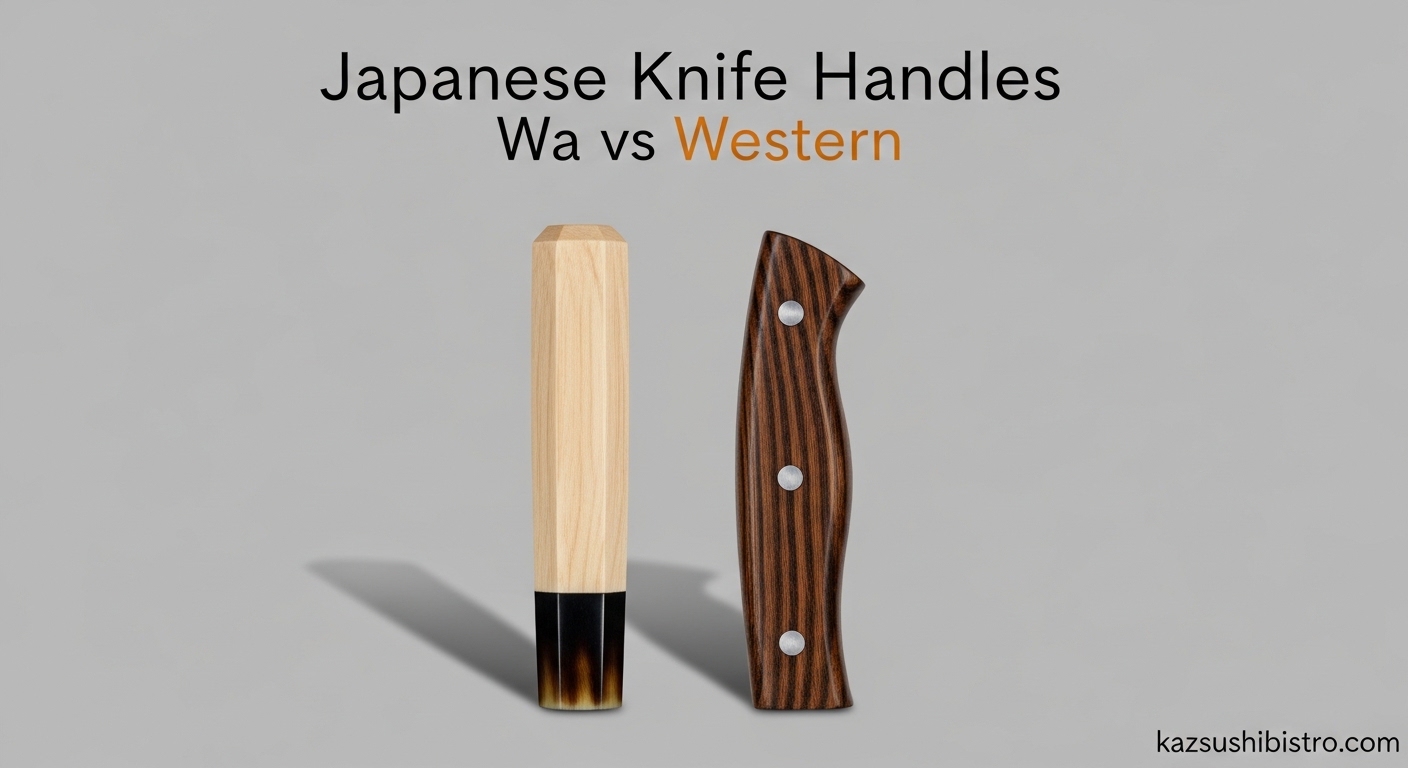
The handle of your knife is far more than a place to rest your hand. It is the bridge between intention and execution, the point where human touch meets refined steel. Understanding Japanese Knife Handles Wa vs Western is essential for anyone serious about their craft, whether you are slicing sashimi at a Tokyo counter or preparing dinner for your family.
In Japanese culinary philosophy, the concept of shun guides every cut. Shun means capturing ingredients at their absolute peak, preserving their cellular integrity through precise, respectful technique. The knife handle you choose directly influences your ability to honor this principle. A wa handle offers the agility and sensitivity needed for delicate work, while a yo handle provides the stability some cooks prefer for power-based cutting.
This guide explores both handle traditions in depth. We will examine construction methods, balance characteristics, grip techniques, and the practical implications for your cooking style. By the end, you will understand not just the mechanical differences, but how each handle connects to the soul of Japanese cuisine.
Table of Contents
What Is a Wa Handle? The Traditional Japanese Approach 2026
A wa handle represents the traditional Japanese approach to knife design, where simplicity and function merge into elegance. The term wa carries deep meaning in Japanese culture, signifying harmony, peace, and the traditional way of doing things. This philosophy extends directly into the handle’s physical form.
Unlike Western handles that add material for bulk, wa handles strip away everything unnecessary. They present as simple cylinders, often eight-sided or slightly oval, crafted from lightweight woods that feel warm against the palm. The blade enters the handle through a hidden tang, a slender extension of steel that runs partway into the wooden body without being visible from the outside.
The Hidden Tang Construction
The hidden tang, sometimes called a stick tang, represents one of the most misunderstood aspects of Japanese knife construction. Western cooks often assume a knife needs full tang construction for strength, but Japanese bladesmiths have spent centuries perfecting alternatives that suit their steel and cutting styles.
In a wa handle, the blade’s metal extension enters a precisely carved opening in the wooden handle. A ferrule, typically made of buffalo horn or synthetic material, sits at the junction between blade and wood. This collar prevents the wood from splitting and provides a smooth transition for your grip. The tang itself may be secured with epoxy, friction fit, or occasionally a small pin.
What surprises many Western cooks is how durable this construction proves in practice. The hidden tang concentrates stress at the blade’s heel, where the steel is thickest, rather than distributing it along the entire handle. For the precise, drawing cuts characteristic of Japanese cuisine, this proves more than sufficient.
Traditional Materials and Their Properties
Wa handles traditionally employ woods that balance lightness with durability. Honoki, or Japanese magnolia, stands as the classic choice. This wood weighs remarkably little, resists moisture better than many alternatives, and possesses a subtle grain that feels smooth during extended use. Many traditional Japanese knives still use honoki today.
Ebony offers a denser, more luxurious alternative. Its dark color and fine grain appeal to chefs who value aesthetics alongside function, though the added weight shifts the balance slightly. Rosewood sits between these extremes, providing middle-ground density with beautiful coloration that deepens over time.
Modern wa handles sometimes incorporate stabilized woods, where resin impregnation enhances moisture resistance and dimensional stability. While purists may prefer traditional untreated woods, stabilized options require less maintenance and perform reliably in professional kitchen environments.
The Cultural Connection to Shun
The wa handle embodies the Japanese approach to ingredients. Light, responsive, and intimately connected to the blade, it facilitates the precise cuts that preserve food cell integrity. When you grip a wa handle properly, you feel every vibration from the cutting edge, receiving immediate feedback about your technique.
This sensitivity matters profoundly when preparing shun ingredients. A tomato at peak ripeness requires almost no pressure to slice cleanly. The wa handle’s lightness allows you to modulate force with fingertip subtlety, making the difference between a clean cut and crushed cellular structure.
What Is a Yo Handle? The Western Tradition
The yo handle represents Western knife-making tradition, where durability and heft take priority over minimalism. The term yo simply means Western or foreign in Japanese, distinguishing these handles from traditional wa construction. European and American knifemakers developed this style over centuries to suit their cutting techniques and steel preferences.
Visually, yo handles present as substantially bulkier than their Japanese counterparts. They typically feature two handle scales attached to a full tang, the continuous piece of steel that extends from blade tip through handle end. Rivets or pins secure the scales, often with a prominent bolster adding weight at the blade-handle junction.
Full Tang Construction Philosophy
Western knife makers emphasize full tang construction as a mark of quality, and for good reason within their tradition. Western knives typically use softer steel than Japanese blades, requiring more force for cutting tasks. The full tang distributes this force along the entire handle length, preventing stress concentration at any single point.
The tang in a yo handle runs the complete length, visible between the handle scales or sometimes enclosed entirely within synthetic materials. Rivets, usually three in number, pass through both scales and the tang itself, creating a permanent mechanical bond. This construction method evolved alongside Western chopping and rock-cutting techniques, where the knife sees more lateral stress.
The Bolster and Its Functions
The bolster, that thick metal junction between blade and handle, serves multiple purposes in yo handles. It adds significant weight where the blade meets the hand, shifting the balance point rearward. For Western cutting styles that emphasize power over precision, this weight provides stability and momentum.
Bolsters also protect the hand from slipping forward onto the blade during heavy cutting tasks. They create a natural stop for your grip, though this same feature can make pinch gripping more awkward than with wa handles. Some modern Western knives now feature partial or tapered bolsters to address this limitation.
Handle Materials and Modern Variations
Traditional yo handles use hardwood scales, often walnut, cherry, or various stabilized woods. The scales are shaped and attached to the tang, then finished with oils or varnish for moisture protection. This method allows for easy handle replacement if damage occurs, though the process requires more effort than with wa handles.
Modern yo handles increasingly employ synthetic materials. Pakkawood, a resin-impregnated wood composite, offers excellent moisture resistance and dimensional stability. Micarta, made from layers of fabric or paper bonded with resin, provides remarkable durability and can be formed into ergonomic shapes difficult to achieve with natural wood. These materials address the maintenance challenges that natural wood handles face in busy professional kitchens.
Design and Construction: Hidden Tang vs Full Tang
The fundamental difference between wa and yo handles lies in how the blade attaches to the handle. This choice affects everything from weight distribution to longevity, from cutting feel to repairability. Understanding these construction methods helps explain why each handle suits different cooking styles.
Why Japanese Knives Do Not Need Full Tang
The question arises naturally: if full tang construction signifies quality in Western knives, why do Japanese knives persist with hidden tangs? The answer lies in steel composition and cutting technique. Japanese bladesmiths typically work with harder steel, often exceeding 60 on the Rockwell hardness scale. This hardness allows thinner edge geometry and superior edge retention, but it also makes the steel more brittle.
A full tang becomes necessary when softer steel requires forceful cutting. The continuous metal distributes stress and prevents blade separation under heavy load. But Japanese knives, with their hard, thin edges, excel at slicing rather than chopping. The cutting motion involves drawing the blade through food with minimal downward pressure, generating less stress on the blade-handle junction.
Our team has observed this distinction repeatedly in professional kitchens. A gyuto with a wa handle performs flawlessly through hours of vegetable prep, while the same blade profile with a yo handle feels unnecessarily heavy for the task. The construction matches the intended use.
Durability in Real-World Conditions
Both construction methods prove durable when matched to appropriate tasks. Yo handles withstand lateral forces better, making them suitable for heavy chopping, splitting, and tasks where the blade might twist in dense material. The full tang construction essentially makes the handle an extension of the blade itself.
Wa handles, despite appearing more delicate, last decades with proper care. The hidden tang concentrates stress at the blade’s heel, where the steel is thickest and strongest. Traditional Japanese knife makers understand this stress distribution intimately, having inherited knowledge from centuries of swordsmithing. When a wa handle eventually loosens, replacement is straightforward, often requiring only a few minutes with basic tools.
Sanitary Considerations
Professional kitchens demand sanitary equipment, and handle construction affects cleanability. The hidden tang of wa handles creates fewer crevices where food particles accumulate. The simple cylindrical shape cleans easily, and the ferrule junction, while requiring attention, presents less complexity than the multiple components of a yo handle.
Yo handles with multiple rivets and seams can trap debris if not properly maintained. The space between handle scales and the tang itself may harbor moisture and organic material, potentially creating hygiene concerns. Modern yo handles with molded synthetic construction address this issue, but traditional scaled handles require vigilance.
Handle Replacement: A Practical Comparison
One significant advantage of wa handles becomes apparent when replacement becomes necessary. A worn or cracked wa handle separates from the blade with relative ease. Heating the junction softens any adhesive, allowing the handle to slide off the tang. A new handle, often available for reasonable cost, installs with minimal skill required.
Yo handle replacement presents greater challenges. The rivets must be drilled out, scales removed, and new material shaped and attached. Many cooks simply discard knives with damaged yo handles rather than attempting repair. This difference makes wa handles appealing to those who view knives as lifetime investments rather than disposable tools.
Balance and Weight: Where the Power Lives
The distribution of weight between blade and handle fundamentally changes how a knife feels in use. This balance point, often overlooked by casual cooks, determines whether a knife feels nimble or stable, quick or deliberate. Wa and yo handles create distinctly different balance characteristics that reward different cutting styles.
Forward Balance of Wa Handles
Wa handles typically position the balance point forward of the handle itself, often at the blade heel or just into the cutting edge. This forward balance, sometimes called blade-heavy balance, means the blade naturally drops toward the cutting board with minimal hand guidance.
For precision work, this characteristic proves invaluable. When slicing sashimi or performing detailed vegetable cuts, the blade’s weight assists the cut rather than requiring active downward pressure. The knife almost wants to cut, needing only guidance rather than force. Over a three-hour prep session, this reduced effort translates to significantly less hand fatigue.
The lightweight handle also enables quick directional changes. A deft flick of the wrist redirects the blade without fighting handle momentum. Sushi chefs rely on this responsiveness when performing the subtle angle adjustments that separate adequate cuts from exceptional ones.
Rearward Balance of Yo Handles
Yo handles typically shift the balance point rearward, often into the handle itself or at the bolster junction. This rearward balance keeps the blade feeling stable and controlled during forceful cutting motions. The handle’s weight counterbalances the blade, preventing the tip from feeling tippy or wandering.
For heavy chopping and rock-cutting techniques, this stability provides confidence. The knife feels planted in your hand, resistant to the lateral forces that develop when cutting through dense material. Western-trained cooks often prefer this feeling of solidity, associating weight with quality and control.
However, this same rearward balance demands more active effort for precision work. The blade does not naturally fall into cuts; you must consciously guide it throughout each stroke. Over extended use, this constant micro-management generates hand fatigue that forward-balanced knives avoid.
Impact on Cutting Technique
Your preferred cutting technique should strongly influence handle choice. If your cooking involves significant chopping, splitting, or heavy vegetable prep, yo handles provide the stability these tasks reward. The rearward balance keeps the knife predictable under load.
If your work emphasizes slicing, detailed cuts, or precision presentation, wa handles offer clear advantages. The forward balance assists the drawing cuts that Japanese cuisine favors, reducing effort while increasing control. The sensitivity of the light handle provides feedback that improves technique over time.
Many professional cooks maintain both handle types, selecting appropriate tools for specific tasks. A yo-handled workhorse handles the heavy chopping, while a wa-handled blade performs the delicate finishing work.
Ergonomics and Grip Technique
How you hold your knife matters as much as which knife you hold. The handle design strongly influences grip options, and different grips suit different hands and tasks. Understanding the relationship between handle type and grip technique helps explain why certain combinations feel immediately right while others never quite work.
The Pinch Grip: Professional Standard
The pinch grip, where thumb and forefinger pinch the blade just above the handle while remaining fingers wrap lightly around the handle itself, represents the professional standard for precision cutting. This grip positions your hand close to the cutting edge, providing maximum control and tactile feedback.
Wa handles excel with the pinch grip for several reasons. The simple cylindrical shape offers no obstructions; your fingers wrap naturally around the slim profile. The lightweight handle does not fight against the grip’s delicate control. The lack of a bulky bolster allows your fingers to sit close to the blade heel without interference.
I spent two weeks exclusively using pinch grip on both handle types to understand the difference. The wa handle felt like an extension of my fingers, responding to subtle pressure changes instantly. The yo handle, with its thicker profile and bolster, forced my grip rearward, reducing the precision pinch grip should provide.
The Hammer Grip: Western Tradition
The hammer grip, where all fingers wrap fully around the handle with the thumb on one side and fingers on the other, suits the heavier cutting tasks Western cuisine often requires. This grip generates more force and provides security during heavy chopping motions.
Yo handles accommodate the hammer grip naturally. The fuller handle profile fills the palm, and the bolster provides a natural stop preventing the hand from sliding forward. The weight of the handle and bolster adds momentum to chopping motions, making the technique feel more effective.
While possible on wa handles, the hammer grip feels less secure due to the slimmer profile. The lightweight construction provides less counterbalance for forceful downward motions. Wa handles prefer the finesse of pinch gripping over the power of hammer gripping.
Hand Fatigue Over Long Sessions
Professional cooks spend hours each day holding their knives. Small ergonomic advantages compound over these extended sessions into significant differences in comfort and endurance. Our observations across multiple professional kitchens reveal clear patterns.
Wa handles generally produce less hand fatigue during precision work. The lightweight construction reduces the mass your hand must control and redirect constantly. The forward balance assists cutting rather than requiring active force application. Cooks using wa handles for detailed prep report less cramping and fewer wrist issues.
Yo handles prove more comfortable for heavy, intermittent cutting. The weight and rearward balance reduce the active effort needed for chopping through dense material. However, for continuous light cutting, the same weight becomes a burden, requiring constant muscular effort to control.
Hand Size Considerations
Hand size significantly affects handle comfort, yet this factor receives surprisingly little attention in knife selection guides. Large hands often struggle with wa handles, finding the slim profile insufficient to fill the palm securely. Small hands may find yo handles bulky and difficult to control precisely.
If your hands run large, consider yo handles or wa handles with thicker octagonal profiles. The D-shaped wa handles, with one flat side, sometimes accommodate larger hands better than purely cylindrical versions. Some modern wa handles incorporate slight ergonomic curves without abandoning the traditional lightness.
For smaller hands, wa handles typically feel immediately more manageable. The reduced diameter allows proper finger placement without over-stretching. The lightweight construction reduces the muscular effort required to maintain grip control, particularly important for users with less hand strength.
Cutting Board Height and Posture
An often-overlooked factor in handle preference is the height relationship between your cutting board and your body. Standard counter height suits average-height users with yo handles, where the weight helps stabilize the blade during downward cuts. But if you are taller or shorter than average, this standard may not suit you.
Wa handles, with their forward balance and precision orientation, often work better with adjusted cutting board heights. Taller users particularly benefit from raising their boards when using wa handles, allowing the pinch grip to function at a comfortable arm angle without hunching.
Your posture during cutting affects both comfort and safety. A handle that forces you to compromise your stance will eventually cause problems, regardless of its other qualities. Consider how your kitchen setup interacts with handle choice when making your selection.
Maintenance, Longevity, and Handle Replacement
Any quality knife represents a significant investment, and understanding maintenance requirements helps protect that investment. Wa and yo handles demand different care approaches, and their repairability differs substantially when damage eventually occurs.
Caring for Wa Handles
Traditional wa handles require mindful moisture management. The natural woods used in traditional construction absorb water, which can cause swelling, cracking, or loosening of the tang fit. Never submerge a wa-handled knife or leave it wet. Wipe the handle immediately after use, particularly at the ferrule junction where water tends to collect.
Occasional oiling helps maintain wood integrity. Food-safe mineral oil applied sparingly every few months prevents the wood from drying and cracking. Apply oil to a cloth first, then rub onto the handle, avoiding excess that could attract debris. Some cooks prefer specialized wood conditioners, though simple mineral oil works well.
If the handle begins feeling loose, address the issue promptly. A wobbling handle indicates the tang is separating from the wood, which can damage both components if ignored. Depending on construction, you may need to reseat the handle, add a securing pin, or replace the handle entirely.
Caring for Yo Handles
Yo handles with synthetic scales or modern composites prove largely maintenance-free beyond normal cleaning. These materials resist moisture and temperature changes that trouble natural wood. Regular washing with mild soap and thorough drying suffices for daily care.
Traditional wood-scaled yo handles require similar care to wa handles, though the multiple seams and rivets create more potential moisture entry points. Pay particular attention to the areas around rivets, where water can seep between scales and tang, potentially causing corrosion or wood damage.
The bolster on yo handles sometimes develops gaps where it meets the blade or handle scales. These gaps can trap food particles and moisture, creating both hygiene concerns and corrosion risks. Regular inspection and prompt cleaning of these junctions extends both handle and blade life.
Handle Replacement Practicalities
When handles eventually require replacement, wa handles offer significant practical advantages. Replacement handles are widely available for common Japanese knife patterns, often costing between $20 and $60 depending on material quality. The replacement process requires minimal tools and skill, making it accessible to home cooks.
To replace a wa handle, heat the junction between handle and ferrule to soften any adhesive. A heat gun or even careful application of a torch works. Once warm, the handle typically slides off the tang with firm pressure. Clean the tang thoroughly, apply fresh epoxy if desired, and slide the new handle into place, ensuring proper orientation.
Yo handle replacement presents greater challenges. Rivets must be drilled out without damaging the tang. New scales must be shaped, drilled, and attached. Many cooks lack the tools and skill for this work, requiring professional knife repair services. The cost often approaches that of a new knife, reducing the economic appeal of repair.
When to Replace vs Repair
Not all damage requires replacement. Minor cracks in wa handles can sometimes be stabilized with thin cyanoacrylate adhesive (super glue) followed by careful sanding. Small chips in yo handle scales can be filled and sanded smooth. These repairs work best on cosmetic damage rather than structural failures.
Replace handles showing significant cracking, loosening, or deterioration that affects function. A handle that rotates on the tang, slips during use, or has developed sharp edges from cracking poses safety risks that repair cannot adequately address. Professional knife services can assess whether your particular damage warrants repair or replacement.
Which Handle Should You Choose?
After understanding the technical differences, the practical question remains: which handle suits your needs? The answer depends on your cooking style, physical characteristics, and the types of tasks you perform most often. This section offers guidance for common scenarios.
For Sushi and Sashimi Preparation
If your interest in Japanese knives centers on sushi and sashimi preparation, wa handles provide clear advantages. The precision these tasks demand aligns perfectly with wa handle characteristics. The forward balance assists the delicate slicing motions that separate fish flesh without tearing cell structure. The pinch grip facilitated by wa handle geometry offers the control necessary for consistent thickness.
Aspiring sushi chefs should prioritize learning proper pinch grip technique with a wa-handled yanagiba or sujihiki. The hours spent developing this skill transfer directly to professional environments, where wa handles dominate. Starting with yo handles creates habits that may require unlearning later.
For Home Cooks Starting Out
Home cooks new to Japanese knives face a genuine dilemma. Wa handles offer the authentic experience and superior performance for the detailed cutting home cooks increasingly attempt. However, yo handles feel more familiar to those trained on Western knives, easing the transition.
If you primarily cook Japanese or Asian cuisines at home, choose a wa handle. The investment in learning proper grip pays dividends in improved results. If your cooking spans multiple traditions with heavy chopping requirements, consider starting with a yo-handled gyuto as a bridge tool, then adding a wa-handled blade for precision tasks.
For Professional Kitchens
Professional kitchens present unique demands that influence handle choice. The fast pace, varied tasks, and shared equipment all matter. Most Japanese professional kitchens exclusively use wa handles, and chefs trained in these environments prefer them universally.
Western professional kitchens increasingly accommodate both handle types. Many line cooks maintain personal knives with wa handles for detailed work while using kitchen-provided yo-handled knives for heavy tasks. This hybrid approach offers flexibility without forcing compromises.
Consider your kitchen’s environment when choosing. High-volume, fast-paced kitchens with less experienced staff may benefit from the durability and familiarity of yo handles. Kitchens emphasizing technique, presentation, and Japanese cuisine naturally favor wa handles.
Hybrid Options: Japanese Blade, Western Handle
Manufacturers increasingly offer hybrid knives that combine Japanese blade profiles and steel with Western yo handles. These options attempt to bridge both worlds, offering the cutting performance of Japanese geometry with the familiarity and durability of Western handles.
These hybrids suit specific users well. Cooks transitioning from Western to Japanese knives appreciate the familiar grip while experiencing improved cutting performance. Those with larger hands sometimes find hybrid handles more comfortable than traditional wa profiles. The full tang construction provides the durability some users associate with quality.
However, hybrids compromise the complete wa experience. The rearward balance of yo handles, even on Japanese blades, changes cutting dynamics significantly. The additional weight alters the nimble feel that defines traditional Japanese knives. Consider hybrids as stepping stones rather than destinations, useful for transition but not the full expression of either tradition.
A Decision Framework
When uncertain, ask yourself three questions. First, what cutting technique predominates in your cooking? Heavy chopping favors yo handles; slicing and precision favor wa handles. Second, what is your hand size and grip strength? Large, powerful hands may prefer yo handles; smaller, precise hands typically prefer wa. Third, what is your kitchen environment and maintenance willingness? Busy, wet kitchens may favor durable yo handles; controlled environments suit the more delicate wa construction.
Remember that neither handle represents absolute superiority. Each evolved over centuries to suit specific needs and techniques. Your task is matching the right handle to your particular situation, honoring both traditions while serving your practical requirements.
Frequently Asked Questions
What is the difference between wa and yo knife handles?
Wa handles are traditional Japanese handles featuring hidden tang construction, lightweight wooden materials, and forward balance. They are cylindrical, simple, and designed for precision cutting with pinch grip technique. Yo handles are Western-style handles with full tang construction, typically heavier, with riveted scales and a bolster. They provide rearward balance and suit hammer grip techniques. The choice reflects different cutting philosophies and kitchen traditions.
Are wa handles comfortable for beginners?
Wa handles feel unfamiliar initially to those trained on Western knives, but most beginners adapt within one to two weeks of regular use. The lighter weight reduces hand fatigue during extended cutting sessions, and the simple cylindrical shape accommodates various grip styles. Beginners interested in Japanese cuisine should start with wa handles to develop proper technique from the beginning, rather than learning habits that require unlearning later.
Why don’t Japanese knives use full tang construction?
Japanese knives typically use harder steel than Western knives, allowing thinner edges that excel at slicing rather than chopping. Full tang construction addresses stress distribution issues in softer steels under heavy loads. Japanese cutting techniques involve drawing the blade through food with minimal downward pressure, generating less stress on the blade-handle junction. The hidden tang concentrates stress at the blade’s thick heel, where the steel is strongest, making it perfectly suited for Japanese cutting styles.
Can you replace a wa handle yourself?
Yes, replacing a wa handle is relatively straightforward and requires minimal tools. Heat the junction between handle and ferrule to soften adhesive, then slide the old handle off the tang. Clean the tang thoroughly and slide the new handle into place, ensuring proper alignment. Some handles use friction fit alone, while others benefit from food-safe epoxy. Replacement handles cost between $20 and $60, making this an economical way to extend a knife’s lifetime or customize its feel.
Which handle is better for sushi chefs?
Professional sushi chefs overwhelmingly prefer wa handles for their work. The forward balance assists the delicate slicing motions essential for sashimi preparation. The lightweight construction enables the precise control needed for consistent fish slicing without crushing cell structure. The pinch grip facilitated by wa handle geometry provides the tactile feedback necessary for the subtle technique adjustments that separate adequate cuts from exceptional ones. Any aspiring sushi chef should learn on wa-handled knives.
Conclusion
The choice between wa and yo knife handles extends far beyond aesthetic preference or brand loyalty. It represents a decision about how you approach your craft, how you relate to your ingredients, and which culinary tradition you align with.
Wa handles, with their hidden tang construction, lightweight materials, and forward balance, embody the Japanese philosophy of shun. They reward precision, sensitivity, and respect for ingredients. The handle becomes an extension of your hand, transmitting every vibration from the cutting edge and enabling the subtle control that preserves food integrity.
Yo handles, with full tang durability, substantial weight, and rearward balance, represent Western culinary values of power, stability, and versatility. They suit heavy chopping, accommodate larger hands, and provide the familiarity many cooks have developed over years of Western knife use.
Neither choice is wrong. Both represent centuries of refinement by master craftspeople who understood their users’ needs. The best handle is the one that fits your hand, suits your technique, and helps you cook with greater confidence and joy. Whether you choose the elegant simplicity of wa or the robust familiarity of yo, may your knife serve you well through countless meals prepared with care and attention.