
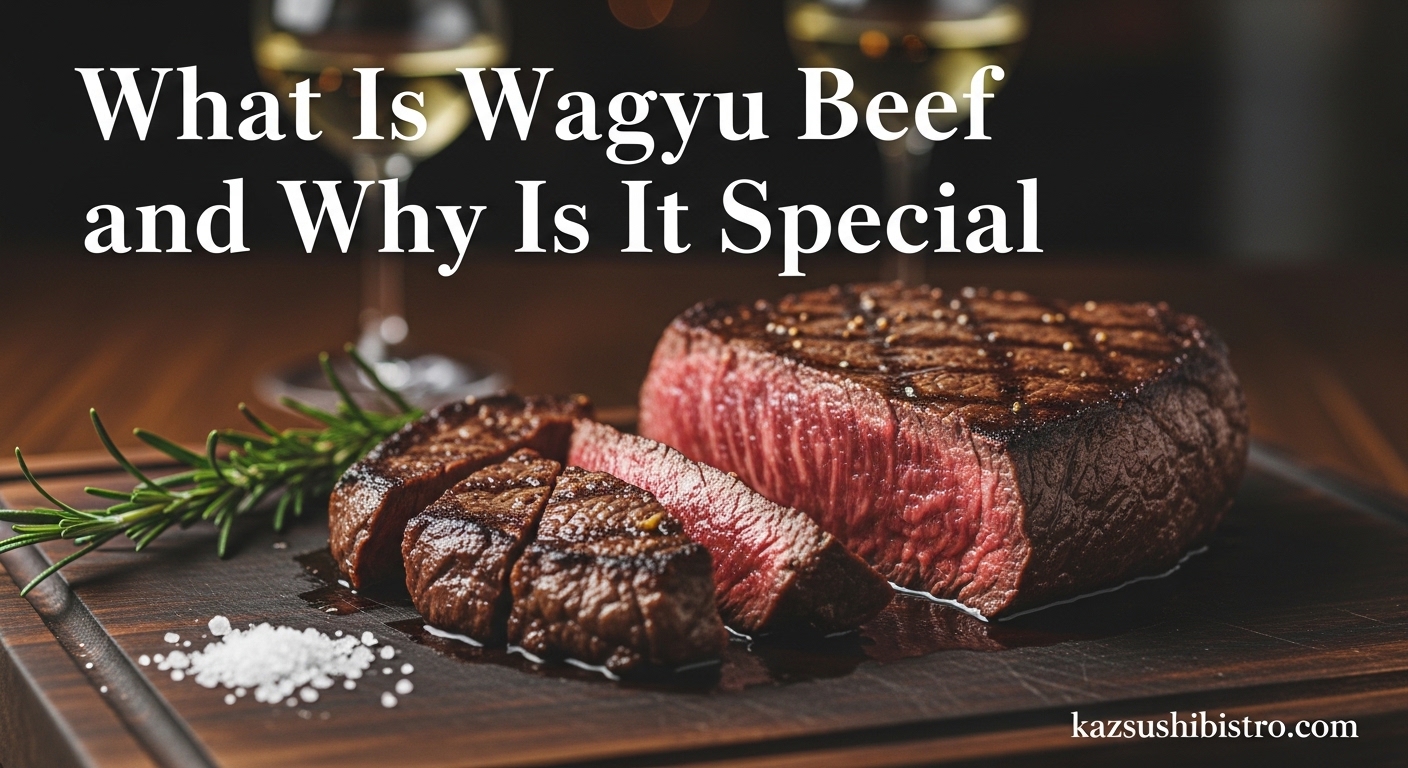
Wagyu beef stands as one of the most prized foods on Earth. The name itself offers the first clue to understanding this extraordinary meat: Wa means Japanese, and gyu means cow. Put simply, Wagyu translates to Japanese cow. But that modest translation hardly captures what makes this beef so remarkable.
I still remember my first bite of authentic A5 Wagyu. The meat practically dissolved on my tongue before I could even chew. That experience taught me why chefs and food lovers speak about Wagyu with near-reverence. The marbling looked like delicate snowflakes woven through crimson meat. The flavor carried notes of butter, nuts, and something uniquely savory that defies description.
In this guide, I will explain exactly what Wagyu beef is and why it commands such devotion. You will learn about the four distinct breeds, the intricate grading system, the science behind that famous marbling, and how to identify authentic Wagyu when shopping. By the end, you will understand whether this legendary beef lives up to its reputation.
Table of Contents
What Is Wagyu Beef
Wagyu refers to four specific breeds of cattle native to Japan. These breeds developed in isolation during Japan’s Meiji era when the country closed its borders to foreign cattle. This genetic isolation created cattle with unique characteristics that no other beef cattle in the world possess.
The story begins over 2,000 years ago when cattle first arrived in Japan from the Asian continent. For centuries, these animals served primarily as draft animals for farming and transportation, not as food sources. The physical demands of pulling carts and plowing fields selected for animals with substantial intramuscular energy stores. This work-heavy lifestyle laid the genetic foundation for the extreme marbling we see today.
Japan banned meat consumption for religious and practical reasons throughout much of its history. When the Meiji Restoration began in 1868, the government lifted these bans and actively promoted beef consumption as part of modernization efforts. Cattle breeding programs began focusing specifically on meat quality rather than working ability. Over the following decades, regional breeding programs refined the characteristics that define Wagyu today.
The Japanese government maintains strict regulations around Wagyu breeding and exportation. Genuine Japanese Wagyu cattle must trace their lineage back to Japan with documented pedigrees. This closed-herd breeding system preserves the genetic purity that makes Wagyu unique. Even today, the Japanese Livestock Industry Association carefully manages the gene pool to maintain quality and consistency.
The Four Wagyu Breeds
Only four breeds qualify as authentic Wagyu. Each breed carries distinct characteristics, and only one produces the legendary marbling that defines premium Wagyu beef.
Japanese Black (Kuroge Washu)
The Japanese Black represents roughly 90% of all Wagyu beef production. This breed produces the extreme marbling that has made Wagyu famous worldwide. The Tajima strain of Japanese Black specifically gives us Kobe beef. Other notable strains include the Shimane, Kedaka, and Hiroshima varieties.
Japanese Black cattle display a black coat and modest size compared to Western beef breeds. They possess the genetic mutation that causes fat to deposit within muscle tissue rather than beneath the skin. This intramuscular fat deposition creates the spiderweb pattern known as shimofuri. The breed also shows superior conversion of feed to marbling fat, making them more efficient at developing quality beef than other breeds.
Japanese Brown (Aakage Washu)
The Japanese Brown, also called Japanese Red or Aakage Washu, accounts for about 7% of Wagyu production. These cattle developed primarily in Kumamoto and Kochi prefectures on the island of Kyushu. They show more moderate marbling compared to Japanese Black but offer a beefier, more pronounced meat flavor.
Japanese Brown cattle display reddish-brown coats and larger frames than Japanese Black. Their fat contains higher concentrations of conjugated linoleic acid (CLA), a fatty acid associated with potential health benefits. While they lack the extreme marbling of their Black cousins, they produce excellent beef with a distinctive robust flavor profile.
Japanese Shorthorn (Nihon Tankaku)
The Japanese Shorthorn developed in northern Japan, particularly in the Iwate and Aomori prefectures. This breed represents less than 1% of Wagyu production and offers a markedly different beef experience. Rather than extreme marbling, Japanese Shorthorn produces lean, flavorful meat with a gamey character similar to bison or grass-fed beef.
These cattle adapted to the cold northern climate with dense coats and efficient metabolisms. Their beef carries high levels of umami compounds and offers a chewy, substantial texture quite different from the melt-in-your-mouth quality of Japanese Black beef. Many Japanese chefs prize Shorthorn for specific preparations where beef flavor matters more than tenderness.
Japanese Polled (Mukaku Washu)
The Japanese Polled ranks as the rarest Wagyu breed, representing less than 1% of production. Developed in Yamaguchi prefecture through crossing Japanese Black with European polled breeds, these naturally hornless cattle produce beef with marbling levels between Japanese Black and Japanese Brown.
Japanese Polled beef offers excellent balance, combining moderate marbling with substantial meat flavor. The breed never gained widespread popularity because it lacks the extreme characteristics that define Japanese Black. However, some Wagyu enthusiasts specifically seek out Japanese Polled for its more restrained, beef-forward profile.
What Makes Wagyu Beef Special
Several factors combine to create the Wagyu experience. Understanding each element helps explain why this beef commands such respect and price premiums.
The Science of Marbling
Marbling refers to the white streaks of fat visible within the red muscle meat. While all beef cattle develop some marbling, Wagyu cattle possess a genetic predisposition for extreme intramuscular fat deposition. Research published in the Journal of Animal Science identifies specific genetic markers in Wagyu that regulate how fat cells distribute throughout muscle tissue.
Regular cattle deposit fat primarily beneath the skin and around organs. This subcutaneous fat serves as energy storage and insulation. Wagyu cattle, by contrast, deposit a significant portion of fat directly within muscle fibers. This intramuscular fat creates the delicate lace-like pattern called shimofuri in Japanese.
The marbling in premium A5 Wagyu can reach 40-50% of the total meat volume. Compare this to USDA Prime beef, which requires just 8-13% marbling. That difference explains everything about the texture and flavor. The fat acts as a flavor carrier and creates the signature mouthfeel.
Fatty Acid Composition
Wagyu fat differs chemically from regular beef fat. The fatty acid profile contains significantly higher levels of monounsaturated fats, particularly oleic acid. Studies show Wagyu beef contains roughly 55% oleic acid compared to 40% in conventional beef. This same fatty acid dominates olive oil and contributes to its heart-healthy reputation.
The melting point of Wagyu fat sits at approximately 77°F (25°C). Human body temperature runs around 98.6°F (37°C). This low melting point means the fat literally melts in your mouth upon contact. You experience this as the signature buttery, creamy texture that defines the Wagyu eating experience.
Wagyu beef also contains higher levels of omega-3 and omega-6 fatty acids than conventional beef. These essential fatty acids play important roles in human health. The fat further contains elevated concentrations of conjugated linoleic acid (CLA), which research suggests may offer metabolic benefits.
Japanese Raising Methods
The way Japanese farmers raise Wagyu cattle contributes significantly to the final product quality. While Western folklore exaggerates some practices, the reality still impresses.
Wagyu cattle in Japan typically live 28 to 36 months before slaughter. This extended timeline allows intramuscular fat to develop fully. Conventional beef cattle often process at 18 to 24 months. That extra year makes a massive difference in marbling development.
Japanese farmers feed their cattle specialized diets rich in high-energy grains, rice straw, and forage. The feeding program intensifies in the final months to maximize fat deposition. Some farmers add beer or sake to feed to stimulate appetite, though this practice remains less common than internet myths suggest. The beer story makes for great marketing but represents only a small fraction of actual Wagyu production.
The environment also matters. Japanese Wagyu barns maintain clean, comfortable conditions with protection from weather stress. Farmers monitor cattle closely for any signs of illness or discomfort because stress negatively impacts meat quality. Some farmers do massage their cattle, though again this practice occurs far less frequently than popular imagination suggests.
The Concept of Takumi
Japanese culture brings a craftsman’s approach to Wagyu production. The concept of takumi describes the dedicated pursuit of perfection through refined technique. Wagyu farmers often come from multi-generational families that have raised cattle for decades or centuries. This accumulated knowledge passes from parent to child, creating ever-deeper expertise.
Many Japanese prefectures maintain registry systems tracking individual animals from birth through processing. Farmers know the genetic history, feeding program, and health records for each cow. This obsessive documentation enables continuous quality improvement and ensures consistency within regional varieties.
Understanding the Wagyu Grading System
The Japanese Meat Grading Association (JMGA) oversees the official grading system for Wagyu beef. This rigorous system evaluates multiple factors to assign a final grade that appears on packaging and certificates.
Yield Grade and Quality Grade
The JMGA assigns two separate grades that combine into the familiar A5 designation. First comes the yield grade: A, B, or C. This measures how much usable meat the carcass produces relative to its total weight. Grade A indicates the highest yield, typically above 72% usable meat. Grade B falls between 69-72%, while grade C falls below 69%.
The quality grade runs from 1 to 5 based on four specific criteria: marbling intensity, meat color and brightness, fat firmness and texture, and fat color and luster. Each criterion receives a score, and the lowest score determines the final quality grade. To achieve grade 5, the beef must score 5 in all four categories.
A5 Wagyu represents the pinnacle: A yield grade combined with 5 quality grade. This designation appears on the most expensive and sought-after Wagyu beef. A4 offers exceptional quality slightly below A5. Even A3 or A2 Wagyu delivers excellent eating experiences, particularly for those who find A5 too rich.
The Beef Marbling Standard (BMS)
Within the quality grade evaluation, marbling receives the most attention. The JMGA uses the Beef Marbling Standard (BMS) scale that runs from 1 to 12. This provides more granular measurement than the 1-5 quality grade alone.
BMS scores of 1-3 show minimal marbling with small, isolated flecks of fat. Scores of 4-7 display moderate marbling with more extensive fat networks visible. Scores of 8-12 represent the extreme marbling that defines true luxury Wagyu. A5 grade requires a BMS score between 8 and 12.
The highest BMS scores (11-12) show so much marbling that the meat appears more white than red. Some chefs call this “snow beef” because of the dense white fat permeating every fiber. This extreme marbling creates the most intense melt-in-your-mouth experience but can overwhelm some palates with richness.
Kobe Beef vs Wagyu
The terms Kobe and Wagyu confuse many diners. Understanding the distinction matters because not all Wagyu qualifies as Kobe, and this affects both price and experience.
All Kobe beef comes from Wagyu cattle. Specifically, authentic Kobe beef must meet these strict requirements: It must come from the Tajima strain of Japanese Black cattle. It must be born, raised, and slaughtered in Hyogo prefecture. It must meet specific marbling and quality standards. The carcass must grade at least A4 or B4 with a BMS score of 6 or higher.
Only about 3,000 to 4,000 head of cattle qualify as authentic Kobe beef each year. This extreme scarcity explains the astronomical prices. True Kobe beef exported to other countries carries certificates of authenticity with a 10-digit identification number. Some restaurants even display nose print certificates verifying the specific animal that provided the beef.
Many restaurants outside Japan advertise “Kobe beef” that does not meet these strict standards. Before 2026, American restaurants could legally label any domestic Wagyu crossbreed as Kobe. Regulations tightened, but mislabeling persists. Authentic Kobe beef outside Japan should come with documentation and command prices reflecting its rarity.
If you see Kobe beef at suspiciously low prices, skepticism serves you well. Genuine Kobe beef in American restaurants typically costs $150 to $300 or more per ounce. Anything significantly cheaper likely represents other Japanese Wagyu varieties or American crossbreeds.
Regional Differences: Japanese vs American vs Australian Wagyu
Wagyu beef now comes from several countries, each producing distinct products. Understanding these differences helps set expectations and guide purchasing decisions.
Japanese Wagyu
Authentic Japanese Wagyu remains the gold standard. Fullblood Japanese cattle raised in Japan under strict regulations produce beef with the most extreme marbling and distinctive flavor. Japanese producers focus entirely on quality over yield, accepting smaller amounts of beef per animal in exchange for superior characteristics.
Japanese Wagyu carries official JMGA grading and displays consistent quality across reputable producers. Regional varieties like Matsusaka and Omi offer alternatives to Kobe with their own loyal followings. Japanese Wagyu commands the highest prices but delivers the most intense experience of everything that makes Wagyu special.
American Wagyu
American Wagyu typically refers to crossbreed cattle containing Wagyu genetics. Fullblood American Wagyu exists but represents a small fraction of production. Most American Wagyu comes from F1 crossbreeds with 50% Wagyu genetics and 50% Angus or other conventional beef breeds.
The United States Department of Agriculture (USDA) grades American Wagyu rather than the JMGA. American Wagyu often grades well above USDA Prime but does not achieve the extreme marbling of Japanese A5. The flavor tends beefier and less delicate than Japanese varieties. American Wagyu offers excellent value for those wanting Wagyu characteristics at more accessible prices.
Australian Wagyu
Australia produces significant quantities of Wagyu beef using both fullblood Japanese genetics and crossbreed programs. Australian producers grade their Wagyu using either the JMGA system or their own AUS-MEAT marbling scale. Australian fullblood Wagyu can approach Japanese quality, particularly from established producers with pure Japanese genetics.
Australian Wagyu often shows slightly different fat composition due to climate and feed differences. The beef typically offers excellent marbling with a flavor profile between Japanese delicacy and American robustness. Australia exports Wagyu widely and has developed strong expertise in Wagyu production over recent decades.
The Eating Experience
Words fail to fully capture eating authentic Wagyu beef. The experience engages every sense in ways that change your understanding of what beef can be.
Flavor and Texture
The first sensation upon tasting Wagyu comes from the texture. The beef feels almost custard-like, with virtually no chew resistance. As the meat contacts your tongue, the fat begins melting, releasing a cascade of flavor compounds. The dominant notes include butter, nuts, and caramel sweetness alongside deep umami savoriness.
The flavor builds gradually rather than hitting immediately. Initial contact brings subtle sweetness. As chewing continues (though “chewing” barely applies to A5 Wagyu), savory depth emerges. The finish stays clean without the fatty aftertaste that accompanies conventional fatty beef.
Many tasters describe Wagyu as almost sweet, though no sugar exists in the meat. This perception comes from the oleic acid and other fatty acids that trigger similar taste receptors. The umami intensity rivals the richest broths and aged cheeses, creating an almost addictive quality that keeps you wanting another bite.
Serving and Portion Size
Richness limits how much Wagyu anyone can comfortably eat. Standard steak portions of 8 to 12 ounces would overwhelm most diners. Japanese steakhouses typically serve Wagyu in 3 to 4 ounce portions, which satisfies completely despite the modest size.
The richness comes from that high fat content. Each bite delivers concentrated energy and flavor. After 4 to 5 ounces, most people feel completely satisfied. Attempting to eat more often leads to palate fatigue where the beef no longer tastes pleasurable.
Many restaurants serve Wagyu with rice, pickled vegetables, or light salads. These accompaniments cut through the fat and refresh the palate between bites. Plain steamed rice works particularly well, providing neutral starch that balances the beef’s intensity.
Sushi and Sashimi Applications
Wagyu appears in Japanese cuisine beyond steak preparations. At KAZ Sushi Bistro and similar establishments, chefs serve Wagyu as sushi and sashimi toppings, offering entirely different experiences from grilled preparations.
Beef tataki involves briefly searing Wagyu, chilling it, then slicing paper-thin. The barely-cooked exterior provides textural contrast while the raw interior showcases the meat’s natural richness. Chefs often dress tataki with ponzu, garlic, or ginger to balance the fat.
Wagyu nigiri sushi places a thin slice of lightly seared beef atop seasoned rice. The warmth of the beef slightly melts the fat into the rice, creating an integrated bite. Some chefs torch the surface immediately before serving, adding smoky char to the buttery meat.
For true Wagyu sashimi, only the highest quality beef suffices. The meat must come from trusted sources with complete traceability. Served raw with minimal accompaniments, Wagyu sashimi offers the purest expression of the beef’s texture and flavor.
Cooking Methods
Simple preparations best showcase Wagyu. The beef needs no marinades, complex sauces, or aggressive seasoning. Salt and perhaps pepper suffice. Any elaborate preparation obscures the subtle flavors that make Wagyu special.
For A5 Wagyu, quick high-heat searing works best. Cast iron or carbon steel pans preheated until smoking create the ideal crust while keeping the interior rare to medium-rare. Overcooking destroys the delicate fat structure that provides the signature texture.
Thin slices for yakiniku (Japanese BBQ) or shabu-shabu (hot pot) cook in seconds. Diners briefly expose paper-thin slices to heat, just enough to render some fat while keeping the center raw or rare. This approach maximizes the melt-in-your-mouth quality.
Home cooks should bring Wagyu to room temperature before cooking and use minimal oil in the pan. The beef releases abundant fat as it cooks. Let the meat rest briefly after cooking to allow juices to redistribute.
How to Identify Authentic Wagyu
The high value of Wagyu attracts mislabeling and fraud. Protect yourself by knowing what authentic Wagyu looks like and what documentation should accompany it.
Visual Inspection
Authentic high-grade Wagyu displays dense, spiderweb-like marbling throughout the meat. The fat appears as fine white threads evenly distributed rather than thick chunks. Lower grades or crossbreeds show sparser marbling with thicker, less integrated fat deposits.
The meat color should appear bright cherry red, not dark or brownish. The fat should look white or slightly cream-colored, never yellow. Package labels should specify the grade (A5, A4, etc.) and ideally the BMS score. Vague terms like “Wagyu-style” or “Wagyu-inspired” indicate the product lacks genuine Wagyu genetics.
Documentation and Certification
Japanese Wagyu exported to the United States must carry certificates of authenticity. These documents include a 10-digit identification number tracing the specific animal. You can verify this number through the Japanese Livestock Industry Association or associated tracking systems.
Kobe beef specifically requires additional documentation including nose print certificates for restaurant sales. Retail Kobe beef packages should display the familiar Kobe beef seal and identification numbers. Without these documents, claims of Kobe authenticity warrant suspicion.
American and Australian Wagyu producers may offer their own certifications. While less formal than Japanese systems, reputable producers provide genetic verification and grading information. Look for producers who disclose Wagyu percentage (fullblood, purebred, or F1 crossbreed) and specific grading details.
Price as an Indicator
Authentic A5 Japanese Wagyu cannot sell cheaply. The production costs, limited supply, and import expenses make low prices impossible. If you see A5 Wagyu at prices comparable to USDA Choice or Select beef, the product almost certainly misrepresents itself.
Expect to pay $100 to $300 per pound for authentic Japanese A5 Wagyu through reputable retailers. American Wagyu crossbreeds typically run $40 to $80 per pound depending on grade. Ground Wagyu offers more affordable entry points at $15 to $30 per pound, though this product mixes Wagyu trim with conventional beef.
Is Costco Wagyu Real?
One question dominates online discussions about Wagyu authenticity. Costco sells Wagyu beef, and shoppers want to know whether these offerings represent genuine products.
Costco does sell authentic Japanese A5 Wagyu at select locations and online. This beef comes from Japanese suppliers with proper JMGA grading and documentation. The A5 designation on Costco packages indicates genuine Japanese Wagyu meeting the highest standards. When you see “Japanese A5 Wagyu” at Costco, you can trust the authenticity.
However, Costco also sells products labeled simply “Wagyu” without specifying origin or grade. These items often represent American Wagyu crossbreeds. The beef may come from cattle with 50% or less Wagyu genetics. While still potentially delicious, this product differs significantly from Japanese A5.
Costco ground beef labeled “Wagyu” typically mixes Wagyu trim with conventional beef. The resulting product offers some Wagyu characteristics at accessible prices but does not replicate the experience of eating true Wagyu steak. Ground Wagyu works well for burgers where the fat content improves juiciness.
FAQ
Is Costco Wagyu beef real?
Costco sells both authentic Japanese A5 Wagyu and American Wagyu crossbreeds. Their Japanese A5 offerings are genuine with proper JMGA grading. Products labeled simply ‘Wagyu’ without origin specified typically represent American crossbreeds with 50% or less Wagyu genetics.
Is the Costco A5 Wagyu real?
Yes, Costco’s Japanese A5 Wagyu is authentic. It comes from genuine Japanese suppliers with proper JMGA certification, 10-digit identification numbers, and meets all requirements for A5 grading. The beef displays the extreme marbling and characteristics expected of true Japanese A5.
Is Wagyu beef really that much better?
Wagyu beef offers a fundamentally different experience from conventional beef. The extreme marbling creates a melt-in-your-mouth texture impossible to replicate with other beef. However, ‘better’ depends on preference. Those who love beefy, chewy steak may prefer USDA Prime. Those seeking tenderness and rich flavor will find Wagyu superior.
What is the American version of Wagyu beef?
American Wagyu typically refers to crossbreed cattle containing 50% Wagyu genetics and 50% conventional beef genetics (usually Angus). Fullblood American Wagyu exists but represents a smaller portion of production. American Wagyu grades above USDA Prime but generally does not achieve the extreme marbling of Japanese A5.
Is Wagyu good for high cholesterol?
Wagyu beef contains higher levels of monounsaturated fats, particularly oleic acid, compared to conventional beef. Some research suggests these fats may have neutral or beneficial effects on cholesterol profiles compared to saturated fats. However, Wagyu remains high in total fat and calories. Those managing cholesterol should consume it in small portions as an occasional treat rather than regular protein.
Is Costco Ground Wagyu actually Wagyu?
Costco ground Wagyu typically mixes Wagyu trim with conventional beef. While it contains genuine Wagyu fat and meat, it does not come from pure Wagyu steaks. The ground product offers improved juiciness and flavor over standard ground beef but cannot replicate the experience of eating Wagyu steak.
How much is 10 lb of Wagyu?
Ten pounds of authentic Japanese A5 Wagyu costs between $1,000 and $3,000 depending on the specific cut and supplier. American Wagyu crossbreeds run $400 to $800 for 10 pounds. Ground Wagyu offers the most affordable option at approximately $150 to $300 for 10 pounds. Prices vary significantly based on grade, origin, and retailer.
Conclusion
Wagyu beef earns its legendary status through a unique combination of genetics, careful breeding, specialized raising practices, and strict grading standards. The extreme marbling, buttery texture, and complex flavor profile create an eating experience unlike any other beef in the world.
Understanding what Wagyu actually is helps you navigate the market with confidence. You now know the four authentic breeds, the difference between Japanese, American, and Australian varieties, and how to identify genuine products. You understand why A5 commands premium prices and what documentation authentic Wagyu should carry.
Whether you choose Japanese A5 for a once-in-a-lifetime celebration or American Wagyu for more regular indulgence, you approach the experience with proper expectations. Start with modest portions, keep preparations simple, and savor each bite mindfully.
At KAZ Sushi Bistro, we appreciate Wagyu not just as steak but as an integral part of Japanese culinary tradition. From tataki to nigiri, this extraordinary beef demonstrates how Japanese craftsmanship elevates ingredients to art. We invite you to experience Wagyu in all its forms and discover why centuries of careful breeding have made it the most prized beef on Earth.