
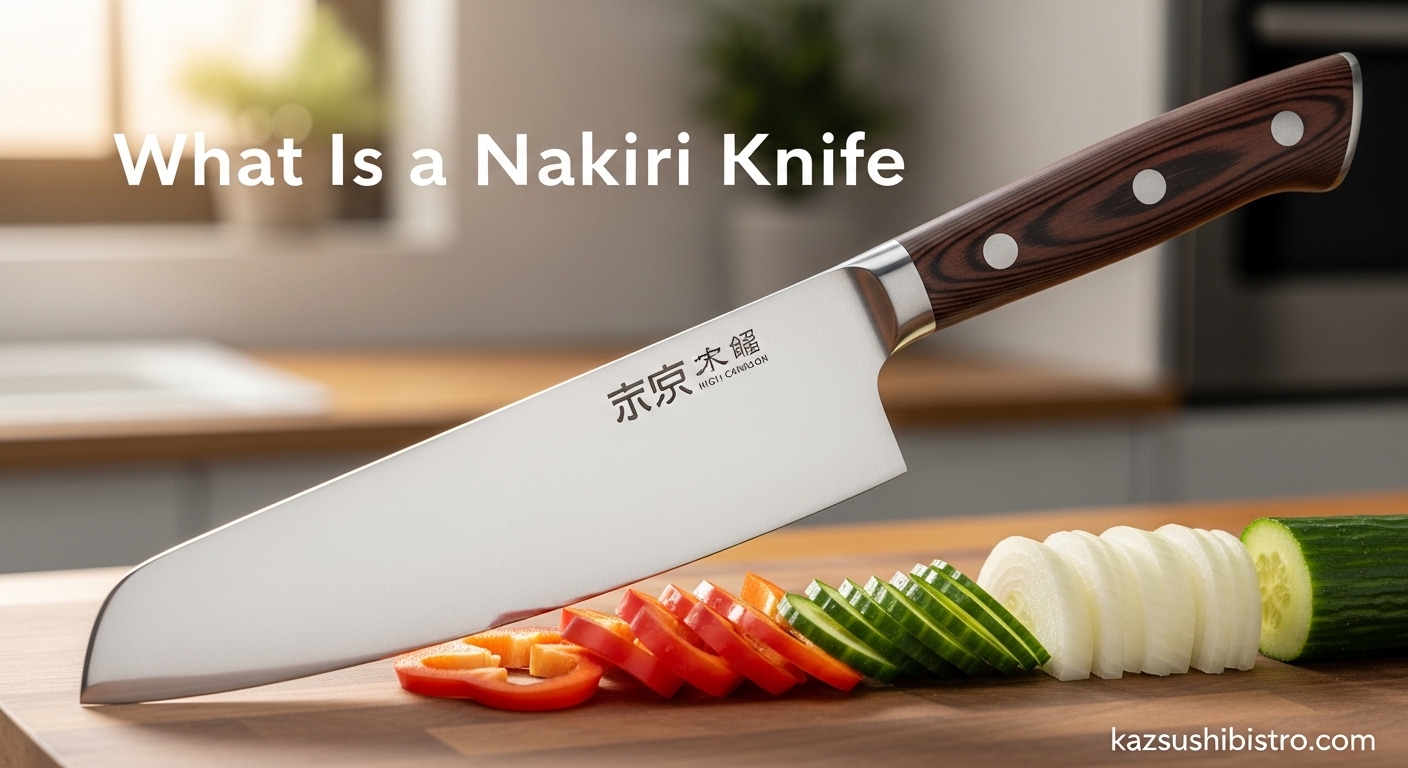
A Nakiri knife is a traditional Japanese vegetable knife designed specifically for cutting vegetables with precision and efficiency. Unlike Western chef’s knives with curved edges, the Nakiri features a completely flat cutting edge that makes full contact with your cutting board. This rectangular blade shape, combined with a tall profile and double-bevel edge, makes it the ideal tool for push-cutting vegetables, slicing greens, and dicing produce with clean, uniform results.
- Rectangular blade with flat edge for full board contact
- Double-bevel (ryoba) edge design for both right and left-handed use
- Tall blade profile protects knuckles during chopping
- Squared tip designed for vegetable work, not piercing
- Thin, lightweight blade for precise, clean cuts
At KAZ Sushi Bistro, our team works with Japanese knives daily. We have seen how the right knife transforms vegetable prep from a chore into a smooth, efficient process. This guide covers everything you need to know about Nakiri knives – what they are, how they work, and whether one deserves a place in your kitchen.
Table of Contents
What Is a Nakiri Knife: A Clear Definition 2026
A Nakiri knife (nakiri bocho in Japanese) is a specialized vegetable cutting tool with a straight, rectangular blade and completely flat edge. The design prioritizes vertical cutting motions over the rocking technique used with Western-style knives. This makes it purpose-built for the repetitive up-and-down chopping motion that dominates vegetable preparation.
The defining characteristic of any Nakiri is its flat edge profile. When you bring the blade down, the entire length contacts the cutting board simultaneously. This produces clean, straight cuts through vegetables without the sliding or tearing that can happen with curved blades. For tasks like slicing onions, chopping cabbage, or dicing carrots, this flat edge delivers consistent results that preserve the structure and freshness of your produce.
Most Nakiri knives feature a double-bevel edge, known as ryoba in Japanese terminology. This means both sides of the blade are sharpened equally, creating a symmetrical V-shaped edge. The double-bevel design makes Nakiri knives accessible to both right-handed and left-handed cooks. It also differs from the single-bevel usuba knife used by professional Japanese chefs, which requires more specialized technique.
What Does ‘Nakiri’ Mean in Japanese?
The word “Nakiri” combines two Japanese characters that tell you exactly what this knife does. “Na” (菜) refers to vegetables or leafy greens. “Kiri” (切) means to cut. Together, nakiri bocho literally translates to “vegetable cutter” or “leaf cutter.”
This naming convention reflects the central role vegetables play in traditional Japanese cuisine. Unlike Western cooking where meat often takes center stage, Japanese home cooking has historically emphasized vegetables, rice, and fish. A knife designed specifically for vegetable preparation was not a luxury item but an essential kitchen tool. The Nakiri emerged from this cultural context as the practical solution for daily vegetable prep in Japanese households.
History of the Nakiri in Japanese Kitchens
The Nakiri developed as the home cook’s version of the professional usuba knife. While usuba knives have been used in Japanese restaurants for centuries, their single-bevel design requires significant skill to use effectively. Home cooks needed something more forgiving that still delivered excellent vegetable cutting performance.
The solution was the Nakiri – essentially a double-bevel version of the usuba that maintained the rectangular shape and flat edge but removed the learning curve associated with single-bevel knives. This made professional-quality vegetable cutting accessible to everyday home cooks without years of training.
Regional variations emerged between Osaka and Tokyo. Osaka-style Nakiri knives typically feature a more rounded tip, while Tokyo-style versions have a more squared-off corner. These differences are largely aesthetic and regional preference rather than functional. Both styles perform identically for vegetable cutting tasks.
Nakiri Knife Blade Design and Features
The Nakiri’s distinctive shape serves specific functional purposes. Understanding these design elements helps you use the knife effectively and appreciate why it performs differently from Western-style knives.
The Rectangular Blade Shape
Unlike the curved belly of a chef’s knife or the sheepsfoot tip of a santoku, the Nakiri’s blade forms a rectangle. The spine runs straight from handle to tip. The edge runs perfectly parallel and flat. This geometry eliminates any curve that would prevent the blade from hitting the board evenly along its entire length.
Flat Edge for Full Contact
The completely flat edge is the Nakiri’s signature feature. When you push down through a vegetable, the blade slices cleanly and lands flat on the cutting board. This full contact prevents the accordion cuts that sometimes happen with curved blades, where the back of the vegetable remains partially attached. It also allows you to scoop chopped ingredients with the blade, using it like a bench scraper.
Tall Blade Profile
Nakiri blades typically stand 2 to 2.5 inches tall from edge to spine. This height provides knuckle clearance when chopping with a pinch grip. It also gives you more surface area for guiding the blade and scooping ingredients. The tall profile makes the Nakiri feel substantial in hand despite its relatively light weight.
Squared Tip Design
The Nakiri lacks the pointed tip found on chef’s knives and gyutos. This squared tip prevents accidental piercing when working with vegetables. It also reinforces the knife’s purpose – this is a vegetable tool, not an all-purpose blade. Some Nakiri knives have slightly rounded corners (Osaka style) while others are more square (Tokyo style).
Thin, Lightweight Construction
Most Nakiri knives feature thin blade stock – typically 1.5 to 2 millimeters thick at the spine. This thinness reduces friction when passing through vegetables, resulting in cleaner cuts that damage fewer plant cells. Less cellular damage means vegetables stay fresh longer and release less moisture during cutting.
Nakiri vs Santoku: Key Differences
The Santoku is often the first Japanese knife Western cooks encounter. Understanding how it differs from a Nakiri helps you decide which belongs in your kitchen – or whether you want both.
The primary difference lies in the edge profile. Santoku knives have a slightly curved edge that allows for gentle rocking motions. Nakiri knives have completely flat edges designed exclusively for up-and-down push cutting. This difference determines which cutting techniques work with each knife.
Blade shape also differs significantly. Santoku knives typically have a sheepsfoot tip that curves down toward the edge. Nakiri knives maintain their rectangular shape from heel to tip. The Santoku’s shorter, more compact blade excels at general kitchen tasks. The Nakiri’s taller, longer rectangular blade dominates vegetable-specific work.
Cutting technique represents the biggest adjustment when switching between these knives. If you primarily rock chop, the Santoku feels natural. If you want to master push cutting for vegetables, the Nakiri is purpose-built for that technique.
Nakiri vs Usuba: Professional vs Home Kitchen
The usuba looks similar to a Nakiri at first glance. Both feature rectangular blades designed for vegetables. The difference lies in the edge geometry and intended user.
Usuba knives feature a single-bevel edge (kataba in Japanese). Only one side of the blade is sharpened, creating an asymmetrical cutting edge. This design allows for extremely precise cuts and paper-thin vegetable slices, but it requires proper technique to prevent the blade from steering during cuts. Usuba knives are standard equipment in professional Japanese kitchens.
Nakiri knives use a double-bevel edge (ryoba). Both sides are sharpened equally, creating a symmetrical edge that cuts straight down without steering. This makes the Nakiri more forgiving and easier for home cooks to use effectively. You sacrifice some ultimate precision compared to a usuba, but gain accessibility and versatility.
Nakiri vs Chef’s Knife (Gyuto): Which Do You Need?
This is the comparison most home cooks care about. If you already own a quality chef’s knife or gyuto, do you need a Nakiri? The honest answer depends on how you cook and what frustrates you about your current knife.
Chef’s knives and gyutos feature curved belly sections designed for rocking motions. The tip tapers to a point for detailed work. These are versatile all-purpose knives that handle proteins, vegetables, and most kitchen tasks adequately.
The Nakiri trades this versatility for vegetable-specific excellence. The flat edge produces cleaner vegetable cuts than any curved blade can achieve. The rectangular shape and tall blade make chopping motions more efficient. Forum discussions among serious cooks reveal that professionals notice a genuine efficiency gain – roughly 5% faster vegetable prep when fully adapted to the push-cutting technique.
For occasional cooks who prepare vegetables a few times weekly, a quality chef’s knife handles the job fine. For anyone who cooks daily, prepares large quantities of vegetables, or values precision in their cuts, the Nakiri earns its place in the knife block.
What Is a Nakiri Knife Used For?
The Nakiri excels at any task involving vegetables. Its design eliminates the compromises that come with using all-purpose knives for specialized work.
Best Foods for Nakiri
- Leafy greens: cabbage, lettuce, kale, spinach, bok choy
- Allium vegetables: onions, shallots, garlic, leeks, scallions
- Root vegetables: carrots, daikon, turnips, radishes
- Squash and pumpkins (cut into manageable pieces first)
- Peppers and chilies of all varieties
- Herbs: cilantro, parsley, basil, mint for tap-chopping
- Tomatoes and soft fruits for clean slicing
What to Avoid
Nakiri knives are vegetable specialists, not all-purpose tools. Avoid using them for tasks that risk damage:
- Breaking down poultry bones or fish bones
- Cutting through frozen foods
- Hard squash rinds (butternut, acorn) without pre-scoring
- Twisting or prying motions that torque the blade
- Coconut or pineapple cores
Forum discussions consistently mention chipping as the primary risk with Nakiri knives, particularly harder Japanese carbon steel versions. The thin, hard blades excel at slicing but can chip if twisted or torqued against hard materials. Stick to vegetables and avoid prying or twisting motions.
How to Use a Nakiri Knife: Proper Techniques
Using a Nakiri effectively requires adjusting your technique from Western-style rocking to Japanese push-cutting. The transition takes practice but becomes natural quickly.
The Pinch Grip
Hold the knife with your thumb and forefinger pinching the blade just above the handle. Your remaining fingers wrap around the handle. This grip gives you maximum control over the blade’s angle and position. The pinch grip feels different from the full-handle grip many home cooks use, but it transforms your cutting precision.
Push Cutting Technique
Raise the blade completely above your vegetable. Bring it straight down in a vertical motion, pushing slightly forward as the edge contacts the food. The flat edge should land flush against your cutting board. Lift and repeat. This up-and-down motion replaces the back-and-forth rocking you use with curved blades.
Tap Chopping for Herbs
Keep the tip of the Nakiri on the board as a pivot point. Raise and lower the handle to chop herbs with a lever motion. The tall blade provides the clearance needed for this technique, and the flat edge minces herbs cleanly without bruising.
Why Rock Chopping Fails
The Nakiri’s flat edge cannot rock. Attempting to rock chop with a Nakiri results in the heel and tip alternately lifting off the board while the center cuts. This creates uneven cuts and wastes energy. Embrace the push cut. It feels more efficient once you adapt.
Forum users consistently mention this technique adjustment as the biggest learning curve. Cooks accustomed to rocking with chef’s knives need a week or two of regular use before push cutting feels natural. Once mastered, most report preferring the efficiency for vegetable work.
Blade Materials and Construction
Nakiri knives come in various steel types, each offering different performance characteristics and maintenance requirements. Understanding these materials helps you choose a knife that matches your willingness to perform maintenance.
Carbon Steel
Traditional Japanese carbon steels like Shirogami (white steel) and Aogami (blue steel) take extremely sharp edges and hold them well. They are reactive metals that develop a protective patina over time. Carbon steel requires immediate washing and drying after use to prevent rust. These knives reward attentive owners with exceptional cutting performance.
Stainless Steel
Modern stainless formulations like VG-10, SG2, and AUS-10 offer excellent edge retention with minimal maintenance. These steels resist corrosion and staining, making them forgiving for home cooks who might not immediately wash their knife. The tradeoff is slightly reduced maximum sharpness compared to carbon steel, though high-end stainless performs admirably.
Damascus and Clad Construction
Many Nakiri knives feature layered Damascus patterns or san mai (three-layer) construction. These combine a hard steel core for edge retention with softer outer layers for durability and stain resistance. The Damascus layers are primarily aesthetic but the cladding adds practical toughness. Look for terms like Kurouchi (black finish), Nashiji (pear skin texture), or Tsuchime (hammered finish) which describe surface treatments.
Rockwell Hardness
Japanese Nakiri knives typically rate 60 to 65 on the Rockwell hardness scale. Higher numbers mean harder steel that takes sharper edges but becomes more brittle. Most home cooks do well with knives in the 60 to 62 HRC range. Professional cooks might prefer 63 to 65 HRC for maximum edge retention despite the increased chipping risk.
Nakiri Knife Sizes: What Length Should You Choose?
Nakiri knives typically range from 150mm to 180mm in blade length, with 165mm (approximately 6.5 inches) being the most common standard.
For most home cooks, a 165mm Nakiri provides the ideal balance. The blade is long enough to handle large cabbages and vegetables efficiently, but not so long that it feels unwieldy on smaller cutting boards. This size works well for hands of most sizes.
Smaller 150mm versions suit cooks with limited space or those who primarily work with smaller quantities. These compact Nakiris maneuver well on apartment-sized cutting boards but require more cuts to process large vegetables.
The 180mm (7 inch) size appeals to professional cooks and serious home chefs who process large volumes. The extra length increases efficiency when chopping piles of vegetables. However, the larger blade demands more cutting board real estate and can feel oversized for casual cooks.
Blade height varies between 45mm and 55mm (approximately 1.75 to 2.15 inches). Taller blades offer more knuckle clearance and scooping surface. Shorter blades feel more nimble. Most quality Nakiris fall in the 50mm range, which satisfies most users.
Care and Sharpening Your Nakiri
Proper maintenance keeps your Nakiri performing at its best. The flat edge actually simplifies sharpening compared to curved blades, though the hard steels common in Japanese knives require appropriate tools.
Daily Care
Hand wash your Nakiri immediately after use with mild soap and warm water. Dry thoroughly with a towel – do not air dry. Carbon steel knives particularly require complete drying to prevent rust spots. Store in a knife block, magnetic strip, or blade guard. Never toss a Nakiri loose in a drawer where the edge contacts other metal.
Sharpening on Whetstones
The flat edge profile makes sharpening Nakiri knives straightforward. You maintain the same angle along the entire edge without the complicated curve management required for chef’s knives. Most Nakiri knives perform best with a 15 to 17 degree angle per side.
Use whetstones for sharpening. Start with a 1000-grit stone to restore the edge, then progress to 3000 to 5000 grit for refinement. High-end knives benefit from 8000-grit polishing. The flat edge contacts the stone evenly, making the sharpening process predictable once you learn the basic technique.
Honing and Maintenance
Ceramic honing rods work well for maintaining a Nakiri edge between sharpenings. Unlike Western knives that benefit from frequent steel honing, Japanese knives with hard steel need less frequent but more substantial maintenance. Touch up the edge weekly with a ceramic rod if you cook daily. Plan for full whetstone sharpening every 2 to 3 months with regular use.
Forum discussions emphasize that carbon steel Nakiris develop character over time. The patina that forms protects the blade and shows the knife’s history. Many owners appreciate this visual record of meals prepared. Just avoid letting actual rust form, which requires more aggressive correction.
Limitations and Who Should Not Buy a Nakiri
A Nakiri is not the right knife for everyone. Understanding its limitations helps you make an informed purchase decision.
- Rock chopping is ineffective with the flat edge – you must adapt to push cutting
- The squared tip cannot perform precision piercing or detailed tip work
- Rectangular blade shape feels awkward for cooks with very small hands
- Hard Japanese steels chip if misused on bones, frozen foods, or with twisting motions
- Requires dedicated storage – the tall blade and squared tip do not fit all knife blocks
Forum consensus from cooking communities suggests the Nakiri justifies its cost for serious vegetable preparers but not for casual cooks. If you prepare vegetables daily, the efficiency gains and cutting quality justify the investment. If you cook occasionally or primarily use pre-cut vegetables, your chef’s knife handles the task adequately.
The Nakiri shines as a second knife for cooks who already own a quality chef’s knife or gyuto. It does not replace your all-purpose blade but complements it. Many owners report reaching for their Nakiri for every vegetable task while keeping their gyuto for proteins and general work.
Frequently Asked Questions
What is the difference between a nakiri knife and a santoku knife?
The Nakiri has a completely flat edge designed for vertical push-cutting vegetables, while the Santoku has a slightly curved edge that allows for gentle rocking motions. The Nakiri features a rectangular blade shape ideal for vegetable prep, whereas the Santoku has a more compact, sheepsfoot-tipped design suited for general kitchen tasks.
What is the difference between a chef’s knife and a nakiri knife?
A chef’s knife has a curved belly and pointed tip designed for rocking cuts and all-purpose use. The Nakiri has a flat edge and squared tip specifically engineered for vegetables. The chef’s knife handles proteins and general tasks well; the Nakiri excels at vegetable cutting with cleaner, more uniform results.
What are Nakiri knives best used for?
Nakiri knives excel at cutting vegetables including leafy greens, onions, carrots, peppers, and herbs. They perform best with push-cutting and tap-chopping techniques. The flat edge produces clean, even cuts that preserve vegetable freshness. Avoid using Nakiri knives for bones, frozen foods, or hard materials that risk chipping the blade.
What are the disadvantages of a Nakiri?
Nakiri knives cannot rock chop effectively due to their flat edge. The rectangular shape feels awkward for some users. Hard steel versions chip if twisted or used on hard materials. They require technique adjustment from Western knife styles. The specialized design means they excel at vegetables but lack versatility for other kitchen tasks.
Conclusion
A Nakiri knife is a traditional Japanese vegetable knife designed for cooks who value precision and efficiency in their vegetable preparation. With its rectangular blade, completely flat edge, and double-bevel design, the Nakiri delivers clean, uniform cuts that preserve the quality and freshness of your produce. The push-cutting technique it requires takes practice, but cooks who make the adjustment often report faster prep times and superior results compared to using all-purpose knives.
Whether a Nakiri belongs in your kitchen depends on your cooking habits. Occasional cooks who prepare vegetables infrequently can rely on their chef’s knife. Serious home cooks and professionals who work with vegetables daily will appreciate the specialized performance a Nakiri provides. Understanding what a Nakiri knife is and how it differs from Western alternatives helps you make an informed decision about whether this Japanese vegetable specialist deserves a place in your cooking routine.