
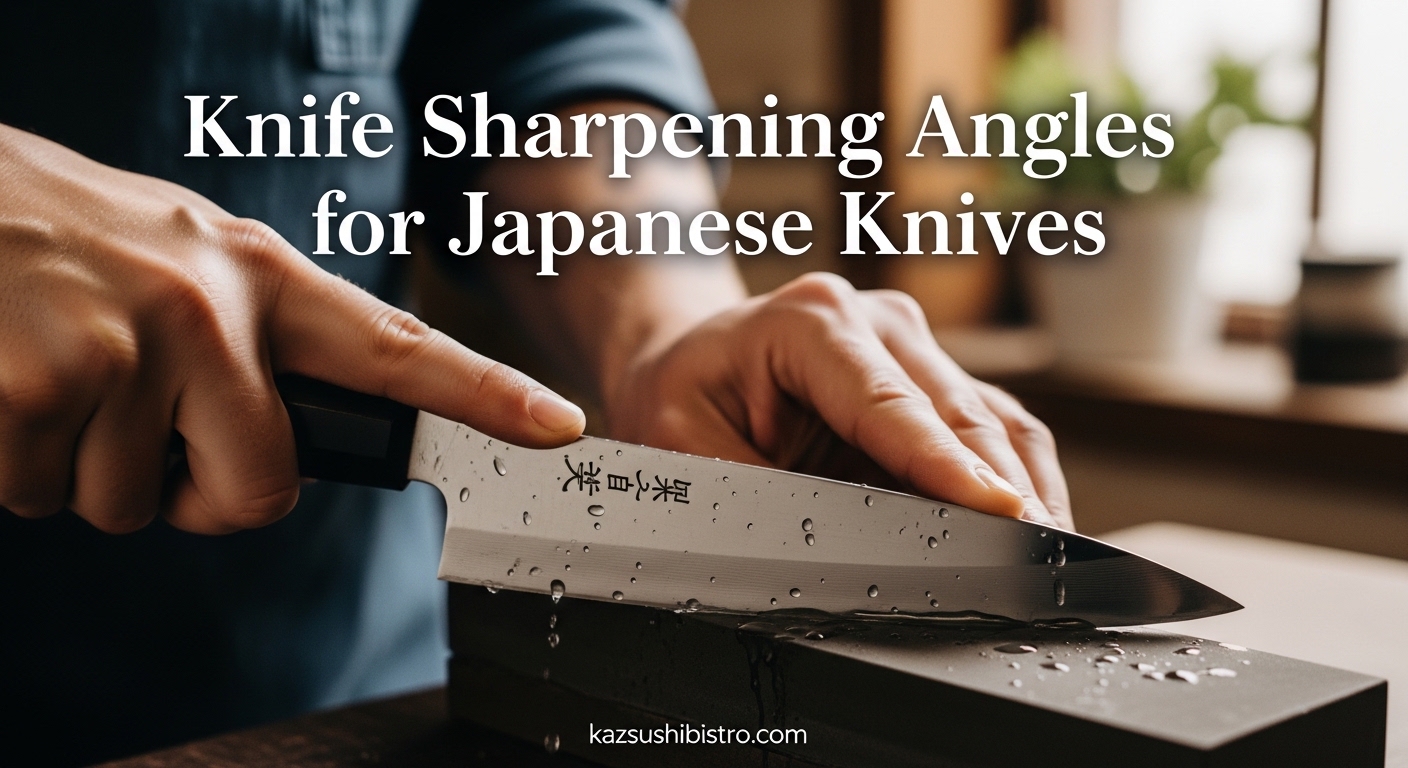
Most Japanese knives are sharpened at 10 to 15 degrees per side, creating a total included angle of 20 to 30 degrees. Double-bevel knives like Gyuto and Santoku typically work best at 12 to 15 degrees per side, while single-bevel knives such as Yanagiba can go as low as 10 to 12 degrees on the bevel side with the ura (back) sharpened nearly flat.
I spent months confused about whether my knives needed 15 or 20 degrees. After ruining one edge and chipping another, I finally understood that Japanese knives require different angles than Western knives. The sharper angle gives you that effortless slicing feel, but it also demands proper technique.
In this guide, I will walk you through exactly what angles work for each type of Japanese knife, how to find your angle without expensive tools, and how to troubleshoot common edge problems. Whether you are sharpening your first Gyuto or refining your Yanagiba for sashimi, this article covers everything you need to know about knife sharpening angles for Japanese knives.
Table of Contents
Quick Reference: Japanese Knife Sharpening Angles 2026
This table gives you the angles at a glance. I have used these ranges on dozens of knives over the past three years, and they consistently produce sharp, durable edges.
| Knife Type | Bevel Type | Angle Per Side | Total Included Angle | Best For |
|---|---|---|---|---|
| Gyuto (Chef’s Knife) | Double | 12-15° | 24-30° | All-purpose kitchen work |
| Santoku | Double | 12-15° | 24-30° | Vegetables, fish, meat |
| Nakiri | Double | 12-15° | 24-30° | Vegetable prep |
| Yanagiba | Single | 10-12° (bevel side) | 10-12° | Sashimi slicing |
| Deba | Single | 15-20° (bevel side) | 15-20° | Fish butchery |
| Petty (Paring) | Double | 12-15° | 24-30° | Precision work |
| Usuba | Single | 10-12° (bevel side) | 10-12° | Vegetable carving |
Your specific angle depends on your steel type and cutting style. Harder steels like SG2 or Aogami Super benefit from slightly higher angles (15-17 degrees) to prevent chipping. Softer stainless steels like VG10 can handle the lower end of the range (12-14 degrees) for maximum sharpness.
Understanding Blade Angles: Per Side vs Included Angle
The terminology confuses many beginners. When someone says “15 degrees,” do they mean per side or total? This distinction matters because getting it wrong can damage your knife.
What Is Per Side Angle?
Per side angle measures the angle between one bevel and the center line of the blade. When you lay a knife on a whetstone, the per side angle is what you maintain between the stone surface and the blade face. For most double-bevel Japanese knives, this ranges from 10 to 15 degrees.
What Is Included Angle?
The included angle (also called total edge angle) combines both bevels. On a symmetrical double-bevel knife sharpened at 15 degrees per side, the included angle equals 30 degrees. Some manufacturers list the included angle in their specifications, which can mislead you into thinking the per side angle is higher.
Single-bevel knives only have one beveled side, so their per side angle equals the included angle. A Yanagiba sharpened at 12 degrees on the bevel side has a 12-degree included angle.
Why the Distinction Matters
If you sharpen a knife thinking 30 degrees is the per side angle when it is actually the included angle, you will create a 60-degree total edge. The result feels dull and saws through food rather than slicing cleanly. Always confirm whether specifications refer to per side or included angles before sharpening.
Optimal Sharpening Angles by Japanese Knife Type
Different knife designs serve different purposes, and their angles reflect those functions. A sashimi knife needs maximum sharpness for clean cuts, while a fish butchery knife needs durability for breaking through bones.
Gyuto (Japanese Chef’s Knife)
The Gyuto resembles a Western chef’s knife but typically uses harder steel. I sharpen my Gyuto at 13 degrees per side. This gives me excellent push-cutting performance on vegetables while maintaining enough durability for occasional chicken bone contact.
For home cooks new to whetstone sharpening, start at 15 degrees per side. As you develop better technique and feel for your specific steel, you can experiment with lower angles. Professional chefs often go as low as 10-12 degrees on their workhorse Gyutos, but they touch up their edges frequently.
Santoku
Santoku knives work best at 12-15 degrees per side. The flatter belly profile compared to a Gyuto means you spend more time push-cutting than rocking. This cutting style benefits from a slightly sharper angle.
I sharpen my Santoku at 14 degrees per side. The slightly higher angle compared to my Gyuto accounts for the fact that I use my Santoku more aggressively on harder vegetables like butternut squash.
Nakiri
Vegetable cleavers like the Nakiri excel at 12-15 degrees per side. The straight edge profile makes maintaining consistent angles easier than on curved blades. Many Nakiri users prefer the lower end of this range (12-13 degrees) because they rarely contact hard surfaces.
The thin blade geometry typical of Nakiri knives means you should avoid angles above 15 degrees. Higher angles defeat the purpose of this nimble vegetable knife.
Yanagiba
Single-bevel sashimi knives require the lowest angles of any Japanese kitchen knife. The bevel side (kireba) typically gets sharpened at 10-12 degrees. The back side (ura) gets sharpened nearly flat, often at just 1-2 degrees to maintain the concave geometry.
The extreme sharpness from these low angles produces the mirror-like sashimi cuts you see in high-end sushi restaurants. However, the edge is delicate. Touching bone or a ceramic plate will chip a Yanagiba edge instantly.
Deba
Unlike other Japanese knives, Deba knives need higher angles for durability. Sharpen the bevel side at 15-20 degrees depending on your usage. If you regularly break through small fish bones, stay toward the higher end (18-20 degrees).
The ura side gets minimal attention – just enough to remove any burr and maintain the concave back. I typically run my stone flat against the ura side for just a few strokes after sharpening the bevel.
Petty (Paring Knife)
Petty knives handle delicate work where precision matters more than durability. Sharpen them at 12-15 degrees per side. I prefer 12 degrees on my Petty because I use it primarily for detail work on soft ingredients.
Usuba
Professional vegetable knives like the Usuba use single-bevel construction similar to Yanagiba. Sharpen the bevel side at 10-12 degrees. The thin edge enables the precise vegetable carving techniques used in traditional Japanese cuisine.
Single Bevel vs Double Bevel: Angle Differences Explained
The distinction between single and double bevel knives confuses many sharpeners. Each type requires completely different techniques and produces different cutting characteristics.
Double Bevel Knives
Double bevel knives have two angled faces meeting at the edge. Most Gyuto, Santoku, and Nakiri knives fall into this category. The symmetrical geometry makes them easy to use for both right-handed and left-handed cooks.
When sharpening double bevel knives, you alternate between sides, removing equal amounts of steel from each bevel. Some Japanese double bevel knives use asymmetric grinds (70/30 or 60/40 splits) favoring the right side. These work best for right-handed users but can be adjusted for left-handed cooks by evening out the bevels.
Single Bevel Knives
Single bevel knives have one flat side (ura) and one angled side (kireba). Traditional Japanese knives like Yanagiba, Deba, and Usuba use this construction. The flat back creates food release, while the angled front creates the cutting edge.
Sharpening single bevel knives requires two distinct steps. First, sharpen the bevel side at the appropriate angle (10-12 degrees for Yanagiba, 15-20 degrees for Deba). Second, lay the stone flat against the ura side and make a few light strokes to remove the burr and maintain the concave geometry.
Left-Handed Considerations
Single bevel knives traditionally come configured for right-handed users. The flat side sits against the food, while the angled side faces away. For left-handed cooks, using a right-handed single bevel knife causes the blade to drift away from straight cuts.
Left-handed single bevel knives exist but remain rare and expensive. Alternatively, left-handed cooks can purchase double bevel Japanese knives, which work equally well for both hands. Some left-handed cooks also learn to use right-handed single bevel knives by adjusting their cutting technique.
How to Find and Maintain Your Sharpening Angle
Maintaining a consistent angle stands as the biggest challenge for beginners. I struggled with this for months until I learned these three methods. Each technique suits different situations and skill levels.
The Coin Stack Method
This technique provides a physical reference for your angle. Stack coins under the spine of your knife to create a consistent lift. On a 50mm tall blade (measured from edge to spine), two US nickels stacked together approximate 12-15 degrees.
To use this method, place your knife edge on the stone. Slide two nickels under the spine near the heel. Lift the spine until it rests on the coins, then remove them carefully while holding the angle. This gives you a physical feel for what 15 degrees feels like on your specific knife.
Remember that coin thickness varies by currency. US nickels work well for 12-15 degree ranges. If you need a different angle, experiment with different coin combinations and measure with a protractor until you find the right stack height.
The Marker Trick
The marker trick helps you find the existing bevel angle on a knife and confirms you are hitting the right spot while sharpening. This method works on any knife regardless of blade height.
Apply permanent marker to the bevel of your knife, covering the area where the edge meets the primary bevel. Make a few light sharpening strokes on your stone at what you think is the correct angle. Examine the bevel after each stroke.
If the marker removes only from the edge, your angle is too high. If it removes only from the shoulder of the bevel, your angle is too low. Perfect angle contact removes marker evenly across the entire bevel face. Adjust your angle until you achieve even marker removal.
I use this technique whenever I sharpen a new knife for the first time. It takes the guesswork out of finding the factory angle and helps me decide whether to maintain that angle or adjust it for my needs.
Angle Guides vs Muscle Memory
Physical angle guides clip onto your knife spine and rest against the stone, mechanically maintaining your angle. These work well for absolute beginners but present some limitations.
Guides can scratch knife finishes, limit your stroke length, and drift during long sharpening sessions. They also prevent you from developing the muscle memory that makes freehand sharpening efficient.
I recommend using angle guides for your first five to ten sharpening sessions to learn what proper angles feel like. After that, practice freehand with the coin method or marker trick for reference. Within a month of regular practice, you will develop the muscle memory to maintain consistent angles without aids.
Maintaining Angle on Curved Blades
Gyuto and other curved knives challenge angle consistency because the blade-to-spine distance changes along the edge. The belly near the tip sits closer to the stone than the heel at the same spine lift angle.
To maintain consistent angles on curved blades, raise the handle slightly as you move from heel to tip. This compensation keeps the edge angle constant even as the blade geometry changes. Practice this rocking motion without the stone first, then add the stone once the movement feels natural.
Japanese vs Western Knife Sharpening Angles
Understanding the differences between Japanese and Western knife angles helps you appreciate why Japanese knives cut differently. It also explains why you should not apply the same sharpening approach to both types.
| Characteristic | Japanese Knives | Western Knives |
|---|---|---|
| Per Side Angle | 10-15° | 18-22° |
| Included Angle | 20-30° | 36-44° |
| Typical Steel Hardness | HRC 60-66 | HRC 54-58 |
| Edge Durability | Higher fragility, better retention | Lower fragility, faster dulling |
| Cutting Feel | Effortless slicing | Slight resistance, more robust |
Western knives use softer, tougher steels that resist chipping but dull faster. The steeper angles (18-22 degrees per side) provide durability for rough kitchen tasks like cutting through joints or working around bones.
Japanese knives use harder, more brittle steels that hold edges longer but chip more easily. The shallower angles (10-15 degrees per side) maximize sharpness for clean cuts on delicate ingredients. This combination of hard steel and shallow angle creates the distinctive Japanese knife performance.
Can You Use One Angle for Both?
Technically yes, but practically no. If you sharpen a Western knife at 15 degrees per side, the soft steel will roll and dent quickly. If you sharpen a Japanese knife at 20 degrees per side, you waste the steel’s potential and create a duller edge than necessary.
If you own both types, maintain separate sharpening routines. I keep my Western knives at 20 degrees and my Japanese knives at 13-15 degrees. This differentiation takes no extra time once you establish the muscle memory for each angle.
Troubleshooting: Chipped vs Rolled Edges
Your edge condition tells you whether your sharpening angle suits your knife and usage. Learning to read these signs helps you adjust your technique for better results.
Signs Your Angle Is Too Low
Chipping indicates an angle too low for your steel or cutting technique. If you notice small chips or missing chunks along your edge, especially after cutting harder vegetables or accidentally touching bone, your angle needs increasing.
Harder steels like SG2, Aogami Super, or ZDP-189 require slightly higher angles than softer stainless steels. If you run a super steel at 10 degrees per side, expect chipping. Raise the angle to 15-17 degrees for these premium steels.
Signs Your Angle Is Too High
Rolling or denting indicates an angle too high for your needs. If your edge folds over rather than cutting cleanly, or if you see shiny spots where the edge has deformed, you have too much angle.
This rarely happens on Japanese knives because most users err toward lower angles. However, if you sharpened a Japanese knife at Western angles (18+ degrees), you will experience reduced cutting performance and potential edge rolling on softer steels.
How to Adjust Your Angle
To increase your angle (fix chipping), add 2-3 degrees to your current sharpening routine. Use the marker trick to confirm you are hitting the new angle. Remove enough steel to completely eliminate the old bevel and establish the new one.
To decrease your angle (fix rolling or improve sharpness), lower by 2-3 degrees. Be patient – this requires removing more steel than raising an angle because you must thin the blade behind the edge to support the lower angle properly.
Steel Hardness Considerations
Different steel types need different angles within the Japanese knife range:
- VG10 (HRC 60-61): Versatile stainless steel works well at 12-15 degrees. Beginners should start at 15 degrees.
- SG2/R2 Powder Steel (HRC 63-65): Hard steel benefits from 15-17 degrees to prevent chipping. The extreme hardness allows good edge retention even at these slightly higher angles.
- White Steel (Shirogami, HRC 61-64): Pure carbon steel sharpens easily and works at 12-15 degrees. Reactive steel requires careful maintenance to prevent rust.
- Blue Steel (Aogami, HRC 62-65): Alloyed carbon steel with tungsten and chromium for better edge retention. Use 13-16 degrees depending on the specific variant (Aogami #1, #2, or Super).
- Aogami Super (HRC 64-66): Extremely hard steel needs 15-17 degrees minimum. This steel rewards skilled sharpeners but punishes incorrect angles with chips.
When in doubt, start conservative. A 15-degree angle works on nearly all Japanese steels. As you gain experience with your specific knives, experiment with lower angles for better performance.
Frequently Asked Questions
Are Japanese knives 15 or 20 degrees?
Most Japanese knives are sharpened at 10 to 15 degrees per side, not 20. The 15-20 degree range applies to Western knives. Double-bevel Japanese knives like Gyuto and Santoku typically use 12-15 degrees per side. Single-bevel knives like Yanagiba use 10-12 degrees on the bevel side.
What angle is best for Japanese knives?
The best angle depends on your knife type and steel. For double-bevel knives like Gyuto and Santoku, 12-15 degrees per side works best. For single-bevel Yanagiba, 10-12 degrees on the bevel side is ideal. Harder steels like SG2 or Aogami Super benefit from slightly higher angles (15-17 degrees) to prevent chipping.
What angle are Japanese knives?
Japanese knives typically have sharpening angles between 10 and 15 degrees per side. This creates a total included edge angle of 20-30 degrees. The exact angle varies by knife type: Gyuto and Santoku use 12-15 degrees, Yanagiba uses 10-12 degrees on the bevel side, and Deba uses 15-20 degrees for durability.
Is a 15 or 20 degree knife sharpener better?
For Japanese knives, a 15-degree sharpener (or lower) produces better results than 20 degrees. The 20-degree setting suits Western knives with softer steel. However, manual whetstone sharpening at 10-15 degrees yields superior edges compared to pull-through sharpeners, which can damage Japanese knife steel.
Do you push or pull a whetstone?
You do both. The proper technique involves pushing the knife away from you (edge leading) on the forward stroke, then either lifting and returning or pulling back (edge trailing) depending on your style. Edge-leading strokes cut faster but require care. Edge-trailing strokes are safer for beginners. Maintain consistent angle and pressure throughout.
How do I know what angle my knife is?
Use the marker trick. Apply permanent marker to the bevel, then make a few light sharpening strokes. If marker removes from the edge only, your angle is too high. If it removes from the shoulder only, your angle is too low. Even removal across the bevel means you have found the correct angle.
Should beginners use angle guides?
Angle guides help beginners learn proper angles for the first 5-10 sharpening sessions. After that, transition to freehand sharpening using the coin method or marker trick to develop muscle memory. Long-term reliance on guides limits your technique and can scratch knife finishes.
Can I sharpen a 10-degree knife at 15 degrees?
Yes, and this often improves durability. If your knife chips at 10 degrees, raising to 12-15 degrees creates a more robust edge. To change angles, sharpen until you completely remove the old bevel and establish the new one. Use the marker trick to confirm you are hitting the new angle consistently.
Conclusion
Knife sharpening angles for Japanese knives require understanding the balance between sharpness and durability. Most Japanese knives thrive at 10-15 degrees per side, with specific recommendations varying by knife type and steel hardness. Your Gyuto and Santoku work best at 12-15 degrees, while specialized knives like Yanagiba demand the precision of 10-12 degrees on the bevel side.
The techniques you learned here – the coin stack method, the marker trick, and the troubleshooting signs – will serve you through years of sharpening. Start conservative at 15 degrees if you are unsure, then adjust based on your edge performance. Remember that chipping means your angle is too low for your steel, while rolling indicates you can go lower for better performance.
Practice on less expensive knives before working on your prized Yanagiba or high-end Gyuto. Muscle memory develops through repetition, and every sharpening session improves your feel for the angles. Within a few months of regular practice, maintaining consistent knife sharpening angles for Japanese knives will feel natural and automatic.