
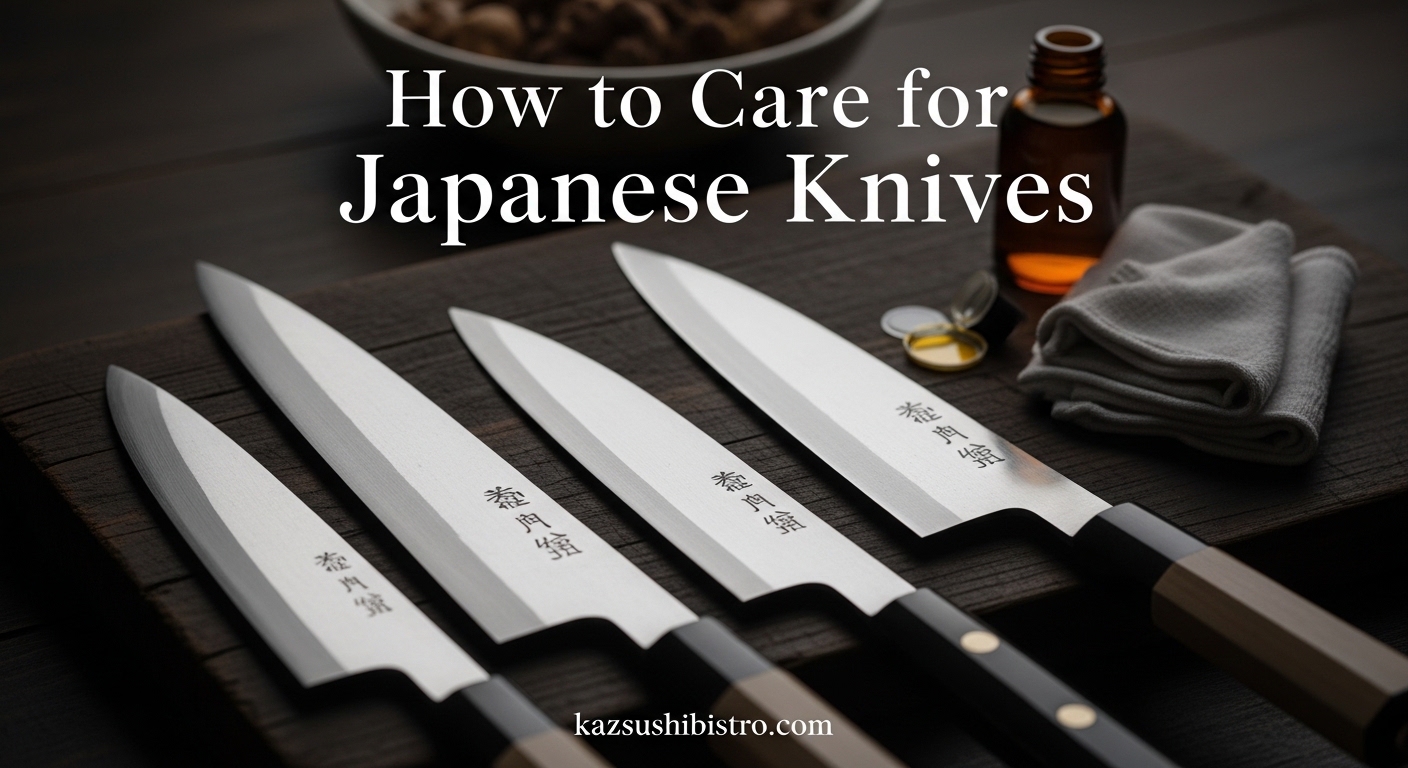
I remember the first time I held a proper Japanese gyuto. The balance was unlike anything I had used before, and the edge seemed to glide through vegetables with almost no resistance. Within a week, I had developed three small rust spots because I did not understand that how to care for Japanese knives differs fundamentally from the German stainless steel knives I grew up with.
Japanese knives are crafted from harder, thinner steel that holds a sharper edge but requires more attention. Most Japanese kitchen knives use steel with HRC ratings between 60-66, compared to 52-58 for Western knives. This hardness creates exceptional sharpness but makes the blade more brittle and prone to chipping if mishandled.
This guide covers everything I have learned over ten years of working with Japanese cutlery. You will discover the daily habits that prevent rust and chips, the storage solutions that protect your investment, and the maintenance routines that keep these precision tools performing at their best for decades.
Table of Contents
Quick Reference: Daily Care Checklist 2026
Before diving into the details, here is the simple routine that will prevent 99% of problems with your Japanese knives.
After Every Use:
- Rinse immediately under warm water
- Wash with mild dish soap and soft sponge
- Dry completely with a soft cloth within 30 seconds
- Store in a dry place with edge protection
Weekly Tasks:
- Hon with a ceramic rod (3-5 passes per side)
- Inspect for any rust spots or damage
- Apply oil to carbon steel blades if used daily
Monthly/As Needed:
- Deep clean the handle if wood
- Sharpen on whetstones when honing no longer restores edge
- Check cutting board for deep grooves that could damage edge
How to Care for Japanese Knives: Daily Cleaning and Drying
Proper cleaning is the foundation of Japanese knife maintenance. The process takes less than 60 seconds once it becomes habit, and skipping any step risks rust, staining, or handle damage.
Step 1: Rinse Immediately
Rinse your knife under warm running water immediately after use. Do not let food particles dry on the blade, especially acidic ingredients like onions, tomatoes, or citrus that can react with carbon steel and cause darkening or rust.
Step 2: Wash Gently
Apply a small amount of mild dish soap to a soft sponge or cloth. Never use abrasive scrubbers, steel wool, or harsh detergents that can scratch the blade surface or damage the finish. Wash the entire blade gently, working from spine to edge with light pressure.
Step 3: Handle with Care
Pay attention to the area where the blade meets the handle. Food debris often collects here and can cause handle swelling or bacterial growth if not cleaned. Use a soft brush or cloth corner to clean this junction thoroughly.
Step 4: Dry Completely
Drying is the most critical step for preventing rust on any Japanese knife, especially carbon steel. Use a clean, soft cloth to dry the entire blade immediately after washing. Do not air-dry, as even stainless steel can develop water spots or minor oxidation if left wet.
For carbon steel knives, I recommend drying in two stages. First, towel-dry the visible moisture. Then run the blade through a clean, dry cloth one more time to remove any residual humidity. This 30-second investment prevents hours of rust removal work later.
Step 5: Final Inspection
Hold the knife at an angle under good light and inspect for any remaining moisture, spots, or developing rust. This takes five seconds and catches problems before they become serious.
Why the Dishwasher Is Never an Option
Never put Japanese knives in the dishwasher. This rule has no exceptions, regardless of what the manufacturer claims about a knife being “dishwasher safe.”
The dishwasher exposes knives to three damaging factors simultaneously. High heat can warp thinner Japanese blades and damage wooden handles. Harsh detergents strip protective oils from carbon steel and can etch the blade surface. The violent water jets cause knives to bang against other items, risking chips and edge damage.
I have seen beautiful $300 gyutos come out of dishwashers with dulled edges, water stains that never fully removed, and handles cracked from heat exposure. The 60 seconds you save by using a dishwasher costs you years of knife life and hundreds in potential damage.
Proper Cutting Techniques for Japanese Knives
Japanese knives are designed for specific cutting motions that protect the edge and deliver clean cuts. Using the wrong technique increases chipping risk and reduces the time between sharpenings.
The Push Cut Method
Most Japanese knives, particularly gyutos and nakiris, are designed for push cutting rather than rock chopping. Push cutting means moving the knife forward and down through the food in a single motion, then lifting and repeating. This technique puts less lateral stress on the thin blade edge.
Rock chopping, common with German chef knives, involves keeping the tip on the board and rocking the blade through food. This motion can twist and torque the thin Japanese edge, causing micro-chips or full blade fractures over time.
What Not to Cut
Never use your Japanese knife on frozen foods, bones (including fish bones), hard seeds, or crusty bread with hard crusts. These materials exceed the design limits of thin Japanese edges and will cause chipping.
Use a separate beater knife or Western-style cleaver for these tasks. I keep an inexpensive stainless steel knife specifically for cutting squash, frozen items, and other hard materials. My Japanese knives handle everything else.
Proper Grip
Hold the knife with a pinch grip rather than a fist grip. Pinch the blade between your thumb and forefinger just in front of the bolster, then wrap remaining fingers around the handle. This grip provides better control and reduces hand fatigue during long prep sessions.
Choosing the Right Cutting Board
Your cutting board choice matters as much as your knife choice. The wrong surface dulls edges quickly and increases chipping risk. The right surface extends time between sharpenings and protects your investment.
| Board Type | Knife Friendliness | Best For | Avoid Because |
|---|---|---|---|
| End Grain Wood | Excellent | Daily use, all Japanese knives | Higher cost, requires maintenance |
| Edge Grain Wood | Good | Budget option, occasional use | Shows cuts faster, harder on edges |
| Soft Rubber (Hasegawa) | Excellent | Professional kitchens, easy sanitizing | Can feel different under knife |
| Hard Plastic | Acceptable | Meat/fish separation | Hard on edges, develops deep grooves |
| Bamboo | Poor | Avoid for Japanese knives | Very hard surface, contains silica |
| Glass/Stone | Never Use | Never use with knives | Destroys edges immediately |
Recommended Cutting Boards
Hinoki Wood Boards: These Japanese cypress boards are naturally antimicrobial, gentle on edges, and beautiful on your counter. The soft wood “heals” after cuts, maintaining a smooth surface longer. They require occasional sanding and oiling but reward you with years of knife-friendly service.
Larchwood Boards: End-grain larchwood from Canada offers similar benefits to Hinoki at a lower price point. The self-healing property protects knife edges, and the natural antimicrobial properties make them food-safe.
Hasegawa Rubber Boards: Professional-grade rubber boards from Japan offer the best of both worlds. They are gentle on edges like wood but can be fully sanitized like plastic. The soft surface grips food well and reduces knife wear.
Storage Solutions That Protect Your Investment
How you store your knives between uses determines how long they stay sharp and how safe they are to handle. Poor storage leads to dulled edges, chips from contact with other items, and accidents when reaching into drawers.
Magnetic Knife Strips
Magnetic strips mounted on the wall offer the best storage solution for Japanese knives. The blade hangs freely without contact, air circulates for complete drying, and edges stay protected from collisions. Look for strips with strong magnets that hold knives securely without requiring excessive force to remove them.
Install the strip where the spine of the knife contacts the magnet, not the edge. This prevents the weight of the blade from pulling against the edge while stored. Keep the strip away from heat sources and direct sunlight that could affect handle materials.
Knife Blocks
Traditional knife blocks work well but have limitations. The slots must fit your specific knives properly. Universal blocks with flexible rods can accommodate various sizes but may not support the blade ideally. Wooden blocks can harbor bacteria if not cleaned periodically.
If using a block, ensure knives are completely dry before insertion. Moisture trapped in the slot can cause rust and handle swelling. Clean the block monthly by shaking out debris and wiping with a cloth lightly dampened with diluted vinegar.
In-Drawer Trays with Blade Guards
If counter space is limited, in-drawer trays with individual blade guards provide good protection. The guard prevents edge contact with other items in the drawer, and the tray keeps knives organized and accessible.
Never store Japanese knives loose in a drawer. They will bang against other utensils, damaging the edge and creating safety hazards when you reach in blindly. If you must use a drawer without a tray, at minimum use individual blade guards for each knife.
Sayas and Blade Guards
Sayas are traditional wooden sheaths custom-fitted to specific Japanese knives. They offer elegant protection and are traditional for knives like yanagiba and deba. For gyutos and santokus, plastic blade guards offer affordable protection when storing in drawers or transporting knives.
Honing vs. Sharpening: Understanding the Difference
Many home cooks confuse honing and sharpening, using the terms interchangeably. Understanding the difference is essential for maintaining your Japanese knives properly.
What Honing Does
Honing realigns the microscopic teeth along the blade edge without removing steel. Through normal use, these teeth bend and fold over, making the knife feel dull even when the edge itself remains intact. Honing straightens these teeth, restoring cutting performance.
Think of honing like combing hair. You are not cutting the hair, just organizing it into proper alignment. Honing should be done regularly, even daily for professional cooks, to maintain peak performance between sharpenings.
What Sharpening Does
Sharpening actually removes steel from the blade to create a new edge. When honing no longer restores cutting performance, the edge has become too worn or damaged, and sharpening is necessary to remove the old edge and create a fresh one.
Sharpening on whetstones removes controlled amounts of steel. A typical progression might use a 1000-grit stone to establish the edge, then 3000-6000 grit stones to polish and refine. This process removes more steel than honing and should be done less frequently, typically every 2-6 months for home cooks depending on use.
Choosing a Honing Rod
Never use a steel honing rod on Japanese knives. The hard steel of the rod can chip the brittle Japanese edge. Instead, use a ceramic honing rod with 3000+ grit rating.
Ceramic rods are hard enough to realign the edge but gentle enough not to cause chipping. Some cooks also use leather strops loaded with polishing compound for the final edge refinement after ceramic rod honing.
Proper Honing Technique
Hold the rod vertically with the tip resting on a stable surface. Place the heel of your knife against the rod at approximately 15-16 degrees (matching your knife’s bevel angle). Draw the knife down and across the rod in a smooth arc, maintaining consistent angle and light pressure.
Perform 3-5 strokes per side, alternating sides with each stroke. Test the edge by slicing through a piece of paper. If it cuts cleanly, you are done. If not, repeat with 2-3 more strokes per side.
Carbon Steel vs. Stainless Steel: Care Differences
Japanese knives use various steel types, broadly categorized as carbon steel or stainless steel. Each requires slightly different care routines.
| Characteristic | Carbon Steel | Stainless Steel |
|---|---|---|
| Chromium Content | Under 12% | Over 12% |
| Rust Resistance | Very Low | High |
| Edge Retention | Excellent | Very Good |
| Ease of Sharpening | Very Easy | Moderate |
| Oiling Required | Yes, after each use | Optional for storage |
| Patina Development | Yes, expected | No |
| Common Types | White #1/#2, Blue Super, Aogami | VG-10, AUS-10, SG2/R2 |
| HRC Hardness | 61-65 | 60-63 |
Understanding Patina on Carbon Steel
Carbon steel knives develop a patina, a colored oxidation layer that appears as grey, blue, or rainbow hues on the blade. This is normal and actually protective. A well-developed patina prevents the red rust that damages blades.
Do not try to keep your carbon steel knife shiny and new. The patina is a sign of a knife being used and loved. Some cooks even force a patina by cutting acidic foods like onions or mustard to accelerate the protective layer formation.
Rust Prevention and Oil Application
Rust is the enemy of all steel knives, but especially carbon steel Japanese knives. Proper rust prevention extends knife life indefinitely, while neglect leads to pitting and structural damage.
When to Oil Your Knife
Carbon steel knives should be oiled after each use if you live in a humid climate or during summer months. In dry climates, oiling after each use may be excessive, but every few days is still wise. Stainless steel knives benefit from occasional oiling before long-term storage.
Apply oil whenever you will not use the knife for more than a day. The thin protective layer prevents any moisture in the air from reaching the steel surface.
Best Oils for Japanese Knives
Camellia oil (tsubaki oil) is the traditional choice for Japanese blades. It is food-safe, odorless, and does not go rancid. Food-grade mineral oil is an affordable alternative widely available at pharmacies. Both work equally well for rust prevention.
Avoid cooking oils like vegetable or olive oil. They become sticky and rancid over time, creating a gunk buildup that attracts debris and can affect food flavors. Never use non-food-safe oils or WD-40 on kitchen knives.
How to Apply Oil
Place one drop of oil on the blade near the handle. Use a soft cloth to spread the oil in a thin, even layer across the entire blade surface. The coating should be barely visible, not dripping or pooled.
Pay special attention to the exposed steel at the bolster and any etched areas that might trap moisture. Wipe away excess oil before cutting food to prevent oil transfer to your ingredients.
Common Mistakes to Avoid
Learning what not to do is as important as learning proper care techniques. These mistakes damage more Japanese knives than all other factors combined.
Never Put Japanese Knives in the Dishwasher: The combination of heat, harsh detergents, and violent water movement destroys knives. This is the single most damaging mistake you can make.
Never Leave Knives Wet: Even brief periods in the sink cause rust on carbon steel and water spots on stainless. Dry immediately, every time, without exception.
Never Cut on Glass, Stone, or Metal: These surfaces destroy edges immediately. Even ceramic plates are too hard for Japanese knife edges. Use only proper wood or soft plastic cutting boards.
Never Cut Frozen Foods or Bones: The brittle Japanese edge chips on hard materials. Use a Western knife or cleaver for these tasks.
Never Use Steel Honing Rods: The hard steel rod chips Japanese edges. Use ceramic rods only.
Never Store Knives Loose in Drawers: Banging against other utensils damages edges and creates safety hazards.
Never Twist the Blade in Cuts: Japanese edges are thin and chip if twisted while cutting. Use straight push or pull cuts only.
Troubleshooting Common Issues
Even with proper care, issues occasionally arise. Here is how to address common problems.
Removing Rust Spots
For minor surface rust, use a rust eraser (Sabitoru stone) or fine-grade synthetic steel wool. Work gently with the grain of any Damascus pattern, not against it. Apply a small amount of oil while erasing to lubricate the surface.
For deeper pitting, professional restoration may be necessary. A skilled sharpener can grind out pits and re-establish the edge, though some steel loss occurs.
Fixing Small Chips
Very small chips (under 1mm) often sharpen out on a 1000-grit whetstone with normal sharpening sessions. Larger chips require more aggressive grinding at lower grits (400-600) to remove the damaged steel before refining the edge.
Handle Problems
Wooden wa-handles can swell from moisture or crack from drying. If swelling occurs, dry the handle thoroughly and lightly sand with fine-grit paper if necessary. For cracks, professional repair or handle replacement is usually needed.
Prevent handle issues by never soaking knives and drying handles immediately after washing. Occasional application of food-safe oil or wax to the handle prevents drying and cracking.
Frequently Asked Questions
Do Japanese knives need to be oiled?
Carbon steel Japanese knives should be oiled regularly to prevent rust, especially after each use in humid environments or before storage. Stainless steel Japanese knives do not require regular oiling for rust prevention but benefit from occasional oiling before long-term storage. Use food-safe camellia oil or mineral oil applied in a thin layer across the blade.
What not to do with Japanese knives?
Never put Japanese knives in the dishwasher, leave them wet in the sink, cut on glass or stone surfaces, cut frozen foods or bones, use steel honing rods, store them loose in drawers, or twist the blade during cuts. These practices cause chipping, rust, and permanent damage to the hard, thin steel.
How often should I oil my Japanese knife?
Oil carbon steel knives after each use if you live in humid climates or during summer months. In dry climates, oil every 2-3 days of use is sufficient. Apply oil whenever storing knives for more than 24 hours. Stainless steel knives only need occasional oiling before long-term storage exceeding a week.
What is the best oil for Japanese knives?
Camellia oil (tsubaki oil) is the traditional choice for Japanese blades because it is food-safe, odorless, and does not go rancid. Food-grade mineral oil is an effective, affordable alternative. Avoid cooking oils like vegetable or olive oil as they become sticky and rancid, and never use non-food-safe lubricants.
Can Japanese knives go in the dishwasher?
No, Japanese knives should never go in the dishwasher. The high heat can warp blades and damage handles. Harsh detergents strip protective oils and can etch the steel. Water jets cause knives to bang against other items, risking chips and edge damage. Always hand wash and dry immediately.
How to remove rust from Japanese knife?
Remove surface rust with a rust eraser (Sabitoru stone) or fine synthetic steel wool, working gently with any Damascus grain pattern. Apply light oil while erasing to lubricate. For deeper pitting, professional restoration may be necessary. Prevent rust by drying immediately after washing and applying protective oil to carbon steel.
How often to sharpen Japanese knife?
Home cooks should sharpen Japanese knives every 2-6 months depending on usage, or when honing no longer restores cutting performance. Professional chefs may sharpen weekly or bi-weekly. Between sharpenings, hone with a ceramic rod every few uses to maintain alignment. Use whetstones starting at 1000-grit for sharpening.
What cutting board is best for Japanese knives?
End-grain wood boards like Hinoki or Larchwood are best for Japanese knives because they are gentle on edges and naturally antimicrobial. Soft rubber boards like Hasegawa are excellent for professionals. Avoid bamboo, glass, stone, and hard plastic boards that dull edges quickly or cause chipping.
Conclusion
Learning how to care for Japanese knives is an investment in tools that can last decades with proper attention. The daily routine is simple: hand wash with mild soap, dry immediately with a soft cloth, store with edge protection, and hone regularly with a ceramic rod.
Understanding the differences between carbon steel and stainless steel helps you adjust your care routine appropriately. Carbon steel demands more vigilance against rust but rewards you with easier sharpening and a beautiful protective patina. Stainless steel offers more forgiveness but still deserves respect and proper technique.
Your Japanese knife represents centuries of metallurgical tradition and skilled craftsmanship. The few minutes you spend on proper care each day preserves that legacy and ensures your knife performs beautifully for years to come. Start with the basics, develop consistent habits, and your knives will reward you every time you cook.