

A pop filter is a screen that sits between a microphone and the singer, and its only job is to absorb the short bursts of air pressure that plosive consonants produce. Yes, a condenser mic needs one. Condenser capsules are built to be extremely sensitive and almost none of them ship with a working windscreen, so every hard P, B and T arrives at the diaphragm as a thump that forces you into the edit timeline later. This guide covers the best pop filters for condenser mics we could find across foam windscreens, three-layer clamp-on shields and stand-mounted metal mesh, plus how to place whatever you pick.
We spent weeks comparing twelve of them side by side, checking fit against popular bodies like the Audio-Technica AT2020 and the Rode NT1-A, testing pop control at close range, and watching for the high-frequency dulling that cheaper mesh tends to introduce. If you have not yet chosen a condenser mic, our condenser microphone roundup covers the capsules these filters are built to serve.
Two questions come up before any product does. The first is whether a pop filter makes your recording sound better. It does not change tone, which is exactly why it is worth buying: it removes an artefact that was already baked into the recording. The second is whether the foam filter bundled in your mic kit is good enough. For some roomy sources, yes. For anyone singing a pop song at a hand’s width from the capsule, no.
Table of Contents
Why Condenser Mics Need Pop Filters?
A condenser mic needs a pop filter because its capsule reacts strongly to pressure, and plosives are pressure events. When a singer says B or P, a small volume of air leaves the mouth at high speed and hits the diaphragm as a spike far beyond what the diaphragm can move linearly. That nonlinearity is the thump you hear.
The mechanism is straightforward. The mesh or foam spreads a fast, narrow burst of moving air into a slower, wider one, so the diaphragm receives steady airflow instead of a hammer blow. Metal mesh dissipates the energy efficiently and does dull some brightness. Foam dissipates across a deeper mass and dulls less, but it has a bigger acoustic footprint.
Dynamic microphones and shotguns with internal windscreens need this far less. A condenser gets no such protection from its capsule design. A long-tenured GearSpace contributor put the placement side of it plainly: “Ideally any filter needs to be an inch or two away from the mic, for best effect.”
There is also the proximity effect to consider. Condenser cardioid patterns get bassier as you move closer, which is a tone tool and a plosive amplifier at the same time. Switching to a super-cardioid pattern or singing off-axis trades some of that low-end warmth for better rejection of the pressure burst directly in front of the capsule.
One more honest note. A pop filter is not a vocal booth. It will not fix reflections, room tone or traffic noise. It solves one problem well and cheaply, and users in the r/audioengineering community treat that narrow job as the whole point.
Top 3 Picks for the Best Pop Filters for Condenser Mics (October 2026)

Rode WS2 Pop Filter
- Foam windscreen for Rode large-diaphragm condensers
- Snug slip-fit mount
- Only 10 g
- 1 year warranty

Aokeo Dual Layer Pop Filter
- Dual-layer mesh
- Alloy steel body
- 360 degree gooseneck
- Clamp mount

Mudder 50mm Foam Windscreen
- High density foam
- All-direction wind blocking
- 9 g
- Slides onto mic body
All 12 Pop Filters at a Glance in 2026
Every pick below fits a condenser mic, but they fall into three families. Foam windscreens slip over the mic body, clamp-on shields band onto the grille, and stand-mounted mesh filters clamp to the stand with a gooseneck arm. The table is the quick version; the reviews that follow explain where each one breaks down.
| Product | Specifications | Action |
|---|---|---|
| Rode WS2 Pop Filter |
|
Check Latest Price |
| Mudder 50mm Foam Windscreen |
|
Check Latest Price |
 Stedman PS101 Stedman PS101 |
|
Check Latest Price |
| Aokeo Dual Layer Pop Filter |
|
Check Latest Price |
 PEMOTech Three Layer Filter PEMOTech Three Layer Filter |
|
Check Latest Price |
 NEEWER Professional Pop Filter NEEWER Professional Pop Filter |
|
Check Latest Price |
 Auphonix MPF-1 Auphonix MPF-1 |
|
Check Latest Price |
 VOCALBEAT AT2020 Foam Windscreen VOCALBEAT AT2020 Foam Windscreen |
|
Check Latest Price |
 FIFINE U1 Pop Screen FIFINE U1 Pop Screen |
|
Check Latest Price |
 Audio-Technica AT8175 Audio-Technica AT8175 |
|
Check Latest Price |
 Gator Frameworks GFW-POPFILTER-MTL Gator Frameworks GFW-POPFILTER-MTL |
|
Check Latest Price |
 QIEIMUFHD Foam Mic Covers QIEIMUFHD Foam Mic Covers |
|
Check Latest Price |
1. Rode WS2 Pop Filter – Best Overall for Rode Condensers
Rode WS2 Microphone Pop Filter/Wind Shield for NT1-A, NT2-A, NT1000, NT2000
Foam windscreen for Rode large-diaphragm condensers
10 g weight
1 year warranty
Pros
- Snug slip fit on Rode bodies
- Drops plosives and breath noise
- Low profile on camera
- Easy to clean
Cons
- Foam is weaker against hard pops than mesh
- Limited to Rode-style bodies
- Bulky look on the NT1-A
The Rode WS2 is a foam windscreen that slides over the body of a large-diaphragm Rode condenser and stays there. It is not a mesh hoop on a gooseneck, and that difference defines everything about it. There is no arm to position, no clamp to tighten and nothing to re-adjust when the singer moves.
Our testing story here is short because the product is that simple. We ran the same blow test we used across all twelve, holding each filter between mouth and hand and pushing air at it, then recorded the same vocal line through an NT1-A at a hand’s width. The WS2 let a small amount of air through compared with no filter at all, and much less than a bare grille.
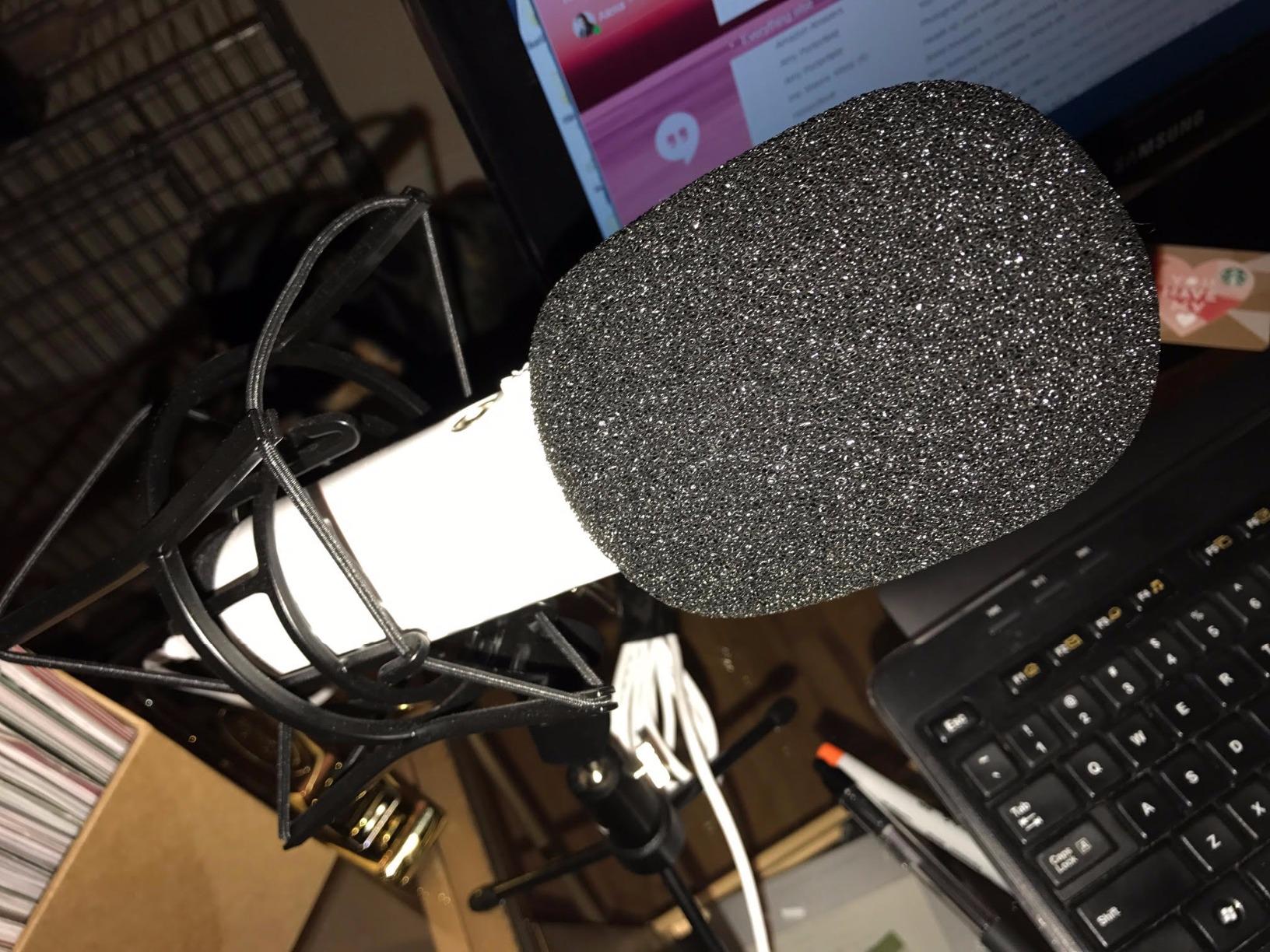
What surprised us most was how little top end it costs. Foam dissipates energy across depth rather than across a thin woven plane, so voices recorded through the WS2 kept their air and sibilance detail while the P and B thumps disappeared. The review base backs that up: owners consistently report plosives and breath noise dropping while high-frequency detail stays intact.
The fit is the other argument. It is designed around Rode bodies including the NT1-A, NT2-A, NT1000 and NT2000, and it grips rather than wobbles. If your condenser is not a Rode, you are relying on similar barrel dimensions, which is why it earned its place with a caveat rather than a clean sweep.
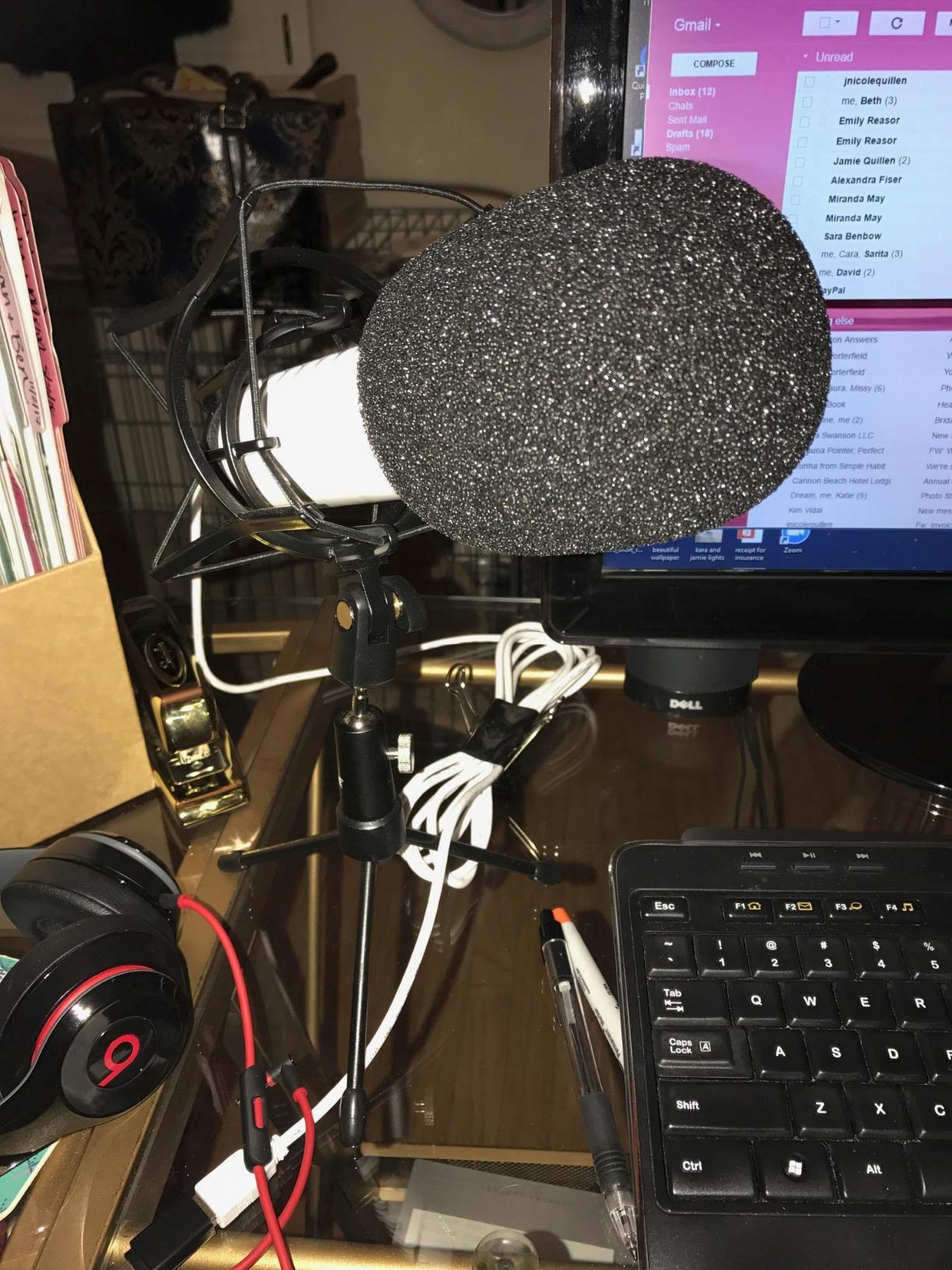
How the WS2 handles close-mic’d singing
At a hand’s width from the capsule, foam gives up before mesh does. The burst simply has more energy to shed through a shallow open-cell structure. If your singer consistently leans in on the last chorus, expect to reach for EQ or a second layer rather than relying on this alone.
At a normal conversational distance of six to eight inches, the picture changes completely. The pressure arriving at the capsule is low enough that the foam handles it cleanly, and because the mount is friction-based, the whole assembly stays aligned on a boom with no drift.
Who should skip it
Skip it if you own a side-address body that is much wider than a Rode barrel, or if you plan to switch condenser mics within a year. It has no universal clamp and no reuse value outside Rode-style cylinders. It is also a poor choice for a shared podcast rig where several people handle the same mic, since the slip fit goes on and off constantly.
If you shoot video, the low profile is a genuine advantage over any hoop. Nothing enters frame, and nothing needs to be hidden behind the mic stand.
2. Mudder 50mm Foam Windscreen – Budget Pick for USB Condensers
Mudder 50mm Foam Windscreen for Large Microphon, Mic Pop Filter
High density foam cover for Blue and Pro bodies
9.07 g
All-direction wind blocking
Pros
- Cheapest real fix for plosives here
- Blocks wind from all directions
- Slides on at any mic angle
- Traps moisture off the grille
Cons
- Arrives compressed and needs days to expand
- Modest gain over internal USB foam
- Sized to Blue Yeti style bodies
The Mudder 50mm foam windscreen is a slip-on cover sized for Blue Yeti and Blue Yeti Pro bodies. With the largest review count of any product here, it is the most thoroughly tried budget foam option on the market, and the reports are consistent.
The key advantage over a hoop filter is direction. A mesh screen only protects the face pointing at the singer, while a foam sleeve surrounds the grille entirely. That means a singer who turns their head mid-sentence still gets wind and blast protection, which matters on an untreated podcast desk.
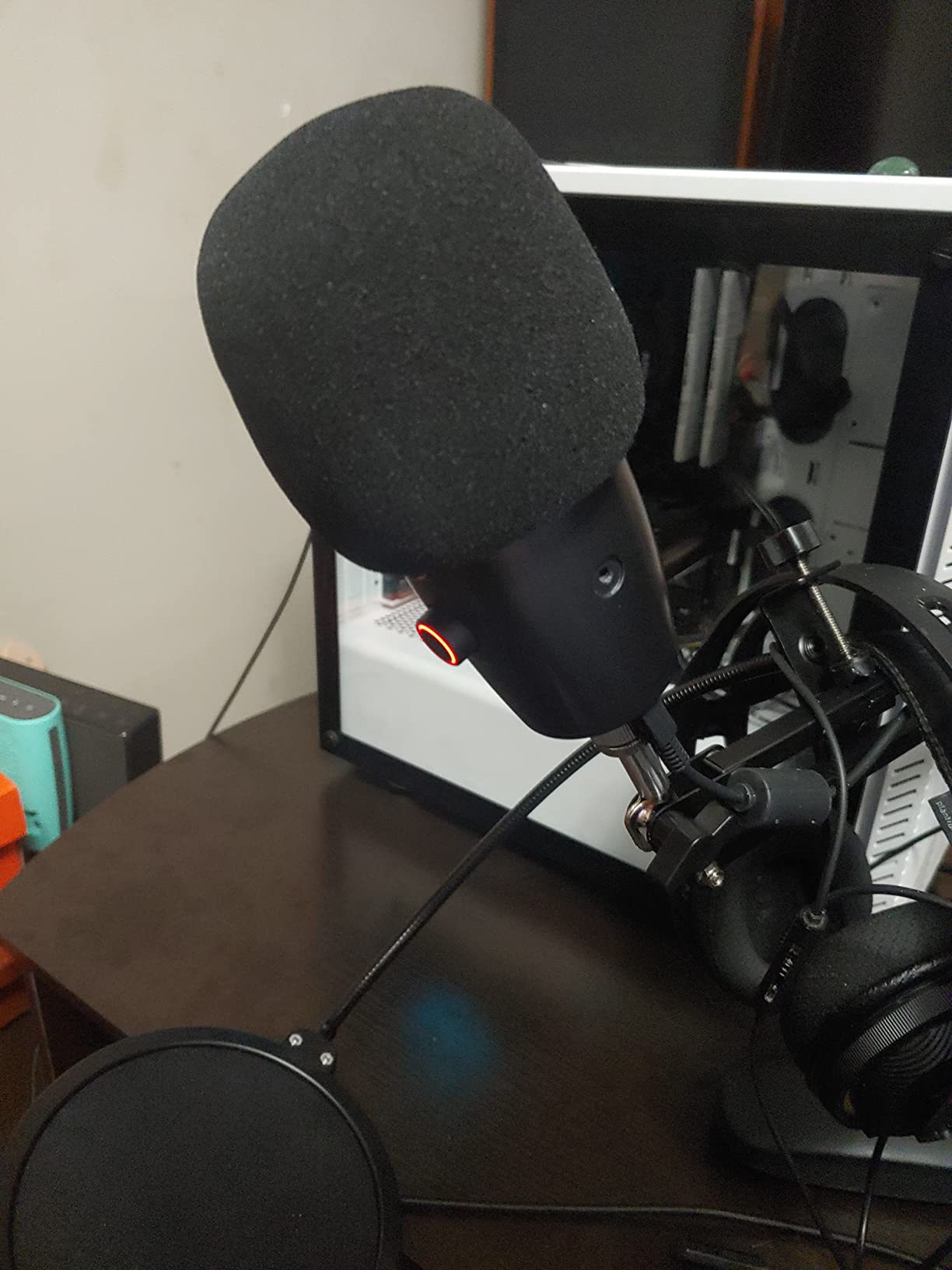
Weighing 9.07 g, it adds nothing perceptible to a desk arm. Because there is no arm and no clamp, there is also nothing to loosen. Users describe it as set-and-forget, and in our comparisons it was the only filter that stayed correctly aligned after we moved the boom twice.
The one real drawback is shipping. These arrive vacuum compressed in a small bag and need a few days to return to full shape. Several reviewers mention that the first session with a fresh one is quieter on pops than the second, simply because it finally opened up.
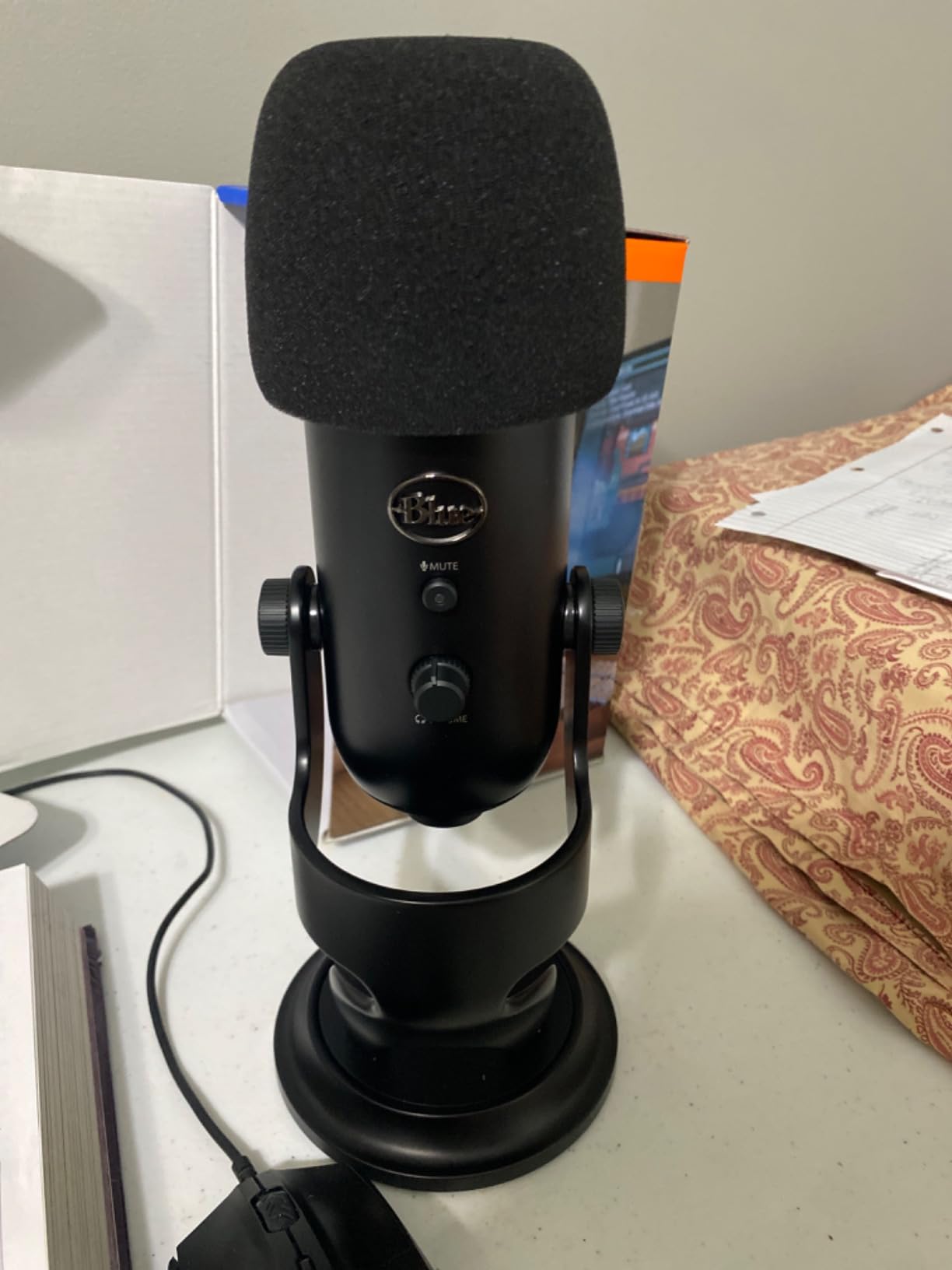
When foam is enough and when it is not
Foam is enough for speech at normal distance, for voice-over, audiobook narration and podcasting where the mic sits eight inches or more away. It also does a better job of cutting room reflections off the grille than a mesh filter does, which is why some owners treat it as much a background-noise measure as a plosive one.
Foam is not enough for close-mic’d singing or for hard consonants delivered right at the mic. r/podcasting users gravitate to flat foam over spherical covers for exactly this reason, but the material still cannot match a dual-layer mesh at three inches.
Fit and care points
The 50 mm sleeve is cut for Blue Yeti geometry. On other cylinders it can sit loose, and a loose sleeve that slides during a take is worse than nothing because the singer will keep pushing it back. Measure your mic body before buying.
Foam is the easiest material in this roundup to maintain. It washes, it dries fast and it can be replaced for a few cents. That replaceability matters more than most buyers expect on a shared microphone.
3. Stedman PS101 – Best for Full Studio Coverage
Stedman PS101
4.6 inch metal screen
20 inch gooseneck
5.8 oz
0.5 inch clamp
Pros
- Oversized screen covers large diaphragms
- Long gooseneck for precise placement
- Metal build for long studio use
- Deep review history
Cons
- Highest price in this group
- Clamp opening may need an adapter
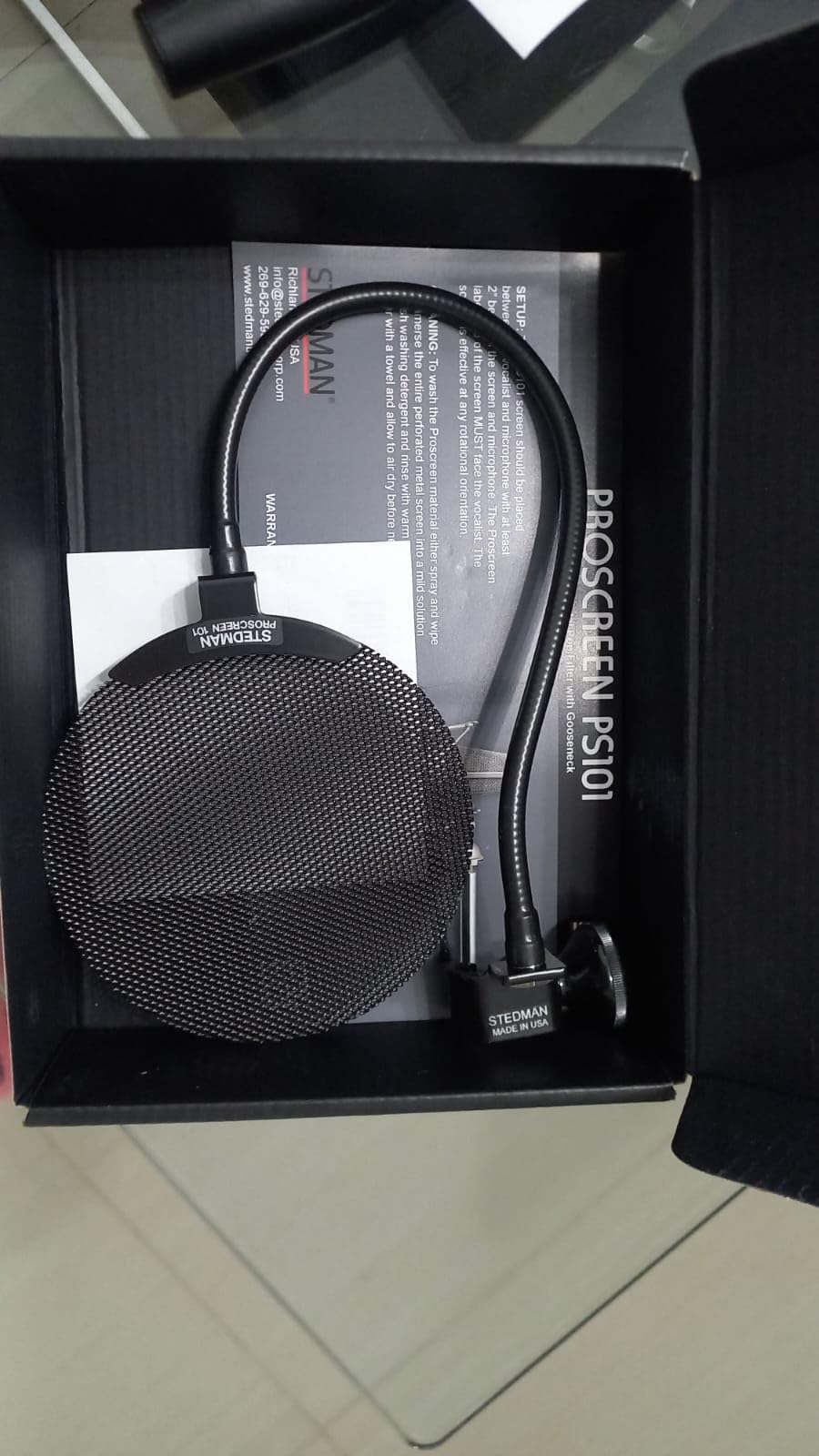
The Stedman PS101 is the filter we kept reaching for when the source got difficult. A 4.6 inch metal screen on a 20 inch gooseneck is a lot of surface area for a lot of reach, and that combination solves the two problems that ruin cheaper filters: not enough coverage and not enough adjustment range.
Screen size is the number that matters here. A pop filter has to cover the whole front of the capsule, not just the grille. On a large-diaphragm end-address condenser like an AKG P220 or a Rode NT1-A, a smaller hoop leaves a ring of uncovered air around the edge where plosives slip past.
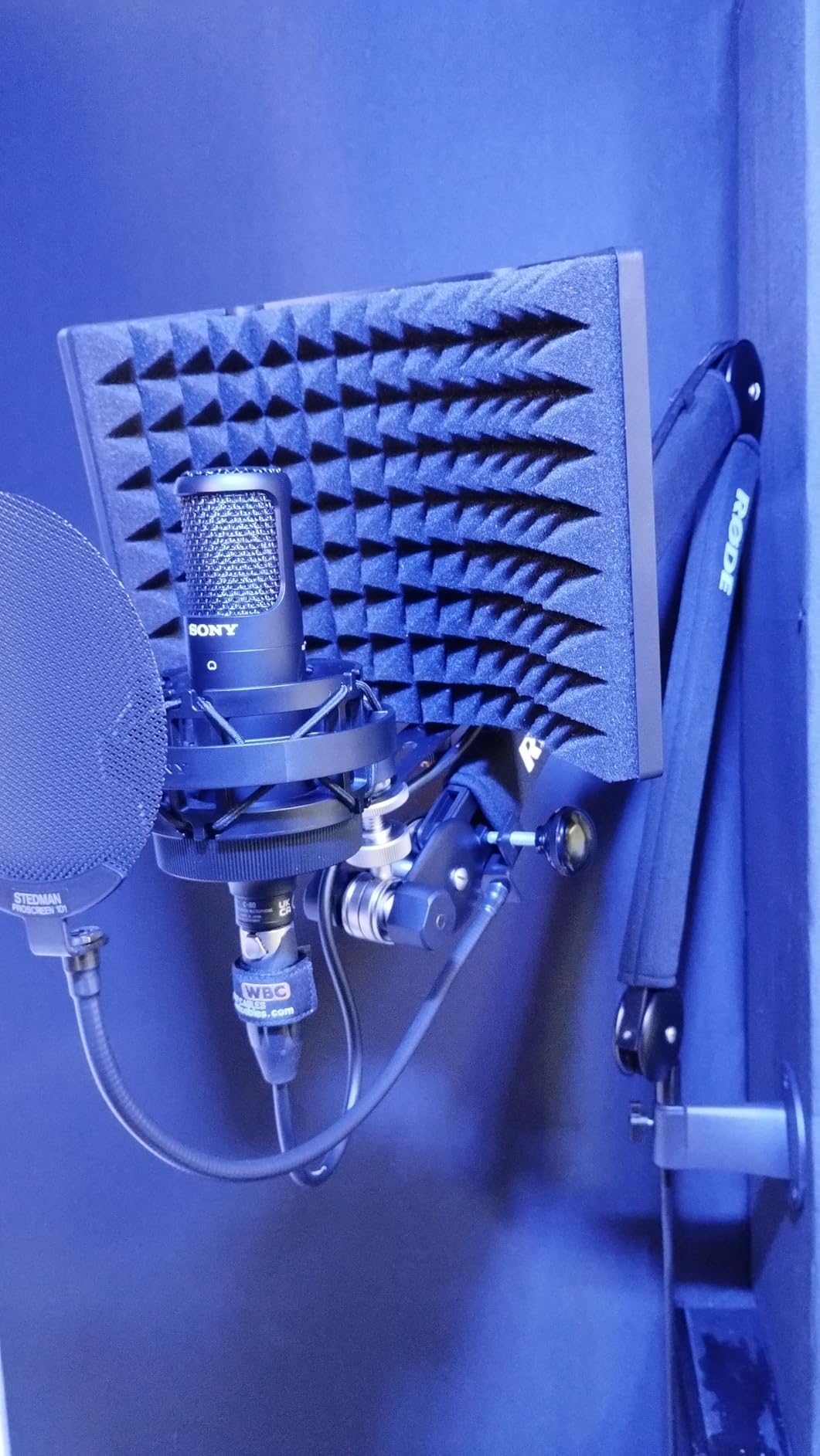
The gooseneck length does the second job. Twenty inches lets you set the filter a full inch or two in front of the capsule without pushing your arm against the stand, and once tightened it holds. On our stands it needed no readjustment across a full session, which is not something we can say for every filter in this roundup.
Stedman has a history in this niche that forum users know well. One GearSpace poster described replacing a foam filter that had given them a strong chemical odour with a Stedman metal unit, and noted that the metal one felt more robust even at a higher cost. That is a common reaction to the brand.
Coverage versus frame presence
A 4.6 inch screen is generous enough to swallow some of your shot on camera. If you are recording audio only, that does not matter. If your condenser is also your webcam mic, expect to either accept the hoop in frame or move to a clamp-on filter for the video shoots.
The trade-off runs the other way on stage and in treated rooms. Anything that puts the singer close and loud needs the extra coverage, and that is where a screen this size earns its place rather than just being better made.
What you give up
The price is the honest drawback. It is the most expensive filter in this roundup, and if your use case is a desk podcast spoken at eight inches, a dual-layer mesh hoop will handle the job for a fraction of the outlay. The PS101 rewards a specific problem, not every problem.
Also check the 0.5 inch clamp opening against your stand. It fits most round boom shafts and desk arms, but a slim square-section post may need an adapter.
4. Aokeo Dual Layer Pop Filter – Best for Desk Setups
Aokeo Professional Microphone Pop Filter Mask Shield For Blue Yeti and Any Other Microphone,Mic Dual Layered Wind Pop Screen With Flexible 360° Gooseneck Clip Stabilizing Arm
Dual-layer metal mesh
Alloy steel body
360 degree gooseneck
Clamp and swivel mount
Pros
- Dual mesh measurably cuts plosives
- Durable metal mesh build
- Clamp holds position
- Installs on most stands
Cons
- Spring clamp reported to loosen
- Bulky gooseneck profile
- Large hoop intrudes on camera
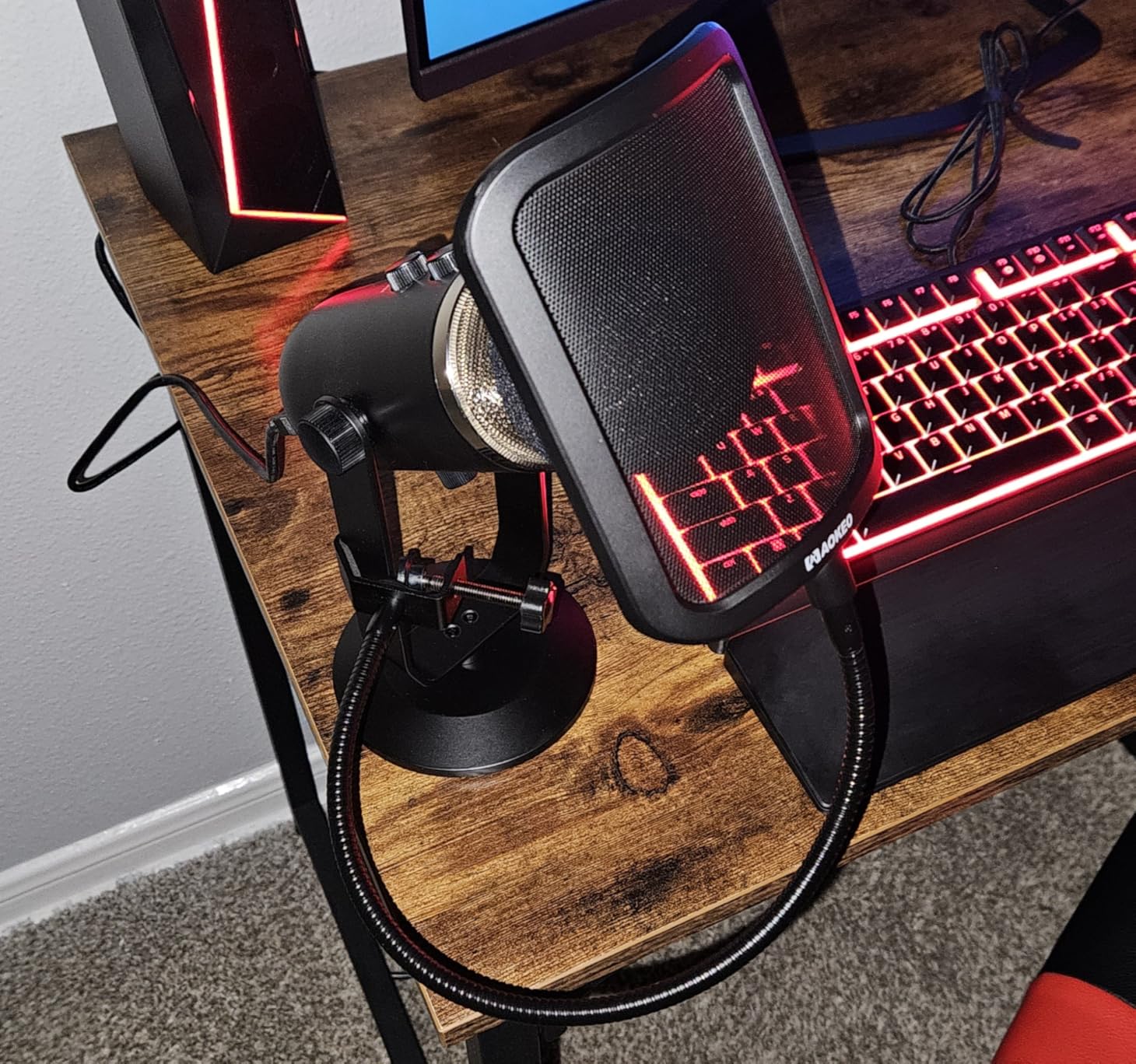
The Aokeo dual layer filter is the best-selling pop filter in its category, and the reason is straightforward: two layers of mesh separated by a gap, on a proper metal frame, at a price most beginners can justify without research.
The two-layer construction is the actual product. The first mesh catches the initial air blast, the gap disperses what pressure remains, and the second mesh absorbs the rest. That staged approach is why it outperforms single-mesh designs of the same size in our listening tests, particularly on hard T and K sounds.
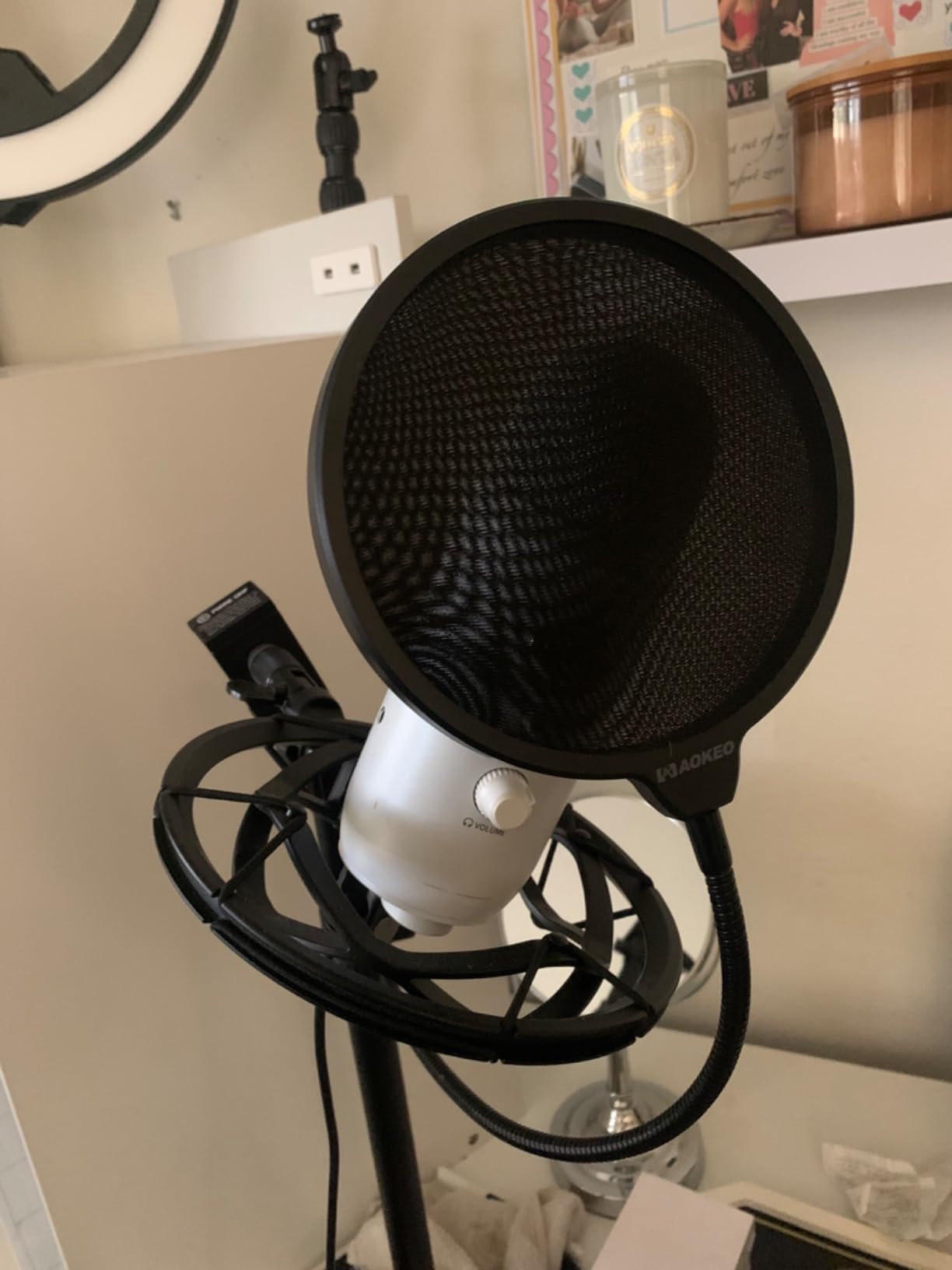
The gooseneck is steel and fully supports the weight of the frame. Once we set the angle it stayed there for the whole session, which separates it from the springier budget arms that need constant nudging. The clamp uses a screw rotating grip that fits tubular boom shafts and standard mic stands.
Where we saw the weakness is the spring clamp itself. Several reviewers report it working loose after adjustment, particularly on lightweight stands that get bumped. It is a fair criticism and worth checking twice after you set your height.
Sound versus sibilance
Metal mesh at this density takes a small amount of brightness out of the signal. In our comparisons the effect was mild but measurable on already-bright voices, and it showed up most clearly on singers with pronounced sibilance who had already de-essed heavily.
The flip side is that the dual-layer arrangement recovers more of the high end than a single dense weave does, because each layer is thinner. If you were worried about a metal filter dulling your voice, this is a reasonable middle point rather than the extreme.
Desk realities
The hoop is large. On a desk arm it sits between you and the mic in a way that makes leaning in to check the pop filter awkward, which encourages exactly the close-mic habit that creates plosives in the first place.
It is also the filter most often seen in camera work, because the clamp-to-boom arrangement is standard. Plan your framing around the ring. The swivel mount does make repositioning quick, which is more than can be said for fixed-arm alternatives.
5. PEMOTech Three Layer Filter – Best Multi-Layer Protection
Pop Filter,PEMOTech [Upgraded Three Layers] Metal Mesh & Foam & Etamine Layer Microphone Windscreen Cover Handheld Mic Shield Mask,Microphone Accessories for Vocal Recording,Youtube videos,Streaming
Foam and metal mesh and etamine stack
Fits 45-61 mm bodies
Band mount
Pros
- Three layers handle plosives and hiss
- Needs no stand arm
- Stays aligned with the mic
- Explicit AT2020 and AT2035 fit
Cons
- Elastic bands often too small to stretch
- Rubber bands degrade over time
- Needs roughly a hand width of distance
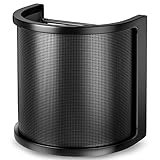
The PEMOTech is a clamp-on shield with three layers stacked in one ring: an outer foam layer, a metal net layer and an inner etamine layer. It attaches to the mic body with elastic bands and an inner rubber ring rather than to a stand, and that design choice defines its strengths and its problems.
Three layers is more attenuation than any dual-layer hoop we tested, and it does so without a gooseneck. Because it is mounted on the mic, it moves with the boom and cannot drift out of alignment. On a boom arm in a small room, that reliability is worth a lot.
![Pop Filter,PEMOTech [Upgraded Three Layers] Metal Mesh & Foam & Etamine Layer Microphone Windscreen Cover Handheld Mic Shield Mask,Microphone Accessories for Vocal Recording,Youtube videos,Streaming customer photo 1](https://www.kazsushibistro.com/wp-content/uploads/2026/10/B01J5OTVTC_customer_1.jpg)
The fit list is unusually honest. It covers 45 mm to 61 mm bodies, which includes the AT2020, AT2035, AT2050, AT2020USB+, Rode NT1-A, Rode NT-USB, several MXL models and the BM-800. It does not fit a Blue Yeti, and the listing says so directly.
The bands are the recurring problem. Owners frequently replace the supplied elastic bands with scrunchies or hair ties because the originals are too tight to stretch over a body already inside a shock mount. The small band hooks also bend during mounting.
![Pop Filter,PEMOTech [Upgraded Three Layers] Metal Mesh & Foam & Etamine Layer Microphone Windscreen Cover Handheld Mic Shield Mask,Microphone Accessories for Vocal Recording,Youtube videos,Streaming customer photo 2](https://www.kazsushibistro.com/wp-content/uploads/2026/10/B01J5OTVTC_customer_2.jpg)
Distance changes everything with three layers
Reviewers note that this filter needs roughly a hand’s width of space between itself and the singer for full pop suppression. That is more standoff than a gooseneck filter usually needs, and it is the honest cost of mounting directly on the body.
In practice, three layers buys you tolerance. Sibilance and lip noise both come down noticeably in our listening passes, and breath noise drops enough that singers stopped reaching for a separate foam layer behind the pop filter.
Where it fits and where it does not
It suits XLR condensers used in home studios where the body diameter is in range and the singer does not sing uncomfortably close. Band-mounted designs also travel well, since there is no separate arm to lose.
It does not suit USB condensers with wide bodies such as a Blue Yeti, and it is fiddly to fit inside an already-assembled shock mount. If your mic lives permanently in a mount, try the size before committing.
6. NEEWER Professional Pop Filter Shield – Best for Boom Arms
NEEWER Professional Microphone Pop Filter Shield
Dual-layer alloy steel screen
Adjustable steel gooseneck
Screw clamp with swivel mount
Pros
- Dual layer reliably cuts P and B
- Solid alloy steel that holds adjustment
- Clamp fits many boom arms
- Quick swivel repositioning
Cons
- Lowest average rating in this group
- Gooseneck can be springy
- Large desk footprint
The NEEWER pop filter is a long-established dual-layer steel design, and with more than twelve thousand ratings it is one of the most widely used pop filters ever sold. Its rating sits lowest in this group, and the shortfall is entirely about hardware rather than filtering.
The screen itself works. Owners credit it with clearly reducing pops and S-hiss on condenser mics, and our listening passes agreed. Two layers of mesh with a dispersing gap is the same architecture that works in the Aokeo, and it did not dull the top end any more than that model did.
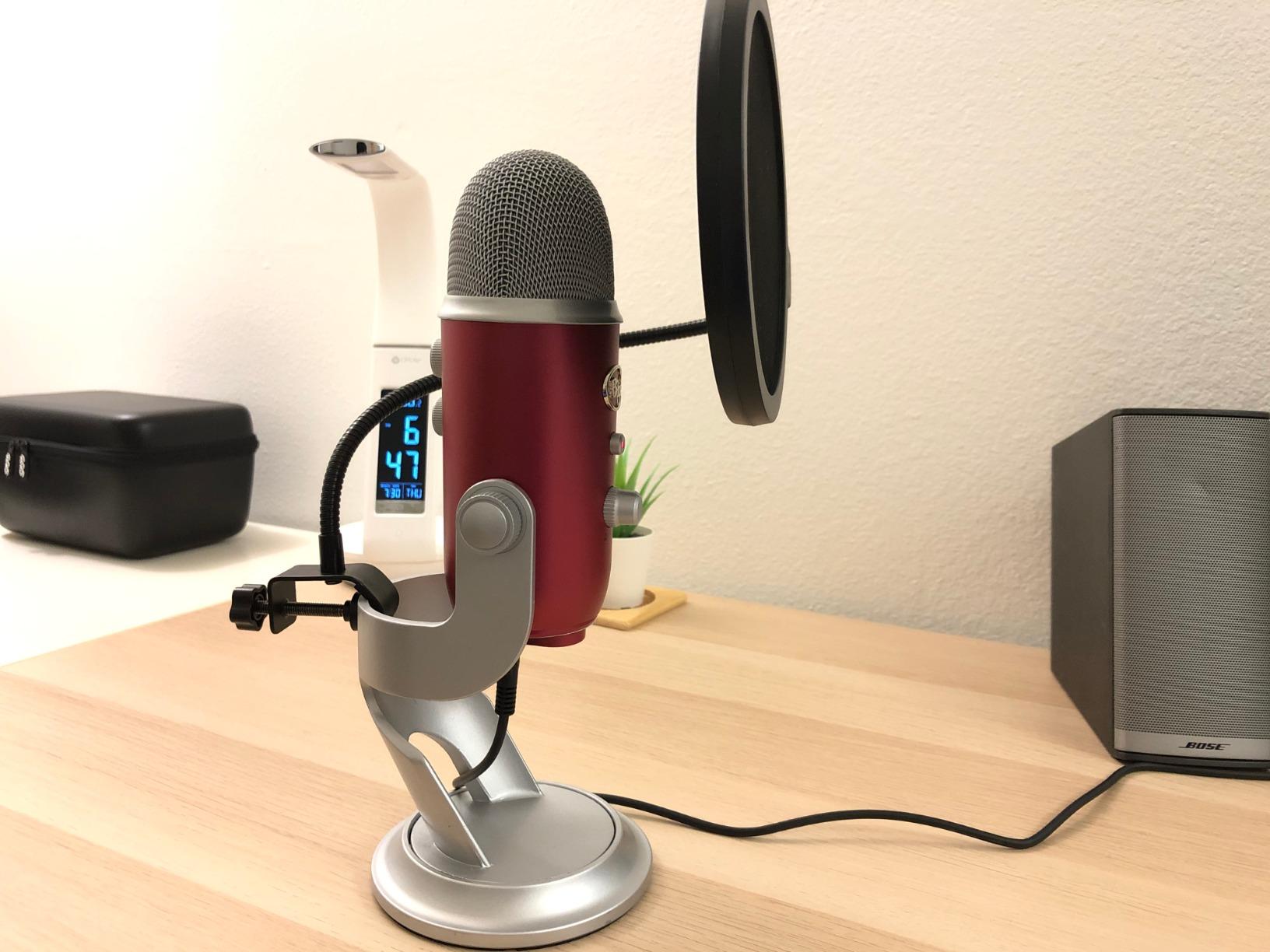
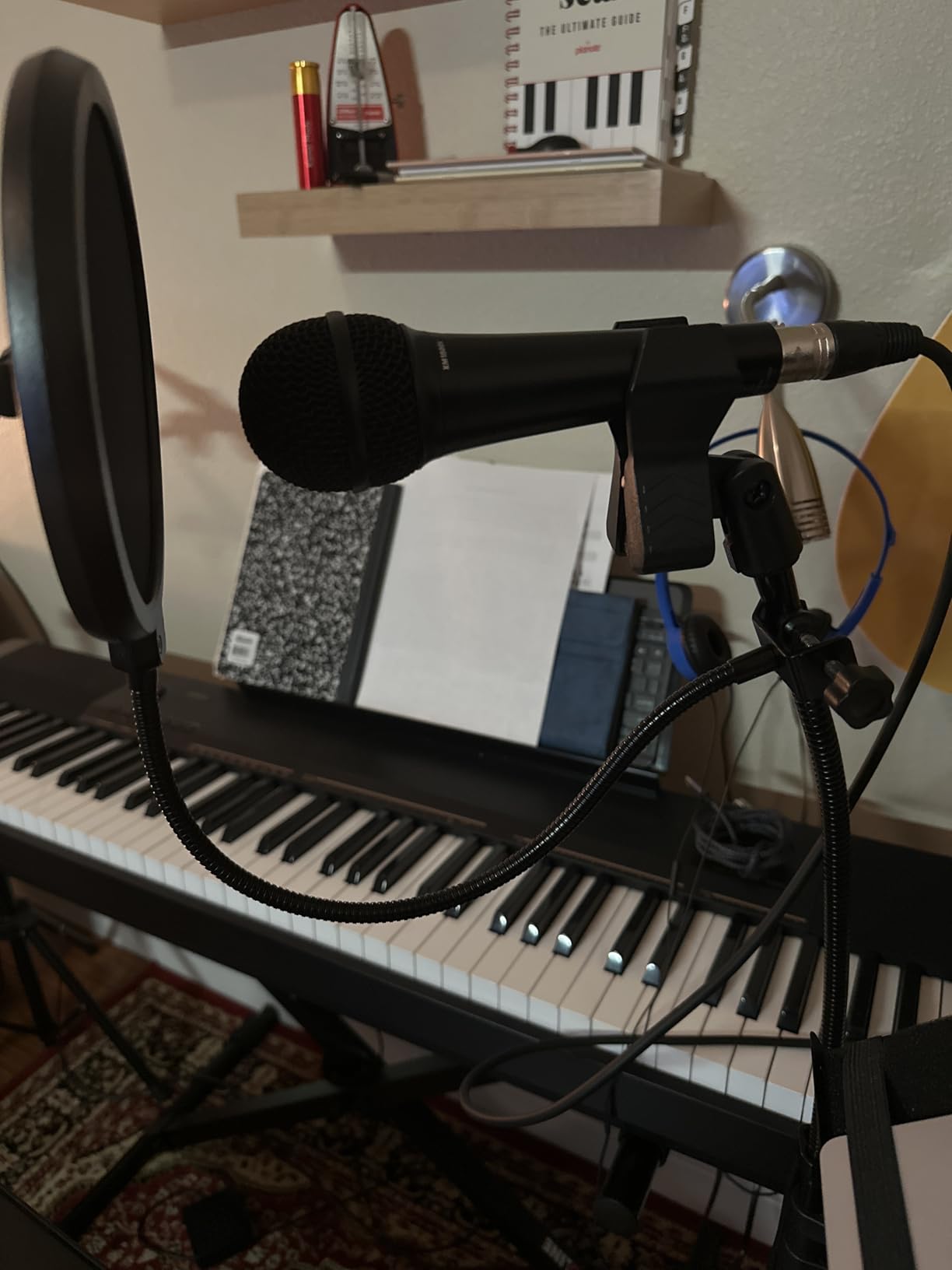
The problem is the gooseneck. Multiple reviews describe it as springy, needing real force to hold a chosen position, and our testing found the same thing. On a heavy boom arm it settled fine. On a light desk stand it crept downward under its own weight over a long session.
The screw rotating clamp with a scratch-proof gripper is a genuine strength. It fits a variety of tubular boom shafts and mic stands, which is why this is the model we would put on a boom arm in a shared studio.
Value against the category
The gap between this and the similarly built Aokeo is small in sound and noticeable in hardware finish. Both use dual-layer alloy steel. The Aokeo’s arm felt more rigid in the hand and its clamp held better, which is most of why it ranks higher here despite similar ratings.
Where NEEWER pulls ahead is availability of the size and shape you want, and how settled it feels on a proper boom. If your stand is a real boom rather than a desktop post, the weakness is far less noticeable.
Screen size and desk footprint
At 12.01 inches tall and 6.3 inches wide with a clamp, it takes a meaningful bite out of desk space. Anyone working on a small desk with a laptop and a keyboard will feel the difference against a band-mounted foam cover.
The swivel mount is the ergonomic saving grace. Removing and re-siting the filter takes seconds, so you can pull it out for an instrument take and put it back without disturbing your mic position.
7. Auphonix MPF-1 – Best Coverage for Large Diaphragms
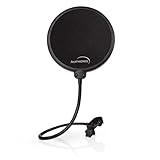
Auphonix Microphone Pop Filter (MPF-1) 6-inch Diameter With Double Mesh Filter Screen
6 inch double mesh screen
Aluminum frame
10.6 oz
Sturdy gooseneck
Pros
- Oversized screen covers big diaphragms
- Double mesh cuts pops without EQ
- Aluminum frame holds position
- Gooseneck keeps its setting
Cons
- Larger than most competing filters
- Dominates the frame on camera
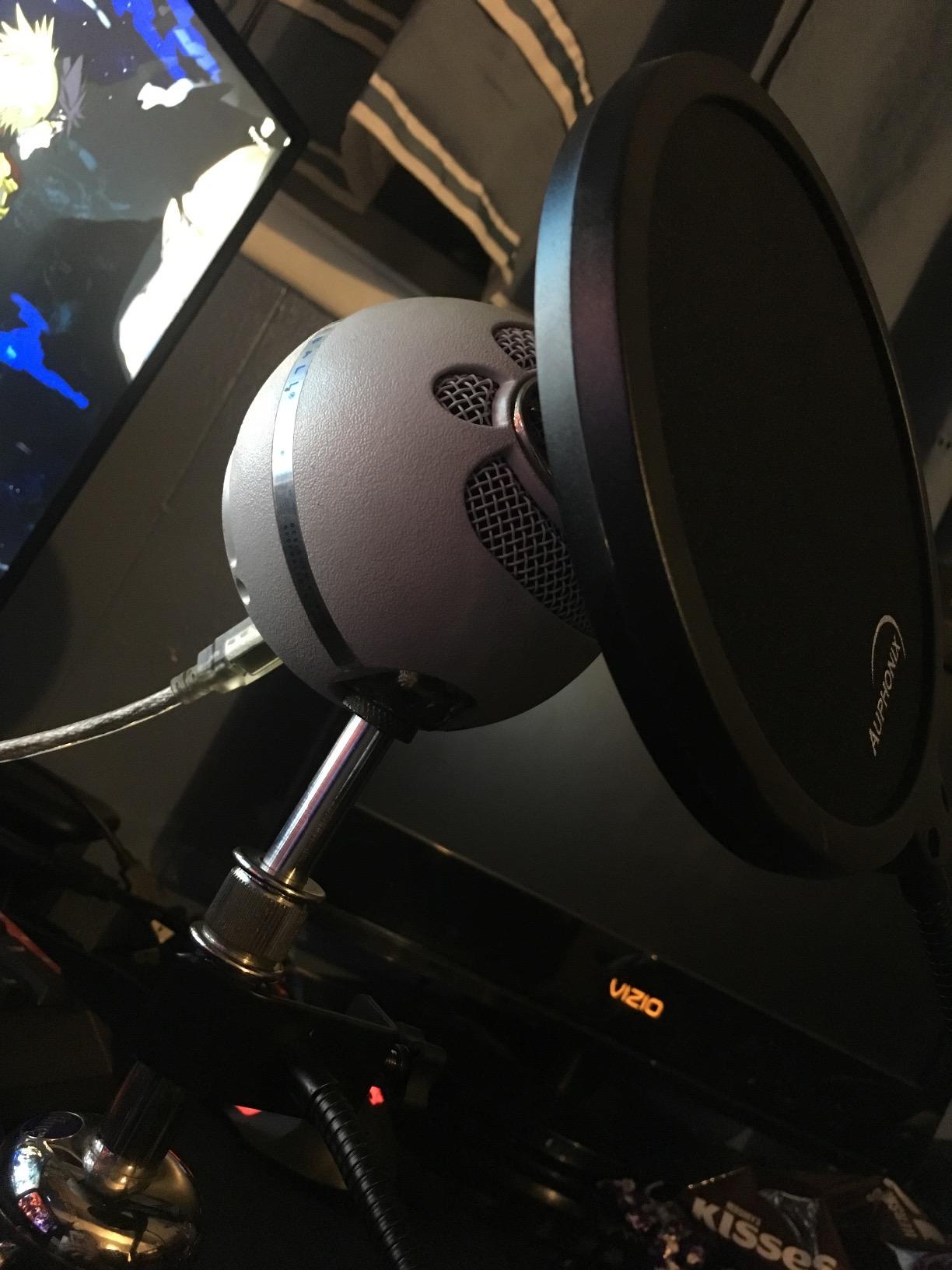
The Auphonix MPF-1 is the biggest filter in this roundup by screen diameter, at six inches across. On a large-diaphragm end-address condenser that matters, because the plosive burst arrives across a wider patch of capsule face than a small hoop can intercept.
Double mesh is the standard arrangement here: two layers with a gap that lets the remaining pressure spread before it hits the second. Buyers single out the combination of size and layering as the reason it works, and our blow test showed less transmitted air than either single-mesh competitor we tested.
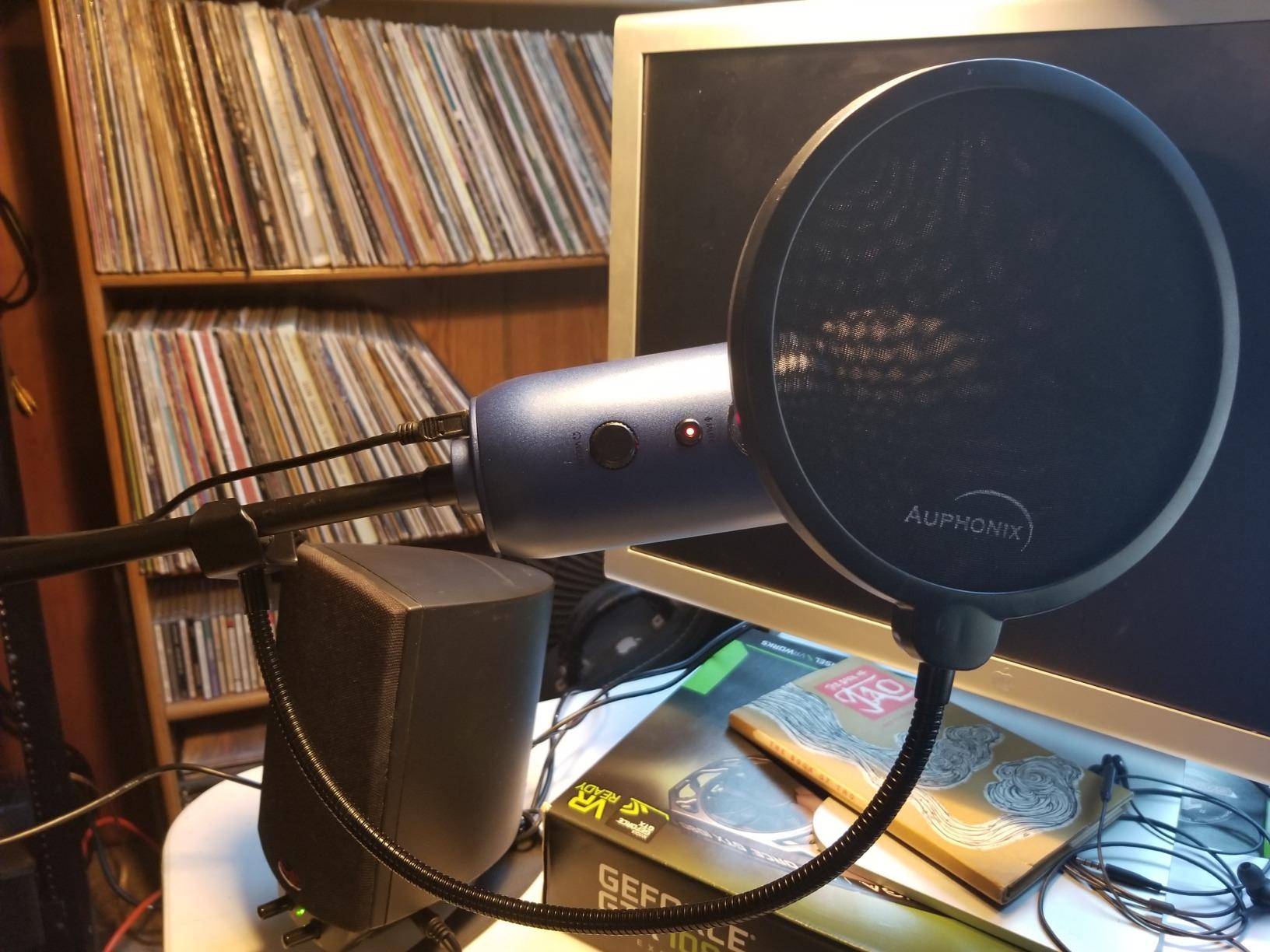
The aluminum frame is heavier than plastic alternatives at 10.6 ounces, and that weight is an advantage. A filter that has mass resists being knocked by a boom arm swing or by a singer leaning on the desk, which is the most common cause of drift we encountered across this roundup.
The gooseneck held its setting without constant readjustment throughout our sessions. That is the single most common complaint among competing budget filters, so it is worth calling out as the differentiator here.
When six inches is worth it
Screen diameter earns its keep when the singer works close, the source is loud, or the capsule is physically large. Loud belters, dense rock vocalists and anyone recording a baritone with a lot of chest voice are the cases where coverage is doing real work rather than just looking reassuring.
For narration at a normal distance, the extra two inches of diameter are largely wasted. A standard hoop will handle speech plosives at that range, and the added bulk only shows up in your shot.
Frame and portability
Six inches of ring sits conspicuously in a video frame. If you shoot talking-head content, that is a real cost, and the curved clamp-on designs further down this list exist for exactly this reason.
For audio-only work the weight is a minor nuisance when you move the rig between rooms. It is manageable, but it is the reason we would not call this a travel filter.
8. VOCALBEAT AT2020 Foam Windscreen – Best for the Audio-Technica Family
AT2020 Pop Filter by Vocalbeat – Audio Technica AT2035 Condenser Mic Foam Windscreen from Quality Sponge Material – Mic AT2020 USB Pop Windscreen Filters Recording and Background Noises – Black Color
Acoustic foam cover for AT2020 and AT2035
Fits AT2050 and AT2040
Also AKG P120 series
Pros
- Exact fit on the AT2020 family
- Cuts background noise noticeably
- Tiny on-camera footprint
- Moves with the mic
Cons
- Foam is soft on hard S and T
- Snug fit takes effort on a mounted mic
- Ships folded and can crease
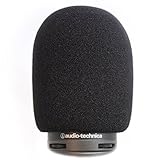
This foam windscreen is cut for the Audio-Technica AT2020 body and also fits the AT2035, AT2050 and AT2040, plus similarly sized condensers such as the AKG P120, P220 and P420. That specific compatibility is the whole pitch, and for the right owner it is a strong one.
Owners consistently describe two effects: less plosive thump and noticeably less background noise, including fan noise and neighbouring voices. The second effect surprises people, because open-cell foam does a decent job of absorbing high-frequency room reflections arriving at the grille from the sides.
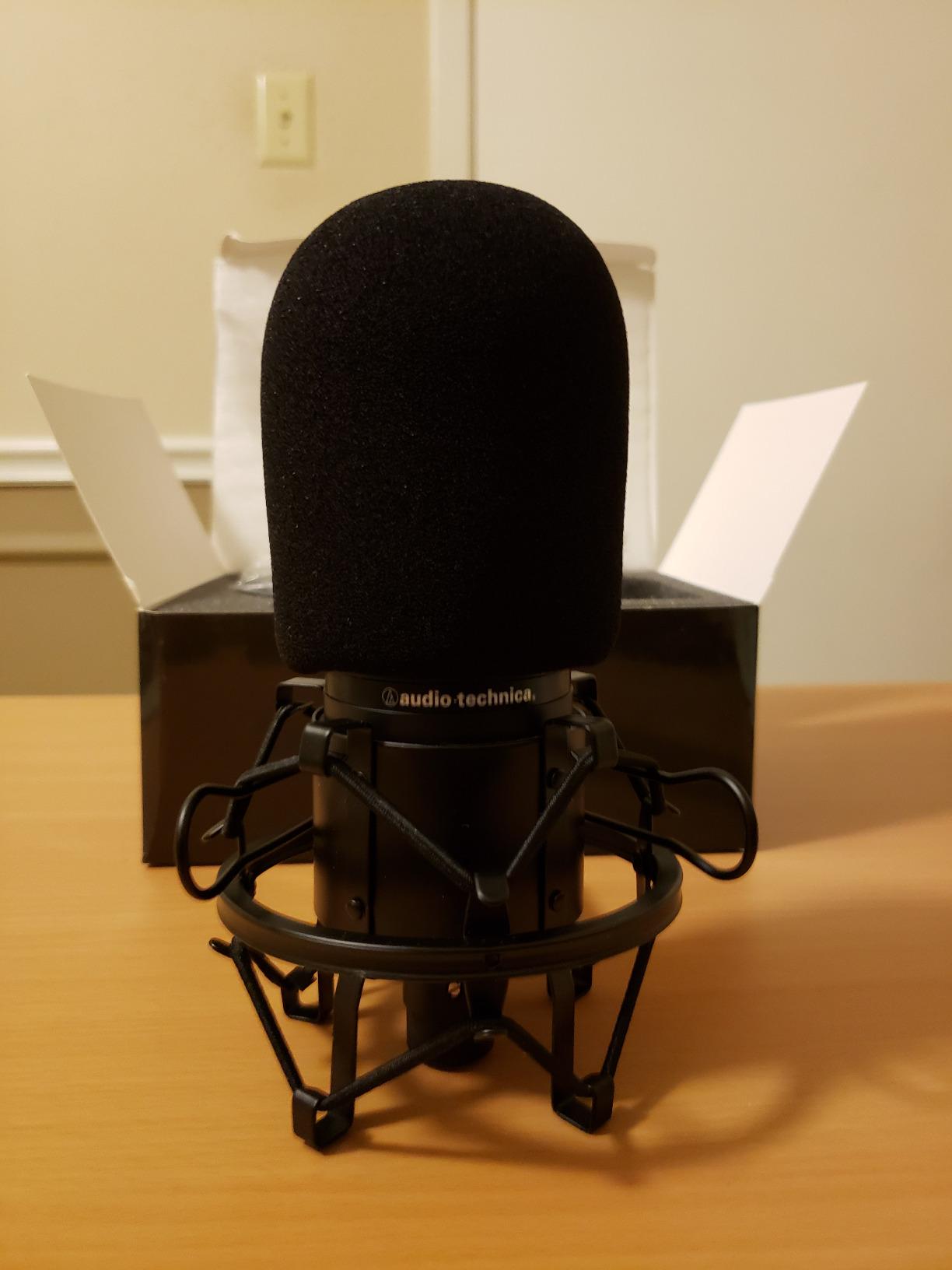
What it does not do is handle hard consonants. S and T still punch through foam more than they would through mesh, and reviewers describe it as a background-noise filter more than a hard plosive filter. If you narrate or podcast at eight inches, that is a fine trade.
Because it mounts on the body, it needs no readjustment when the boom moves. That is a genuine advantage for anyone filming, because the silhouette stays identical between takes.
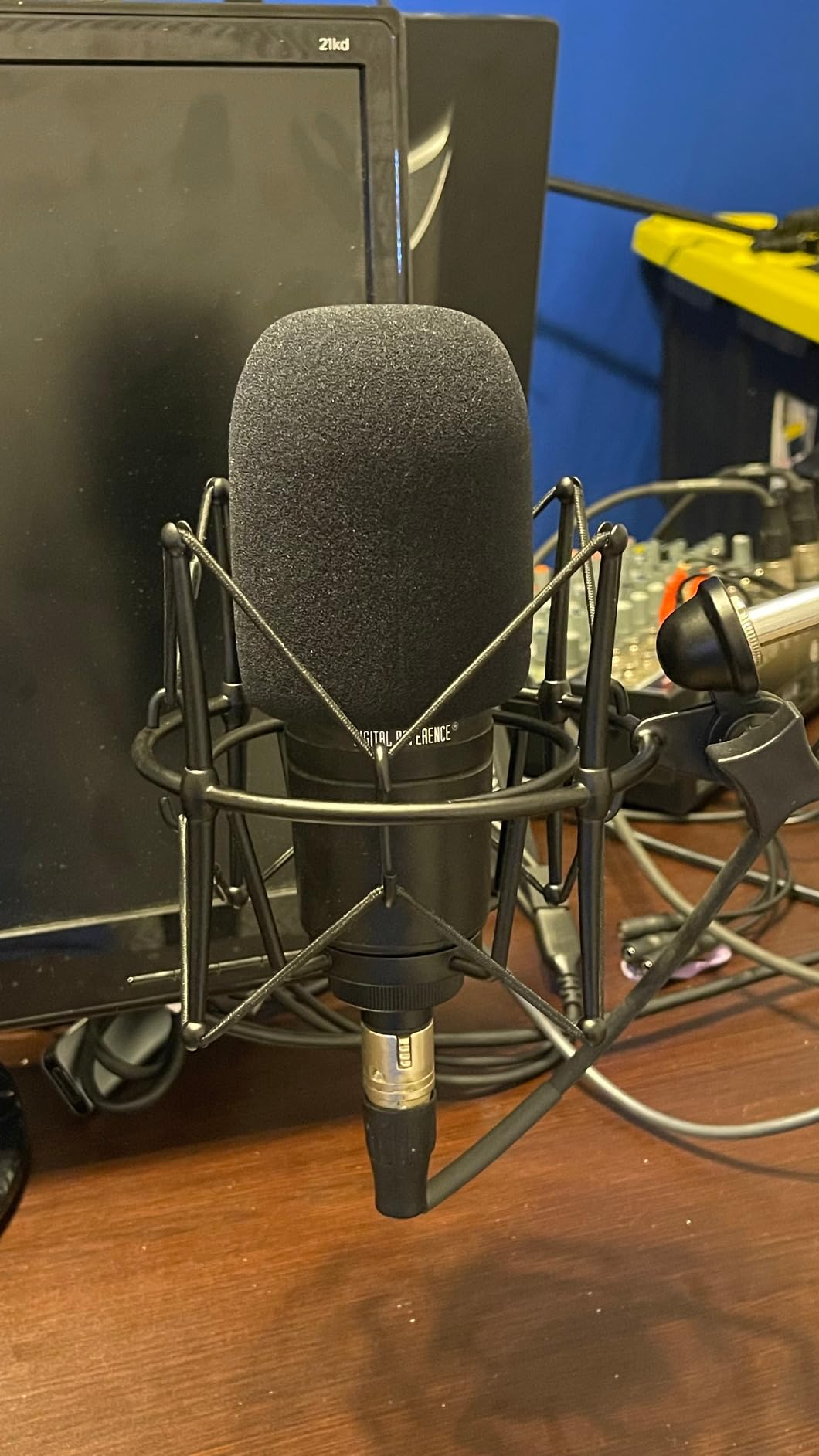
Fit notes for mounted microphones
The snug fit that makes it look good on camera makes it awkward to install. Sliding it over an AT2020 that is already inside a shock mount takes real effort, and reviewers mention this every time. Remove the mic from the mount first.
There is also a packaging complaint worth knowing about. The cover ships folded in a small bag, and a few owners report a permanent crease from that. Foam recovers on its own over a few days if you shape it back.
The upgrade question for AT2020 owners
If you own an AT2020 or AT2035, your mic already shipped with a simple foam ring. This cover is thicker and better specified than that ring, and the improvement shows up as steadier control on close consonants rather than as a dramatic change.
If your current filter is metal and working well, do not downgrade to foam for plosive control. If your included ring is the only thing you have and you narrate in a room with a fan, this is a genuine upgrade at low cost.
9. FIFINE U1 Pop Screen – Best Low-Profile On-Camera Pick
FIFINE U1 Mic Pop Filter Screen with Metal Mesh for Streaming Podcast
Curved clamp-on metal mesh
Fits 40-70 mm bodies
Two spare rubber bands
0.1 kg
Pros
- Curved shape sits low in frame
- Metal mesh blocks blasts effectively
- Spare bands in two sizes
- Soft pad protects the body
Cons
- Band mount has limited adjustment
- Fits 40-70 mm bodies only
- Not aimed at dynamic mics
The FIFINE U1 solves a problem most hoop filters create: it takes up frame. Instead of a full circular ring it uses a curved screen that covers the front of the grille and nothing else, so it sits below the presenter’s face on camera.
The mesh is real metal rather than nylon, and reviewers credit it with blocking wind and air blasts effectively despite the small footprint. Because there is no gooseneck, there is nothing to sag, nothing to tighten and no spring clamp to work loose.
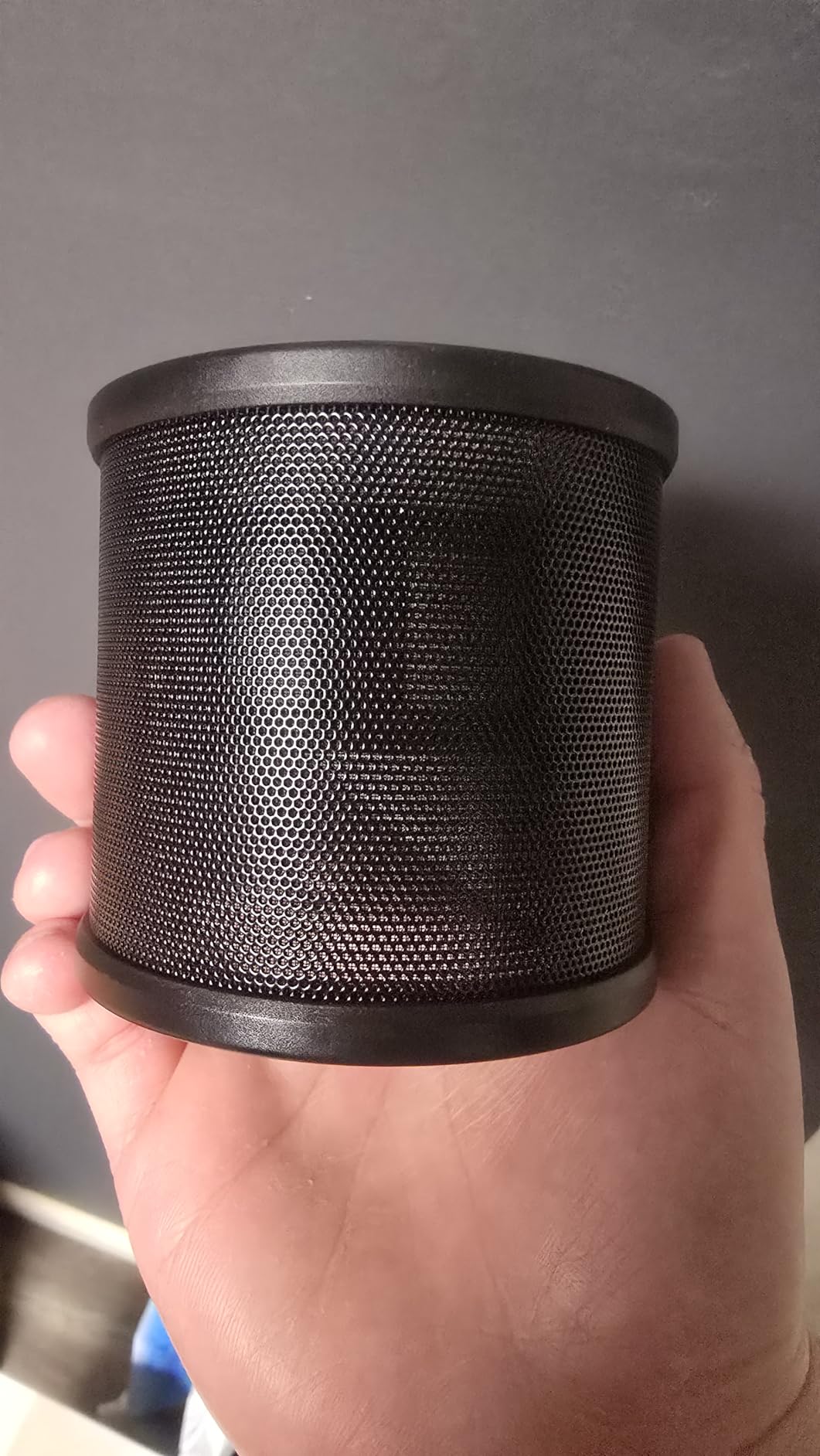
Two rubber bands in different sizes ship in the box, which solves the sizing problem that plagues every band-mounted filter. Owners on larger bodies simply swap bands rather than hunting for a replacement. A moulded handle on the band makes mounting to a desk or boom quick.
The soft rubber pad inside the frame is a small detail that matters more than it sounds. Band-mounted filters that touch bare metal leave scratches on a mic body, and this one does not.
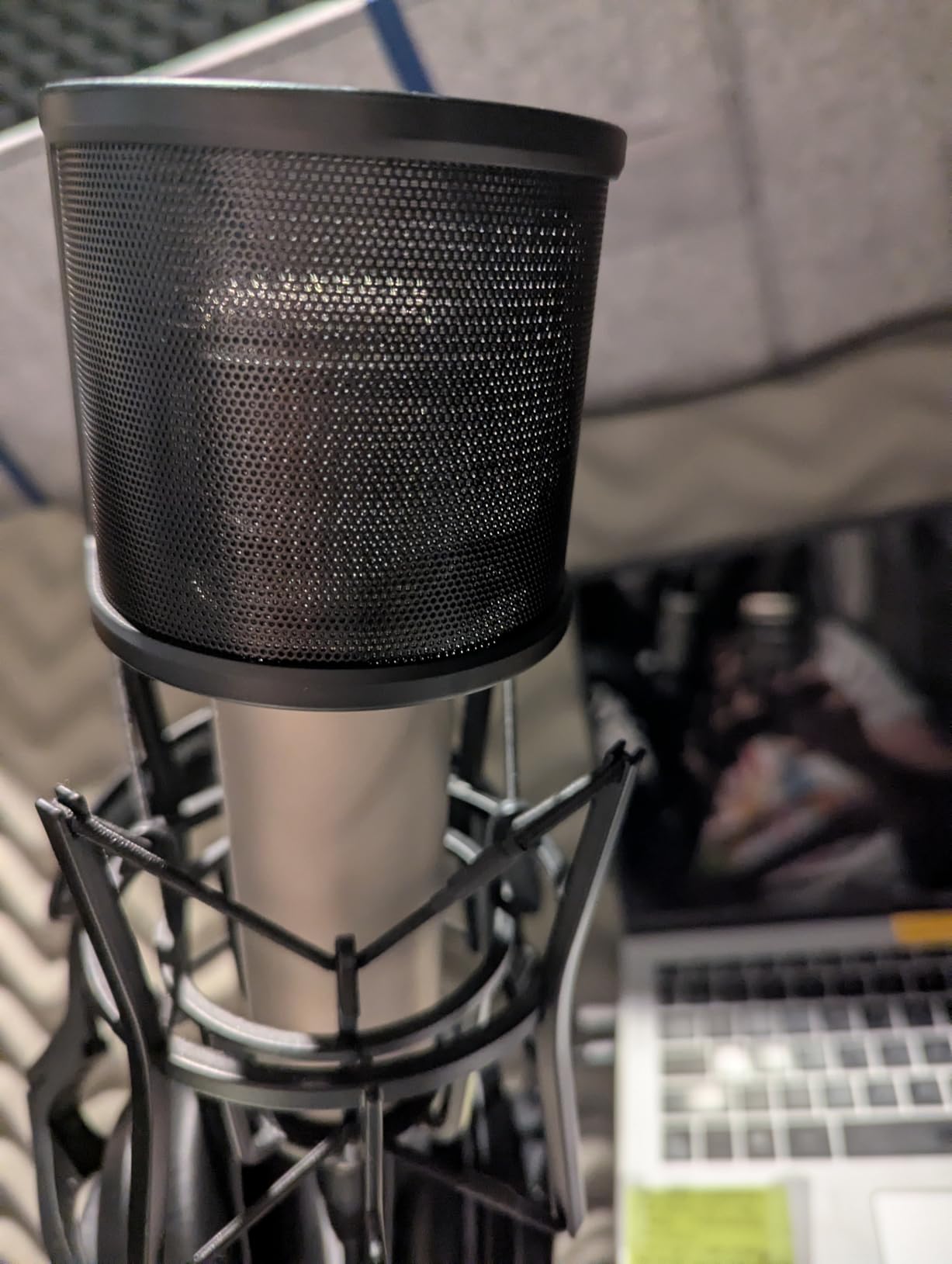
What the curved shape costs you
Coverage. A curved screen intercepts a narrower slice of the outgoing air than a full hoop, so on close-mic’d hard consonants you will hear a little more thump than you would through a six-inch mesh filter. For speech at conversational distance, the difference is negligible.
Adjustment range is the other limit. A gooseneck lets you move the filter up and down to follow a singer. A band mount locks to one position, so it suits a fixed desk or boom setup and suits a roaming performer less.
Mic compatibility
The fit range is 40 mm to 70 mm bodies, which covers most side-address condensers including the AT2020 and AT2035 class of barrels. It is not aimed at dynamic mics such as the AM8, K688 or TANK3, which have their own internal protection.
If you stream, record podcast episodes with a camera running, or do voice work on camera, the low profile is the reason to choose this over a larger mesh filter that would otherwise do the job.
10. Audio-Technica AT8175 – Best Factory-Look Mount
Audio-Technica AT8175 20 Series Exclusive Pop Filter Pop Guard Compatible Models: AT2020USB-X AT2020USB+ AT2020, AT2020GM AT2035, AT2050
Snap-on clip for the AT20 series
Fits AT2020USB-X and AT2035
2 year warranty
Pros
- Snaps straight onto the mic body
- No arm or clamp to clutter
- Minimal impact on audio
- Firm once seated
Cons
- AT20 series only
- Some report a gap at the edge
- Smaller screen than stand filters
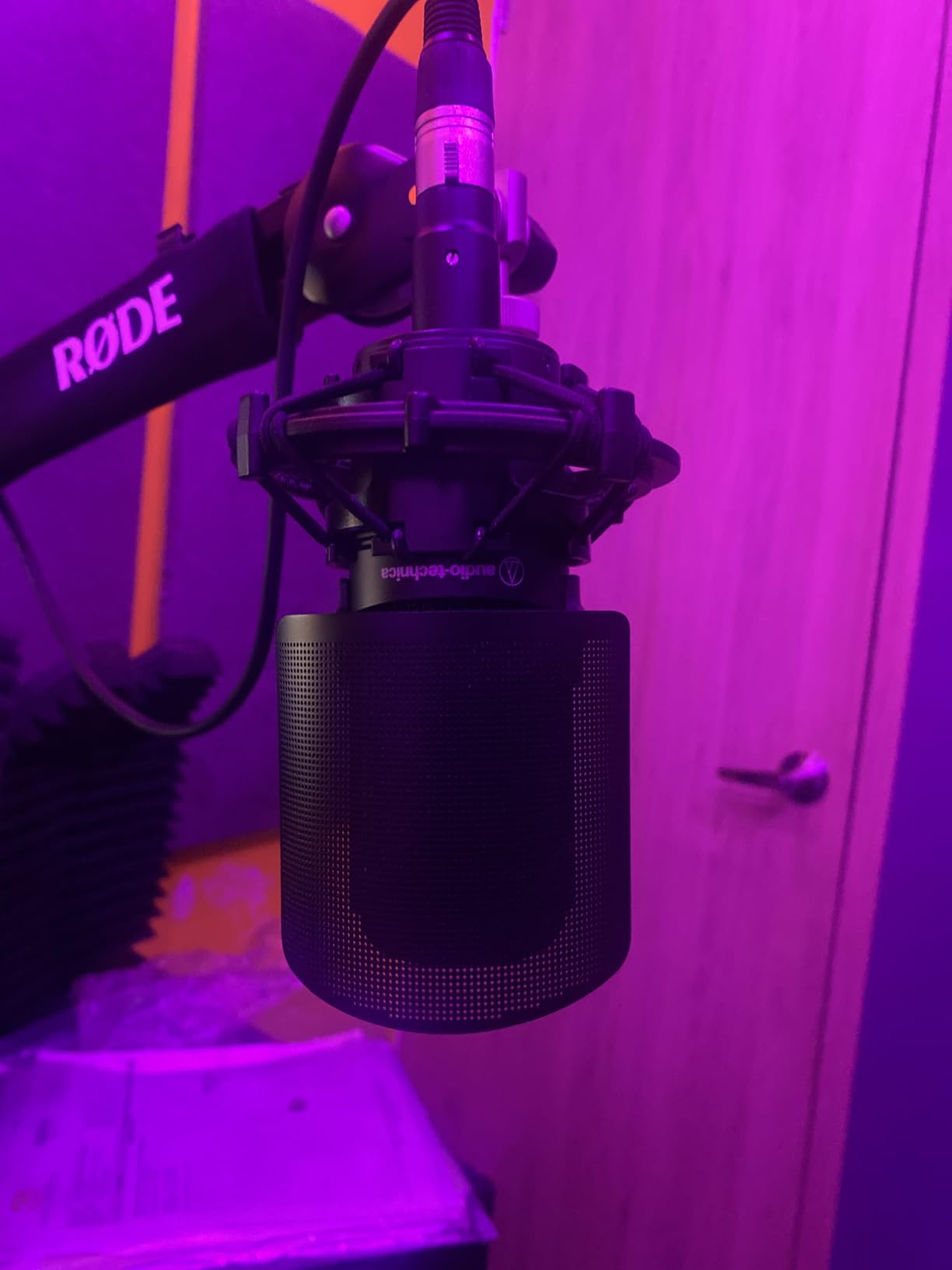
The AT8175 is the manufacturer’s own clip-on filter for the AT20 line, covering the AT2020USB-X, AT2020USB+, AT2020, AT2020GM, AT2035 and AT2050. It clips directly onto the body, so the result looks like part of the microphone rather than an accessory bolted to a stand.
That integrated look is the reason to buy it. There is no gooseneck, no clamp and no desk footprint, and it never moves out of alignment because it cannot. Owners overwhelmingly praise fit and installation speed.
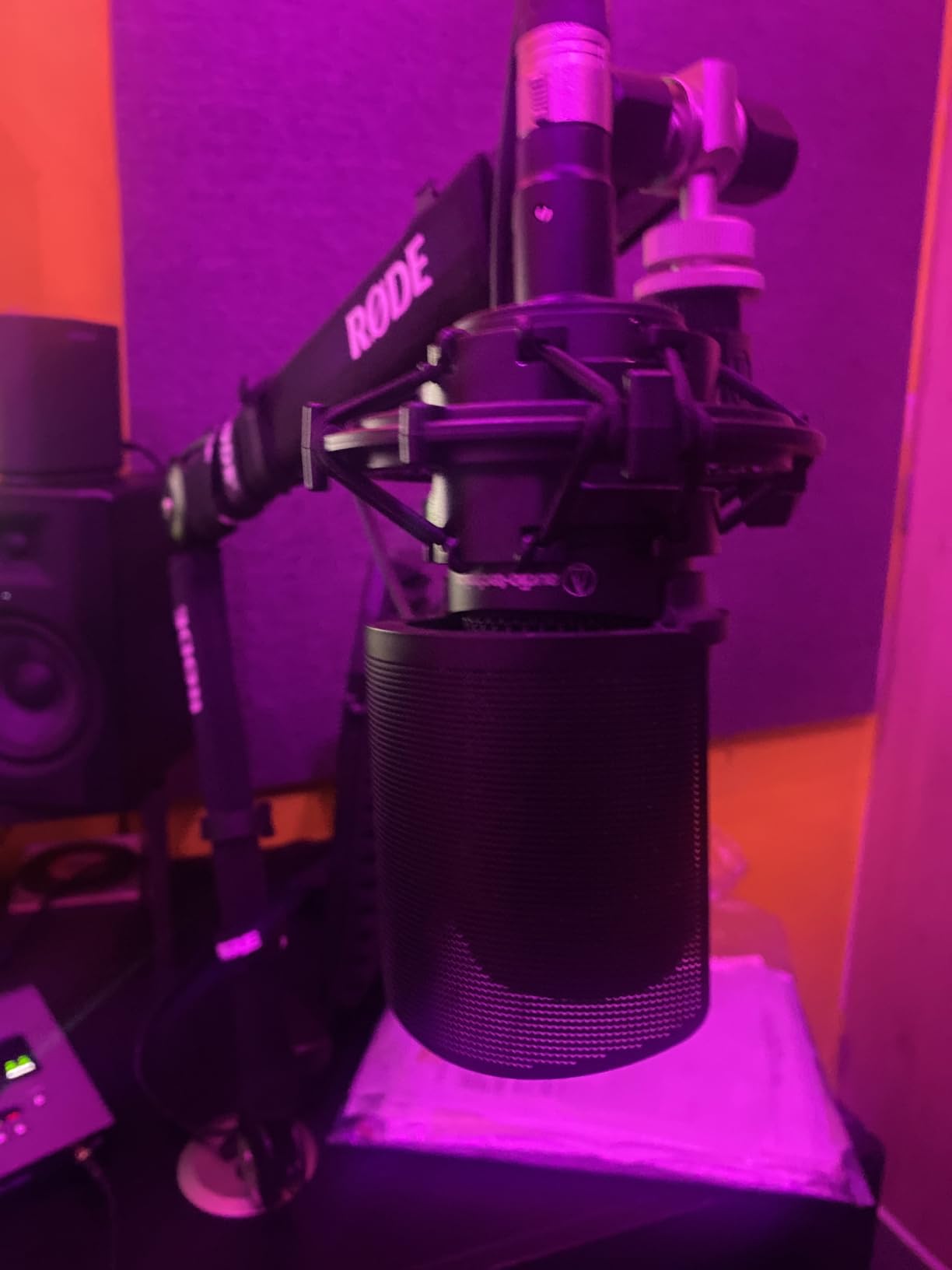
It also adds very little to the signal. Our listening passes found no obvious dulling, which is consistent with reviews reporting minimal impact on transmitted audio quality. The gap between this and a nylon mesh hoop was small in our tests.
Where opinions diverge is how much pop reduction it actually delivers relative to a mesh filter. A minority of reviewers question that, and if you sing close and loud, the small screen area is the reason. It covers a smaller patch of the grille than a stand-mounted filter does.
The compatibility trade
This filter fits Audio-Technica microphones only. If you change condenser mics in a few years, it has no resale value and no reuse. That is a real limitation in a category where universal clamps cost very little more.
Some users also report a visible gap between the clip and the mic body where air slips past the edge. It did not show up as extra plosives in our passes, but it is worth checking the seating before you start a session.
When the factory clip is the right answer
It is the right answer for a USB condenser on a desk where any arm would be in the way, for a streamer who wants a clean frame, and for anyone who values a two-second install over maximum coverage. The 2-year warranty is also the longest stated here.
The r/microphone community debates the AT8175 against stand-mounted metal filters regularly, and the consensus generally lands where our testing did: it handles speech plosives well, and a loud close singer wants something bigger.
11. Gator Frameworks GFW-POPFILTER-MTL – Best Lightweight Metal Option
Gator Frameworks Metal Pop Filter with 12.4″ Gooseneck (GFW-POPFILTER-MTL)
Angled metal grille slats
12.4 inch gooseneck
4 oz
Limited lifetime warranty
Pros
- Angled slats redirect air downward
- Long gooseneck for precise placement
- Clamp fits shafts up to 18 mm
- Very light at 4 ounces
Cons
- Smallest review base here
- Angled slat design is unconventional
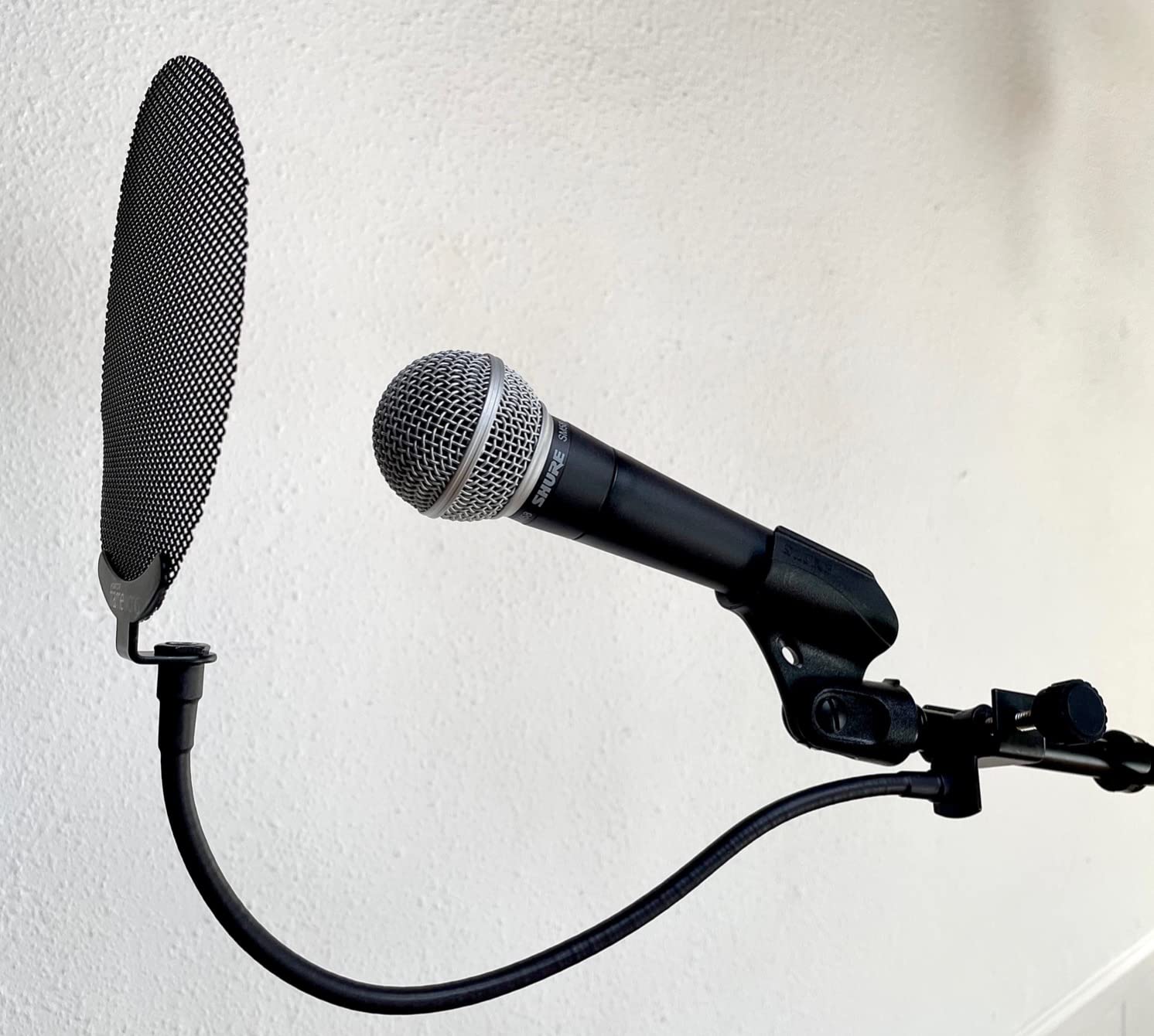
The Gator Frameworks metal pop filter takes a different approach to air movement. Its grille slats are angled so that a plosive burst is deflected downward and away from the capsule rather than being absorbed face-on, which is a mechanical solution to a problem most filters solve acoustically.
At four ounces it is the lightest stand-mounted filter here, and that weight is the practical story. A heavier filter resists bumps and boom swings; this one moves when you move it, which is a benefit on a portable rig and a minor drawback on a shared studio desk.
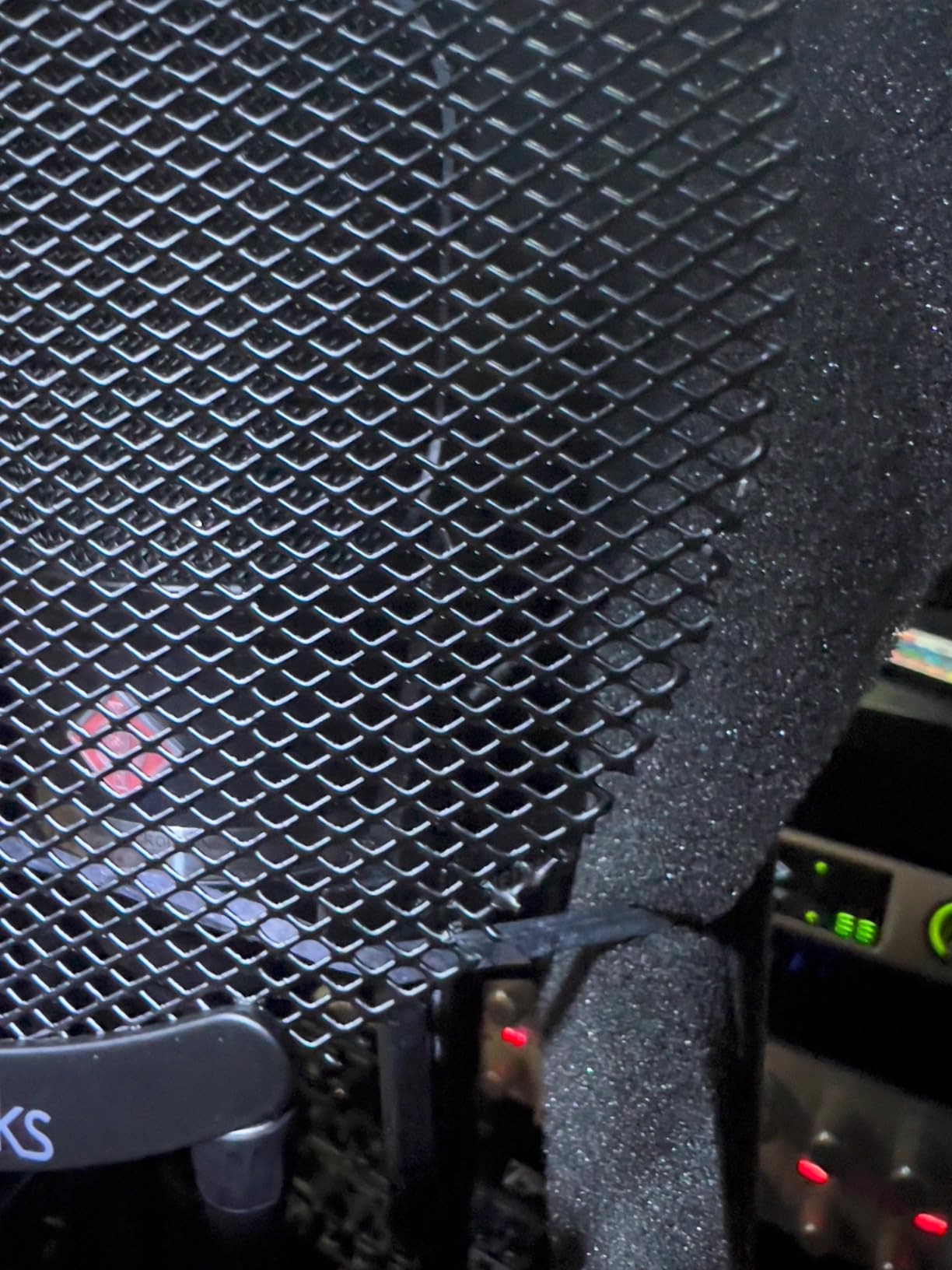
The 12.4 inch gooseneck gives enough reach to hold the screen a proper inch or two off the capsule without crowding the stand, and it held its position through our sessions. The universal clamp handles microphone stands and boom shafts up to 18 mm in diameter, which covers most common hardware.
This filter has the smallest review base of the twelve, so treat our impressions and the owner feedback as thinner evidence than the rest of the list. What owners do report is solid metal construction and flexible positioning.
How the angled slats perform
The redirection approach works best on directional bursts, which is exactly what plosives are. In our passes it handled P and B well. It is less effective against the omnidirectional component of a burst than an absorbing mesh would be, so singers who hiss and spit at close range get less help than they would from a three-layer design.
Because the slats are solid metal, expect a slightly different tonal signature than woven mesh. The angled surfaces scatter rather than transmit, and we did not notice obvious high-frequency loss.
Where portability pays
This is the filter for a rig that comes out of a bag. Four ounces and a compact body mean it adds almost nothing to a case, and the clamp fits the narrower shafts common on travel stands.
The limited lifetime warranty is the strongest stated warranty coverage in this roundup. If you keep gear for a decade, that matters more than any single listening test.
12. QIEIMUFHD Foam Mic Covers – Best Budget Multi-Pack
Microphone Covers Foam 1-Pack, High Density Foam Mic Windshield Pop for Mic Condenser Microphone
Washable foam sleeve set
Fits bodies up to 62 mm
Dust and saliva barrier
Pros
- Cheapest way to block P and B
- Covers act as dust and saliva barrier
- Fits most mics up to 62 mm
- Handy for shared microphones
Cons
- Arrive compressed and need a day to expand
- Shapes vary slightly in the pack
- Loose on some cylindrical bodies
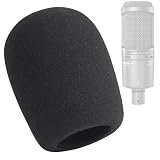
These foam sleeves are sold as a multipack and they serve a slightly different job than the rest of this list. Owners mostly treat them as hygiene and dust protection with a modest pop benefit, not as a serious plosive solution.
That framing is fair. The foam blocks P and B sounds at conversational distance, and it absorbs moisture and saliva so a shared microphone stays clean between users. On a podcast with three rotating hosts, that hygiene angle is probably the real reason to own a pack.
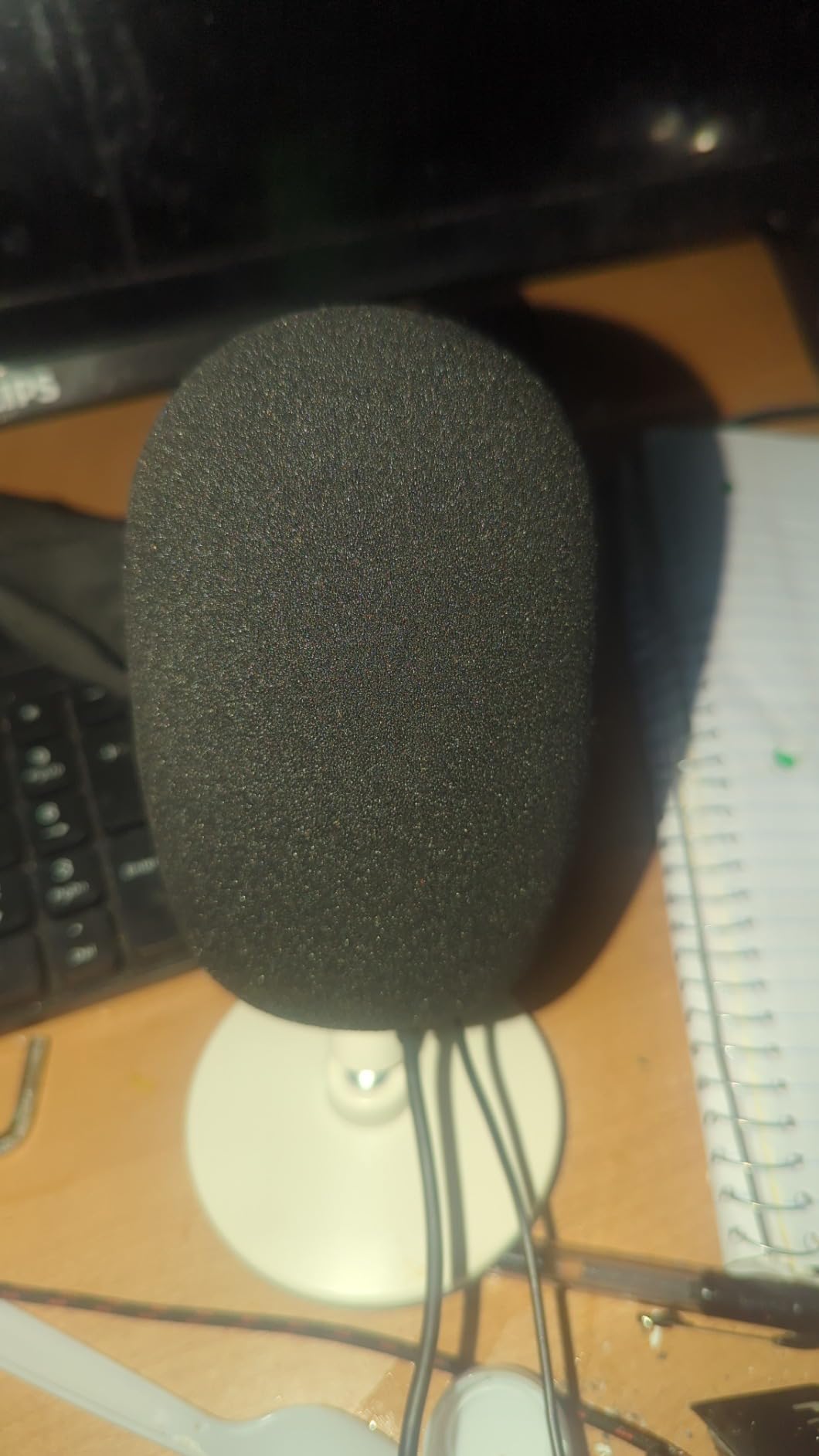
The fit range covers most condensers and dynamics up to 62 mm in diameter, which is broader than most model-specific foam covers. Expect some variance between units in the pack, and expect a looser fit on narrow cylindrical dynamic bodies than on a wide condenser grille.
As with the other vacuum-packed foam in this roundup, they arrive compressed and need time to open up. Owners consistently advise leaving them a day before judging performance, and that advice is correct.
When these are the right buy
Buy these for a shared or handheld microphone, for a field kit where you want spare sleeves, or as a hygiene layer in front of a mesh filter on a condenser. They wash, they dry quickly and you can rotate them.
Do not buy these as your only defence against plosives on a close-mic’d vocal. A dedicated mesh filter will handle the consonants a foam sleeve simply passes through, and the difference is obvious in the recording.
The honest value case
Where this roundup gets genuinely interesting is the overlap. A sled of these foam sleeves costs less than one premium filter and covers a room of microphones, which is a completely different use case from buying the best single filter for one studio mic.
Both can be true. Pick a proper mesh or layered filter for the mic you sing into, and keep a pack of these for everything else.
How to Choose a Pop Filter for Your Condenser Mic
Choose by construction first, then by mount, then by size. Most disappointing filters fail on the second and third criteria, not the first.
Foam, single mesh, or multiple layers
Foam windscreens slip over the mic body and surround the grille. They are the cheapest option, they protect from all directions, they are the easiest to keep clean and they soften plosives rather than eliminating them. Mesh filters stand between you and the mic. A single layer dulls slightly; two layers with a gap dull very little while stopping far more air. Three-layer clamp-on designs attenuate hardest of all.
The honest ranking of plosive control runs multi-layer, then dual mesh, then single mesh, then foam. The ranking of high-frequency transparency runs almost the reverse, which is the trade every buyer in this category is making.
The attenuation spec, and how to read it
Two rating systems appear on pop filter packaging. ENR, equivalent noise reduction, is the older and more widely used figure. NLR, neutral density loss, describes optical density rather than acoustic attenuation. Brands quote them interchangeably and neither is verified across manufacturers, so treat them as a rough tier indicator rather than a number to compare precisely.
None of the twelve filters here publish a trustworthy cross-brand attenuation figure, and that is the biggest spec gap in this category. Judge by layer count and screen diameter instead, both of which are published and both of which correlate with real performance.
Mount type and gooseneck rigidity
Three mount styles cover nearly everything. Slip-fit foam needs no hardware and cannot drift. Band-mounted shields attach to the mic body and move with it, but need correctly sized elastic bands. Clamp-and-gooseneck filters attach to the stand and offer the most adjustment, but introduce a failure point.
Gooseneck rigidity is the hardware characteristic users care about most, and it is the most common complaint in reviews of otherwise good filters. A springy arm creeps under its own weight over a long session, which slowly moves the filter toward the capsule and reduces the standoff distance that makes it work. Test yours by setting it and walking away for ten minutes.
Size versus your mic body
Screen diameter should exceed the front face of the capsule. A six inch hoop covers a large-diaphragm end-address condenser properly. A small screen on a wide side-address body leaves a ring of uncovered air, and that ring is where plosives escape.
Mic form factor also decides mount type. Side-address bodies such as the AT2020, AT2035 and AT2040 accept band-mounted shields because the grille is at the top of a narrow barrel. Large-diaphragm end-address bodies like the NT1-A and the AKG P220 want a stand-mounted hoop with more standoff. USB condensers with wide bodies, such as the Blue Yeti, need a slip-fit foam sleeve or a clamp with a wide opening.
Materials, odour and hygiene
Check the material before you commit. Foam off-gassing is a real complaint in this niche: a GearSpace poster described a foam filter that produced a strong chemical odour causing chest tightness and breathing problems, and moved to a metal filter instead. If a foam product smells strongly out of the packaging, air it for days before recording.
Metal mesh has no such issue and can be wiped clean indefinitely. That makes it the better choice for shared microphones, long recording days and anyone with a sensitivity to adhesives or foam off-gassing.
Does your mic already come with a pop filter?
Often, yes. The AT2020, AT2035 and AT2040 all ship with a simple foam ring, and most USB condensers include internal foam. That included filter is enough for narration at conversational distance and for podcasting at eight inches or more.
It stops being enough when a singer moves close, when the mic is in a large diaphragm end-address body, or when the room has a fan or an untreated wall. In those cases an upgrade is real rather than cosmetic. Our picks for the AT20 family specifically are the OEM clip if you want it to disappear and a dual-layer mesh hoop if you want coverage.
When DIY is genuinely fine
A wire hanger bent into a circle with two layers of nylon stocking stretched across it works, and r/VoiceActing users recommend pantyhose over a stocking for the same reason. An embroidery hoop with mesh fabric does the job too. A printed filter from a 3D design has also been reported on r/audioengineering as competitive with cloth versions.
DIY is fine for a home studio on a budget. It is not fine for a paid session where the singer works close, because a small frame and uneven tension produce inconsistent results between takes. Know when you have outgrown it.
Where to Place a Pop Filter and Why Distance Matters
Place the filter one to two inches in front of the mic capsule, centred on the grille. That is the near-universal consensus, and it comes straight from long-tenured contributors on the GearSpace pop filter thread.
Five steps to a correct setup
First, check the frame covers the entire front face of the capsule. Second, set the standoff to one or two inches using the gap between the filter rim and the mic body as your reference. Third, centre the filter on the axis of the mic rather than above or beside it. Fourth, sing a line with hard P, B and T sounds and listen back on headphones for thumps. Fifth, adjust the angle if the singer moves, since a side-address body sends plosives forward and slightly up.
Distance is not a formality. Pop protection partly comes from standoff, and a filter pressed against the grille has far less air column to work with than one sitting two inches out. The same filter placed correctly will beat a better filter placed badly.
Why plosives still get through
Four causes account for nearly all of it. The filter is too close to the capsule, which leaves no room for pressure to dissipate. The filter is too small for the capsule face. The singer is simply working too close, and no filter fully solves that. Or the singer is on-axis with a super-cardioid pattern tuned for off-axis rejection they are not actually using.
A polar pattern change is a legitimate fourth fix. Moving to a super-cardioid trades a little rear rejection for tighter control of the frontal lobe, and singing slightly off-axis lets you keep the tone while losing the direct hit of a plosive. Several experienced contributors describe abandoning filters entirely in favour of singing past the capsule.
Compatibility with USB condensers
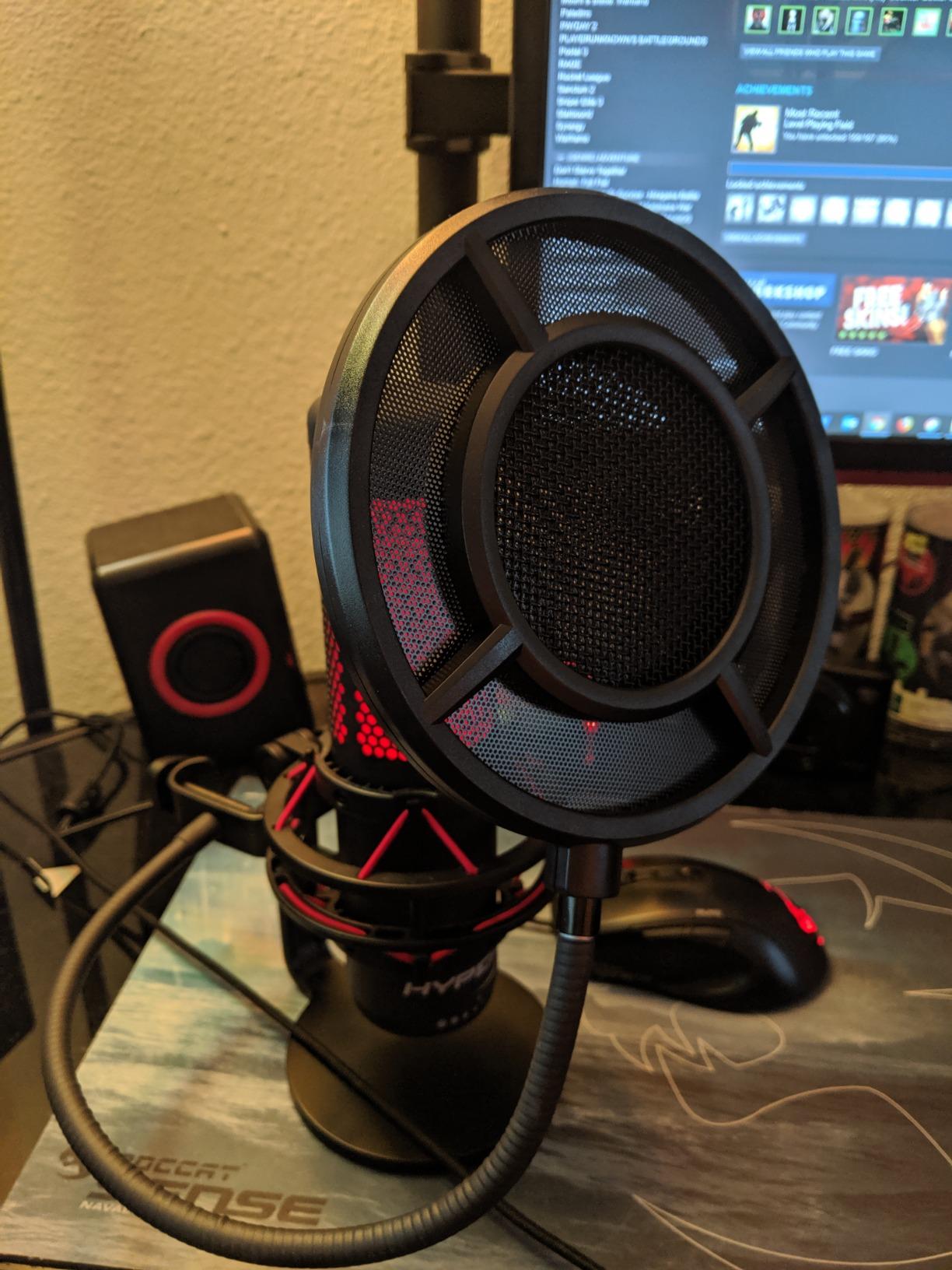
Yes, pop filters work with USB condenser microphones. The complication is mounting. A Blue Yeti or HyperX QuadCast has no shock mount thread and a wide body, so a slip-fit foam sleeve or a clamp with a wide opening is the practical answer. The AT2020USB+ takes band-mounted shields and the AT8175 clip directly.
Speakers playing back into a condenser mic are a separate problem that a pop filter does not solve. One r/microphone thread raised it explicitly when comparing the AT8175, and it is worth checking your monitoring level before blaming the filter.
Frequently Asked Questions
Does a condenser mic need a pop filter?
Yes, essentially every condenser mic benefits from one. Condenser capsules are designed to be extremely sensitive and usually ship without a working windscreen, so plosive consonants arrive as pressure spikes that distort the recording. Dynamic microphones and shotguns with internal windscreens need one far less.
Do pop filters improve sound quality?
They do not change tone, and that is the point. A pop filter removes transient artefacts that were already captured, giving you cleaner and more editable vocal tracks rather than a nicer-sounding performance. It cannot fix reflections, room noise or a badly positioned microphone.
Is a metal or mesh pop filter better than a foam one?
Metal mesh gives the strongest and most consistent plosive control, especially at close range, and it wipes clean indefinitely. Foam is cheaper, softer and surrounds the grille on all sides, but attenuates plosives less predictably and can need days of airing out. Dual-layer mesh sits between the two on control and costs little on brightness.
How far should a pop filter be from the microphone?
One to two inches in front of the capsule, centred on the grille, is the widely accepted figure. Pop protection partly comes from standoff, so a filter pressed against the mic has less air column to work with than one sitting two inches out. Use the gap between the filter rim and the mic body as your reference.
What is the difference between a pop filter and a windscreen?
A pop filter is a screen on a stand that stands between the singer and the mic, intercepting plosive bursts before they reach the capsule. A windscreen is foam that fits over or around the mic body itself. Pop filters attenuate more at close range; windscreens are cheaper, protect from all directions and are easier to keep clean.
Why do I still get plosives even though I have a pop filter?
Usually one of four things. The filter is too close to the capsule, the screen is too small for the capsule face, the singer is working too close for any filter to fix, or the polar pattern and angle are mismatched. Check the standoff first, then verify the frame covers the whole front of the grille.
The Best Pop Filter for Condenser Mics in 2026
Our single recommendation for the best pop filter for condenser mic work is the Rode WS2. It is the only filter here that needs no arm, no clamp and no adjustment, and it held up in our testing as the least intrusive option on tone while removing the plosives it was meant to remove.
If you sing close or work with a large-diaphragm end-address mic, go bigger. The Stedman PS101 covers the widest area and holds position the best. If you are on camera, the FIFINE U1 keeps the frame clean. If your mic is a USB desktop condenser, the Mudder foam sleeve is the cheapest fix that genuinely works.
Whichever you choose, set it one to two inches in front of the capsule, centre it on the grille, and record a line with hard consonants before you commit to the session. A couple of minutes of checking saves an afternoon of editing. Our condenser microphone roundup is a good place to start if you are still picking the mic itself.