
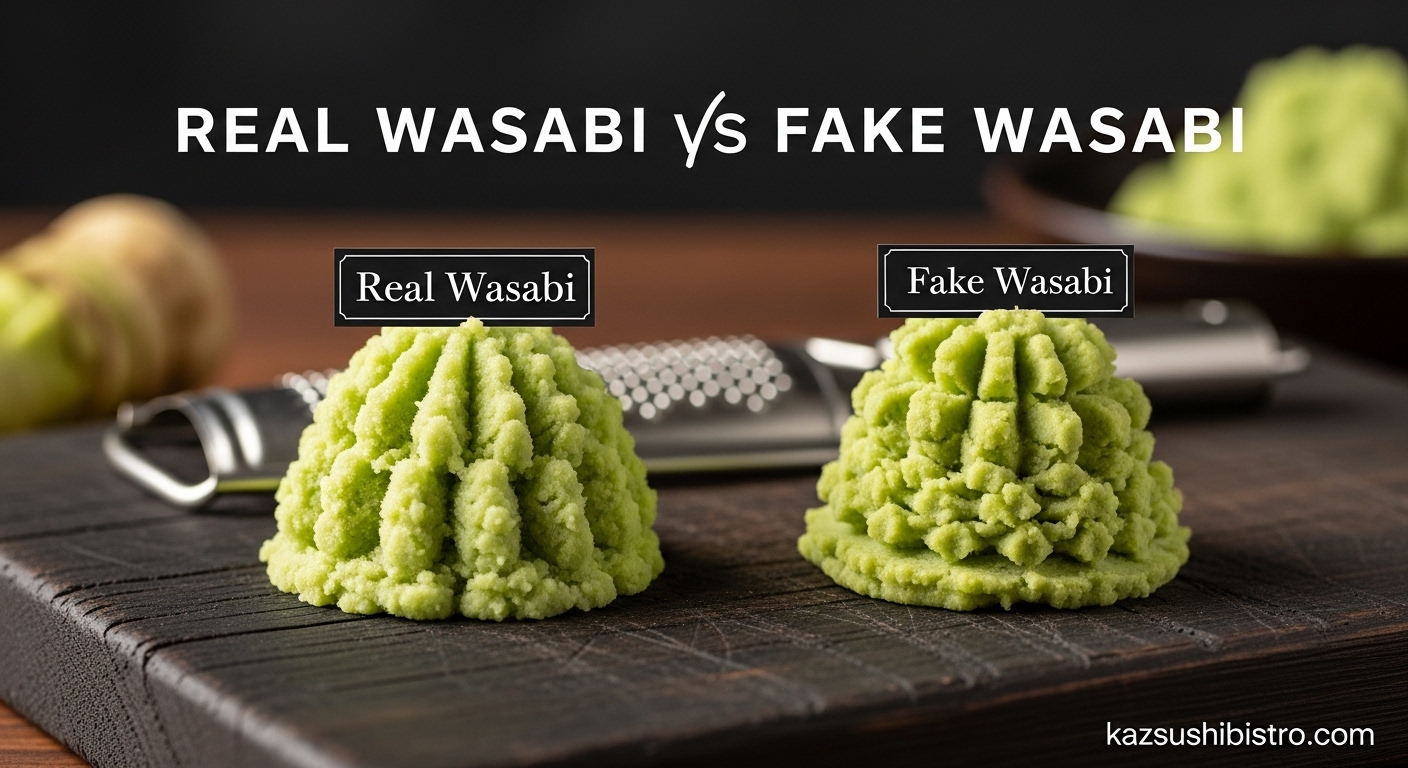
Here’s something that might surprise you: you’ve probably never eaten real wasabi. That green paste sitting next to your sushi? Almost certainly fake. In fact, 95% of wasabi served outside Japan is imitation. The real stuff is rare, expensive, and tastes completely different from what most people expect.
At our restaurant, we get questions about wasabi every single day. Diners want to know why the wasabi at high-end omakase counters tastes so different from their local sushi joint. Others are shocked to learn that the tube of “wasabi” in their refrigerator contains almost no actual wasabi at all.
This guide will show you exactly what separates authentic wasabi from the imitation version. You’ll learn how to identify real wasabi at restaurants, understand why it costs so much, and discover the fascinating science behind that signature nasal heat. By the end, you’ll know more about this mysterious green paste than 99% of sushi lovers.
Table of Contents
Real Wasabi vs Fake Wasabi: At a Glance 2026
Before diving into the details, here’s a quick comparison of what separates the real deal from the common imitation. Use this as your cheat sheet for spotting authentic wasabi:
| Feature | Real Wasabi | Fake Wasabi |
|---|---|---|
| Main Ingredient | Grated Wasabia japonica rhizome | Horseradish, mustard, green dye |
| Texture | Coarse, fibrous, slightly gritty | Smooth, uniform, paste-like |
| Color | Muted pale green to beige | Bright artificial green |
| Heat Duration | 5-10 seconds, then fades completely | Lingers for minutes |
| Flavor | Complex, herbal, slightly sweet | Harsh, one-dimensional burn |
| Preparation | Freshly grated before serving | Pre-made, shelf-stable |
| Price | $160-250 per kg | $5-15 per kg |
| Availability | Rare, high-end restaurants only | Everywhere (supermarkets, most sushi spots) |
The difference is night and day. Real wasabi offers a fleeting, clean heat that enhances the fish without overwhelming it. Fake wasabi delivers a harsh, lingering burn that can mask the delicate flavors of quality sushi. Once you taste authentic wasabi, the imitation version becomes almost unbearable.
What Is Real Wasabi? Understanding Wasabia Japonica
Real wasabi comes from Wasabia japonica, also known by its scientific name Eutrema japonicum. This plant belongs to the Brassicaceae family, which includes mustard, horseradish, and cabbage. But don’t let that family connection fool you. Wasabi is a completely different species with unique properties.
The part we eat isn’t actually a root. It’s a rhizome, an underground stem that grows horizontally. This distinction matters because rhizomes have different cellular structures than true roots. When you grate a wasabi rhizome, you break open those cells and trigger a chemical reaction that creates the signature heat.
Wasabi has been cultivated in Japan since at least the 7th century. Historical records from the Nara period mention wasabi being used for its medicinal properties before it became a sushi accompaniment. Japanese monks recognized its antibacterial qualities long before modern science confirmed them.
The Perfect Growing Conditions
Wasabi is notoriously difficult to grow. The plant requires very specific conditions that exist naturally in only a few places on Earth. It thrives in cool, mountain stream beds where water temperature stays between 45-65°F year-round.
The plant needs clean, running water constantly flowing over its roots. Still water will kill it. It also requires high humidity, partial shade, and pristine growing medium free from contaminants. These requirements make commercial cultivation incredibly challenging.
Japan produces the vast majority of the world’s authentic wasabi. Shizuoka Prefecture alone accounts for approximately 70% of Japan’s wasabi production. Other major growing regions include Nagano, Iwate, and Shimane prefectures. Each region produces slightly different flavor profiles based on local water mineral content and climate.
Time Investment: The 2-3 Year Wait
Here’s another reason real wasabi costs a fortune: patience. A wasabi plant takes 18 months to 3 years to reach harvestable size. During that time, farmers must maintain perfect water flow, monitor for disease, and protect plants from temperature fluctuations.
One failed pump or contaminated water source can destroy an entire crop. Compare that to horseradish, which grows in almost any soil condition and reaches harvest size in just one growing season. The time and risk involved in wasabi farming directly translate to the final price tag.
What Is Fake Wasabi Made Of?
That green paste you’ve been eating? It’s primarily European horseradish mixed with mustard powder and green food coloring. Some premium versions might contain 1-3% actual wasabi, but most contain none at all. The Japanese call this imitation “seiyo-wasabi” (Western wasabi) to distinguish it from “hon-wasabi” (true wasabi).
Let’s break down the typical ingredients in a tube of “wasabi” from your local supermarket:
- Horseradish (50-70% of the mixture)
- Mustard powder (20-30%)
- Green food coloring (spirulina, artificial dye, or spinach extract)
- Stabilizers and preservatives
- Sorbitol or other sweeteners
- Occasionally trace amounts of real wasabi powder (1-3%)
The horseradish provides the heat. The mustard adds an extra kick. The green dye makes it look like what people expect wasabi to look like. It’s a convincing illusion, but one that falls apart the moment you taste authentic wasabi side by side with the fake version.
Why Restaurants Use Fake Wasabi
The math is simple. Real wasabi costs $160-250 per kilogram. A comparable amount of horseradish-based imitation costs $5-15. For a busy sushi restaurant serving hundreds of customers daily, that difference is massive.
But cost isn’t the only factor. Fake wasabi is shelf-stable for months. Real wasabi must be grated fresh and loses its potency within 15-20 minutes. Imitation wasabi requires no special preparation, no specialized tools, and no training. It’s convenient, consistent, and cheap.
Most American diners have never tasted real wasabi anyway. They expect that harsh, lingering burn. When restaurants serve authentic wasabi, some customers actually complain that it’s “not spicy enough.” The imitation has become the standard through sheer ubiquity.
Real Wasabi vs Fake Wasabi: The Taste Test
The taste difference between real and fake wasabi is immediately obvious once you know what to look for. It’s not subtle. It’s a completely different sensory experience that starts the moment the paste touches your tongue.
The Heat: Clean vs Harsh
Real wasabi produces what enthusiasts call “clean heat.” When you eat authentic wasabi, the spiciness shoots straight to your sinuses, creates an intense but brief sensation, and then completely disappears within 5-10 seconds. There’s no lingering burn, no mouth discomfort, no regret.
Fake wasabi burns differently. The heat sits in your mouth and throat, sometimes lingering for several minutes. It feels harsher, more aggressive, and less refined. The sensation comes from different chemical compounds that don’t dissipate as quickly.
This difference comes down to chemistry. Real wasabi contains volatile compounds called isothiocyanates (ITCs), specifically allyl isothiocyanate, which evaporate quickly. Horseradish contains different sulfur compounds that stick around longer. Both irritate mucous membranes, but wasabi does it with more finesse.
The Flavor: Complex vs One-Dimensional
Beyond the heat, real wasabi offers a complex flavor profile that fake wasabi cannot replicate. Authentic wasabi has subtle herbal notes, a hint of natural sweetness, and an earthy undertone that complements raw fish beautifully.
Fake wasabi tastes like one thing: hot green paste. There’s no nuance, no depth, no botanical complexity. The horseradish dominates completely, and the mustard adds a sharp, acidic edge. It’s functional but uninspiring.
Reddit users frequently describe the difference as “night and day.” One r/sushi member put it perfectly: “Real wasabi enhances the fish. Fake wasabi fights with it.” That distinction matters enormously when you’re paying premium prices for quality sushi.
The Texture: Fibrous vs Smooth
Texture provides the easiest visual clue for identification. Real wasabi, freshly grated from the rhizome, has a coarse, slightly fibrous texture. You can see tiny particles of plant matter. It looks like wet, gritty sand rather than smooth paste.
Fake wasabi has the consistency of toothpaste or Play-Doh. It’s uniformly smooth with no visible texture. Some Reddit users describe it as “suspiciously perfect.” That smoothness comes from industrial processing and stabilizers.
The color differs too. Real wasabi ranges from pale green to beige, sometimes with brown spots from the rhizome skin. Fake wasabi is a vibrant, artificial green that never occurs in nature. If your wasabi looks like it belongs in a glow stick, it’s not authentic.
Why Is Real Wasabi So Expensive and Hard to Find?
The high price of real wasabi isn’t price gouging. It’s a reflection of genuine scarcity, production difficulty, and labor intensity. Understanding these factors helps explain why authentic wasabi remains a luxury ingredient.
Growing Challenges
Wasabi farmers must recreate specific mountain stream conditions. This means building elaborate water systems, monitoring temperature constantly, and protecting plants from any environmental stress. A single power outage can destroy an entire crop.
The plants are also susceptible to disease and pests. Because wasabi requires such clean water, farmers cannot use many conventional pesticides. They must rely on careful monitoring and organic methods, which increases labor costs.
Climate change has made wasabi farming even harder. Rising temperatures and unpredictable weather patterns have reduced viable growing areas in Japan. Some traditional wasabi farms have closed in recent years because conditions no longer support production.
Harvesting and Processing Labor
When wasabi finally reaches maturity after 2-3 years, harvesting it requires skill. Farmers must carefully dig around the rhizome without damaging it. A damaged rhizome loses value and degrades faster.
After harvest, real wasabi requires immediate, careful handling. It must stay cool and moist. It cannot be frozen (which destroys the cellular structure needed for grating). Transportation requires specialized packaging and rapid delivery.
Compare all this to horseradish: a hardy root vegetable that grows in any decent soil, tolerates temperature variations, harvests easily with standard equipment, stores for months, and ships without special handling. The cost difference makes perfect sense.
Why America Rarely Uses Real Wasabi
Import restrictions, shipping costs, and shelf life issues make real wasabi especially rare in the United States. By the time wasabi travels from Japan to an American restaurant, much of its peak flavor has already degraded.
A few American farms have started cultivating wasabi in Oregon, Washington, and North Carolina. These domestic sources help, but production remains tiny compared to demand. Most American-grown wasabi goes directly to high-end restaurants and specialty retailers.
The bottom line: if you’re eating at a mid-range sushi restaurant in America, you’re almost certainly getting horseradish. Even at upscale places, many reserve real wasabi for omakase customers or charge extra for it. Free, unlimited wasabi is always the fake stuff.
How to Identify Real Wasabi: 5 Proven Methods
Now that you understand what makes real wasabi special, here’s how to spot it in the wild. These identification methods work whether you’re at a restaurant or buying wasabi for home use.
1. Check the Texture
Look closely at the wasabi paste. Real wasabi has visible texture. You’ll see tiny fibers, grittiness, and irregularities. It looks organic and handmade because it is. Fake wasabi looks machine-perfect with a smooth, uniform surface.
2. Observe the Color
Authentic wasabi ranges from pale green to beige or light brown. It might have spots or variations in color. Fake wasabi is a bright, consistent green that looks like it came from a chemistry lab. That neon green color is a dead giveaway.
3. Time the Heat
Take a small amount and note how long the spiciness lasts. Real wasabi heat peaks quickly and fades within 10 seconds. Fake wasabi keeps burning. If you’re still feeling it after 30 seconds, you’re eating horseradish.
4. Look for Fresh Grating
At restaurants, real wasabi is grated fresh at the counter or table. If you see a chef using an oroshigane (traditional grater) to prepare your wasabi right before serving, that’s a great sign. Pre-made paste sitting in a bowl is always fake.
5. Read Ingredient Labels
For store-bought wasabi, check the ingredients. If “horseradish” appears first, it’s not real wasabi. Authentic wasabi products list Wasabia japonica as the primary ingredient. Be wary of vague terms like “Japanese style wasabi” or “wasabi flavor.”
One more restaurant tip: if the wasabi is free and unlimited, it’s definitely fake. Real wasabi is too expensive for restaurants to give away. High-end places often charge extra for authentic wasabi or reserve it for omakase dining.
Health Benefits of Real Wasabi
Beyond its culinary value, real wasabi offers genuine health benefits that fake wasabi cannot match. These benefits come from unique compounds found in Wasabia japonica, not horseradish.
Powerful Antimicrobial Properties
Wasabi’s isothiocyanates (ITCs) show remarkable antibacterial effects. Research demonstrates activity against several foodborne pathogens including E. coli, Salmonella, and Staphylococcus aureus. This explains why wasabi became the traditional accompaniment for raw fish.
Modern studies confirm what Japanese fishermen knew centuries ago. Wasabi helps protect against the bacteria naturally present in raw seafood. While it won’t eliminate all risk, it provides a meaningful additional layer of protection.
H. Pylori Research
Several studies have investigated wasabi’s effects on Helicobacter pylori, the bacteria responsible for many stomach ulcers. Research published in medical journals shows that wasabi’s ITCs can inhibit H. pylori growth in laboratory conditions.
This doesn’t mean wasabi cures ulcers. Human digestive processes differ from laboratory conditions. However, the research suggests that regular consumption of real wasabi might support digestive health in ways that horseradish cannot replicate.
Anti-Inflammatory and Antioxidant Effects
Isothiocyanates demonstrate anti-inflammatory properties in scientific studies. Chronic inflammation contributes to numerous health conditions, so foods that reduce inflammation offer potential long-term benefits.
Wasabi also contains antioxidants that help neutralize free radicals. These compounds support overall cellular health and may contribute to reduced disease risk. Again, these specific compounds appear in authentic wasabi, not horseradish substitutes.
Digestive Health Support
Traditional Japanese medicine has long used wasabi to support digestion. The compounds in real wasabi may stimulate digestive enzyme production and support healthy gut function. Some people report improved digestion when consuming authentic wasabi with meals.
That said, wasabi’s intensity can irritate sensitive digestive systems. People with gastritis, ulcers, or acid reflux should consume it cautiously. The same compounds that provide benefits can cause discomfort in compromised digestive systems.
How to Use and Enjoy Real Wasabi
If you’re fortunate enough to acquire real wasabi, proper preparation and usage maximize the experience. The fleeting nature of wasabi’s flavor means timing matters enormously.
Proper Grating Technique
Traditional wasabi graters, called oroshigane, use sharkskin or metal with fine teeth. The circular grating motion breaks open wasabi cells to release the volatile compounds that create heat and flavor. A fine microplane works as a substitute if you don’t have traditional tools.
Grate only what you’ll use immediately. The 15-20 minute window for peak flavor is real. After that, the volatile compounds dissipate and you’re left with a milder, less interesting paste. Many sushi chefs prepare wasabi just moments before serving each piece.
Sushi Etiquette
Traditional sushi etiquette suggests placing a small amount of wasabi directly on the fish, then dipping the fish (not the rice) in soy sauce. The wasabi should complement the fish, not dominate it. With real wasabi’s complex flavor, this balance becomes even more important.
At high-end omakase counters, the chef typically applies the ideal amount of wasabi to each piece. Trust their judgment. They’ve tasted that specific fish with that specific wasabi and know the right proportion.
Storage Tips
Store fresh wasabi rhizomes in the refrigerator wrapped in damp paper towels. They’ll keep for 2-3 weeks if properly maintained. Check periodically and re-moisten the towels as needed. Do not freeze fresh wasabi. Freezing destroys the cellular structure needed for proper grating.
Powdered real wasabi (rare but available) stores longer but still degrades over time. Keep it airtight, cool, and dark. Even powder loses potency within several months of opening.
Beyond Sushi
Real wasabi works beautifully with other foods. Try it with grilled beef, in salad dressings, mixed into mashed potatoes, or with raw oysters. The complex flavor profile adds depth to many dishes beyond traditional Japanese cuisine.
Wasabi leaves and stems are also edible, though rarely seen outside Japan. They offer a milder version of the rhizome’s flavor and work well in salads, pickles, or as garnish. Some specialty Japanese markets carry these during spring harvest season.
Frequently Asked Questions
Is wasabi made from horseradish?
Real wasabi comes from the Wasabia japonica plant, not horseradish. However, most wasabi sold in tubes and served at restaurants is actually made from European horseradish mixed with mustard and green food coloring. This imitation is sometimes called ‘Western wasabi’ or ‘seiyo-wasabi’ to distinguish it from authentic ‘hon-wasabi.’
Do Japanese eat fake wasabi?
Yes, many Japanese people eat imitation wasabi regularly, especially at casual dining establishments. Even in Japan, authentic wasabi is expensive and reserved for special occasions or high-end restaurants. However, Japanese consumers are generally more aware of the difference and can seek out real wasabi when they want it.
What is the price of real wasabi?
Real wasabi typically costs between $160-250 per kilogram wholesale. Retail prices for consumers are even higher, often $50-100 per pound for fresh rhizomes. This compares to $5-15 per kilogram for horseradish-based imitation wasabi. The price reflects the 2-3 year growing period, specific cultivation requirements, and labor-intensive harvesting process.
Does fake wasabi taste the same as real wasabi?
No, the taste is significantly different. Real wasabi offers a complex, herbal flavor with a clean, fleeting heat that fades within 5-10 seconds. Fake wasabi provides a harsh, one-dimensional burn that lingers for minutes. Real wasabi has subtle sweetness and depth, while fake wasabi tastes primarily of horseradish and mustard. Most people describe the difference as ‘night and day’ once they taste them side by side.
Is wasabi good for the gallbladder?
Some traditional medicine practitioners suggest wasabi may support gallbladder function by stimulating bile production. The isothiocyanates in real wasabi do have effects on digestive processes. However, scientific evidence specifically linking wasabi to gallbladder health remains limited. People with existing gallbladder conditions should consult healthcare providers before consuming large amounts of wasabi.
Does wasabi help with H pylori?
Laboratory studies show that wasabi’s isothiocyanates can inhibit Helicobacter pylori bacteria growth in test conditions. This suggests potential benefits for digestive health. However, eating wasabi has not been proven to treat H. pylori infections in humans. The concentrations needed for antibacterial effects may differ from normal dietary consumption. Wasabi should complement, not replace, medical treatment for H. pylori.
Can I eat wasabi with gastritis?
People with gastritis should consume wasabi cautiously. The same compounds that give wasabi its health benefits can irritate inflamed stomach linings. The sharp heat may cause discomfort or worsen symptoms. If you have gastritis, try a tiny amount first to test your tolerance. Consider avoiding wasabi entirely during active flare-ups and consult your healthcare provider for personalized advice.
Why doesn’t America use real wasabi?
America rarely uses real wasabi due to cost, import challenges, and shelf stability issues. Real wasabi costs 15-50 times more than imitation. It requires fresh preparation and loses potency within 15-20 minutes. Importing from Japan adds transportation time and expense. A few American farms now grow wasabi domestically, but production remains small. Most American restaurants find imitation wasabi economically practical while satisfying customers accustomed to the horseradish-based version.
Conclusion: Is Real Wasabi Worth It?
Understanding the difference between real wasabi vs fake wasabi changes how you approach sushi. That green paste you’ve been eating your whole life isn’t wasabi at all. It’s a horseradish-based substitute that delivers a harsher, less refined version of the authentic experience.
Real wasabi offers something genuine: complex flavor, clean fleeting heat, and the satisfaction of eating an ingredient that required years of careful cultivation. It’s expensive, perishable, and hard to find for good reason. The difficulty of growing Wasabia japonica makes authentic wasabi a true luxury ingredient.
Does that mean you should avoid fake wasabi? Not necessarily. The imitation version serves its purpose. It’s affordable, accessible, and provides the nasal heat that many diners expect. But now you know what you’re missing.
If you’re curious about authentic wasabi, seek out high-end omakase restaurants that advertise fresh-grated wasabi. Expect to pay extra for the real thing. Or try purchasing a small amount online from specialty retailers. Even a single taste of authentic wasabi will forever change how you view that green paste next to your sushi.
The world of real wasabi is fascinating, delicious, and surprisingly complex. Whether you ever taste authentic wasabi or not, understanding what separates the real from the fake makes you a more informed diner. And that knowledge enhances every sushi experience from this point forward.