
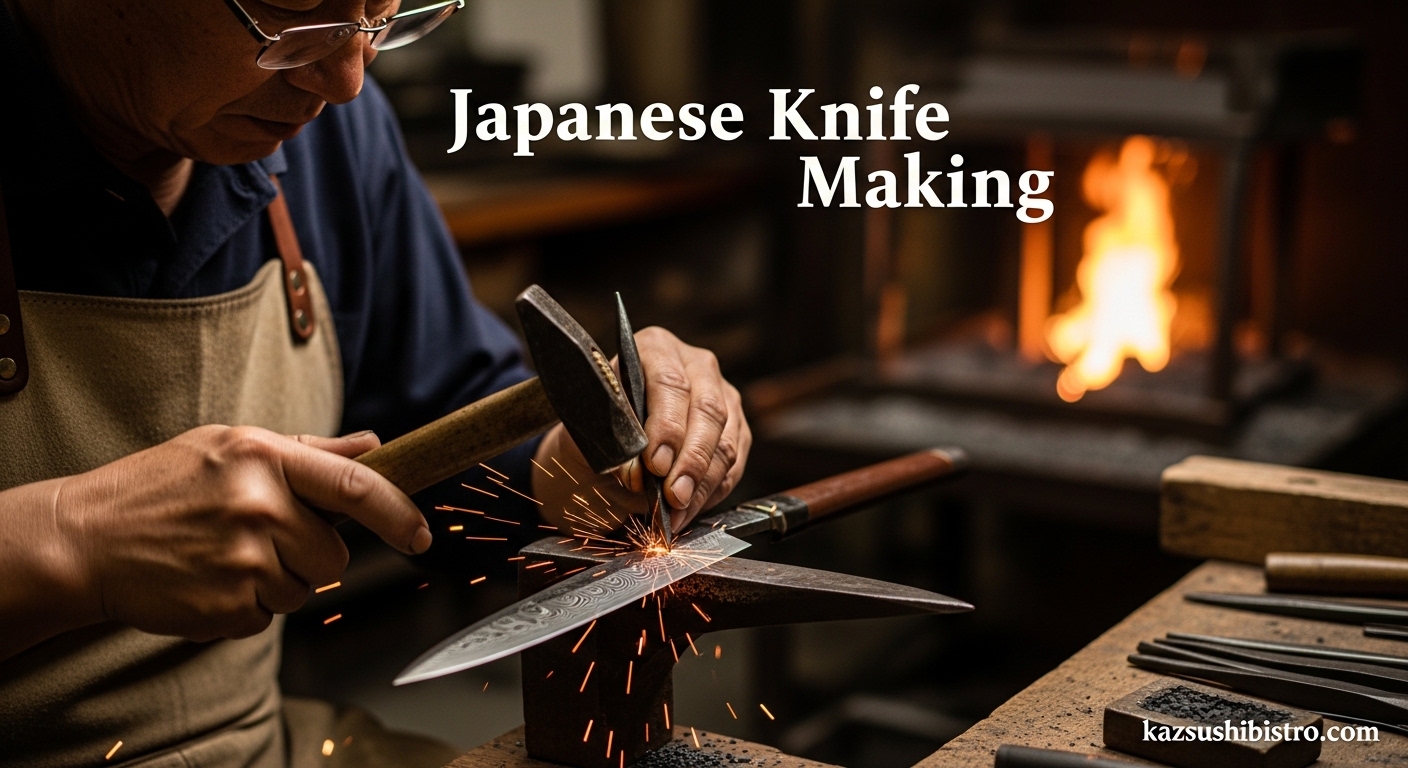
There is a quiet moment in every professional kitchen when a chef picks up their knife and pauses. That pause speaks to something deeper than utility. It connects to a thousand-year legacy where steel meets soul, where the art of Japanese knife making transforms simple cutting into something almost sacred.
History of Japanese knife making spans more than a millennium. From ancient stone tools carved by the first inhabitants of the archipelago to the gleaming blades that now grace Michelin-starred kitchens worldwide, this craft represents one of humanity’s most enduring traditions.
I spent months researching this legacy, visiting museums and speaking with craftspeople. What I discovered changed how I understand not just knives, but the relationship between a maker and their creation.
Table of Contents
Prehistoric Origins: Stone Tools in Ancient Japan 2026
Japanese blade making began long before iron ever touched these shores. Archaeological discoveries across the archipelago reveal that the earliest inhabitants were crafting stone blades as far back as 30,000 years ago.
What makes these ancient tools remarkable is their sophistication. Unlike crude European flint implements of the same era, Japanese stone tools show evidence of deliberate polishing and edge refinement. Craftspeople used a technique called polished stone tool making that created edges sharp enough to process fish and game with surprising efficiency.
During the Jomon period (14,000-300 BCE), this craft evolved further. Archaeologists have uncovered knife-like stone implements with distinct blade and handle sections, suggesting early ergonomic thinking. These were not merely broken rocks but intentionally designed cutting tools that reflected an understanding of how the human hand works.
The unique geological conditions of Japan played a role in this development. The volcanic nature of the islands provided abundant obsidian and fine-grained basalt, materials that could be worked into exceptionally sharp edges. This natural abundance helped foster a culture that would later become obsessed with blade perfection.
By the Yayoi period (300 BCE-300 CE), bronze and iron began arriving from the Asian mainland. The knowledge of metalworking spread slowly across the archipelago, but those millennia of stone blade refinement had already established something crucial. Japanese craftspeople understood that a blade was more than a tool. It was an extension of the person wielding it.
Ancient Beginnings: The Nara Period and Early Iron Blades
The Nara period (710-794 CE) marks the true beginning of Japanese knife making as we recognize it today. During this era of imperial consolidation, Japan absorbed Chinese cultural influences while developing distinctly local traditions.
The etymology of the Japanese word for kitchen knife reveals these Chinese roots. Houchou (庖丁) derives from the Chinese name Pao Ding, a legendary cook mentioned in the ancient Daoist text Zhuangzi. In that 3rd century BCE story, Pao Ding demonstrated such mastery with his cleaver that he could butcher an ox without ever touching bone, preserving his blade’s edge for nineteen years. When the concept arrived in Japan, houchou became synonymous with kitchen knives of all types.
The Shosoin treasury at Todaiji Temple in Nara preserves some of the oldest surviving examples of Japanese metalwork. Among its treasures are iron blades from the 8th century that show remarkable craftsmanship. These early knives feature laminated construction, with hard steel edges welded to softer iron backs, a technique that would define Japanese blade making for centuries.
During the Nara period, knife making began separating from general metalworking. Specialized smiths emerged in temple complexes and imperial workshops. Buddhism played a significant role in this development. Monastic communities needed precise tools for preparing ceremonial offerings and medicinal herbs. Religious dedication demanded excellence, and monks became early patrons of blade craftsmanship.
The imperial court also drove innovation. Aristocrats required elaborate table services, including specialized knives for different foods. This created early demand for variety in blade shapes and sizes. The foundation was being laid for what would eventually become the incredibly diverse world of Japanese kitchen knives.
The Heian Period: Knives as Status Symbols and the Houchou-shiki Ceremony
The Heian period (794-1185) transformed knives from practical implements into objects of cultural significance. As the imperial court moved to Kyoto, Japanese aesthetics flourished, and blades became expressions of refinement and status.
During this era, the Houchou-shiki ceremony emerged. This formal knife ceremony involved the ritual preparation of fish in imperial and noble households. Master chefs would perform precise cutting techniques before assembled guests, demonstrating both culinary skill and spiritual purity.
The ceremony reflected deeper Buddhist influences that permeated Japanese culture. Taking life to sustain life required mindfulness and respect. The knife became an instrument through which this spiritual balance could be maintained. Proper technique honored the fish. A dull or clumsy blade represented moral failing.
Elite households competed to possess the finest knives. Craftsmen began signing their work, establishing reputations that transcended individual commissions. The concept of meibutsu, or famous products, took hold. A knife from a renowned maker became a valuable gift between aristocrats, sometimes worth more than swords.
The period also saw the emergence of regional styles. Kyoto, as the cultural center, developed preferences for elegant, lightweight blades. Provincial areas favored sturdier implements suited to their local ingredients. This geographical diversity would eventually crystallize into the distinct traditions of Kansai and Kanto knife making.
By the late Heian period, the foundation of Japanese knife culture was complete. Blades were no longer mere tools but carriers of meaning, history, and identity. The stage was set for an even more dramatic evolution.
The Samurai Era: Legendary Swordsmiths and the Rise of Seki City
The Kamakura period (1185-1333) brought the samurai to power, and with them came revolutionary advances in Japanese blade making. The demands of warfare drove metallurgical innovation that would eventually benefit kitchen knives as much as battlefield weapons.
Seki city in Gifu Prefecture emerged during this era as Japan’s premier sword-making center. According to tradition, master swordsmith Motoshige moved to Seki in the 13th century, drawn by the region’s unique resources. The area offered pure water from the Nagara River, high-quality sand for polishing, and charcoal from abundant forests. Most importantly, it possessed the specific iron-rich soil needed for traditional smelting.
Seki smiths developed techniques that remain legendary. They pioneered differential hardening, coating blade spines with clay before heating to create the characteristic hamon temper line. This produced swords with hard, sharp edges and soft, flexible backs, the ideal combination for weapons that must cut without breaking.
No discussion of this era is complete without the legendary smith Masamune. Active in the late 13th and early 14th centuries, Masamune is widely considered Japan’s greatest swordsmith. His blades were said to possess not just physical excellence but spiritual virtue.
The famous legend comparing Masamune to his rival Muramasa illustrates the cultural significance of Japanese blades. According to the story, both smiths created blades of extraordinary sharpness. When tested in a stream, Muramasa’s sword cut everything that touched it, leaves, twigs, even fish swimming by. Masamune’s blade, by contrast, passed through the same stream while leaves and twigs floated harmlessly around it. A monk observing the test declared that Muramasa’s sword was evil, killing indiscriminately, while Masamune’s was honorable, refusing to cut unnecessarily.
This story reveals how Japanese culture viewed blades as possessing character and moral quality. A knife was not merely metal but an expression of its maker’s spirit. This philosophy would eventually transfer from swords to kitchen knives, explaining why Japanese chefs speak of their blades with such reverence.
By the Muromachi period (1336-1573), Seki had become synonymous with blade excellence. The city would eventually transition from swords to kitchen knives, but the metallurgical knowledge accumulated over centuries of sword making remained intact.
From Battlefields to Kitchens: The Muromachi and Edo Periods
The transition from swords to kitchen knives began during the Muromachi period and accelerated through the Edo period (1603-1868). This transformation represents one of the most fascinating chapters in the history of Japanese craftsmanship.
Several factors drove this shift. The Tokugawa Shogunate brought lasting peace to Japan, reducing demand for swords while increasing interest in culinary arts. The rise of the merchant class created new markets for luxury goods, including fine kitchen implements. And the development of distinct regional cuisines required specialized cutting tools.
During the Edo period, the classic Japanese kitchen knife forms emerged. The Deba developed for butchering fish, its thick spine and single bevel making it perfect for cutting through heads and bones. The Yanagiba evolved for slicing sashimi, its long, slender blade enabling single-motion cuts that preserve fish texture. The Usuba appeared for vegetable work, its straight edge and thin blade suited to precise cuts required by Kyoto cuisine.
Regional differences crystallized during this era. Kansai style knives, centered on Osaka and Kyoto, favored lighter, thinner blades for delicate work. Kanto style knives, serving the Tokyo area, tended toward sturdier implements suited to the region’s heartier cuisine. These differences persist today, with chefs often preferring the style that matches their regional training.
The division of labor also became formalized. Traditional Japanese knife making involves distinct specialists. One smith might forge the blade, another handle the rough grinding, a third perform the final sharpening, and a fourth craft the handle and fittings. This system allowed masters to develop extraordinary depth in their specific domain.
Quality control became increasingly sophisticated. Blade testing methods evolved from simple cutting to precise measurements of edge geometry and steel composition. Guilds formed to maintain standards and protect craft secrets. The apprentice system ensured knowledge passed from master to student across generations.
By the late Edo period, Japanese kitchen knives had reached a level of refinement that would not be significantly improved for centuries. The basic forms were established. The metallurgical techniques were perfected. All that remained was to preserve this knowledge through the turbulent times ahead.
Sakai City: The Heart of Japanese Knife Making
If Seki city represents the military heritage of Japanese blades, Sakai embodies their culinary soul. Located in Osaka Prefecture, this city of 800,000 people produces over 90 percent of Japan’s professional kitchen knives.
Sakai’s blade-making tradition dates to the 5th century CE, when the city emerged as a major construction center for kofun, the massive burial mounds built for emperors and nobles. Craftsmen forged tools for moving earth and cutting stone. When kofun construction ended, these skills transferred to other purposes.
The city truly became “Japan’s Kitchen Knife Capital” during the 16th century. Portuguese traders introduced tobacco to Japan, and Sakai craftsmen began making the thin, sharp blades needed to cut fine tobacco for pipes. Shogun Tokugawa Ieyasu himself preferred Sakai blades for his tobacco, granting the city’s craftsmen special privileges and protection.
This tobacco blade expertise eventually transferred to kitchen knives. Sakai smiths discovered that the same qualities needed for slicing tobacco, thinness, sharpness, and precision, applied equally to preparing food. The city’s reputation grew until it dominated the domestic market.
What distinguishes Sakai is its unique production system. Unlike integrated workshops elsewhere, Sakai maintains extreme specialization. The process involves ten distinct craftsmen, each focusing exclusively on one step. Forge masters, rough grinders, blade straighteners, edge makers, handle craftsmen, and others each contribute their expertise.
A typical Sakai knife passes through ten workshops before completion. This might seem inefficient, but it produces extraordinary results. Each specialist has spent decades perfecting their specific skill. No generalist, however talented, could match the combined expertise of ten masters in their respective domains.
Visiting Sakai today offers a glimpse into living history. The Sakai City Museum and the Sakai Traditional Crafts Museum display centuries of knife-making artifacts. Some workshops have operated continuously for over 500 years, with current masters representing the 20th or 25th generation in unbroken succession.
Modernization: The Meiji Restoration and Western Influence
The Meiji Restoration of 1868 brought unprecedented change to Japan. The country opened to the world after centuries of relative isolation, and traditional crafts faced both challenges and opportunities.
Commander Matthew Perry’s arrival in 1853 had already signaled transformation. Foreigners brought new technologies and new demands. Japanese craftsmen, ever adaptable, began incorporating Western techniques while preserving their core traditions.
The most dramatic impact came after World War II. General Douglas MacArthur’s occupation administration banned sword making entirely in 1945, viewing swords as symbols of militarism. Thousands of swordsmiths suddenly found their craft illegal. Many turned to kitchen knives to survive.
This influx of sword-making expertise transformed the cutlery industry. Smiths who had spent careers creating weapons applied their skills to culinary tools. The post-war period saw a golden age of kitchen knife innovation as displaced masters sought new outlets for their talents.
Western influence also grew during this era. Japanese chefs began training in Europe, returning with new ideas about kitchen tools. The Gyuto, essentially a Japanese interpretation of the French chef’s knife, emerged in the 1950s. Its Western-style double bevel and pointed tip suited the international cuisine gaining popularity in Japan.
The Santoku appeared around the same time, representing a different kind of fusion. Its name means “three virtues,” referring to its intended use with meat, fish, and vegetables. Shorter and flatter than a Gyuto, with a rounded tip, the Santoku suited home cooks who wanted versatility without the intimidation of professional tools.
Globalization brought Japanese knives to international attention. Western chefs discovered that Japanese blades offered advantages over European alternatives. Japanese steel stayed sharper longer. Japanese edge geometry enabled more precise cuts. By the 1980s, Japanese knives were appearing in professional kitchens from New York to Paris.
Today, the Japanese cutlery industry balances tradition and innovation. Computer-aided design assists master smiths. Modern materials supplement traditional steels. Yet the fundamental techniques, tatara smelting, differential hardening, the ten-step Sakai process, remain unchanged.
Traditional Forging Techniques: The Craftsmanship Behind Japanese Knives
Understanding Japanese knife making requires examining the techniques that distinguish these blades from all others. The process involves over fifty distinct steps, each requiring years to master.
The journey begins with tamahagane, the traditional steel used in premium Japanese knives. This material is produced through tatara smelting, a method that has remained essentially unchanged for centuries. Craftspeople layer iron sand and charcoal in a clay furnace, then tend the fire for three days and nights, never letting the temperature drop. The resulting steel contains carbon in varying amounts throughout its structure, creating natural layers of hard and soft metal.
Smiths select specific pieces of tamahagane based on their intended use. High-carbon sections become cutting edges. Lower-carbon portions form the blade body. This selective use of different steel types allows smiths to optimize properties that would be impossible in homogeneous modern steel.
Forging involves repeatedly heating, hammering, and folding the steel. A blade might be folded sixteen or more times, creating thousands of layers. This process serves two purposes. It distributes carbon evenly throughout the steel. It also creates the beautiful jigane patterns visible on high-end blades.
Two main construction methods exist. Honyaki knives use single pieces of differentially hardened steel, like traditional swords. These represent the pinnacle of the craft, capable of taking the finest edges but requiring skill to maintain. Kasumi knives combine hard steel edges with soft iron backs, welded together. These are more forgiving and practical for daily use.
The differential hardening process distinguishes Japanese blades. Smiths coat blade spines with clay before heating, then quench in water. The clay insulates the spine, causing it to cool slower than the exposed edge. This creates two distinct crystal structures. The edge becomes extremely hard martensite, capable of taking a razor edge. The spine remains softer pearlite, providing flexibility and preventing breakage.
Sharpening is equally sophisticated. Traditional Japanese waterstones come in dozens of grades, from coarse 200-grit stones for shaping to 30,000-grit stones for polishing. Master sharpeners might spend an hour on a single blade, working through progressively finer stones until the edge achieves mirror smoothness.
Modern Japanese knives also incorporate contemporary materials. Some smiths use powdered metallurgy steels that offer exceptional hardness. Others laminate traditional Japanese steel with stainless outer layers for corrosion resistance. These innovations extend the tradition rather than replacing it.
Frequently Asked Questions About Japanese Knife History
What does Houchou mean in Japanese?
Houchou (庖丁) is the Japanese word for kitchen knife, derived from the Chinese name Pao Ding, a legendary cook mentioned in the ancient Daoist text Zhuangzi. The term has been used in Japan since at least the Nara period (710-794 CE) to describe specialized cutting implements.
What is the difference between Seki and Sakai knives?
Seki city is historically associated with samurai sword making and produces knives with stronger sword-making heritage, often featuring honyaki construction. Sakai city specializes in kitchen knives with an extreme division-of-labor system where ten different craftsmen contribute to each blade, resulting in exceptional refinement for culinary use.
What is the Masamune vs Muramasa legend?
According to legend, when tested in a stream, Muramasa’s sword cut everything it touched indiscriminately, while Masamune’s blade allowed leaves and twigs to float harmlessly past. A monk declared Muramasa’s sword evil and Masamune’s honorable, illustrating the Japanese belief that blades possess spiritual character reflecting their maker.
How are traditional Japanese knives made?
Traditional Japanese knife making involves over 50 steps including tatara smelting to create tamahagane steel, selective forging of different carbon-content steels, differential hardening using clay coatings, and progressive sharpening on waterstones. The Sakai method involves ten specialized craftsmen, each performing one specific step.
When did Japanese kitchen knives develop?
Distinct Japanese kitchen knife forms emerged during the Edo period (1603-1868) as regional cuisines developed. The Deba for fish butchering, Yanagiba for sashimi slicing, and Usuba for vegetable work all appeared during this era. Modern forms like the Gyuto and Santoku developed after World War II.
What is the Houchou-shiki ceremony?
The Houchou-shiki is a formal knife ceremony from the Heian period (794-1185) where master chefs performed ritual fish preparation before assembled guests. It demonstrated both culinary skill and spiritual purity, reflecting Buddhist beliefs about respecting life taken to sustain life.
The Living Legacy of Japanese Knife Making
The history of Japanese knife making stretches across millennia, from stone tools of the Paleolithic to the gleaming blades carried by chefs in 2026. Throughout this journey, certain constants remain. Japanese craftspeople view blades as extensions of human capability. Quality is measured by function and spirit, not appearance alone. Regional traditions honor local conditions while contributing to a national heritage.
Today, this legacy faces challenges. Master smiths age without enough young apprentices to replace them. Modern manufacturing offers cheaper alternatives that lack traditional character. Yet the fundamental value proposition of Japanese knives, exceptional performance through refined craftsmanship, remains compelling.
Global recognition has never been higher. Michelin-starred kitchens worldwide feature Japanese blades. Cooking enthusiasts collect knives as functional art. Museums from the Metropolitan in New York to the Victoria and Albert in London display Japanese blades among their most treasured holdings.
For those who wish to experience this living tradition directly, several destinations offer authentic encounters. The Sakai City Museum and Sakai Hamono Museum in Osaka Prefecture showcase centuries of cutlery history. The Seki Hamono Museum in Gifu Prefecture focuses on sword and knife making with working demonstrations. Some Sakai workshops still accept visitors who want to witness ten craftsmen collaborate on a single blade.
When you hold a Japanese knife, you connect to all of this. The 30,000-year tradition of Japanese blade making. The monks of the Nara period. The samurai smiths of Kamakura. The specialized craftsmen of Sakai. The post-war masters who redirected their skills from swords to kitchens. Each contributes to the knife in your hand.
This is why chefs pause before cutting. They know what they hold. And now, so do you.