
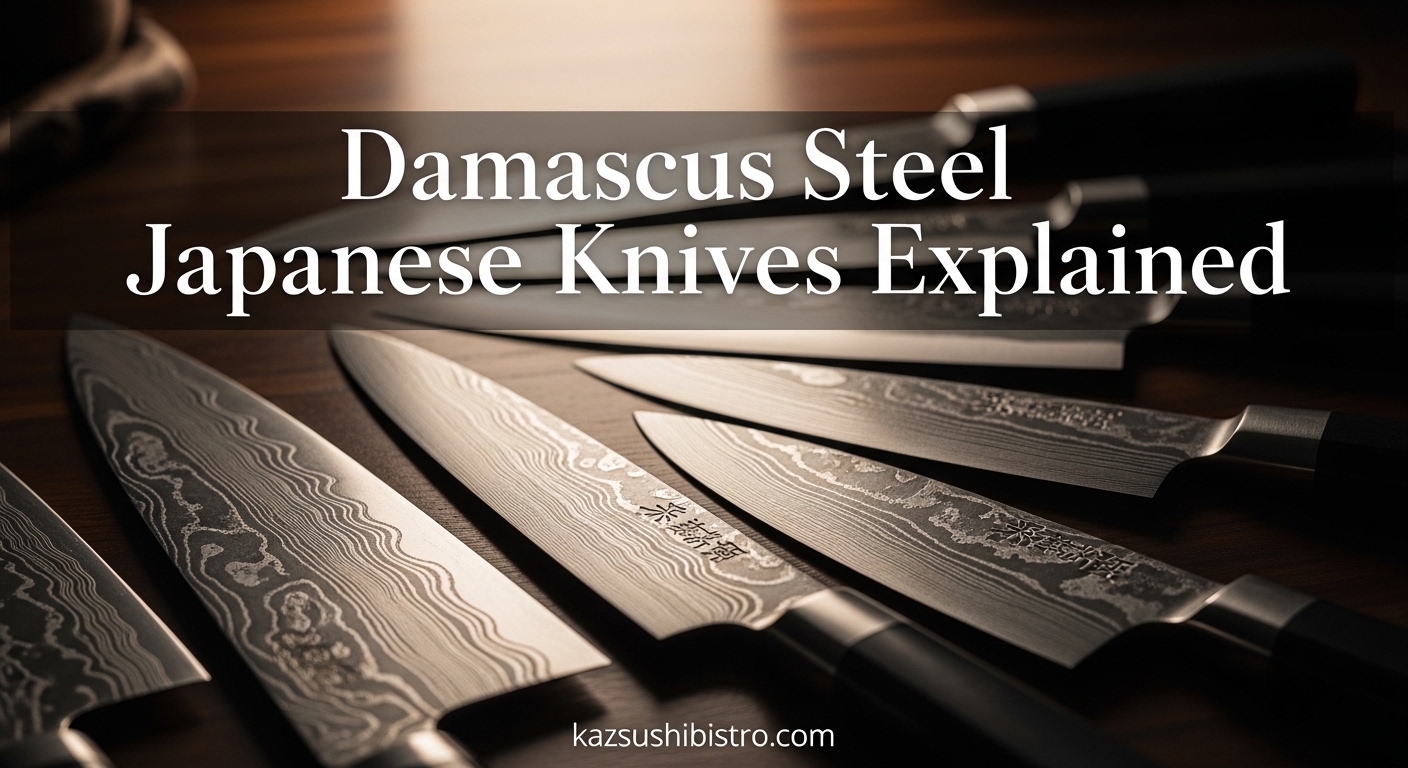
Damascus steel refers to layered steel with distinctive wavy, water-like patterns created by forge-welding multiple layers together. Ancient Damascus (known as Wootz steel) was a legendary crucible steel made in India and the Middle East; modern Damascus is pattern-welded steel created through a technique rediscovered in the 20th century. The short answer to whether Damascus steel Japanese knives are better: the Damascus cladding is primarily aesthetic, while the cutting performance comes entirely from the core steel hidden inside.
I have spent years researching Japanese knives and talking to blacksmiths in Sakai and Seki. The mystique around Damascus steel creates confusion. Many home cooks believe the wavy patterns somehow make the blade sharper or stronger. That is not how it works.
In this guide, I will explain exactly what Damascus steel is, how it is made, why those beautiful patterns appear, and what actually matters for performance. You will learn how to identify authentic Damascus, care for these knives properly, and decide whether the investment makes sense for your kitchen.
Table of Contents
What Is Damascus Steel?
Damascus steel is metal featuring visible wavy or rippling patterns created by layering different types of steel and forging them together. The technique is called pattern welding. Two or more steel types are stacked, heated in a forge, hammer-welded into a solid billet, then folded and manipulated to create intricate designs.
Modern Japanese Damascus knives almost always use a construction called san-mai, meaning “three layers.” A hard core steel forms the cutting edge, while softer Damascus-clad layers protect the sides. This combines the sharpness of hard steel with the durability and rust resistance of the outer layers.
Ancient Wootz vs Modern Pattern Welding
The original Damascus steel, now called Wootz, was produced in South India and Sri Lanka starting around 300 BCE. This was crucible steel made by melting iron with specific additives in sealed clay crucibles. The resulting ingots developed carbide structures that created patterns during forging.
The technique for making true Wootz steel was lost by the 18th century. No one today can replicate the exact process used by ancient smiths. Modern Damascus steel is fundamentally different: it is pattern-welded steel created by mechanically layering and forging different steels together.
How the Patterns Are Created
The visible Damascus pattern comes from the interaction between different steel types in the layered billet. When the smith etches the finished blade in acid, the different metals react at different rates. High-carbon steel darkens dramatically. Nickel-alloyed steel remains bright. This contrast creates the characteristic light-and-dark designs.
The smith controls the pattern through manipulation. Twisting the billet creates spiral designs. Cutting grooves across layers before re-forging creates ladder patterns. Grinding curves before flattening creates raindrop effects. Each pattern requires specific techniques passed down through generations of craftsmen.
The History of Damascus Steel: From Ancient Wootz to Modern Kitchens 2026
The story of Damascus steel spans over two millennia. It begins not in Syria, but in the crucibles of ancient South India.
The Wootz Origin
Around 300 BCE, Indian metallurgists developed a technique for producing ultra-high carbon steel in crucibles. They called this steel Wootz. The material contained carbon levels of 1.5 to 2 percent, far higher than typical bloomery iron. This was achieved by heating iron ore with glass and organic materials in sealed containers for days.
The resulting steel ingots contained microscopic carbide structures. When forged into blades, these carbides aligned into visible patterns. The metal exhibited remarkable hardness and the ability to hold a wicked edge. Arabic traders brought these ingots to the Middle East, where Syrian smiths in Damascus turned them into legendary swords.
The Damascus Swords
Between 900 and 1600 CE, swords forged from Wootz steel in Damascus became prized across the known world. Crusaders encountered these blades and marveled at their performance. Stories spread of swords that could slice through silk handkerchiefs dropped across the blade. European nobility paid fortunes for genuine Damascus blades.
The pattern on these swords was not merely decorative. It indicated the quality and composition of the underlying steel. The forging process in Damascus developed to enhance and control these patterns, elevating the craft to an art form.
The Lost Technique
By the 18th century, Wootz steel production had disappeared. The specific ore sources, the exact recipe of additives, and the closely guarded techniques were lost. Multiple factors contributed: the rise of firearms reduced sword demand, traditional trade routes shifted, and the oral tradition of Indian metallurgists was disrupted by colonial disruption.
Attempts to reverse-engineer Wootz steel began in the 19th century. Scientists including Michael Faraday studied surviving blades. While they identified high carbon content and specific impurities, no one could recreate the original process. The secret of ancient Damascus steel remained lost.
The Modern Revival
Pattern welding as a technique never fully disappeared. Japanese swordsmiths continued folding steel for katanas. European smiths preserved layered steel techniques for gun barrels. But the connection to Damascus-style patterns was largely forgotten until the 20th century.
In the 1970s, bladesmith William F. Moran demonstrated modern pattern welding at a knifemakers guild show. His work sparked renewed interest. Japanese blacksmiths, particularly in Sakai and Seki, began applying pattern welding techniques to kitchen knives. The marriage of traditional Japanese blade geometry with layered steel patterns created the modern Damascus kitchen knife market.
Today, Japanese Damascus knives represent the pinnacle of this craft. Master smiths like Kageura, Hinoura, and Anryu create blades with dozens or even hundreds of layers, combining functional performance with artistic beauty.
How Modern Damascus Steel Is Made
The creation of a Damascus steel knife involves multiple precise steps. Each stage requires skill, experience, and careful control of temperature and pressure. Understanding this process explains why authentic Damascus commands premium prices.
Step 1: Selecting and Stacking Steel
The smith begins by selecting two or more steel types with different properties. Common combinations include high-carbon steel paired with nickel-alloy steel. The nickel resists acid etching and stays bright, while the high-carbon steel darkens, creating contrast.
For Japanese kitchen knives, the core steel determines cutting performance. Popular choices include VG10 (a stainless steel with excellent edge retention), SG2/R2 (a high-speed powder metallurgy steel), and Aogami (Blue Carbon) steels (high-carbon steels prized by professionals). The smith cuts thin sheets or bars of the cladding steels and stacks them around the core.
Step 2: Forge Welding
The stacked billet goes into a forge heated to approximately 2200 degrees Fahrenheit. At this temperature, the steel becomes plastic but not liquid. The smith removes the billet and hammers it forcefully, causing the layers to bond at the molecular level. This is forge welding.
Success requires precise temperature control. Too cold and the layers will not bond. Too hot and the steel will burn or lose carbon content. The smith judges temperature by color: a bright yellow-orange indicates proper forge welding heat.
Step 3: Folding and Layer Multiplication
After the initial weld, the smith cuts the billet, folds it, and welds again. Each fold doubles the layer count. Starting with 8 layers, one fold creates 16. Five folds produce 256 layers. Ten folds yield over 1,000 layers.
Japanese Damascus knives typically range from 32 to 73 layers in the cladding. Some premium blades feature over 100 layers. However, more layers do not necessarily mean better performance. The smith chooses layer counts based on the desired final pattern and the properties of the specific steels being used.
Step 4: Pattern Manipulation
This is where artistry enters the process. The smith manipulates the billet to create specific patterns. For a twist pattern, the smith rotates the billet while drawing it out into a bar, creating a spiral of layers. For a ladder pattern, the smith grinds grooves across the bar, then flattens it again, exposing the end grain in a rung-like arrangement.
Raindrop patterns require grinding hemispherical depressions into the billet surface before flattening. Random or organic patterns result from irregular manipulation. Each smith develops personal techniques and signature patterns. Some legendary Japanese smiths are recognizable by their distinctive pattern styles alone.
Step 5: Shaping and Heat Treatment
Once the pattern is established, the smith forges the billet into a blade shape. For Japanese knives, this means creating the specific geometry required: the thin, acute edge angle of a Yanagiba for sashimi, the sturdy heel of a Deba for fish butchery, or the versatile profile of a Gyuto chef knife.
Heat treatment follows forging. The blade is heated to critical temperature (different for each steel type) and quenched rapidly, usually in oil or between cooled plates. This hardens the steel. A subsequent tempering process at lower temperature reduces brittleness while maintaining hardness. Proper heat treatment is crucial for performance and distinguishes master smiths from lesser makers.
Step 6: Grinding, Polishing, and Etching
The blade is ground to its final geometry and polished. For Damascus, the smith uses progressively finer abrasives to prepare the surface. Then comes the magic moment: acid etching.
The blade is submerged in ferric chloride or another acid solution. The different steel layers react at different rates. Carbon steel darkens to near-black. Nickel steel remains silvery or golden. The contrast reveals the pattern hidden within. Etching time ranges from minutes to hours depending on the desired depth and contrast.
After etching, the smith neutralizes the acid and applies protective treatments. The result is a blade that is both functional tool and metal sculpture.
Common Damascus Steel Patterns
The pattern on a Damascus knife is not random. It is a deliberate design created through specific techniques. Understanding these patterns helps you appreciate the craftsmanship and identify quality work.
| Pattern | Appearance | Creation Method |
|---|---|---|
| Raindrop | Oval or circular spots resembling water droplets | Grinding hemispherical depressions into billet before flattening |
| Ladder | Horizontal or vertical lines resembling ladder rungs | Cutting grooves across layers then re-forging flat |
| Twist | Spiral or diagonal lines wrapping around the blade | Rotating the billet while drawing it into a bar |
| Random/Organic | Flowing, unpredictable waves and swirls | Irregular manipulation without specific pattern tooling |
| Wavy | Classic water-like flowing lines | Standard forge welding without specific manipulation |
Raindrop Pattern
The raindrop pattern features oval or circular spots that look like water droplets on the blade surface. This is among the most popular patterns for Japanese kitchen knives. The effect requires considerable skill, as the smith must grind consistent hemispherical depressions and then flatten the billet precisely to reveal the circular patterns.
Well-executed raindrop patterns show uniform droplets aligned in rows or staggered arrangements. Poor execution results in irregular shapes or partial patterns. When evaluating a raindrop Damascus knife, look for consistency in the droplet size and spacing.
Ladder Pattern
Ladder patterns display straight lines crossing the blade, resembling the rungs of a ladder. The pattern can run horizontally, vertically, or diagonally depending on how the smith orients the billet. This pattern requires cutting grooves across the layered bar, then forge-welding it flat again.
The ladder pattern offers a more geometric, structured appearance compared to organic flowing patterns. It is particularly striking on blades with high layer counts, where the fine lines create almost a textile-like appearance.
Twist Pattern
Twist patterns show diagonal or spiral lines wrapping around the blade. The smith creates this by rotating the square billet while drawing it out lengthwise. The degree of twist determines the angle of the pattern lines.
This pattern is dramatic and immediately eye-catching. It works especially well on blades with very high layer counts (100+), where the fine layers create intricate spirals. Twist Damascus is often used for premium chef knives where the pattern will be visible during use.
Random and Organic Patterns
Some smiths prefer to let the steel itself determine the pattern. Through irregular folding, manipulation, and surface grinding, they create organic, flowing patterns that resemble wood grain, water currents, or marble. These patterns are unique to each blade.
Master smiths like Takeshi Saji and Shiro Kamo are famous for their organic patterns. Their signatures are recognizable to collectors. These patterns require the most experience to execute well, as the smith must control the process while allowing natural variation.
Performance vs Aesthetics: What Actually Matters
Here is the truth about Damascus steel that many sellers will not emphasize: for kitchen knives, the Damascus cladding is almost entirely aesthetic. The cutting performance comes from the core steel, not the wavy patterns on the sides.
The Performance Myth Debunked
Marketing often suggests that Damascus steel is inherently superior. The layered construction does offer some structural benefits. The soft cladding can protect a brittle hard core from chipping. The layered structure can improve durability. But the wavy pattern itself does nothing for cutting.
I have tested dozens of knives over the years. A $150 mono-steel knife with VG10 core and no Damascus cladding cuts identically to a $300 knife with VG10 core and 67-layer Damascus cladding. The extra $150 buys you beauty, not performance.
Professional chefs know this. Walk into any high-end sushi restaurant in Tokyo and you will see simple carbon steel knives without Damascus patterns. The chefs choose pure performance over aesthetics. They want the thin geometry and extreme hardness possible with mono-steel construction.
When Damascus Cladding Actually Helps
There are legitimate functional benefits to Damascus construction, though they are often overstated. The san-mai construction protects hard core steel from corrosion and damage. Stainless Damascus cladding over carbon steel core gives you the edge quality of carbon with easier maintenance.
The layered structure can also improve food release. Some users find that Damascus-clad blades are less “sticky” than flat-ground mono-steel, though this varies by grind geometry and the specific pattern. The microscopic texture of etched Damascus may reduce surface tension between blade and food.
Core Steel Determines Everything
When evaluating a Damascus knife, ignore the pattern and focus on the core steel. This is what touches your food, maintains the edge, and determines how long the knife stays sharp. The cladding could be butter-soft for all it matters to cutting performance.
Japanese Damascus knives typically use one of several core steels:
VG10 is a popular stainless steel containing cobalt, molybdenum, and vanadium. It takes a fine edge and holds it well. HRC hardness typically ranges from 60-62. VG10 Damascus knives are excellent choices for home cooks wanting low-maintenance performance with beautiful appearance.
SG2 (also called R2 or Super Gold 2) is a powder metallurgy high-speed steel. It achieves HRC 63-64 and offers exceptional edge retention. The powder metallurgy process creates a very fine, uniform carbide structure. SG2 Damascus knives represent premium performance tier.
Aogami (Blue Steel) #1 and #2 are high-carbon steels from Hitachi. Blue #2 contains tungsten and chromium for improved hardenability and edge retention. These steels take incredibly sharp edges but require maintenance as they will rust and develop patina. Damascus cladding helps protect the sides while leaving the edge exposed.
Aogami Super (Blue Super) adds vanadium and achieves HRC 64-66. It offers the best edge retention of the carbon steels but is more difficult to sharpen. Professional chefs prize Blue Super for its performance, though it demands skill to maintain.
The Value of Craftsmanship and Beauty
Even if Damascus does not improve cutting performance, it offers other forms of value. You are buying functional art. A hand-forged Damascus knife represents hours of skilled labor. You are supporting craftspeople keeping traditional techniques alive.
Many home cooks find genuine joy in using beautiful tools. Opening a drawer and seeing a Damascus blade can spark pleasure before you even start cooking. That emotional value is real, even if it does not show up in cut tests.
From forum discussions and my own conversations with knife enthusiasts, the “joy factor” is a major reason people buy Damascus. They appreciate the craftsmanship, enjoy explaining the technique to guests, and feel connected to a tradition spanning centuries.
Core Steel Types in Japanese Damascus Knives
Understanding the core steel options helps you choose the right Damascus knife for your needs. Each steel offers different tradeoffs between sharpness, edge retention, ease of maintenance, and price.
| Steel | Type | HRC Hardness | Edge Retention | Maintenance |
|---|---|---|---|---|
| VG10 | Stainless | 60-62 | Good | Low – dishwasher safe |
| SG2 / R2 | PM Stainless | 63-64 | Excellent | Low – highly stain resistant |
| Aogami Blue #2 | Carbon | 61-63 | Very Good | High – will rust without care |
| Aogami Super | Carbon | 64-66 | Excellent | High – requires oiling/drying |
| Shirogami White #2 | Carbon | 61-63 | Good | High – very reactive |
VG10: The Popular Choice
VG10 dominates the mid-range Damascus market for good reason. Developed by Takefu Special Steel Company in Fukui Prefecture, this steel contains 1% carbon, 15% chromium, 1% molybdenum, and 0.2% vanadium. The result is a stainless steel that takes a fine edge and holds it reasonably well.
VG10 Damascus knives typically cost between $100 and $250. Brands like Shun, Miyabi, and Yoshihiro offer extensive VG10 Damascus lines. For home cooks wanting a beautiful knife without maintenance headaches, VG10 Damascus represents the sweet spot.
The downside: VG10 can be chippy if the heat treatment is poor. Some mass-produced VG10 knives run soft (HRC 58-59) to prevent chipping, sacrificing edge retention. Quality makers hit HRC 61-62, finding the right balance.
SG2/R2: The Premium Powder Steel
SG2 (known as R2 by some makers or Super Gold 2) represents powder metallurgy advances. The steel is atomized into fine powder, then compressed and sintered. This creates extremely uniform carbide distribution with no large carbides to interfere with cutting.
SG2 achieves HRC 63-64 while maintaining toughness. Edge retention exceeds VG10 significantly. A well-made SG2 Damascus knife will stay sharp through weeks of home cooking. The stainless nature means minimal maintenance.
Expect to pay $250 to $500 for quality SG2 Damascus knives. Takamura, Mcusta, and higher-end Shun lines use this steel. The performance justifies the price for serious home cooks who want maximum edge life.
Aogami (Blue Carbon) Steels
Hitachi Metals produces the Aogami line of high-carbon steels favored by traditional Japanese knifemakers. Blue #2 (Aogami #2) contains approximately 1.1% carbon plus tungsten and chromium. It offers excellent edge retention and sharpness while being somewhat easier to sharpen than harder steels.
Blue Super adds vanadium and more carbon, achieving higher hardness. It holds edges longer but requires more skill to sharpen. Both steels react with food acids and will develop patina or rust without proper care.
Damascus cladding helps protect Blue steel blades. The cladding provides corrosion resistance on the sides while leaving the edge exposed for maximum sharpness. This combination is popular with enthusiasts wanting traditional carbon steel performance with reduced maintenance.
Shirogami (White Carbon) Steels
Shirogami (White Steel) contains fewer alloying elements than Aogami. It is highly reactive but takes an exceptionally fine edge. Shirogami #2 is commonly used in traditional Japanese knives. When paired with Damascus cladding, it offers the ultimate sharpness with some protection.
These knives require commitment. You must dry the blade immediately after use. Oiling is recommended. The patina that develops is considered beautiful by enthusiasts but may alarm cooks expecting stainless behavior.
How to Care for Damascus Steel Knives
Damascus steel knives require specific care to maintain both performance and appearance. The etched pattern can fade or corrode if neglected. Proper care preserves the beauty while ensuring the blade performs for decades.
Cleaning and Drying
Never put Damascus knives in the dishwasher. The harsh chemicals, high heat, and physical knocking will damage the edge and potentially corrode the pattern. Hand wash only.
Clean your knife immediately after use. Food acids, especially from onions, citrus, and tomatoes, will react with the steel. Use warm water and mild dish soap. A soft sponge removes residue without scratching the pattern.
Drying is critical. Do not let the knife air dry. Water spots can etch into the pattern and cause corrosion. Use a clean towel to dry the blade thoroughly, including the area near the handle where water collects.
Oiling for Carbon Steel Damascus
If your Damascus knife has carbon steel core or cladding, oiling provides additional protection. Apply a thin layer of mineral oil, camellia oil, or food-safe knife oil to the blade after drying. This creates a barrier against moisture and oxygen.
Store oiled knives in a way that allows air circulation. Knife blocks, magnetic strips, or blade guards all work. Avoid storing in leather sheaths long-term, as leather can hold moisture against the blade.
Sharpening Without Losing the Pattern
One common concern is whether sharpening will ruin the Damascus pattern. The pattern extends through the cladding layers, so normal sharpening will not eliminate it. However, aggressive sharpening or reprofiling can eventually wear through the cladding.
Use water stones for sharpening. Start with 1000 grit for maintenance, finishing with 3000-8000 grit depending on desired polish. Avoid aggressive diamond plates or grinding wheels that remove material rapidly.
When sharpening, focus on maintaining the original bevel angle. Japanese knives typically have asymmetrical edge angles. The pattern on the cladding provides a visual guide: keep the scratch pattern consistent with the original geometry.
Storage Recommendations
Store Damascus knives properly to prevent damage. Magnetic strips keep blades accessible and dry. Knife blocks protect edges but ensure the block is clean and dry inside. Blade guards or sayas (wooden sheaths) protect edges during drawer storage.
Never store Damascus knives loose in a drawer. They will knock against other metal, damaging edges and potentially the pattern. The etched surface is slightly more vulnerable to scratching than polished steel.
Restoring Faded Patterns
Over time and with sharpening, the Damascus pattern can appear less vivid. You can restore contrast with a light etch. Use ferric chloride solution (available from electronics suppliers) diluted with water. Dip the blade briefly, neutralize in baking soda solution, rinse and dry.
Be careful not to over-etch. The acid affects the steels differently, and excessive etching can create a rough surface. If unsure, professional knife services can restore Damascus patterns safely.
What to Look for When Buying Damascus Steel Japanese Knives
The Damascus knife market includes genuine craftsmanship and mass-produced imitations. Knowing what to look for ensures you get authentic value rather than marketing illusion.
Identifying Authentic vs Fake Damascus
Real pattern-welded Damascus shows three-dimensional depth. The pattern continues into the steel, not just sitting on the surface. Look at the spine of the knife: real Damascus shows layers continuing through the thickness.
Laser-etched fake Damascus has a superficial appearance. The pattern looks printed on. It lacks the depth variation of true etched steel. Price is a clue: genuine hand-forged Damascus under $50 is suspicious.
Another fake technique involves acid etching a pattern onto mono-steel without any layering. This creates a Damascus-like appearance without any of the construction. These knives are not inherently bad, but sellers should not market them as true Damascus.
Trusted Blacksmiths and Brands
Certain names indicate quality Damascus craftsmanship. Japanese blacksmiths like Kageura, Hinoura, Anryu, and Shiro Kamo are renowned for their Damascus work. Their knives command premium prices but offer authentic artistry.
Established brands like Shun, Miyabi, and Yoshihiro produce consistent quality Damascus lines at various price points. These companies have reputations to maintain and use genuine pattern welding techniques.
From forum discussions, buyers consistently recommend avoiding unknown Amazon brands with extravagant layer count claims. A knife advertised as “2000 layers” for $30 is certainly fake. Quality Damascus requires skilled labor that costs money.
Price Expectations at Different Tiers
Entry-level Damascus ($80-$150) typically uses VG10 core with 32-67 layer stainless cladding. These are machine-made or semi-handmade. Quality varies significantly in this range.
Mid-range Damascus ($150-$350) offers hand-forged blades from known makers or higher-end factory production. Core steels include VG10, SG2, or Aogami. Layer counts range from 67 to 173. These knives balance craftsmanship with accessibility.
Premium Damascus ($350-$800+) represents master blacksmith work. Hand-forged, individually crafted, often with custom handle materials. Core steels include SG2, Aogami Super, or specialized alloys. These are collectible tools as much as kitchen equipment.
Questions to Ask Sellers
When buying, ask specific questions. What is the core steel? What is the HRC hardness? Who made the knife? Where was it produced? Reputable sellers know these details.
Be wary of vague marketing language like “Damascus steel” without specification. Quality sellers specify the core steel, the cladding steels, and the construction method. Transparency indicates authenticity.
Frequently Asked Questions
What makes Damascus steel special?
Damascus steel is special because it combines functional performance with artistic beauty. The distinctive wavy patterns are created through pattern welding, a labor-intensive process of layering and forging different steels together. While the pattern is primarily aesthetic, the layered construction can provide structural benefits and connects users to centuries of knifemaking tradition.
Does Damascus steel rust?
Whether Damascus steel rusts depends on the steel types used. Stainless Damascus with VG10 or SG2 core steel resists rust and requires minimal maintenance. Carbon steel Damascus with Aogami or Shirogami cores will rust if not properly cared for. The Damascus cladding helps protect the sides, but the exposed core steel at the edge remains vulnerable to corrosion. Always dry carbon steel Damascus knives immediately after use.
Does the original Damascus steel still exist today?
Original Damascus steel, known as Wootz, no longer exists. The technique for producing this ancient crucible steel was lost by the 18th century. Modern Damascus steel is pattern-welded steel, which is fundamentally different in creation method though visually similar. No one today can replicate the exact process used by ancient Indian and Syrian smiths.
How much do you need to sharpen so you can cut with the knife?
A new Damascus knife should be sharp enough to cut immediately out of the box. For maintenance, sharpen when the knife no longer slices paper cleanly or requires noticeable pressure to cut vegetables. Touch up on a 1000 grit stone every 1-2 weeks with regular home use. Full sharpening sessions on progression stones (1000-5000 grit) are needed every 1-3 months depending on usage frequency and cutting technique.
Is it OK to sharpen Stainless steel knives?
Yes, stainless steel knives including Damascus with stainless cores sharpen perfectly well on water stones. VG10 and SG2 steels sharpen easily and take a fine edge. These steels are actually more forgiving for beginners than high-carbon steels because they resist chipping better. Use the same sharpening technique as for carbon steel knives.
Can you sharpen bread cutting knives?
Serrated bread knives can be sharpened using specialized techniques, but straight-edged Damascus knives are sharpened normally. Most Damascus kitchen knives have straight edges designed for push-cutting or rocking motions, not serrations. Sharpen these on flat water stones maintaining the original bevel angle. Do not use electric sharpeners or pull-through devices as these damage Japanese knife edges.
How do you care for the knives so it won’t rust?
To prevent rust on Damascus knives, follow these steps: 1) Wash immediately after use with warm water and mild soap. 2) Dry thoroughly with a clean towel, never air dry. 3) For carbon steel, apply a thin layer of food-safe oil after drying. 4) Store in a dry location using a knife block, magnetic strip, or blade guard. 5) Avoid cutting highly acidic foods and leaving residue on the blade. 6) Never put Damascus knives in the dishwasher.
Final Thoughts
Damascus steel Japanese knives represent the intersection of function and art. The wavy patterns that make these knives beautiful are created through genuine craftsmanship, not applied decoration. When you buy a quality Damascus knife, you are acquiring a tool made by skilled hands using techniques passed down through generations.
Remember that the Damascus cladding is primarily aesthetic. The core steel determines how the knife cuts, how long it stays sharp, and what maintenance it requires. Choose your Damascus knife based on the core steel that matches your needs: VG10 for easy maintenance, SG2 for premium edge retention, or Aogami for traditional carbon steel performance.
Damascus Steel Japanese Knives appeal to cooks who appreciate both performance and beauty. If you value the joy of using handcrafted tools, if you want a knife that sparks conversation, if you are willing to pay for artistry alongside function, then Damascus deserves a place in your kitchen. If pure performance is your only metric, a mono-steel knife will serve you equally well at lower cost.
The tradition of Damascus steel spans over two thousand years. Owning a Damascus knife connects you to that lineage. Every time you use it, you participate in a craft tradition that outlives trends and technologies. That connection to history is something no specification sheet can capture.