
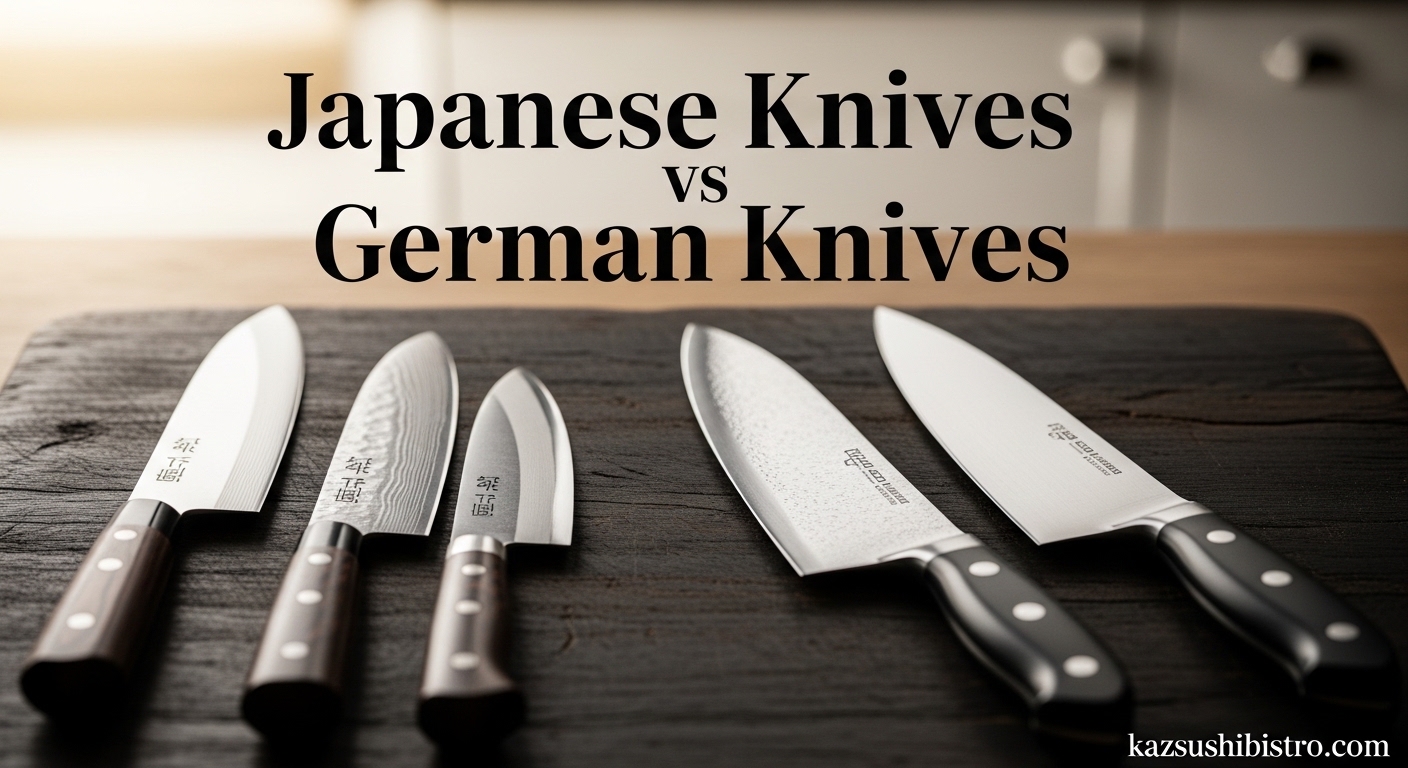
Walking into a kitchen supply store, you face a decision that has puzzled home cooks and professional chefs for generations. Should you invest in a Japanese knife with its razor-sharp reputation, or opt for the workhorse durability of a German blade? This guide breaks down everything you need to know about Japanese knives vs German knives, from steel composition to cutting techniques.
After 15 years working in professional kitchens and teaching knife skills at culinary schools, I have spent countless hours with both traditions. The truth is neither style is objectively superior. Each evolved to solve specific problems in specific culinary cultures. Your cooking style should dictate your choice.
By the end of this article, you will understand the historical roots, technical differences, and practical applications of both knife traditions. You will know exactly which blade suits your needs and why.
Table of Contents
Historical Background: How Two Traditions Emerged
The divide between Japanese and German knives runs deeper than marketing. It reflects centuries of metallurgical evolution shaped by geography, warfare, and cuisine.
The German Knife Tradition
German knife-making centers on Solingen, a city that earned the nickname “City of Blades” during the Medieval period. The craft began with sword production in the 14th century, but the region pivoted to cutlery as firearms made swords obsolete. By the 18th century, Solingen blades traveled across Europe and beyond.
Zwilling J.A. Henckels established operations in 1731, making it one of the oldest knife manufacturers still operating today. Wüsthof followed in 1814, and both families have maintained production in Solingen for over two centuries. The German approach prioritized durability and versatility. A knife needed to handle everything from butchering meat to chopping root vegetables without failing.
The steel available in the region contained higher chromium levels naturally, which led to the development of stainless steel formulations. German knifemakers engineered blades that resisted corrosion and maintained structural integrity under stress.
The Japanese Knife Tradition
Japanese knife-making traces directly to samurai swordsmithing. During the Muromachi period (1336-1573), master craftsmen developed techniques for folding and tempering steel that produced blades of extraordinary sharpness. The same forges that produced katana eventually transitioned to kitchen knives during the Edo period (1603-1868), when the warrior class declined.
The region of Sakai, near Osaka, became the center of Japanese blade production. Swordsmiths applied their knowledge of differential hardening to create kitchen knives with hard carbon steel edges and softer, more flexible spines. This construction allowed for extreme sharpness while preventing the blade from shattering.
Japanese cuisine demanded precision. The preparation of sashimi requires cuts so clean they do not tear fish fibers. Vegetable work in kaiseki cooking demands consistent, thin slices. These needs drove Japanese knifemakers to prioritize sharpness over durability.
Steel and Hardness: The Rockwell Scale Explained 2026
The most significant technical difference between Japanese and German knives lies in steel hardness, measured on the Rockwell C scale (HRC). This measurement determines how well a blade holds an edge and how resistant it is to damage.
Understanding Rockwell Hardness
The Rockwell scale measures a material’s resistance to permanent deformation. For kitchen knives, the C scale applies, with higher numbers indicating harder steel. The scale runs from approximately 50 to 70 HRC for cutlery applications.
Harder steel can take a sharper edge and maintains that edge longer. However, increased hardness brings brittleness. A blade at 65 HRC can chip if it contacts bone or a hard countertop. Softer steel dulls faster but bends rather than breaks, making it more forgiving.
German Steel Characteristics
Traditional German knives typically measure between 56 and 58 HRC. This relatively soft steel formulation allows the blade to flex without chipping. When cutting through joints or around bones, a German knife can twist and torque without damage.
The tradeoff comes in edge retention. A German knife at 56 HRC requires more frequent sharpening than its Japanese counterpart. However, the softer steel also sharpens more easily on basic honing rods and pull-through sharpeners.
Most German knives use stainless steel formulations containing 13-15% chromium. This chromium content creates a protective layer that prevents rust and staining, making maintenance simpler for home cooks.
Japanese Steel Characteristics
Japanese knives typically fall between 60 and 66 HRC, with some specialized blades reaching 68 HRC. This harder steel holds an acute edge far longer than German equivalents.
The higher hardness enables more aggressive bevel angles. Where German knives typically feature 17.5 to 20 degree bevels on each side, Japanese knives often use 10 to 15 degrees. This creates a keener cutting edge that slices with less resistance.
Many traditional Japanese knives use high-carbon steel with minimal chromium. These blades can achieve HRC ratings of 62-66 but require careful maintenance to prevent rust. The steel develops a patina over time, a natural oxidation layer that actually protects the blade.
Blade Shape and Geometry
The visual differences between Japanese and German knives extend beyond aesthetics. Blade geometry fundamentally changes how each knife performs.
German Blade Profiles
German chef’s knives feature pronounced curves along the cutting edge, typically with a continuous belly from heel to tip. This curvature supports the rock chop technique, where the cook keeps the tip anchored and rocks the blade through food.
The blades are thicker overall, especially at the spine. A typical German chef’s knife measures 3-4 millimeters at the spine near the bolster, tapering gradually toward the edge. This heft provides momentum when cutting through dense materials.
German knives almost universally use double bevels, meaning both sides of the blade angle toward the edge symmetrically. This creates a durable, stable cutting geometry that works for both right and left-handed users.
Japanese Blade Profiles
Japanese knives tend toward flatter profiles, particularly in the heel half of the blade. This straight edge excels at push cutting, where the entire blade travels straight down through the food.
The blades are significantly thinner. Many Japanese knives measure 2 millimeters or less at the spine, creating less resistance when cutting. This thinness enables the precise, delicate work required for sushi preparation.
Some Japanese knives use single bevels, particularly specialized fish knives like the yanagiba. The blade angles to one side only, creating an extremely sharp edge that slices cleanly through protein without tearing. Single bevel knives require either right or left-handed versions.
Cutting Techniques: Rock Chop vs Push Cut
The geometry differences dictate entirely different cutting approaches. Understanding these techniques helps you choose the right knife for your cooking style.
The Rock Chop Technique
The rock chop works best with German knives and their curved profiles. To execute it, keep the knife tip in contact with the cutting board while lifting and lowering the handle. The blade rocks through food in a continuous motion.
This technique proves efficient for mincing herbs and aromatics. The curved blade keeps contact with the board, allowing rapid, repetitive cuts without lifting the knife completely. Many home cooks naturally gravitate toward this motion.
German knives support rock chopping through their weight distribution. The bolster and handle provide heft that drives the blade through ingredients without requiring excessive force from the user.
The Push Cut Technique
Japanese knives excel at push cutting. With the flat blade profile, you lift the knife completely, place it where needed, and push straight down through the food. The cut happens in a single motion.
This technique produces cleaner cuts with less bruising to delicate ingredients. When preparing vegetables for presentation or slicing fish for sashimi, the push cut preserves texture and appearance.
Push cutting requires a sharper edge to work effectively. A dull blade will crush rather than slice when pushed straight down. This explains why Japanese knife users invest more time in maintenance.
Tap Chopping Variations
Both knife styles accommodate tap chopping, a technique where you lift and drop the blade repeatedly. This works well for breaking down larger items where precision matters less than speed.
With German knives, tap chopping often blends into rock chopping as ingredients break down. Japanese knives maintain cleaner separation between cuts, which professional chefs prefer for certain applications.
Handle Design and Balance
How a knife feels in your hand matters as much as how it cuts. Handle design and overall balance create distinct experiences between German and Japanese traditions.
German Handle and Bolster Design
Traditional German knives feature full bolsters, the thick metal junction between blade and handle. The bolster adds weight, protects fingers from slipping onto the edge, and provides balance.
This construction creates a handle-heavy balance point. When you grip a German chef’s knife properly, the weight settles back toward your hand. This reduces fatigue during extended use and provides control for heavy cutting tasks.
Modern German knives have introduced demi-bolster or half-bolster designs. These reduce weight while maintaining finger protection. Zwilling Pro and Wüsthof Classic Ikon both use demi-bolsters for improved sharpening access.
Handles on German knives are typically ergonomic, shaped to fit Western grip styles. They fill the palm and provide secure holds even with wet or greasy hands.
Japanese Handle and Balance
Traditional Japanese knives use wa-handles, cylindrical wooden handles that attach to partial tang blades. The balance point sits forward, closer to the blade, creating a blade-heavy feel.
This forward balance aids in precision work. The blade responds immediately to subtle wrist movements, giving the user fine control over cutting angle and depth. Sushi chefs prefer this sensitivity when making paper-thin slices.
Wa-handles are lighter than German equivalents, often weighing half as much. This reduces overall knife weight, which matters when you spend hours making repetitive cuts.
Some modern Japanese knives designed for Western markets use full tang construction with ergonomic handles similar to German styles. These hybrids aim to capture the sharpness of Japanese steel with the familiar feel of Western knives.
Essential Japanese Knife Styles
Japanese knifemaking produced numerous specialized designs, each optimized for specific tasks. Understanding these styles helps you build a functional collection.
The Gyuto
The gyuto serves as the Japanese equivalent to the Western chef’s knife. The name translates to “cow sword,” reflecting its original purpose for butchering beef. Modern gyuto knives work as all-purpose kitchen tools.
Gyuto blades typically measure 210mm to 270mm (8 to 10.5 inches), with 240mm being the most common length. The profile is flatter than a German chef’s knife but retains some curve near the tip for occasional rock chopping.
This knife suits cooks who want Japanese sharpness with reasonable versatility. A quality gyuto can handle 90% of kitchen tasks, from vegetable prep to protein fabrication.
The Santoku
Santoku means “three virtues,” referring to its proficiency with vegetables, fish, and meat. This shorter, wider blade gained popularity in Western markets as an alternative to the chef’s knife.
Most santoku knives measure 165mm to 180mm (6.5 to 7 inches). The sheep’s foot tip drops straight down rather than curving, creating a flat cutting edge well-suited to push cutting.
Many home cooks find the santoku more manageable than longer chef’s knives. The compact size fits smaller cutting boards and provides excellent control for detailed work.
The Yanagiba
The yanagiba is a single-purpose knife designed exclusively for slicing raw fish. Its long, narrow blade measures 240mm to 300mm, allowing slices to be made in a single drawing motion without sawing.
The single bevel construction creates extremely clean cuts. When preparing sashimi, a yanagiba slices through fish flesh without crushing cells or tearing fibers. This preserves texture and appearance in ways no other knife can match.
For sushi enthusiasts, the yanagiba represents the pinnacle of specialized Japanese knifemaking. It has no German equivalent in function or performance.
The Deba
The deba is a heavy, thick knife designed for butchering fish. Its robust spine and single bevel edge allow it to cut through heads and bones while the delicate tip fillets flesh cleanly.
Deba knives are specialist tools for those who process whole fish regularly. They demonstrate how Japanese knifemaking creates purpose-built solutions rather than generalist tools.
Essential German Knife Styles
The German tradition emphasizes versatility over specialization. Most German knife sets contain fewer pieces than Japanese equivalents because each knife handles broader tasks.
The Chef’s Knife
The German chef’s knife, sometimes called a “cook’s knife,” serves as the ultimate generalist. Blade lengths range from 160mm to 360mm, with 200mm to 260mm being standard for home use.
The pronounced belly curve supports rock chopping across the entire edge. The thick spine provides heft for splitting joints and cutting through squash or watermelon.
A single quality German chef’s knife can replace an entire block of specialized blades for many home cooks. It will not excel at any single task the way a Japanese specialist does, but it performs acceptably across all tasks.
The Santoku Variant
German manufacturers have adopted the santoku form factor, producing knives with the same general shape but using German steel and construction methods. These offer a middle ground between traditions.
Wüsthof and Zwilling both produce santoku knives with their standard 56-58 HRC stainless steel. These knives maintain German durability with a more compact, manageable size.
For Sushi Preparation: Which Tradition Reigns Supreme
At KAZ Sushi Bistro, we work with both knife traditions daily. When it comes to sushi preparation specifically, Japanese knives dominate for good reason.
Why Japanese Knives Dominate Sushi
Sushi preparation demands the absolute sharpest edge for clean cuts through delicate fish. The cellular structure of raw fish tears easily under pressure. A dull or thick blade crushes rather than slices, ruining texture.
The yanagiba remains the professional standard for sashimi. Its single bevel and acute edge angle produce slices that separate cleanly without sticking or tearing. No German knife can replicate this performance.
For vegetable preparation in sushi making, the nakiri or usuba (vegetable knives) provide the thin, straight edges needed for precise cuts. These traditional shapes exist only in Japanese knifemaking.
When German Knives Work in Sushi Prep
German knives find use in sushi kitchens for specific heavy-duty tasks. Breaking down whole tuna or salmon sometimes requires the heft and durability of a German blade. The softer steel can handle contact with bone without chipping.
Some sushi chefs keep a German chef’s knife as their “beater” blade for rough prep work, saving their Japanese knives for the precision final cuts where presentation matters.
Professional Recommendations
If you are serious about making sushi at home, invest in at least one quality Japanese knife. A 240mm gyuto covers most needs, while a dedicated yanagiba elevates your sashimi to restaurant quality.
For those building a complete sushi knife collection, the traditional trio includes the yanagiba for slicing, the deba for butchery, and the usuba for vegetables. This represents the professional standard.
Care and Maintenance Requirements
Your maintenance commitment should factor heavily into knife selection. Japanese and German knives demand different levels of care.
Sharpening Frequency and Methods
German knives require sharpening every 2-4 months with regular home use. The soft steel responds well to honing rods used weekly between sharpenings. Most home sharpening systems work effectively on German blades.
Japanese knives need sharpening less frequently, often every 6-12 months, because the hard steel holds edges longer. However, when they do need sharpening, they demand more skill. The hard steel requires whetstone sharpening rather than pull-through devices.
Japanese knives with high-carbon steel edges benefit from stropping on leather or newspaper between whetstone sessions. This maintains the extreme sharpness that makes these knives special.
Carbon Steel Patina and Care
High-carbon Japanese knives develop a patina, a blue-gray or brown discoloration on the blade surface. This patina is not rust. It is a natural oxidation layer that actually protects the steel from corrosion.
Many Japanese knife enthusiasts prize beautiful, even patinas. Some deliberately force patina formation by cutting acidic foods like onions or by applying mustard patterns to the blade.
Despite the protective patina, carbon steel requires immediate drying after use. Never let high-carbon knives air dry or sit wet. A light coat of food-safe mineral oil provides additional protection during storage.
Storage Recommendations
Both knife traditions benefit from edge protection during storage. Magnetic strips work well for both types, keeping edges visible and accessible while preventing contact with other utensils.
In-drawer knife blocks or blade guards protect edges when knives must be stored in drawers. Japanese knives with their thin, hard edges are particularly vulnerable to chipping if jostled against other metal objects.
Never store quality knives loose in drawers. The edges will contact other utensils, causing damage that requires premature sharpening.
Quick Comparison Summary
For at-a-glance reference, here are the key differences between Japanese and German knives:
Steel Hardness: Japanese HRC 60-66 vs German HRC 56-58. Harder steel holds edges longer but chips more easily.
Bevel Angle: Japanese 10-15 degrees vs German 17.5-20 degrees. Sharper angles cut cleaner but dull faster.
Blade Thickness: Japanese 2mm or less vs German 3-4mm at the spine. Thinner blades slice with less resistance.
Primary Technique: Japanese excels at push cutting vs German optimized for rock chopping.
Maintenance: Japanese needs whetstone sharpening and careful drying vs German works with standard sharpeners and tolerates more abuse.
Weight: Japanese knives are typically lighter and blade-heavy vs German knives with handle-heavy balance.
Best For: Japanese knives suit precision work, sushi, and vegetables vs German knives excel at heavy-duty tasks, meat butchery, and general kitchen work.
Which Should You Choose
The right knife depends entirely on your cooking habits, maintenance willingness, and budget.
Choose German If:
You want one knife that handles everything without babying. German knives forgive mistakes, survive contact with bones and hard surfaces, and sharpen easily on basic equipment. If you cook diverse cuisines and do not want to think about knife maintenance, German is your answer.
Home cooks who value durability over ultimate sharpness prefer German knives. They work well for families where multiple people use the knives, including those who may not treat blades gently.
Choose Japanese If:
You value precision and are willing to maintain your tools. Japanese knives reward careful users with cuts that German knives simply cannot achieve. If you prepare sushi, value presentation, or enjoy the ritual of knife care, Japanese blades deliver.
Cooks who primarily work with vegetables and fish see the greatest benefit from Japanese knives. The sharpness and thinness make repetitive prep work faster and more enjoyable.
The Hybrid Approach
Many serious home cooks and professionals own both traditions. A German chef’s knife handles heavy-duty work while a Japanese gyuto or santoku manages precision tasks.
This dual approach gives you the best of both worlds without compromise. Start with one quality knife from whichever tradition appeals more, then expand your collection as needs develop.
Frequently Asked Questions
Is a German or Japanese knife better?
Do professional chefs use Japanese knives?
What are the top 3 knives to own?
What country makes the best kitchen knives?
Conclusion
The debate between Japanese knives vs German knives ultimately comes down to matching tools to tasks. German knives remain the practical choice for home cooks seeking durability and versatility. Their forgiving nature and easy maintenance suit busy kitchens where knives see varied use.
Japanese knives reward dedicated users with performance that approaches artistry. For sushi preparation, vegetable work, and any cooking where precision matters, Japanese blades have no equal. The investment in learning proper care pays dividends in cutting performance.
At KAZ Sushi Bistro, we appreciate both traditions. Our sushi chefs reach for Japanese yanagiba and gyuto when preparing your meal, while our prep team uses German knives for the heavy lifting behind the scenes.
Whichever tradition you choose, invest in quality. A single excellent knife from either tradition outperforms a block full of mediocre blades. Start with one knife that matches your primary cooking style, learn to care for it properly, and let your skills develop alongside your tools.